https://buy-zithromax.online buy kamagra usa https://antibiotics.top buy stromectol online https://deutschland-doxycycline.com https://ivermectin-apotheke.com kaufen cialis https://2-pharmaceuticals.com buy antibiotics online Online Pharmacy vermectin apotheke buy stromectol europe buy zithromax online https://kaufen-cialis.com levitra usa https://stromectol-apotheke.com buy doxycycline online https://buy-ivermectin.online https://stromectol-europe.com stromectol apotheke https://buyamoxil24x7.online deutschland doxycycline https://buy-stromectol.online https://doxycycline365.online https://levitra-usa.com buy ivermectin online buy amoxil online https://buykamagrausa.net

Texas hospitality (gays need not apply)

Two women marry, legally, in California. One spouse takes the other's name, automatically, legally, no fuss, no muss. The change of name was recorded on her California drivers license and on her US social security card.

But, on moving to Texas, she finds she cannot get a Texas drivers license because, well, her birth certificate has her birth name on it and, by golly, all those social security and previous drivers license cards don't count for ID because that would mean Texas was "recognizing" one of those evil gay "marriage" things.

Unless she wants to spend $500 and bring it before a judge and hope that said judge thinks her desire to change her name is legit, and isn't somehow part of some Evil Un-Biblical Gay Plot.

Dear Texas: recognizing the name that someone brings to your state, as previously established by the federal government and the state that she formerly resided in, is not somehow going to cover you with gay cooties, let alone represent your moral approval of two women being legally wed. But failing to recognize it will probably be a great way of getting your current state constitutional amendment struck down.

Originally shared by +Kee Hinckley:

Texas is refusing to recognize name changes due to same-sex marriages.
An out-of-state marriage certificate isn't considered sufficient ID.

You can go spend $500 and see if a judge will agree to change your last name from Smith to Smith, but you can't just show them the marriage certificate they accept for all other couples.

I don't see any way that's going to stand up in court. If a California citizen legally changed their name in California, then I've got to believe Texas has to recognize the name change. But they'll fight it all the way I'm sure.


Texas Woman Denied Driver’s License over Same-Sex Marriage
Connie Wilson says the Texas Department of Public Safety refused her a driver’s license because her last name was changed through a same-sex marriage.

View on Google+

It's a horrifyingly radical change … to the way things were before

The other day I blogged (https://hill-kleerup.org/blog/2014/09/08/help-help-im-being-repressed.html) about a silly NRA press release nattering on about the current quixotic effort by Senatorial Dems to pass a constitutional amendment allowing for campaign finance limits, rolling back the clock to before the SCOTUS Citizens United ruling decreed that corporations are people, friend, when it comes to free speech, which of course means money, or the subsequent SCOTUS McConnell v. FEC ruling that said aggregate spending limits on individuals in campaigns were also a violation of free speech.

Well, the editors of the National Review want you to know that the NRA is not just the lobbying arm of the American gun industry, but hold a position that is just like theirs. To wit, that what the Democrats are trying to do is "voting to repeal the First Amendment," in an attempt to "to suppress criticism of themselves and the government, and to suffocate any political discourse that they cannot control."

Yeah, just like John McCain did back when he passed a campaign finance reform law. Back when the idea that corporations couldn't be limited from contributing money to campaigns, or that individuals couldn't be capped in their ability speak spend, was considered a Bizarro World opinion.

The text of the proposed amendment is here: http://www.scribd.com/doc/148408191/Udall-Constitutional-Amendment-on-Campaign-Finance

The National Review editors go on, gravely, that the amendment "would invest Congress with blanket authority to censor newspapers and television reports, ban books and films, and imprison people for expressing their opinions. So long as two criteria are met — the spending of money and intending to influence an election — the First Amendment would no longer apply."

The National Review editors are laboring under two misapprehensions (to say the least).

First, they consider the only form of effective advocacy to be the spending of money. They buy into (so to speak (so to speak)) the idea that if you aren't throwing money at it, you aren't really speaking.

This says volumes about what they consider "free speech" to be, and why the idea that a rich person, or a rich corporation, is therefore entitled by their wealth to de facto more speech than you or me is so pernicious.

I have a lot of ways that I can express my opinion, including about elections, without spending money. They work a lot better when not drowned out by multi-million-dollar ad campaigns.

Second, they've missed Section 3 of the amendment: "Nothing in this article shall be construed to grant Congress the power to abridge the freedom of the press."

So all that stuff about censoring newspapers and television reports. Um … not so much.

"It is worth reiterating that for all of the apocalyptic talk about all-powerful corporations, the Citizens United decision was at its heart about the fact that the government sought to make it a crime to show a film critical of Hillary Clinton at a time when she was running for office."

No, that it was illegal for a corporation (or a union) to produce and air an electioneering broadcast mentioning (favorably or unfavorably) a candidate in a federal election being held within 60 days. That's hardly Patrick Henry territory there.

"A First Amendment that does not protect criticizing political figures is not a First Amendment at all. The amendment that Democrats are putting forward is an attack on basic human rights, the Constitution, and democracy itself. If those who would criticize the government must first secure the government’s permission to do so, they are not free people."

Really? Because I don't see anything in here about asking the government's permission for criticizing government. I see something here about leveling the playing field for people spending money in support of (or opposition to) any candidate. I don't think this means what you think it means — unless your are treating the First Amendment as the Freedom to Spend Money.

"Harry Reid and Senator Tom Udall of New Mexico, the amendment’s author, should be ashamed of themselves. The First Amendment has been a bulwark of liberty for more than two centuries, since long before either of the states that these vandals represent was even in the Union."

Restrictions on campaign spending were first introduced in 1907, with the Tillman Act. The Federal Corrupt Practices Act (1925) and the Hatch Act (1939) also placed various curbs and restrictions on free speech monetary contributions. Further restrictions went into play in 1943 (the Smith-Connally Act) and 1947 (the Taft-Hartley Act).

In 1974, in the aftermath of Watergate, the Federal Election Campaign Act (FECA) was amended to impose more comprehensive campaign finance restrictions and expenditures, with further amendments in 1976. The Bipartisan Campaign Reform Act (BCRA, aka McCain-Feingold) was passed in 2002 and signed into law by George W. Bush.

None of the worthies, of either party, involved in these various exercises (including signing Presidents Teddy Roosevelt, Calvin Coolidge, Franklin Roosevelt, Harry Truman, Gerald Ford, and George W. Bush) didn't see these as restrictions on the First Amendment. And whether you count the 103 years from the Tillman Act to Citizens United,, or the 60 years since the FECA amendments to today, the nation seems to have endured in that time without a totalitarian regime imprisoning en masse of journalists and citizens for criticizing those in power.

Now, honestly, I'd rather we didn't amend the Constitution, on principle. But the Supreme Court has made it clear that, 5-4, they consider spending money to be free speech, and corporations as protected by free speech in this context as natural human beings. If we disagree with that, there's little to do but to amend the Constitution to address the problem.

It seems to me the National Review headline should read, "We'll take Free Spending, Thank You." For my part, I'd like to think we live in a democracy, not a plutocracy, you're welcome.


The Editors – We’ll Take Free Speech, Thank You
Senate Democrats are on the precipice of voting to repeal the First Amendment.

That extraordinary fact is a result of the increasingly authoritarian efforts of Democrats, notably Senate majority leader Harry Reid of Nevada, to suppress criticism of themselves and the government, and to suffocate any political discourse that they cannot control.

The Supreme Court in recent years has twice struck down Democratic efforts to legally suppress inconv…

View on Google+

"Help! Help! I’m being repressed!"

The Daily Caller article manages to bury a single reference in the middle that makes it clear that what’s being talked about is financial contributions, not “free speech” as most people (besides a slim majority on SCOTUS and corporate lobbying groups) recognize it.

To be sure, the Senate Dems are playing politics as well, since it’s obvious that no such Constitutional Amendment could possibly pass Congress at this time. But the self-righteous disingenuousness of the NRA here is breathtaking.

Originally shared by +National Rifle Association:

In January 2010, the U.S. Supreme Court removed unconstitutional restrictions on the ability to speak freely at election time for grassroots groups like NRA and others. Now, U.S. Senate Majority Leader Harry Reid is aggressively trying to reverse the decision by pushing “Senate Joint Resolution 19,” a proposed “amendment to the Constitution of the United States relating to contributions and expenditures intended to affect elections.”


Harry Reid Trying To Use Constitutional Amendment To Silence NRA, Its Members, And Free Speech

In January 2010, the U.S. Supreme Court handed down a key decision in the case of Citizens United v. Federal Election Commission. The decision removed unconstitutional restrictions on the ability t

View on Google+

Free Speech vs Terrorist Support

What are the boundaries of Constitutional protection of Free Speech (esp. regarding political topics), vs incitement of and coordination with Evil Terrorists Who Want To Kill Us? And, no, you can't cop out with a "I'll know it when I see it?" excuse.

(And, no, I don't have a clear answer. I'll know it when I see it. But I'd much prefer to err on the side of Free Speech.)


Is Translating Jihadist Texts on the Internet a Crime?

In the spring of 2005, Tarek Mehanna began translating radical Arabic books and videos into English for the website At Tibyan. The materials had an undeniable flavor of terrorism, encouraging readers to join al-Qaida and kill American soldiers in Iraq. But even the government acknowledges that Mehanna never translated anything…

View on Google+

So … maybe … the world hasn’t gone completely crazy

It seems that the story last week (https://hill-kleerup.org/blog/2014/08/31/which-is-dangerously-crazy-one-might-ask.html) about an teacher who was hauled off Soviet-style for mental examination after it was discovered he had written a book that involved a school shooting in the future … was not altogether accurate.

According to the authorities (who, it now seems, are back from a leisurely Labor Day vacation), the real issue had to do with a letter that the gent wrote. He is undergoing mental health care, but was never arrested.


Mental health issues, not books, led to teacher’s suspension

Reports circulated this weekend that a middle school teacher in Dorchester County, Md., had been placed on administrative leave over his two futuristic novels about school violence. That is not that case, authorities tell the L.A. Times.

View on Google+

YOU WILL OBEY! OBEY!

(To be said, of course, in a Dalek voice.)

There's not a lot I can add to +Yonatan Zunger's thoughts on the following paragraph, coming from a professor of "homeland security" and a long-term (and current) member of the LAPD:

''If you don’t want to get shot, tased, pepper-sprayed, struck with a baton or thrown to the ground, just do what I tell you. Don’t argue with me, don’t call me names, don’t tell me that I can’t stop you, don’t say I’m a racist pig, don’t threaten that you’ll sue me and take away my badge. Don’t scream at me that you pay my salary, and don’t even think of aggressively walking towards me. Most field stops are complete in minutes. How difficult is it to cooperate for that long?'

1. Aside from that paragraph, and a few supporting ones beyond it, the writer has a lot of good stuff to say, including recommendations about car cameras, body cameras, and a lot of other things.

2. This is actually not bad advice in most circumstances. There's very little to be gained in most cases in getting up in a cop's face about something. You can catch more flies (and fewer citations) with honey instead of vinegar. And taunting or aggravating or threatening the guy with the state sanction to hurt you if he thinks it's justified (or justifiable) is rarely a good idea.

But, then, I'm rarely harassed by cops. Neither are my neighbors. I don't have to worry about (perceived or real) racial profiling. I don't usually attend protests. I've managed to avoid having the SWAT teams kick in my door because they got the address wrong. So my perspective here may be skewed.

But a key difference is that I'm not a cop saying this.  If I advice my friends, my daughter, my readers, to, in general, treat cops with tempered calm and friendliness, and to comply with their requests except when (a) in custody or (b) they feel profoundly wrong, that's my advice as a civilian.  When a police officers advises you that the way to avoid getting tazed or beaten or sprayed is to OBEY (and then file a complaint later), it's far too easy to see that as … well, a threat, not a well-meant piece of advice.

As to the rest of my opinions, Yonatan says them as well if not better than I can.

Reshared post from +Yonatan Zunger

This is a profoundly disturbing editorial. It's an op-ed written by a police officer in the Washington Post, and its message is very simple: 

"If you don’t want to get shot, tased, pepper-sprayed, struck with a baton or thrown to the ground, just do what I tell you. Don’t argue with me, don’t call me names, don’t tell me that I can’t stop you, don’t say I’m a racist pig, don’t threaten that you’ll sue me and take away my badge. Don’t scream at me that you pay my salary, and don’t even think of aggressively walking towards me. Most field stops are complete in minutes. How difficult is it to cooperate for that long?"

I wish I could tell you that this article betrayed a sense of the absurd, or that it was meant in some kind of satirical fashion. It isn't. His argument is simple: you have no idea what's going on for that cop or what the cop is going through. The cop has the right to use whatever force is needed. So if you don't want to get shot, do everything the cop says, never argue, never object. Later, he says, you can "ask for a supervisor, lodge a complaint or contact civil rights organizations if you believe your rights were violated."

To list a few of the exceptionally obvious things which this ignores:

(1) All of the arguments that you don't know what a cop is going through, that this "routine traffic stop" is actually very dangerous for them, and so on, apply just as well to the person being stopped. In fact, especially if you don't look white and upper-class enough, that routine stop is even more dangerous for you than for the cop: the cop doesn't know if you're armed and willing to become violent, but (by Dutta's own admission) you do know that the cop is. Saying that people being stopped need to be respectful and do what the cop says, but that the cop isn't under any such obligation to anyone else, is an invitation for violence.

(2) These post facto remedies which he suggests are incredibly limited in their value. Go ahead and lodge a complaint; it will promptly be filed in the appropriate place. Under the POBOR (Peace Officers' Bill of Rights, a California law) and similar laws elsewhere, you get all sorts of guarantees here: for example, that if a decision is made in regards to your complaint, you will be notified of that decision within 30 days. It does not guarantee, for example, that a decision will actually be made, and in fact it guarantees that if a decision isn't made within a year, the officer will face no consequences from it. The police have a tremendous degree of immunity, and outside of very exceptional situations, are investigated only by an internal system.

(You can read the text of the POBOR here: https://www.cslea.com/legal/pobor . Other states have similar laws, but you should check your own state's laws for the details)

(3) If a police officer does something wrong during a stop, it can have serious consequences for you, which will not be redressed no matter what. As far as the police are concerned, an arrest isn't a "consequence," since the courts can easily throw it out; but go ahead and explain that to your employer when you're telling them why you didn't come to work. Being threatened and harassed every time you walk out the door in your neighborhood isn't a "consequence," because if the cop didn't have a good reason, they wouldn't have done anything.

Knowing that you might be publicly bullied and humiliated, in front of your children, your spouse, or your employer, that you may be searched, beaten, or arrested at any time — and that such things happen routinely to you and everyone around you — is something acceptable, in the view of this editorial, because you have the right to file a grievance later with the same organization which has decided that this behavior is, at a baseline, OK.

My purpose here isn't to say that people should be rude or threatening to cops. I'm saying that the obligation of police and citizens is a reciprocal obligation. It is absolutely true that the work of police is dangerous and complicated, and they require certain allowances in order to be able to do their jobs; however, if you translate that to "they must be granted unlimited authority over the citizenry, and must never be challenged, except after the fact and in very limited ways," then the police have been set up to become villains, not heroes. 

Dutta's attitude is profoundly corrupted: he has taken the real and reasonable fears of police about doing their jobs, and expanded it into a notion of the police as being a class above the public, with tremendous powers of force and coercion, and subject to not even contradiction. If you heard this sort of statement from soldiers, you would think you were living in a military junta; if you hear this from police officers, you wonder if they think we are living in a junta.

h/t +Xenophrenia for the link.

I’m a cop. If you don’t want to get hurt, don’t challenge me.
It’s not the police, but the people they stop, who can prevent a detention from turning into a tragedy.

The right to take photos

Absolutely true article. This has been confirmed in court again and again.

And, of course, if you are taking their pictures, the police don't have the right to smash your cell phone, take your cell phone, lock you in a cell for a few hours (or more), hit you over the head, gas you, or knock you down and stomp on you.  

And I'm sure that if that just happens to occur during the heat of a "security situation" or "public disturbance," they'll eventually issue an apology of some sort at a press conference. 

(h/t +Andreas Schou)

Reshared post from +Phoebe Gleeson

Citizens have the right to take pictures of anything in plain view in a public space, including police officers and federal buildings. Police can not confiscate, demand to view, or delete digital photos.

Any American Can Take Any Police Officer’s Photo
A Washington Post reporter was arrested outside of St. Louis, Missouri, on Wednesday evening after video-recording law-enforcement officials. He was well within his rights—and would have been even if he weren’t a journalist.

Dear Canada: I don't live in you, either

So keep your hands off of what I can search for.

I mean, honestly, think for a moment. Where does this end?  Does Turkey get to request materials related to the Armenian genocide be removed from all search indices? Will the victims in Tiananmen Square be silenced by a Chinese court? Will war criminals who can find a friendly court be able to expunge their global record?

And why limit matters there?  What other edits of history, of culture, must be allowed?  Can Iran ask for links to the blasphemer Salman Rushdie and his works be removed globally?  Would a new Comstock Act let the US request that searches for birth control methods be eliminated, not just within our borders but globally?

Once you start claiming a global jurisdiction to hide information that you think is wrong, evil, useless, or harmful, you, Canada (and you, EU), establish a precedent that will bite everyone, yourselves included, in the butt.

Reshared post from +Steven Flaeck

We will soon be reduced to a compartmentalized system of national intranets so that companies can avoid courts claiming global jurisdiction by remaining beyond their physical reach.

Canadian court forces Google to remove search results worldwide, as fears of “memory hole” grow — Tech News and Analysis
Summary: A Canadian court is forcing Google to remove search listings not just for google.ca, but beyond the country’s borders too. The case could lead to more regional censorship practices becoming global.

Dear EU: I don't live there, so bugger off

Okay, that's maybe a little rude, but, honestly, so is saying "We don't want you to just erase/hide info on your servers / services that are in our jurisdiction, but the ones that aren't in our jurisdiction, either."  It's reducing elevating community standards to the least common denominator — "We don't like this data, so it has to be gotten rid of around the world."

I don't care if it's pictures of Tiananmen Square in 1989 or news accounts of some guy being mentioned in a real estate imbroglio on 1998, leaving it up to government bodies (even "good guys") to control the Memory Hole is never a good idea, and their insisting on controlling that information worldwide is just wrong.

The ultimate risk here is that the EU says, "Okay, Google, you no longer have the right to crawl any sites that are within our jurisdiction; we'll roll out our own search engine." Or "fine, we're going to block, as a continent, access to all Google search sites (and, probably, everything else." Which just balkanizes (if I can use a European reference) the Internet, which is great news for busy-bodies who think they know what information you should and should not access, but bad news for everyone else. 

Embedded Link

EU regulators to Google: “Right to forget” needs to go worldwide
Regulators are hammering out the fine art of being forgotten—at home and abroad.

On the killing of killers

Nothing in my objections to this execution in particular have anything to do with Wood or his particularly nasty crimes. The questions of (a) is killing killers just and (b) is it administered justly (i.e., are those who deserve this punishment actually the ones being so punished) are a different debate to have.

For me, the bottom line is that if states are having to keep secret their magical formulae and purchasing practices for drugs to execute prisoners, because the companies involved don't want it known — that should say something, should it not?  The state should be keeping secrets only for a compelling reason: personal privacy, national security, that kind of thing.  Not because it's more convenient to keep it secret. Especially when they're doing it wrong, and leaving people dangling along the path to death for two hours (reducing us to debates over whether he was "snoring" or "snorting and gasping for breath").

'One thing I object to is that this has been called a "botched" execution. It actually was not. This wasn't Clayton Lockett, who died in agony in Oklahoma after the death squad blew out the vein through which he was supposed to be poisoned. This time, the procedure worked the way it was supposed to work. Only the mystery drugs didn't, C'est la guerre, to paraphrase Jan Brewer, who intends to continue her secret medical experimentation on death-row inmates, because this is America, where we are nothing if not just.'

Amen.

It’s Time to End Our State-Sponsored Barbarism
You may have missed it — but not if you check in with Kindly Doc Maddow, who was on it from jump — but we had another exercise in state-sponsored barbarism this week, this time in where-the-fck-else, Arizona. A condemned convict named Joseph Rudolp…

Buffering Free Speech

My instincts are to support freedom of speech in all its glories and conveniences. That said …

… it's not a good world where anti-abortion protesters can chant their litanies to the very doorways of clinics while those women who feel that's what they need to do have to run the gauntlet against them …

… but politicians and political conventions can designate "free speech zones" down the block and around the corner for all inconvenient protesters.

Massachusetts To SCOTUS – In Your Face
Massachusetts has lost no time in passing new legislation to replace the women’s clinic “buffer zone” law that was struck down by the Supreme Court just weeks ago.

License plates and free speech

Interesting (split) ruling from the 5th Circuit, confirming the idea that license plates with messages, symbols, etc., are personal speech by the person displaying them (not state speech by the government issuing them), and therefore Texas cannot block license plates by the Sons of Confederate Veterans, including the Confederate flag.

Aside from the curiosity that Texas was actually fighting this, it's an interesting ruling in that it implies that pretty much anyone with enough committed support can get any sort of viewpoint statement or symbolism put on a license plate (short of obscene materials, presumably). Church of Satan? Black Panthers? Gay Rights? Islamic Jihad? Role Playing Gamers?  Now's your chance, if the state can't block you (though the risk you run from other motorists, vandals, or from increased police scrutiny, may be another matter).

Or, alternately, states can simply go back to, y'know, issuing plain old license plates.

Federal Appeals Court Orders Texas To Issue Confederate Flag License Plates
This is a genuinely difficult case, although for reasons unrelated to whether Texas engaged in viewpoint discrimination by refusing to print license plates that display a symbol used by racist, slaveholding traitors.

Marriage equality comes another big step closer in Colorado

Ironically, "civil unions," intended to get around Colorado's constitutional ban on gay marriage, were cited as evidence of unequal protection of the law in the ruling. The judge immediately stayed the decision, as the whole issue wends its way through federal courts and up to SCOTUS.

(h/t +Scott M. Baron)

Colorado’s same-sex marriage ban shouldn’t stand, judge rules
A state judge struck down Colorado’s ban on same-sex marriage, but he prevented gay and lesbian couples from immediately marrying by staying his decision.

George Takei on WWII and Patriotism

A remarkably moving and inspiring talk from a man who was interned during the Second World War as an "enemy non-alien."

Why I love a country that once betrayed me
When he was a child, George Takei and his family were forced into an internment camp for Japanese-Americans, as a “security” measure during World War II. 70 years later, Takei looks back at how the camp shaped his surprising, personal definition of patriotism and democracy.

Independency

Patriotism gets a bad rap in a lot of quarters because it so easily elides into nationalism and jingoism.  We've seen that historically, and it's never a good thing, but I think it's also not a good thing when we lose connection with our nation and its ideals — not in a "neener, neener, we're bigger and badder than you" kicking-sand-in-the-face kind of way, but in a "here's what we believe in, here's what we are willing to live and die for" kind of way.

I believe in America, and its ideals.  We fall short — waaaaaay short — of those ideals far too often, and are far too often unwilling to admit when we do so. And our pride in those lofty ideals, our falling short, and our denial about it, can all lead to just anger and disillusionment, at home and abroad.

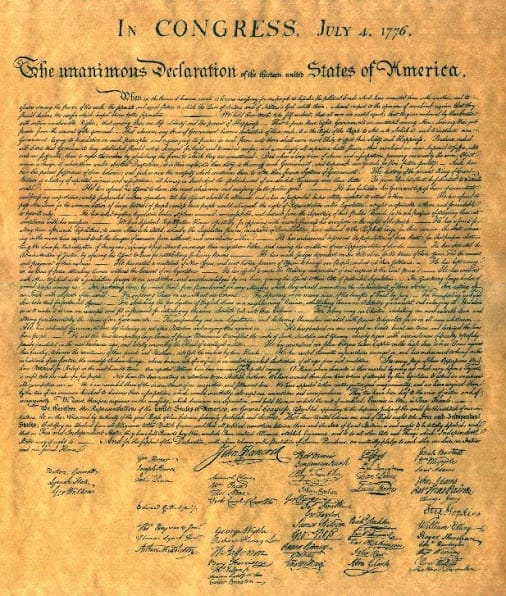
But those ideals, epitomized in so many ways by the Declaration of Independence, remain. And as long as they remain something that we aspire to — and protest for, and fight for, and admit where we've turned away from them and strive to do better — then this Independence Day holiday will have meaning.

Liberty. Equality of all in rights. The freedom to pursue our lives as we see fit, subject only to not stepping on each other in doing so. And that we are all in it together as a nation, pledging, like the signers, our Lives, our Fortune, and our Sacred Honor.

I spent an inordinate amount of time on my quotation site (http://wist.info) this morning, finding five new quotes to go for the day. Here they are.

"There is not a liberal America and a conservative America — there is the United States of America. There is not a black America and a white America and Latino America and Asian America — there’s the United States of America."
— Barack Obama (b. 1961) American politician, US President (2009- )
Keynote speech, Democratic National Convention (26 Jul 2004)

"In no country is there so much devolving upon the people relating to government as in ours. Unlike any other nation, here the people rule, and their will is the supreme law. It is sometimes sneeringly said by those who do not like free government, that here we count heads. True, heads are counted, but brains also."
— William McKinley (1843-1901) US President (1897-1901)
Speech, Woodstock, Connecticut (4 July 1891)

"July 4, 1776 was the historic day on which the representatives of three millions of people vocalized Concord, and Lexington, and Bunker Hill, which gave notice to the world that they proposed to establish an independent nation on the theory that all men are created equal, that they are endowed by their creator with certain inalienable rights, that among these are life, liberty, and the pursuit of happiness. The wonder and glory of the American people is not the ringing Declaration of that day, but the action then already begun, and in the process of being carried out, in spite of every obstacle that war could interpose, making the theory of freedom and equality a reality."
— Calvin Coolidge (1872-1933) American lawyer, politician, US President (1925-29)
Equal Rights (1920)

"Our nation was founded to perpetuate democratic principles. These principles are that each man is to be treated on his worth as a man without regard to the land from which his forefathers came and without regard to the creed which he professes. If the United States proves false to these principles of civil and religious liberty, it will have inflicted the greatest blow on the system of free popular government that has ever been inflicted."
— Theodore Roosevelt (1858-1919) US President (1901-1909)
“Americanism,” speech to the Knights of Columbus, New York (12 Oct 1915) 

"I am well aware of the Toil and Blood and Treasure, that it will cost Us to maintain this Declaration, and support and defend these States. Yet through all the Gloom I can see the Rays of ravishing Light and Glory. I can see that the End is more than worth all the Means. And that Posterity will triumph in that Days Transaction, even although We should rue it, which I trust in God We shall not."
— John Adams (1735-1826) US President (1797-1801)
Letter to Abigail Adams (3 Jul 1776)

A happy and safe Fourth of July to all.

Corporations are religious people, friend

Well, that's… pretty irksome.

Can we now ask that "closely-held family corporations" clearly identify themselves on all want ads and web pages, with a warning that "The Supreme Court has ruled that we can do pretty much whatever we want in employment law as long as we claim it's based on our religious beliefs"?

Reshared post from +Andreas Schou

Two things about this decision:

(1) Its theory of corporate personhood is backward.

A corporation is not its shareholders. It is not its management. It is not its board of directors. Nor is it its workers, its creditors, or its customers. A corporation is a distinct legal entity which only has the properties which the law gives it — this being why managers and shareholders are not vicariously liable for the acts of the corporation, and the why corporations can be held liable for acting in its owners' interest.

This is less clear for closely-held corporations than those that are public. But if a minority shareholder in a closely-held corporation sued to prevent it from implementing an onerous and costly religious duty, the corporation would be liable — it's wasting corporate resources for purposes unrelated to the pursuit of profit. The majority apparently realizes this, and as a result tries to narrow the ruling to apply only to this case.

(2) The Court creates a category of religious beliefs that are immune to factual inquiry.

The core of Hobby Lobby's belief is the following: that a list of birth control drugs are, in fact, abortifacients. Unlike beliefs about the number of angels that can dance on the head of a pin, where and when particular people lived in the 0th century, and whether are zero gods, one, or many, this question can be disaggregated into a factual and a moral question.

"Is abortion immoral?", is a moral question which, in conjunction with a religious answer, is protected First Amendment subject matter.

"Does blood contain some sort of numinous essence which transmits ritual impurity?", is a factual question to which the answer is "no," but the source of the answer is found in the same place as the question, and it is immune from further inquiry.

"Is birth control abortion?", however, is a factual question with a particular answer. (That answer is "no.") In order to avoid ruling on the factual issue, the Court allows Hobby Lobby to embed it inside its hypothetical religious beliefs.

We can, and should, respect freedom of conscience without immunizing particular wrong answers to further inquiry. 

Justices Rule in Favor of Hobby Lobby
The Supreme Court ruled, 5 to 4, that family-owned corporations cannot be required under the Affordable Care Act to pay for insurance coverage for contraception.

SCOTUS – No cell phone searches without a warrant

Wow. You don't get a lot of unanimous rulings from the Supreme Court these days, but here's one of them.

'Cellphones are unlike anything else police may find on someone they arrest, Chief Justice John Roberts wrote for the court. They are "not just another technological convenience," he said, but ubiquitous, increasingly powerful computers that contain vast quantities of personal, sensitive information. "With all they contain and all they may reveal, they hold for many Americans the privacies of life," Roberts declared. So the message to police about what they should do before rummaging through a cellphone's contents following an arrest is simple: "Get a warrant."'

California and the US had asserted that cell phones were no different from anything else in an arrested person's pockets.  Wisely, the justices disagreed.  

And it's not like the information there is unsearchable — the cops just need to convince a judge that there is "probable cause" to search the phone (just like a car or a house), usually for particular information related to an accused crime, and it can be done.  It just can't be done willy-nilly, looking for something "interesting."

‘Get a warrant’ to search cellphones, Justices say
WASHINGTON (AP) — In an emphatic defense of privacy in the digital age, a unanimous Supreme Court ruled Wednesday that police generally may not search the cellphones of people they arrest without first getting search warrants.

Utah’s gay marriage ban is struck down

This is another one that may end up with SCOTUS, unless they decide to just let these rulings stand, but it coming from a federal appeals court lends it extra oomph. The key here is that the 10th Circuit includes Colorado, which may mean my own state's shameful constitutional ban may come into question as well (it's already being challenged).

Federal appeals court strikes down Utah’s gay marriage ban, but stays its decision
In a landmark decision Wednesday, the 10th U.S. Circuit Court of Appeals ruled that Utah’s ban on same-sex marriage violates the U.

Defense attorneys DEFEND. That's their job

It is the nature of our criminal justice system that attorneys for the defense are meant — indeed, are obligated by the canons of their profession — to defend in any legal fashion possible. Whether they think their client is a wrongfully accused saint or the worst scum ever to walk the earth, their job is to do whatever they can to combat the immense power of the state (the police and the DA's office) by scrambling for any reasonable doubt they can instill.

That's why no less a luminary than John Adams could make (though he feared it would break) his reputation defending the British soldiers accused of the Boston Massacre. The principle of presumption of innocence until the state has made its case, and the right of any accused to the best defense possible, are the foundation of our justice system.

That sometimes means mounting a vigorous defense for someone you know is an awful person, someone who is, in fact, guilty of the crime. But a lawyer can no more ethically fail to do their best in such a case than a doctor can ethically fail to do their best in saving the life of an awful person.

Which is why, as the article notes, attacks on former defenders for actually doing their job are not only wrong, but dangerous.

Why It’s Wrong to Make a Defense Attorney’s Career a Partisan Issue
When Republicans went after Debo Adegbile—President Obama’s former nominee to the Civil Rights Division of the Justice Department—they focused their fire on his prior professional obligations as a defense attorney, and in particular his work in the defense of Mumia Abu-Jamal, the convicted murderer of a Philadelphia police officer. Pennsylvania…

Tribalism and the bilateralism of rights

There are times I have to sadly assume that the urge for Us vs Them is somehow riveted into our genetic code, right next to the part where our sex hormones turn off our brains and the part where we can't societally plan for anything further out than five years.

How else to explain people who get all up in your face about their rights, about how they are disadvantaged and downtrodden and have been historically hurt by others, who then turn around and act like assholes to everyone else.

Respect, and rights, and freedom are all two way streets, guys (and, yes, gals). Caring about the injustices done to you and waving off the injustices done to other is not only blind, it's counter-productive.

So, yes, guys, men do have some special problems in our society. Can we acknowledge that and work to change it without denying that others have their own special problems that should also be addressed — problems that maybe we have, wittingly or unwittingly, contributed to?  And can we do it without suddenly turning all women into lying shrews and castrating lesbians who deserve whatever's done to them because "WE'RE NUMBER ONE! WE'RE NUMBER ONE!"?

Please?

Reshared post from +George Wiman

If you've peeked out from under the rock lately, you know there's a thing going on with Twitter and Facebook and G+ using the hashtag #YesAllWomen, about the awful treatment practically all women have experienced. Not from all men, in case you want to jump in and say "Not me!" but from too many men. Often from men who identify with something called the MRM, or Men's Rights Movement. Many of whom infest the forums of the gaming world.

Except the makers of the role-playing game Eclipse Phase told them to go away; "We don't need you".  Which inspired novelist Chuck Wendig to say something similar: go away, MRAs. I am posting his missive here because of a parenthetical comment about balls as a sign of toughness and a vagina as a sign of weakness. That paragraph alone is worth the read…

http://terribleminds.com/ramble/2014/05/29/burning-the-mra-playbook-or-yesallmras/ 

Burning The MRA Playbook (Or, #YesAllMRAs)
The other day I wrote this thing — “Not All Men, But Still Too Many Men” — with the goal of pointing folks toward the #YesAllWomen hashtag on Twitter, where women talked about their stories, expe…