Well, yes.
And no.
Well, as long as that’s settled.
Elsewhere on the interwebs, someone posted a meme based on some not-so-long-ago comments by Rebecca Solnit, which may or may not have resembled this one:
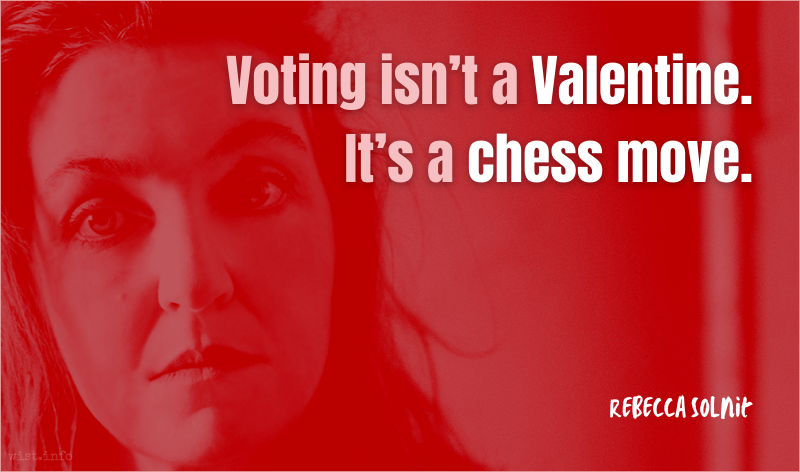
Build movements. Vote with your values, but vote strategically. Voting isn’t a Valentine. It’s a chess move.
This is a call for strategic voting (casting one’s vote in a way to further particular strategic political aims) and a rejection of idealistic voting (voting for a candidate that meets your values and ideals).
That led to one commenter (and I’m not going to link back into it for a variety of reasons, at least some of them technical) commenting (in not quite these words):
Strategic voting is a massive problem. It’s not acceptable; it shouldn’t be normal. Voting for a candidate should be endorsing that candidate. We should never settle for the lesser of evils. The lesser of evils … is evil.
So, having set up a straw man (the individual isn’t here to defend themselves), let me knock it down. Because I think this is important, if not existentially important, today, here, right now, in the United States. It’s been critical for several elections, for that matter, but going into the 2026 Mid-Terms and toward the next Presidential election in 2028 (assuming either of those actually happen), it’s yugely important to think this through.
Let me group my arguments into four points.
1. We do not have infinite choices
In any democracy, the choices are limited — to the candidates running and/or the parties putting forward candidates. In the US, our winner-takes-all election system has brought us to a rigid two-party system. That’s awful, but that’s the reality.
A two-party system means there are just two viable candidates, one from each party, for major contests. Trump vs Harris. Biden vs. Trump. Trump vs. Clinton. Obama vs. Kerry. Etc. You either choose one, or the other, or you are effectively handing the choice off to others to choose one or the other (choosing not to participate in the system is part of the system itself, and is an action with moral consequences).
Don’t suggest third parties will make a difference here. The institutional roadblocks to such parties (which the two in-power parties have seen to) are nearly insurmountable. Moreso is the psychological issue; not only anger enough to get a winning proportion of voters (and financial supporters) to move from one party or the other or “independent” status to supporting a new or previously insignificant party, but courage enough to believe that they aren’t throwing their vote away on a protest candidate. This last is something which the dire straits we face makes even less likely, especially since it’s an effort that would need to be sustained for multiple election cycles, which means it would be effectively throwing a vote away during that period.
(Side note: “Independent” voters are a misnomer, by the way, even as they’ve become the plurality in many areas. Most “independent” voters actually vote very consistently for one party or the other. Many of them are “independent” out of dislike of the system, or of the party structure whose candidates they still support, or even just out of not wanting partisan phone calls during election season.)
So, in nearly all ways that matter, in the US, today, the choice is between the Republican or the Democrat for each of the partisan races. You might get some “independent” or third party candidate winning here or there, but nothing that’s going to require the media to come up with a new color for that faction. Such candidates much more often act — knowingly or unknowingly — as spoilers.
So that’s the choice. You have to endorse (with a vote) the Dem, or you have to endorse the GOPer, or you have to endorse letting everyone else making the decision for you.
2. We aren’t voting for a candidate, but for what they will do
In a representative democracy (which is what the US ostensibly is, and can argue the point further down), we elect representatives, from the smallest village council to the President of the United States. We are choosing people to make political choices for us, since all of us crowding into a room to vote on everything isn’t practical, and we all have day jobs anyway.
Do I have to love the candidate I am voting for? I mean, sure, I might really like them. They might seem like a nice person, or a kind person, or a charismatic speaker. They might have done things in their lives — service to others, charity, climbing out of difficult origins — that are admirable.
But is that who I am voting to represent me in Washington?
Or am I voting for someone to pursue my policy preferences and goals?
What if it’s someone I don’t like? They abandoned their spouse and children. They stole from charity. They were dishonorably discharged from military for cowardice.
Well, I probably would be less likely to vote for them, both because I don’t like them and, even more importantly, I probably can’t trust what they are saying they will do once in office.
But what if that nogoodnik was able to demonstrate that they agreed with and, in fact, had previously supported the government policies I care about — following the course and methods I agree with on, let’s say, four out of five of the top issues I think our government needs to be tracking? Would I vote for them then? Or do they have to pass the “love to have ’em over for a beer and barbecue” test?
I’d love to think my president is a swell person. But it’s not — it should not — be a prerequisite for being my representative, any more than it’s a prerequisite for my dentist, or my auto mechanic, or my grocery clerk. If they do the job I am wanting them to do, and do it better than the alternative … I think it’s clear who I should pick.
3. The “Valentine” quote isn’t ignoring values
We’ll be going over what “endorsement” means in a bit, but while the shorthand (Valentine vs. Chess) makes the whole thing sound like some nightmarish realpolitik of leaving all values to the side, the quote itself includes the admonishment, “Vote with your values, but …”
The values in a voting choice extend beyond whether candidate X is a good or bad person. There’s an array of value-based policy desires — around welfare, around defense, around international relations, around climate change, around economics — that people prioritize differently. If you think the most important matter facing the US today is not enough gold-foil on our monuments, then voting for that value means voting for the candidate you think is most likely to pursue that policy, weighed against how they are likely to do about your second-, third-, and etc.-important policy goals.
Voting for someone shouldn’t be because you think they a paragon, or that they will do everything you want done. Both of those are a mook’s game. It’s about what you want done and who is more likely to do more of it better.
That segues into …
4. Every candidate is an evil
That’s a bit harsh, but I believe it’s true. And I’m not even talking “kicks puppies and steals from the collection plate” evil, or “is beholden to Big Business Group X for all the money they’ve given him” evil. I’m not even talking about a Fallen Humanity / Original Sin theological evil.
Every candidate is going to pursue policies I don’t agree with. Or fail to pursue policies that I support. Or pursue those policies, but in a way that I dislike.
For that matter, every candidate, as a human being, will have feet of clay about something. Maybe many somethings. There are no paragons. There is no Savior on a White Horse coming to rescue us by doing everything right and effectively (and if one shows up, I will be extraordinarily skeptical about what they are hiding).
It is literally impossible to find a candidate who I completely agree with, unless I am being lied to or their positions are so vague that I can’t actually discern what they are. Any candidate put forward, especially in the extremely limited universe of “someone who is nominated for President from one of two parties,” is going to be a compromise.
I am going to have to compromise my values to some degree, or else allow the majority (very roughly speaking) decide how my values will be offended. I’m going to choose to vote for a Bill Clinton, no matter what a mess his personal life is and how bad his “Third Way” welfare policies are, because I think, net-net, voting for Pappy Bush would be (would have been) worse. I didn’t support Biden’s primary candidacy in 2020; he wasn’t my preferred “compromise” when there were other choices, and there were things he espoused or pursued or supported I didn’t agree with — but I voted for him in a hot second over Donald Trump in the final election because I believed he would be better (and still would today, even knowing the areas where he disappointed me during his presidency).
Any candidate is a compromise. Sometimes the compromise is even of the nose-holding variety, a compromise that will allow some evil to happen, but (one judges) less evil, less virulent and destructive evil, than the alternative.
I don’t have to love the candidate I support for trying to protect / advance the policies my values support. It’s not a Valentine, it is a chess game. I have to choose the candidate who will best protect / advance those policies without, in my judgment, doing other things so egregiously bad that they make that strategic “win” a net loss.
Hell, if Donald Trump supported and advanced my political agenda for the federal government — let’s say leading the charge for renewable energy and climate change mitigation, working to improve the lives of the poor, engaging positively with world governments to pursue values of freedom and collaboration, making law enforcement protectors of civil rights instead of their offenders, crafting a welcoming and constructive immigration policy, espousing the virtues of diversity, letting women choose, letting trans folk transition as they need to — if he did all those things, or maybe even half of them vigorously enough, rather than the reverse on all of them, I’d have a lot more patience for his crappy aesthetic sense, his egotistical sense of entitlement, his endless lying and slander, and his philanderous love life. I’d be willing to let him redecorate the White House to make it look like a Poor Man’s Versailles, if he he was actually making the rest of the nation, and the world, a better place.
Yes, the lesser of two evils is in fact, evil, and we should continue to find ways to make future choices less evil-requiring. But that’s not the choice we’re faced with when we mark our ballots (unless you are voting for someone who has a comprehensive plan for political campaign reform and can actually get elected to do something about it). We are faced with choosing the lesser of two evils (or letting everyone else choose for us), with the belief that, at the very least, they are less evil, and that can be a moral, values-driven decision, too, even if sometimes distasteful.
This last point leads to the last.
4. There is always a difference
This sort of discussion always seems to devolve to, “Well, both parties are crooked, both candidates are bad, and the corporations control everything, so why bother?” It’s not a matter of lesser evils any more, it’s about it’s all evil.
And there’s something to that argument. Corporations (as “people” with equal “free speech” (contribution) rights) do have huge control over things. The party organizations often have crooked, or power-hungry, or just bad people in them. And, as we’ve discussed, no candidate is actually a paragon; both will make bad / wrong / evil decisions and pursue bad / wrong / evil policies, at least in my judgment.
But …
That doesn’t mean they are the same. I’m thinking presidential candidates here, but the same is true for any political contest. Yes, the two candidates may toe the line for industry X or billionaire Y in a very similar fashion. They may both buy into and protect a society and economy that rewards the already-rich, punishes the already-poor, and provides huge dividends for investors in defense contractors and petro-chemical conglomerates.
You can look at both candidates and see them as the products of a corrupt system, and therefore decide that choosing to vote one way or the other is an exercise in futility, so why bother (or, worse, get personally dirtied by voting for one or the other of them).
But …
I can agree that the system is (largely) rigged, and the choices (roughly) vested into that system. But saying there would be no difference in the nation or the world if Hillary Clinton had been elected in 2016, or Donald Trump re-elected in 2020, or Kamala Harris had been elected in 2024, seems unsustainable to me. I’m not saying that voting against Donald Trump in each of those instances meant I thought we would be on a clear course toward paradise … but I refuse to agree that things would be as bad as they are this moment, or that there wouldn’t be things better than the alternative of Trump winning in any given one or two of those matches. Which is, in fact, what we got, because too many people thought voting for Hillary, or Kamala, would be a compromise of their values, a vote for the “lesser of two evils,” disregarding what Donald Trump was saying. And, sure, neither Clinton nor Harris (nor Biden) were ideal; all three had records before (and after) with actions and policies I didn’t like …
… But I don’t like Brussels Sprouts, either, even if I dislike Okra more; the strategic question is, which choice for an obligatory serving of greens is going to get me the dessert I want out of the meal.
(Yes, some people voted for Donald Trump, in all three of those elections, believing he would be a positive good or that the alternatives would be greater evils. The argument works both ways, and is inevitable in a democracy.)
What I’m getting at is that either you work with the system you have (including trying to use it to change it), or you allow the system to roll onward without your participation and opportunity to reform it. Staking out some sort of moral high ground by asserting that “strategic voting” is evil because it leads you to vote for “the lesser of two evils” which means you’re actually supporting evil, and that you should only vote for a candidate if you fully, whole-heartedly, completely endorse and support them and their actions … is deeply misguided and unsupportable idealism. It doesn’t work in the real world because it’s based off of hypothetical absolutes — there are perfect candidates, there is either good or evil and nothing in-between, voting makes no difference in the system — that don’t align with reality. It’s all-or-nothing thinking, a cognitive distortion.
And to the extent it leads people to let greater evils be elected by primly standing “above” the fray, it is in itself evil.
Anyway, that’s what I think.