
 Part of an ongoing series of 5e (2014) Rules notes. See the end of the post for notes on 5.5e (2024) rules.
These notes came from early on in my 5e experience, since the delineations of what you could do in a given turn wasn’t immediately clear.
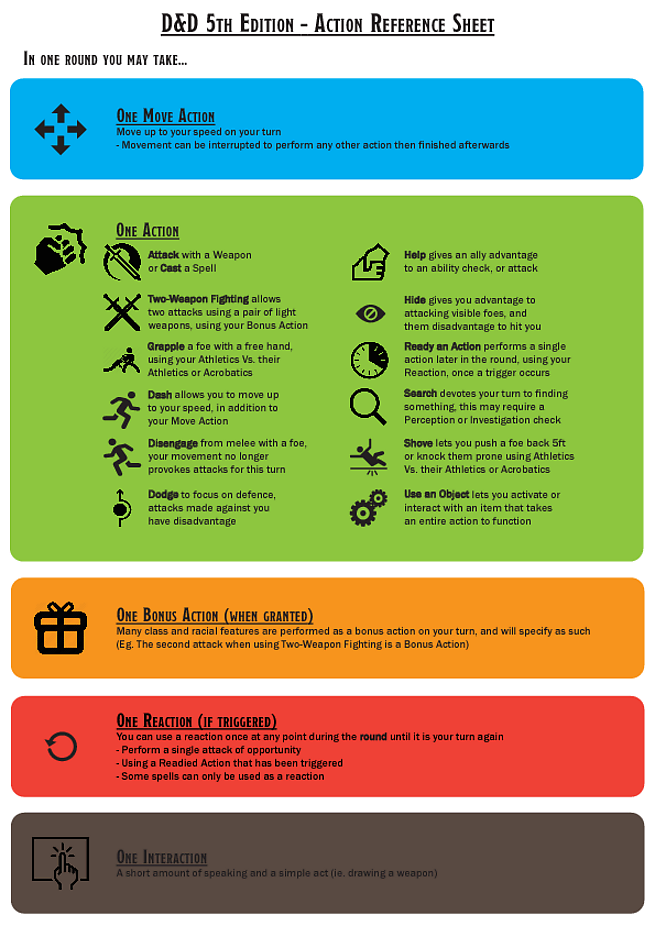
So, on your turn in a round of combat (which is basically when you need to be concerned about it), you can do the following, where/when your character is able to do so:
- A Move (this can be broken into parts around your other activities).
- An Action.
- (If you have one) a Bonus Action.
- A free interaction with the world around you.
Outside of your turn in the round, you may also take a Reaction.
(See also my notes on the Action Economy about maximizing use of these elements.)
Actions
Actions include (PHB 192) Attack, Cast a Spell, Dash, Disengage, Dodge, Help, Hide, Ready, Search, Use an Object. Your class or a special feature may provide other Actions, and NPCs may have their own Action list as well.
It’s important to distinguish between an “attack” and the Attack Action.
- An “attack” is when you roll a D20 (usually) to try to hit someone. Attacks may be made in the Attack Action, but they can occur at other times.
- An Attack Action is one of your turn slots which may include one more more attacks in it.
Extra Attack vs. MultiAttack
“Extra Attack” is something Fighters (etc.) get as a class advantage at various times. It means that when you take the Attack Action, you can do multiple attacks (e.g., instead of a single longsword blow on the orc, you take two, or even three).
(This is different from doing Two-Weapon Fighting (PHB 195) where the second attack is a Bonus Action).
“Multiattack” is something NPCs (and a few shapeshifting PCs) do — an animal’s claw-claw-bite, for example. It is its own Action, a Multiattack Action, not an Attack Action. Each of those attacks is usually also available separately, which is important with Opportunity Attacks.
That all sounds picky, but it means that if rules refer to an Attack Action, a Multiattack Action does not count.
Reactions, Opportunity Attacks, and Readying
Opportunity Attack (PHB 195) allows, as a Reaction (not during your turn, but during someone else’s), “one melee attack” when the target tries to step out of reach. Extra Attack doesn’t come into play (because it’s not giving you an Attack Action, just an attack): the Paladin doesn’t get to swing twice against a retreating foe, just once. Neither does Multiattack: when you move away from the giant bear, it can claw at you, but not claw-claw-bite.
Readying lets you take a pre-specified Reaction (“if anyone steps in front of me, I will swing my sword at them”). You can only Ready a single attack, not an Extra Attack or a Multiattack, because Reactions don’t take place on your turn. E.g., the Monk (PHB 79) notes that the Extra Attack is only on their turn. Ditto Fighter (PHB 72). Multiattacks are also intended only on the attacker’s turn.
(More on Readying an action here.)
Similarly, you can only use a Bonus Action on your turn (PHB 189). A two-weapon fighter can Ready an attack (or take an Opportunity Attack) with their rapier, but not their Bonus Action attack with a dagger.
So does this change in 5.5e?
 Very little about this changes in 5.5e (2024), from an overall structure of rules. Various special abilities (class features, feats) and circumstances (e.g., Surprise) make different use of Actions or Bonus Actions (or Reactions) than they did before.
Common Actions are much more carefully defined in 5.5e than in 5e.
The list of Actions is also changed a bit:
| Action | Summary |
|---|---|
| Attack | Attack with a weapon or an Unarmed Strike. |
| Dash | For the rest of the turn, give yourself extra movement equal to your Speed. |
| Disengage | Your movement doesn’t provoke Opportunity Attacks for the rest of the turn. |
| Dodge | Until the start of your next turn, attack rolls against you have DISADvantage, and you make DEXterity saves with ADVantage. You lose this benefit if you have the Incapacitated condition or if your Speed is 0. |
| Help | Help another creature’s ability check or attack roll, or administer first aid. |
| Hide | Make a Dexterity (Stealth) check. |
| Influence | Make a Charisma (Deception, Intimidation, Performance, or Persuasion) or Wisdom (Animal Handling) check to alter a creature’s attitude. |
| Magic | Cast a spell, use a magic item, or use a magical feature. |
| Ready | Prepare to take an action in response to a trigger you define. |
| Search | Make a Wisdom (Insight, Medicine, Perception, or Survival) check. |
| Study | Make an Intelligence (Arcana, History, Investigation, Nature, or Religion) check. |
| Utilize | Use a nonmagical object. |
The most significant differences here:
- There is now a Magic Action for, well, magic. Rather than have spellcasting be part of Attack, and using a magic item part of Use an Object, they have been separated. This should allow for better refinement and definition of when what can (or cannot) be done, and differentiation between using spellcasting and sword-swinging.
- There is now a specific Influence Action for CHArisma-based actions (and WISdom (Animal Handling). The point here is to clarify that these are Actions that take a turn (an Action), not things that — maybe? — you can do while also swinging your sword around.
- Use an Object is now Utilize, and, as with the above, it is defined strictly for non-magical objects. At the same time, using Utilize with special tool kits (e.g., Thieves’ Tools) is much better defined; each tool kit has a Utilize action or two. That means that the previously poorly defined Pick Locks and Disarm Traps are clearer in what happens and how (specifically using Sleight of Hand and Thieves’ Tools against a DC 15).
- Search used to include both WISdom rolls (e.g., Perception) and INTelligence rolls (e.g., Investigation). This has now been broken out between Search (WISdom) and Study (INTelligence). We’ll cover that distinction more in the appropriate entry. Main outcome here is to group together like things for common effects and usage rules, and to (re)clarify that these sorts of things take an Action.
3 thoughts on “D&D 5e Rules – Actions, Attacks, MultiAttack, Extra Attack, and Attacks of Opportunity!”