 This post is just focusing on D&D 5.5e (2024) rules. This general category is so messy, I don’t dare try to simultaneously describe the 5e (2014) variants.
Some of this material is already covered (so to speak) in my posts on Cover and Surprise. At some point in time I should probably integrate it together, but, until then …
Surprise
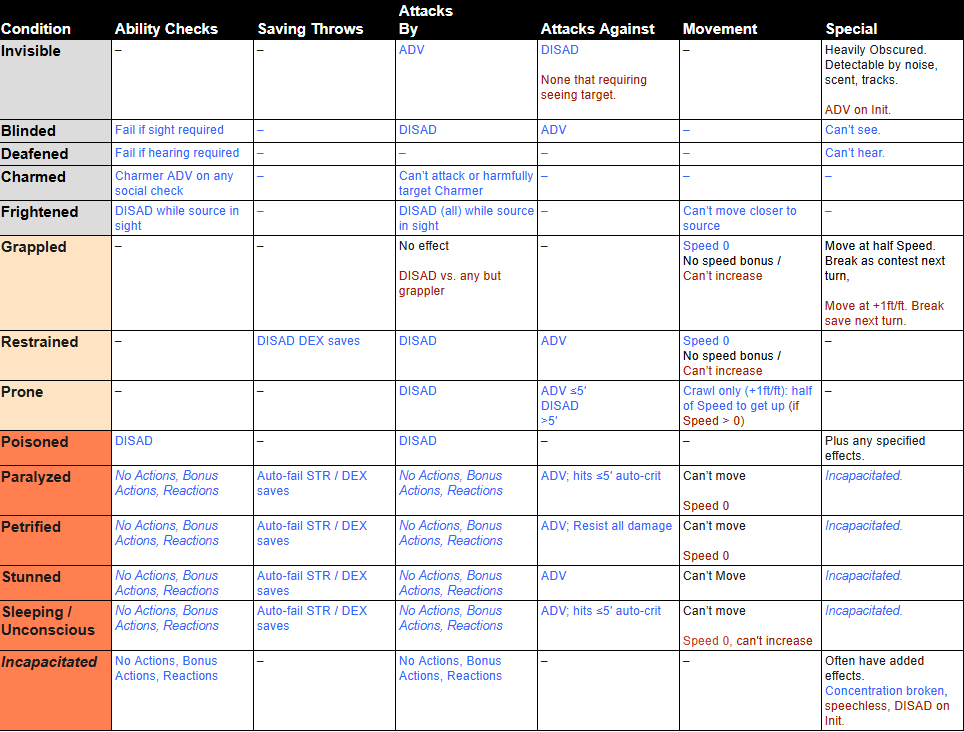
5.5e significantly changed the Surprise rules. Gone is the “you’re frozen until your first turn, then you’re still gimped until your next turn” stuff, in exchange for being at Disadvantage on Initiative. 5.5e also tried to normalize the Hiding / Cover aspects of Surprise, in part by making being Hidden the functional equivalent (and called it by the name) of being Invisible (i.e., having the Invisible condition). Which sometimes makes for odd situations, but …
After a session where things got a bit complicated, I did a re-read of the 5.5e rules (links for all this are down below). The rules, as always, look straightforward, a framework that should make sense, whether it does or not. The devil, as always, is in applying it to an actual combat situation.
I’ve linked to some of the rules at the bottom of the post, and [footnoted] to them in what I’ve collected below.
At any rate, fundamentally Surprise happens under a combination of two conditions:
- when a combatant is “caught unawares by the start of combat” [3] or, as phrased in the 5e rules, “doesn’t notice a threat.”
- in a case where being covert (in movement / positioning (Stealth), or in behavior (Deception)) is better than a target’s awareness (spotting someone (Perception), or being aware of their motivation (Insight); this is likely a Passive check, since you only Actively try to perceive such things when you are already aware of the risk/threat of the situation, and so aren’t prone to Surprise because of the first condition).
That second condition is mechanical — dueling skills of various sorts. The first is a bit more subjective and narrative, and requires some adjudication. Can a guard who is watching for an attack be caught unawares? If you’re creeping down a dungeon corridor, looking for an ambush, are you aware that there is a threat (even if you don’t know it specifically)? How long can you be actively alert for such stuff (that guard might be flagging by the end of the third watch)? What if the type of combat or threat is itself unexpected (the goblins drop down through the illusory ceiling)?
That’s all why they pay DMs the big bucks.
Something that may tie into both of these aspects is Travel Pace[7]. This often comes up in overland travel from Point A to Point B, but can be applicable within a dungeon — and both affects some of the rolls above as well as the attitude: e.g., if the players say they are walking at a fast pace to get to the dungeon ahead, there are mechanical effect on their senses, but it’s also an implication they aren’t expecting an attack.
Walking Pace |
Feet/min | MPH | Miles / day | Notes |
|---|---|---|---|---|
| Fast | 400 | 4 | 30 | DISadvantage on Percept, Survival, Stealth |
| Normal | 300 | 3 | 24 | DISadvantage on Stealth |
| Slow | 200 | 2 | 18 | ADVantage on Percept, Survival |
Surprise is also individual — the Surprise status of each creature on one side or the other can vary depending on the above factors.
Our focus here is mostly on the Surprise that comes from an Attacker being physically Hidden, but bear in mind that it can be broader than that is useful.
Hiding = Invisibility
A potential Attacker can use the Hide action, making DC 15 Stealth check while out of the Opponent’s line of sight, and while[2] …
- Heavily Obscured
- behind Three-Quarter Cover
- behind Total Cover
… to effectively become Invisible.[2] (The D20 check rolled by the person Hiding is the DC for someone to Perceive them[2]).
This can be for teeing up an ambush, or mid-battle sneaking about. To get all the advantages of being Hidden, though, you have to have explicitly taken the Hide action; otherwise you’re just getting protection from cover.
Rolling Initiative
First off, Initiative is rolled when combat starts.[4] Not after someone gets in the first blow or their sneaky alpha strike from cover, but when attack dice are about to be rolled.
- If an Attacker is initiating the combat (“Okay, team, I’m going to be in front and cast Fireball!”), the Attacker gets (DM’s discretion) Advantage on their Initiative roll.[6] (This one is hidden in the DMG as an option, and is the sop to the “But nobody is supposed to move until I cast my spell” issue.) This rule holds regardless of being Hidden or Surprised or not (yes, the guy who throws the first punch in the bar brawl rolls Initiative on Advantage to do it), but often comes up in context of an ambush or bursting into the enemy’s room.
- If an Attacker is Invisible (Hidden and unknown to be there by the target), the Attacker gets Advantage on their Initiative roll.[1]
- If the Opponents are Surprised (they didn’t know the Attacker was there and weren’t in “expecting combat” mode), they roll Initiative with Disadvantage.[3,4]
So let’s say Bob wants to get the drop on an Orc heading off to sleep. He positions himself around a corner (in Total Cover), and explicitly Hides himself (makes sure nothing is showing, tries to stay quiet, etc.). The Orc figures the hallways is safe and isn’t expecting any surprises, and their Passive Perception isn’t enough to meet the Stealth roll Bob made when he Hid.
Bob gets Advantage on Initiative for starting things, and would also get Advantage on Initiative because he is (until he attacks) Invisible. Advantage only adds once, of course.
The Orc doesn’t know Bob is there, and has no reason to be worried, so they get Disadvantage on Initiative. If the Orc knew that Bob had run away in this direction, and were watching out for him, they would roll Initiative normally. Ditto if they heard a noise from ahead and advanced cautiously.
Results of Initiative
If, after Initiative is rolled, there are allies who go before the Attacker initiating combat, then if they want the Attacker to get that first strike off, they need to Dodge or Help (if that applies) or, more likely, Ready an action. (This seems counter-intuitive, as it seems to penalize quick-reflexes folks; a Readied action isn’t as robust or useful as one normally taken. But that’s how it goes; the alternative is to blow the plan for that initiating Attacker to actually initiate the attack.)
If, after Initiative is rolled, any of the Opponents (even Surprised ones) still get a better Initiative than the hidden Attacker, they are (on the honor system) aware something is about to happen and can, within limits, respond first. Effectively, they are reacting to the Attacker popping out of hiding, even if they can’t directly do anything about it this turn. Faster Opponents can Dodge, try to Perceive the hidden attackers, warn their fellows, throw up magical defenses, etc.
In other words, those Opponents are still reacting faster than the Attacker, even if they can’t see them or directly attack them (yet).
The faster Opponents could, theoretically, Ready an action to shoot anyone who shows up “where I heard that noise.” If the Attacker is effectively Hidden / “Invisible,” that Readied action would not go off until after the Attacker did their thing, because that attack (see below) is what technically drops the “Invisibility” they have.[2]
Okay, so that handles Initiative … how about actual attacks (and counter-attacks)?
Attacks from Hiding
If the Attacker is Invisible (Hidden and unknown to be there by the Opponent):
- the Attacker gets Advantage on their Attack (this can be any time in the battle, not just on the first round)[1]
- their Opponent attacks a still-Invisible target with (at best) Disadvantage.[1,5] If where the Opponent says they are attacking is not where their target is, the attack automatically misses.[5]
Note that if the “Invisibility” only comes from being behind Total Cover (the Attacker has not taken a Hide action, too):
- the Attacker will not get Advantage for their attack
- the Opponent can’t see them to target them in turn
The Attacker’s “Invisible” condition from Hiding ends immediately after an Attack roll (or a Verbal spell, or making a sound, or if the Opponent finds them).[2] (In other places it says after an “attack hits or misses,” but I think that’s effectively the same thing.[5])
- Which, as written, implies that an Attacker with multiple attacks (e.g., Fighters at 5th Level) only get that Advantage to hit on their first attack roll, not on subsequent ones. The condition ends after an Attack roll, not an Attack action.
- If the Attacker wants to get “Invisible” again, they must duck behind cover and do another Hide to regain that “Invisible” condition.[2] Just moving back behind Total Cover would give them physical protection, but the Opponent still knows they are there, so the Attacker won’t get Advantage on their next attack (“I know he’s behind that tree so I’m keeping an eye on that”).
Certain spell effects, like Greater Invisibility, can cause the Invisible condition to be instantly restored, or never actually lost, without having to Hide; these are a really annoying complications, just saying.
Net-Net
Is all this complex? Yeah, especially given player and DM cleverness and the wide variety of spaces and situations to which it could apply. Could it be simplified? Maybe, but only by handwaving more and more things that “should” be considered important in a combat.
I’ve tried to tie the material above to actual rules, but there is some DM interpretation going on. If you aren’t sure, discuss it with your DM first; they may have different interpretations than I do.
Would you like to know more?
Here are the rule links for the [footnotes] above.
- The Invisible Condition
- The Hide Action
- Surprise
- Initiative
- Cover: Unseen Attackers and Targets
- DM’s Toolbox: Initiative
- Travel Pace