
D&D 5e/5.5e Rules – Weapon Juggling!

Drawing and sheathing weapons, whilst changing what weapon you are using, gets a little … complicated.

Know the RulesPart of an ongoing series of 5e (2014) Rules notes.  See the end of the post for notes on 5.5e (2024) rules.

This is one that the tables of our gaming group generally do wrong — or, at least, not Rules as Written (PHB 190) for quite some time:  what it takes, action-wise, to change from one weapon to another.

When describing what you can do on your turn, the rules say:

You can also interact with one object or feature of the environment for free, during either your move or your action. For example […] you could draw your weapon as part of the same action you use to attack. If you want to interact with a second object, you need to use your action.

And, under the rule on interacting with objects around you, it says:

draw or sheathe a sword

In other words, you can on any given turn, for free, (a) draw a weapon, or (b) sheathe/put away a weapon … but not both. This means the (very common) “Hmmm, with which of my array of weapons am I attacking with on this turn?” maneuver doesn’t work (RAW).

Round 1 – I plonk the bad guys with my bow.
Round 2 – Ooh, a bad guy is in my face, I stab him with my sword.
Round 3 – I shoot the guy across the room with my bow.
Round 4 – I charge in and stab that guy with my sword.

Nope. Essentially, switching weapons takes a full Action (putting away one weapon for free, Use an Object for your Action to draw the other one), meaning no attack that round.

This also complicates life for thrown weapon players. If drawing one of your throwing daggers takes up your free object interaction, then even if you have multiple attacks for your Attack action, you won’t have a way to draw additional daggers / shuriken / etc.

A couple of ways around this if you want a quick weapon change (one-way):

  1. Don’t put your weapon away. Just drop it (as you would a torch), which takes no time, and then lets you use your free interaction to draw your new weapon. Except in exceptional circumstances, there’s no call to worry about damage to the weapon. Dropping something takes no no time, and then you can draw your other weapon.
    Getting that weapon back to use again in the battle seems like it would be dodgy, but the rules do let you pick something up just as easily as drawing from a sheathe, for that free object interaction. Of course, if you have to flee the battle, the weapon might be left behind. Or, more seriously, the bad guys could grab the weapon you dropped, too.
  2. You can also, if you really don’t want to lose your weapon and maintain maximum flexibility, do something along the lines of (Turn 1) Attack-Sheathe then (Turn 2) Draw-Attack as a way of switching weapons, but it’s not something you can do every turn, and it does leave you empty-handed (for Opportunity Attacks) elsewhere in that turn.
  3. Rogues (Thieves) can use Fast Hands on their Bonus Action to Use An Object. That totally works for this (free action to put away a weapon, FH>UAO to draw a new one, then Attack). That’s doubtless why Legolas took a couple of levels of Rogue at one point.

Frankly, all of this strikes me as Not Fun. Which is why we’ve tended to drop this from our games, as DMs are allowed to do. But that has some consequences.  The design idea behind this restriction, among other factors, seems to be

  • Drawing that distinction between archery fighters and melee fighters, and balancing between them (archery fighting is generally considered a bit OP in 5e; this means archery fighters dealing with guys getting in their faces have to decide between retaining their bow and being at a Disadvantage for shooting at folk at 5 feet, or switching weapons and being slowed down after their attackers are gone before resuming plonking at range). It reduces the homogeneity of folk swapping instantly between being ranged fighters and melee fighters.
  • It also breaks the “video game weapon-swap” meme a bit.
  • And it addresses the RL aspect that sheathing a sword and unlimbering a bow and drawing and shooting really does take more than six seconds (though, of course, RL considerations only go so far).

Lastly, of course, there are Feats and Sub-Class Features that explicitly allow faster drawing / sheathing of weapons; playing without that restriction renders them less useful. (I.e., the game is already built around the restriction, so removing the restriction theoretically unbalances things.)

Would you like to know more?

Weapon jugging in 5.5e

dnd 5.5/20245.5e (2024) shakes things up a bit here, by explicitly (PHB Appendix C, p. 361, and the Free Rules) allowing a draw or sheathe/stowing of a weapon as part of an attack within the Attack action, either before or after an attack, and not necessarily with the same weapon.

Equipping and Unequipping Weapons. You can either equip or unequip one weapon when you make an attack as part of this action. You do so either before or after the attack. If you equip a weapon before an attack, you don’t need to use it for that attack. Equipping a weapon includes drawing it from a sheath or picking it up. Unequipping a weapon includes sheathing, stowing, or dropping it.

This lets you juggle weapons much more easily, especially as you get, e.g., Extra Attack, coming along.

It also appears that this Equipping / Unequipping rule is distinct from the Thrown property on weapons in 5.5e, which separately notes you can draw-and-throw as part of the attack. That means you could (if you can attack twice during your Attack action:

  • Attack 1:
    • Attack with my sword.
    • Sheathe my sword (Unequipping) for free after that first attack.
  • Attack 2:
    • Draw-and-throw a dagger
    • Draw my sword again.

Note that the previous free “interaction” from 5e has been, if not dropped, then scattered a bit. There is now an explicit Utilize Action for when an object requires an action to use it. If you are doing something with an object as part of a different Action, that interaction should be free, as with the Equipping / Unequpping text above.

That said, it does still exist, noted under Interacting with Things in combat:

You can interact with one object or feature of the environment for free, during either your move or action.  For example, you could open a door during your move as you stride toward a foe.
   If you want to interact with a second object, you need to take the Utilize action. Some magic items and other special objects always require an action to use, as stated in their descriptions.
   The DM might require you to use an action for any of these activities when it needs special care or when it presents an unusual obstacle. For instance, the DM might require you to take the Utilize action to open a stuck door or turn a crank to lower a drawbridge.

It’s unclear to me if you can do that free Interaction for an initial draw/sheathe of a weapon, which would make things even more flexible.
D&D 5e/5.5e Rules – Wands and Attacks!

Is attacking someone with a wand the same as casting a spell? Is it an attack? Or is it something else?

Know the RulesPart of an ongoing series of 5e (2014) Rules notes.  See the end of the post for notes on 5.5e (2024) rules.

Use of a wand in combat is not an Attack, or a Weapon Attack, or anything you could put into the chain of attack actions that a higher level martial character (like a Fighter) can use.

The Magic Missile wand, for example (and other wands use similar language), says:

While holding it, you can use an action to expend 1 or more of its charges to cast the magic missile spell from it.

Using a wand is an Action (more specifically, a Use an Item Action).  You get one Action per turn (and one Bonus Action and one Reaction), with very few exceptions.

This doesn’t come into play with the Fighter’s Extra Attack feature at higher levels. While the nomenclature is confusing, that lets a fighter do multiple attacks within a single Attack Action (it isn’t adding to the number of Actions, it’s adding to the, if I can coin the phrase, sub-actions under the Attack sort of Action).

I.e., a higher level Fighter may be able to swing a sword at an opponent three times in a round, but they can still only fire off a wand a single time.

Using a wand also not casting a spell. That is a particular type of action (quite literally, the Casting a Spell Action). If it were, then it would affect the limitations of only one leveled spell cast per turn. If a magic user uses a wand, they can still cast any level spell is cast as a Bonus Action.

The edge case exception here is that Action Surge gives a Fighter an extra Action — which Action could, in fact, be used for Using a [Magic] Item. I.e., getting two shots off the Magic Missile wand.

Wands and 5.5e

dnd 5.5/2024Things are mostly the same under the 5.5e (2024) rules, though with slightly different nomenclature. 

Using a wand (or any magic item) is done as the newly named Magic Action, as is spellcasting and the like. Unfortunately, the new rules also are quite clear that you cannot use Action Surge to take an extra Magic Action, so we’re back down to a single use of the wand per turn.

On the other hand, allowing use of a wand as a Magic Action still doesn’t forestall using a leveled spell via a Bonus Action or Reaction (5.5e calls them “slotted spells”).

D&D 5e/5.5e Rules – Surprise!

Ambushes and surprises are a normal part of D&D sessions. How are they handled in the current rules?

Know the RulesPart of an ongoing series of 5e (2014) Rules notes.  See the end of the post for notes on 5.5e (2024) rules.

Since it comes up periodically and I Here are my notes on how Surprise works in D&D 5e — at our table, at least, given the complexities of Active vs. Passive skills and variations under different DMs.

When Does Surprise Happen?

Surprise occurs when two parties (1+) meet and one of them is unaware of the other until action has begun.

Two thoughts on this:

  1. A situation where there is obvious risk can’t engender surprise unless an attack comes from a completely unexpected direction.  If are aware of danger, and are taking normal precautions for it, you cannot easily be surprised (you can be ambushed, but you won’t suffer the consequences of surprise).
  2. Trying to be and stay aware has limitations. Even if you know you are in a combat zone, you can only spend so much time and energy watching for bad guys above, below, and in all directions.

Note that “action” usually means “combat,” given D&D’s proclivities, but it doesn’t have to.

The basics are encapsulated thus (broken into points for clarity):

So what happens when the parties meet?

The PHB says (broken into points):

The DM determines who might be surprised.

(Though he’ll try to be fair about it and as impartial as possible.)

If neither side is trying to be stealthy, they automatically notice each other.

E.g., “You round the corner and there is a party of dwarves walking toward you. Both sides stare at each other for a moment … but after that joint moment of, yes, startlement, each party remains on an even footing with each other.”

Or it’s even, both sides are approaching the corner, chatting with each other, hobnailed boots clattering, and they become aware of something around the corner at about the same time. In either case, surprise is moot.

Otherwise, the DM compares the Dexterity (Stealth) checks of anyone hiding [or otherwise trying to be stealthy] with the Passive Wisdom (Perception) score of each creature on the opposing side.

The caveat I added is important; the rules (and a lot of discussion) has to do with one party laying in wait for the other, but it could as easily be trying to creep up on another group. There’s also sort of an arbitrariness here — it’s easy to think of a situation where both sides are trying to be stealthy while listening for trouble … the thief sneaking up on a corner while a guard is waiting for someone to step around the corner, but is unaware of when it will happen. Who gets to make the Stealth check vs the Perception check? Hmmmmm …

Also, note that comment on Passive Perception. We’ll get back to that.

Any character or monster that doesn’t notice a threat is surprised at the start of the encounter. […] A member of a group can be surprised even if the other members aren’t.

There’s a bit of artifice here. While there is a remarkable amount of argument about “a threat,” essentially it means that if you hear any of the orcs who are laying in wait ahead, sufficient to put you on your guard, you will not be surprised by any of them — even, arguably, by the orcish assassin coming up from behind (because there’s no facing, so your presumed awareness is 360° once you’re on the alert).

This last is is important, and is further clarified in the Sage Advice Compendium :

You can be surprised even if your companions aren’t, and you aren’t surprised if even one of your foes fails to catch you unawares.

Surprise, then, is an individual thing for characters (and, to a more limited degree, for opponents): I, as a character, have to detect any of the other side to not be surprised (if I hear one person’s chain mail jingling, I become alert and won’t be surprised).  But my not being surprised doesn’t affect my fellow players.

That can seem kind of weird, depending on the timing. But if we’re walking into a trap, my detecting someone is deemed a last-second thing; I can’t shout out, “Hey, it’s goblins! Don’t be surprised!” (Though circumstances can allow that — I’m trying to spot something on the trail ahead, and there’s a glint of metal three switchbacks up the hill … I am allowed to warn my friends in that case.

How Does Surprise Get Determined?

This starts getting into that whole Active and Passive Skill thing.

  • Active Skills are when you roll 1d20 and add your Ability and Skill Proficiency scores.  They represent an active effort on your part (“I’m trying to do X”).
  • Passive Skills are just “what you do most of the time,” and they are served by basically replacing that d20 roll with a 10 (i.e., making it a perpetual average role).

Some DMs out there argue that it also represents the minimum you can get on an Active Skill  roll, but I disagree; actively looking for things can allow someone to get distracted (while I’m focusing on telling whether that glint ahead on the trail is steel or a shiny rock, I miss the tripwire across the path I might otherwise have seen).

(See more on Passive Perception here.)

The problem with Passive Skills is that they are meant to represent two things: (1) the “average” background ability and (2) a way for the DM to save time. Rather than have everyone roll Perception (or the roll it themself behind the screen), it’s far easier (and less alerting to the players) for the DM to know that Bob’s Passive Perception is 12, so they will always see a hidden thing with DC10, and always miss one with DC15, unless they are actively searching.

Easier, but kind of dull. “Oh, this floor of the dungeon appears to be populated by DC10 traps. Bob strolls through it with no chance of being caught by any of them.”

And the “easy” aspect is dubious in  Roll20 (or any VTT): I can click on a pre-set macro and roll everyone’s Active Perception any time I want. Not only is it hidden from the players, but it allows for variation — someone other than the highly perceptive Rogue can spot the trap once in a while (though, on average, it’ll still be the highly perceptive Rogue), and it means that if the highest Passive Perception is 15, DC20 traps aren’t automatic hits.

As a general rule, and for DM convenience, the “who rolls this, the Players or the Monsters” is usually focused on the Players (which is more fun for them, but also a lot easier for the DM). So a way to do this is that the Orcs, as they lay in wait, all use their Passive Stealth (effectively the DC number), while the Players all roll their Active Perception (or the DM rolls it for them) — or, if the ambush is on the other foot, the Orcs all use their Passive Perception and the Players all roll their Active Stealth. While the bad guys relying on Passives is kind if dull, it’s much simpler.

Two examples:

Characters Surprising Monsters

E.g., “Hey, here come some monsters, lets ambush them!” (Or perhaps, “There’s a monster camp up ahead, let’s creep up on them.”)

In its most basic form, the players prepare their ambush, and each rolls a Stealth check. It gets compared to the Passive Perception of the target monsters. The problem here is that the big fighter wearing plate mail is always going to have a crap Stealth roll, meaning the monsters (who all have the same Passive Perception) will always hear them.

An alternative, especially if the party has a chance to collaborate and plan and are aware of what the bad guys are doing, is to roll a Group Check (PHB 175, and more written here):

When a number of individuals are trying to accomplish something as a group, the DM might ask for a group ability check. In such a situation, the characters who are skilled at a particular task help cover those who aren’t.

To make a Group Ability Check, everyone in the group makes an Active Ability Check. If at least half the group succeeds, the whole group succeeds. Otherwise, the group fails. That lets the stealthy Rogue counter the noisy Fighter (“Pssst — watch out for that twig you’re about to step on!”). The success usually has to be against a unitary number/difficulty, though, e.g., the Passive Perception of the opposition.

Group Checks can be used for anything, but they’re really designed for when a single individual failure would mean the whole group fails.

Monsters Surprising Characters

This sounds like it should be the same thing, and, ideally, it is, but pragmatically, it’s usually handled a little differently.

So, for example, rather than the DM rolling (Active) Stealth for each of the monsters (fine for one or two, a real problem with twenty), the suggestion is to use the Passive Stealth (10 + DEX bonus + Stealth bonus).

The only problem with using the Passive Stealth there is that a Player who misses (either Passive Perception or an Active Perception roll) misses against all of them, and someone who makes the needed number succeeds against all of them. Unfortunately, that’s the kind of abstraction that is inevitable in this kind of simulation.

Using Active Perception rolls for the Players is probably better (and, if the DM has a macro set up for it, easy).

What Happens When Someone Is Surprised?

Pre-5e there was the concept of a “surprise round” — a round in which the surprisers get to act, and the surprised don’t.

5e changed this a bit. When the first action of an encounter takes place, Initiative gets rolled by everyone (even folk who are surprised). If you are deemed surprised, it means you:

  • cannot Move or take an Action (including a Bonus Action) on your first turn
  • cannot React until after your first turn

So the band of goblins gets the drop on all your party. Everyone’s initiative rolled and likely intertwined, but as each party member’s turn comes up in the   first round, they cannot do anything during during that turn. But once each their turns has come up (and been squandered as they recover from surprise) they can React (e.g., take an Opportunity Attack, cast Shield, etc.).

E.g. Susan and Bob surprise Goblins 1 and 2. They all roll Initiative, and it goes in the order Susan, Goblin 1, Bob, Goblin 2.

  1. Susan runs past Goblin 1 (who cannot React with an Opportunity Attack because they are surprised) and stabs Goblin 2.
  2. Goblin 1’s turn comes up; they cannot take any Move or Action and just stand there, agog with surprise.
  3. Bob decides to finish off Goblin 2. He runs past Goblin 1 … but since Goblin 1’s turn this first round has passed, Goblin 1 Reacts, taking an Opportunity Attack to stab Bob.
  4. Goblin 2’s first turn comes up; they, too, cannot take any Move or Action … but once their turn is over, if Susan tries to run back to help Bob, Goblin 2 can try an Opportunity Attack, too. And when Goblins 1 and 2 come up in the next round, they will be Moving and Acting as normal.

Would you like to know more?

Surprise in 5.5e (2024)

dnd 5.5/2024We’ll evaluate at a later time all of the Active/Passive stuff above (the stuff that determines if there is surprise). The meat here is how the effects of surprise 

Surprise in 5.5e has been significantly simplified — maybe a bit too much.

Surprised creatures roll Initiative at Disadvantage.

That’s it.  No special Surprise Round. No differentiating between types of actions. Roll Init at Disadvantage.  Quick characters will (likely) still be pretty high in the Initiative order (but maybe not).

Though it’s worth noting that if the attackers in ambush are successfully (through Hide (with Stealth) or Invisibility) hidden, they get Advantage on the Init roll. Which widens the gap in Init still more.

The upshot of this, though, is that Surprise matters a bit less. Everyone will get to do something Round 1; you won’t have surprisers who effectively get two attacks in, which, in an Action Economy, can be deadly.  This is a Good Thing if it’s your party being surprised; it’s a Bad Thing if you’re doing the surprising.

Arguably, this almost takes too much of the sting out of Surprise. The surprisers will still get the first blows in, but the surprised will spring back quickly.

It will be interesting to see how folk end up in their evaluation of it.

Lurching toward D&D 2024 (5.5e)

Some thoughts on the new D&D semi-edition.

So I’ve been neglecting my work on this website for a while, and want to play a little catch-up, especially as our gaming group starts encountering the new semi-edition of D&D.

One D&D logo
Branding Past

First, some nomenclature. The new semi-edition was originally called “One D&D,” so as to imply that it’s the system we would have forever.  For some reason, that was then changed to calling it “D&D 5th edition (2024),” with the previous version now being referred to as “D&D 5th edition (2014)” (the parentheses indicating the year it first came out).

This is cumbersome, so most references are to just “2024” vs “2014.”

Personally, I think this is still kind of confusing, for two reasons:

  1. “2014” and “2024” look very similar. They are the same length, 75% the same characters, and the only difference is in the same place.  Easy for the eye to mistake them, and I find myself doing that almost every time.
  2. These are not the same game.

Not that they aren’t very similar, mind you.  And there is a very rough comparability between them.  And you can do some mixing and matching — with work — between the systems. But the implication that these are both “5th edition” is a pleasant fiction design to deflect accusations that WotC just wants to sell more books.

dnd 5.5/2024So I’ll be generally using the alternate terminology that a number of sites have adopted of referring to the older semi-version as 5e and the new semi-version as 5.5e (see keen little icon I drew up to the right).

So from what I have read (and which we are now encountering in the Real World), here are the answers to some basic comparability questions.

Some questions

Can I use 5e characters in a 5.5e campaign?

In theory, yes, though there is a sense that 5e characters are a bit less powerful and usable than 5.5e, so doing a character built in 5e as a 5.5e character, without making any other changes, it’s suggested to just give them an extra feat.

But … it’s also clearly stated that if you run a 5e character in a 5.5e campaign, you really need to use as many of the 5.5e rules as possible; a 5e character in a 5.5e campaign must use the 5.5e rules on Surprise and Inspiration, etc.  Just like a running an old 1950s Ford operating on a 2025 freeway, you can do it, but finding leaded fuel and a mechanic that can service it, etc., might be difficult, plus you run risks with not having a third brake light or daytime headlamps, let alone full-blown seat belts front and back (which you might be required to install after the fact). It’s a bit hazy what to do as your 5e character levels up — should they use 5e leveling rules for their class, or 5.5e?

An alternate option is to rebuild your 5e character in 5.5e.  This is probably the cleanest solution, especially if you try to be diligent about keeping a similar growth path and set of options (which hopefully haven’t been annoyingly nerfed in 5.5e).  It’s biggest advantage is that there is no question but that it is a 5.5e character when you are done, and you can easily move on from there.

UPDATE: In revising all of my 5e rules posts to also reflect 5.5e rules, my overall analysis is that while most of the major game subsystems are the same (sometimes a bit simplified), the biggest changes are in the details: Spells, Feats, etc. Any conversion from a 5e character to 5.5e is supposed to use the latter’s rules, which means reviewing all those spells very carefully and seeing what you maybe need to tweak.

Some sites that go into changes between the semi-editions:

What if I am bringing over from 5e, or using from 5e, a class or  subclass that 5.5e doesn’t support yet?

One of our players wants to run an Artificer in a new campaign. Artificers haven’t been formally added to the 5.5e rules yet (a play test draft has been released, but with unpleasant, I am told, differences from 5e, and further changes are expected until the new class is published).  The same can be true for certain subclasses.

The guidance is if you are building fresh, you take the manual process of building the character as  5.5e one, with timing of class features as in 5.5e (subclasses always come in at 3rd level), but adding the spells and (sub)class features that 5.5e uses.

If converting over from 5e character, and you don’t want to rebuild the character … the rough guidance is to just give them an extra Feat.  Talk with your DM.

What if I have a 5e character of a race (species) that hasn’t been written up for 5.5e yet?

The guidance here parallels that of class/subclasses that haven’t been converted over yet.  Go ahead and use the 5e race with its features, but build it under 5.5e rules (regarding stat bumps, backgrounds, when species features come in, etc.).  Talk with your DM first, of course.  When WotC sells you a new book down the line with the revised version of the species, decide whether to backfill the new changes, or just stick with “classic.”  It’s not going to break the game.

The exception here is for races that will not be converted, in particular, hybrids or “half-” creatures like half-elves and half-orcs, which WotC has decided are too problematic (not without some justification). The recommendation is to choose one thing or the other (make your half-elf either an elf or a human; make your half-orc either an orc or a human, etc.).  If you need backstory around it, have them be adopted.

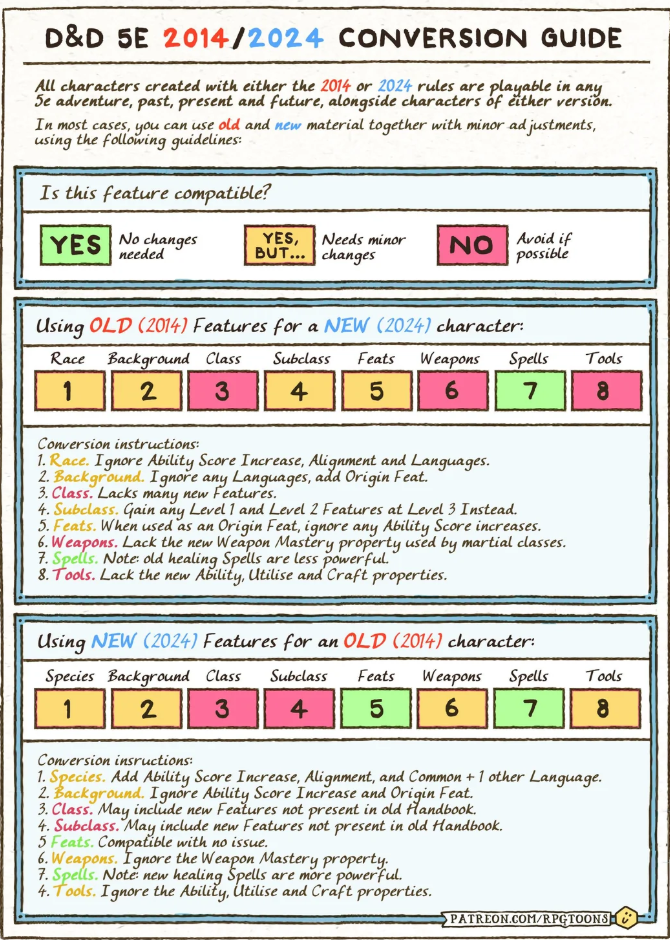
Here’s a nicely done guidelines of the “minor” things that have to be done differently to use 5.5e to build 5e characters, or 5e rules to build 5.5e characters.  The author has a different threshold of what’s a significant compatibility problem (and glosses over some major spell changes), but it’s another way of looking at this information.

Using D&D 2014 and 2024 characters and rules together
A lot of red and orange there
Can I use a 5e scenario / module in 5.5e?

Yes, but …

The module materials will all be written up with 5e rules and versions of monsters and NPCs and 5e spell lists and 5e mechanics.  You can Just Do It as written, or you might want to take the time and effort to update some or all of the material to take advantage of the new way 5.5e handles things like monsters that cast spells, monster races with multiple “classes”/roles, etc.

What about VTT issues?

This is where we get an added layer of complexity. I can’t speak to VTTs other than Roll20, but here’s what I’ve learned so far about 5.5e and that VTT. This centers on the character sheet system, as that is the only place where the system rules are embedded.

  1. Implementation of 5.5e into Roll20 is still dodgy.  Or so I’ve been told by at least one player. Not all species / classes / feats that have been brought into 5.5e have made it into the character sheet and advancement features in Roll20.
  2. Working in a mixed campaign — one supporting 5e and 5.5e characters and/or NPCs — causes problems.  This is because Roll20 implemented its 5.5e character sheets with a new tech stack, different from what was used with 5e.  The new tech stack removes a ton of cruft from the old one, and is much more easily modifiable as 5.5e progresses, but it doesn’t have the same hooks and API variable names or exposure that the old 5e character sheet had. Thus, macros you have written for 5e may not work with 5.5e characters or NPCs (and vice-versa)

This last is particularly a problem when you want to run with 5.5e rules and characters, but are using a 5e module, as all of its NPCs will be using the 5e character sheet (for NPCs), which Roll20 will get indigestion over (and, again, some macro issues will crop up).  Converting all the monsters to 5.5e would be a huge lift.

I spent about a week trying to overcome those issues. I didn’t come up with a great answer, most of the macro stuff can be worked around (esp. if the only 5e characters are NPCs, meaning the NPCs run with their own set of macros, which often happens).  The best answer may be to hold off running a 5.5e set of characters until (a) more 5.5e material is published and brought into Roll20, and (b) Roll20 makes their 5.5e implementation more robust.

Net-net

All of the above issues are, fundamentally, compatibility issues. They are very similar to what came up when D&D went from 3.0 to 3.5, which is why it’s frustrating for WotC to pretend that there are no significant compatibility issues.

Mixing and matching 5e/5.5e stuff is going to be something of a pain for the next few years. Ultimately, the 5e stuff will die out or be successfully converted (for VTT purposes, if nothing else).  For our table, at least, we’re just going to stick with 5e for the moment, and see where things are in a few years when the next campaign kicks off.

Is D&D 2024e backwards compatible? Call me dubious.

The 2024e edition is a new set of rules. WotC doesn’t want you to believe that.

One D&D logo
Or whatever it’s being called this week

WotC has been insistent, insistent I say, that the new edition of D&D is not, in fact, a new edition. This is not D&D 6e! This is not even D&D 5.5e! This is …

Well, they call it 2024e, because that is not at all confusing with what 5e is being called now (2014e).

But, of course if it were not a new edition, why would we need to refer to it differently?

Or, to look at it another way, why not just call it D&D with new optional rules like have shown up in things like Tasha’s, etc.?

Because then they wouldn’t sell new books, amirite?

But we’re not to call it a new edition. It is simply rule changes that are completely compatible with the older, um, previous, er, differently-numbered-year edition not-an-edition set of numbers.

A Caveat

Note: the changes in rules from 2014e / 5e to 2024e are not necessarily bad. In fact, a lot of them sound kind of interesting. But are they backwards-compatible? Do they not imbalance encounters and conflicts in earlier modules? Will players in a given campaign be able to change to 2024e without making any difference? Will 5e characters be as good against new 2024e campaigns? If some players want to switch but others do not, will that work well? Will various Virtual Tabletops handle mixed parties and/or modules?

Two examples that got a fair amount of play in my reading today:

Surprise in 2024e

In 5e / 2014e, when a group or individuals are Surprised, they roll Initiative as normal, but are unable to take any Actions or Reactions or movement through their first turn, after which they can only React until their  next turn.

So that’s pretty harsh. Surprised foes (or friends) are at a serious deficit here. In an Action Economy,

In 2024e, Surprised individuals … roll Initiative at Disadvantage.

That’s a much simpler mechanic, but it’s also a lot easier mechanic.  Rather than missing out on an entire turn, you just tend to come late in a turn.

Either alternative is arguable. But are they the same? Can you have a mix of players choosing a different version, for themselves or their opponents? Can you seamlessly change the rule to match previous challenges? Does it just become another option?  Is it a significant enough change to actually alter how an encounter ends?

Inspiration in 2024e

Inspiration is an optional rule in 5e / 2014e. The DM (with input from the players) can give someone up to 1 point of Inspiration. That Inspiration can be turned in (in advance) for Advantage on an attack roll, saving throw, or ability check.

Okay, pretty straightforward. A D20 roll can be rolled with Advantage.

The 2024e version changes the mechanic and the name. It’s now “Heroic Inspiration,” and it allows instead a re-roll on any roll a player makes — an attack, a damage roll, a healing roll, whatever.

A key here, from the designers, was the sense that too much adds Advantage. That’s kind of ironic, as Advantage was intended as a way of simplifying the endless plusses/minuses of 3e, 3.5e, and 4e. But there was here a sense that too much was being simplified and rolled into a trinary Advantage/Disadvantage mechanic.

In addition to that rather significant change, there are now a variety of mechanical ways to gain “Heroic Inspiration,” including a Fighter subclass that just basically gets their point refreshed every turn.

It’s an interesting design choice, and I can see a lot behind it. It can make for more ways to leverage Inspiration (through broader dice rolls, and also by taking out of the unstackable Advantage bucket). It also makes, through its expanded Inspiration, a more reliable way of getting it.

On the other hand, it introduces Yet Another Mechanic. And it weakens that RP focus of the current Inspiration mechanic.

Good? Bad? I can see arguments either way. But it’s a very distinct choice, and something a table will need to decide One Way or The Other. Unlike the Surprise mechanic, I don’t think it changes balance — but does that make it Backwards Compatible?

Just call it a new edition, fergoshsakes

People who have bought 5e, will have three choices.

  1. Change to 2024e, either mid-campaign, or next time there’s a module change (and upgrade any 5e-era modules to use the new rules).
  2. Stick with 5e, and hope they can “backwards compatible” the mechanics of 2024e-era modules into those rules.
  3. Mix and match — in existing campaigns or in new ones, evaluate the 2024e  rules that have changed and depending which ones to pull in and which to continue using (and where players can select different conclusions).

Option 1 is pretty standard for a new actual edition. Option 2 might be possible with an actual edition change, but it would be a bit of work.   Option 3 only is possible if that “backwards compatible” notion is real.

These sneak peaks (the first 2024e volume only comes out in September) make me think that WotC has tried to come up with something better enough and different enough to justify getting a new set of books (or virtual add-ins to the VTT … or both!) while pretending that it’s just a set of optional improvements.

I resent that.

I will almost certainly get the new edition of books and rules and use them in the future. I will remain resentful that WotC has been playing games with the whole thing to make money and pretend like they aren’t.


The Once and Future D&D

WotC’s latest announcements on where the new D&D not-an-edition is going are … interesting.

If I read this article correctly …

OneD&DWell, first, begone “One D&D”!  Welcome “D&D 2024”! The concept is, I think, kind of the same, but now they are adding a year on there so that it will sound out of date at some point.

The new core books will be … a thousand pages long? Crikey.

The reason for that length?  All the old stuff (“D&D 2014”) will still be in there, alongside the new stuff (“D&D 2024”).  You don’t have to choose! You can mix and match and blend and use it all, because it will all be backwards compatible, in all directions! Fun for all, especially the GM (who has to keep all these things in mind) and various software systems that have to keep track of double the rules and selected options.

New DnD2024 Design Goals
Also, free puppies in every box!

WotC is trying to have it both ways:  a new system to be excited about (and to buy books for), but not obsoleting the old stuff (though you’ll really want the new stuff because some players will want the new stuff).  So all that money you invested in D&D 2014 stuff is still a good investment, except that you’ll want to buy the 1000-page core books for the new version because that’s what all the cool kids will be doing.

I’m fine with their sticking with the basic 5e mechanics, which are sound. But the forward-backward compatibility stuff is dodgy. I still would rather they just call it 6e or 5.5e and be honest about it.


D&D 5e/5.5e Rules – Action Economy!

It’s a bit Inside Baseball, but understanding it can be the difference between PC Life or Death

Know the RulesPart of an ongoing series of 5e (2014) Rules notes.  This also covers 5.5e (2024) rules.

You will sometimes read about D&D and encounters and danger levels and rules imbalance and things like that, and you’ll hear the term “Action Economy.”

What’s that?

Essentially,

the larger your Action Economy ⇒
the more things you can do in a turn ⇒
the more powerful you are

And that’s true for individuals, as well as for groups.

  • A big part of character advances are adding more attacks, more Bonus Action options, etc. Similarly, more powerful monsters have more attacks and actions in a turn (including legendary and lair powers).
  • All things being equal, the side that has the greater numbers of combatants has an advantage in combat, because their cumulative Action Economy, the opportunities they have for success in combat, is greater.
  • Bounded Accuracy , as one person put it, “makes everybody dangerous no matter how weak but does so at the cost of making everyone vulnerable no matter how strong.” Which means, by implication, over time a bunch of weak (but dangerous) characters can overwhelm a strong (but vulnerable) one.
  • PCs often have advantage in combat because designed encounters often have more PCs vs fewer (but individually more powerful) enemies. Sure, that big monster there can do three physical attacks, or maybe a big spell effect. But the PCs together often get more Attacks, Spells, Bonus Action abilities, etc., than enemies, individually or (and this is important) in aggregate. They often also get specialized Reactions others than Opportunity Attack. This only starts to partially equalize when you get up to epic creatures that have legendary and lair actions, but even there, numbers tell.
  • Everything you can do is part of your Action Economy: Actions, Bonus Actions, Reactions, and Moves. The more you can set yourself up (tactically, in a battle, or strategically, in your character design) to do something effective with all of those options in a turn, the more effective (and deadly) your character will be.
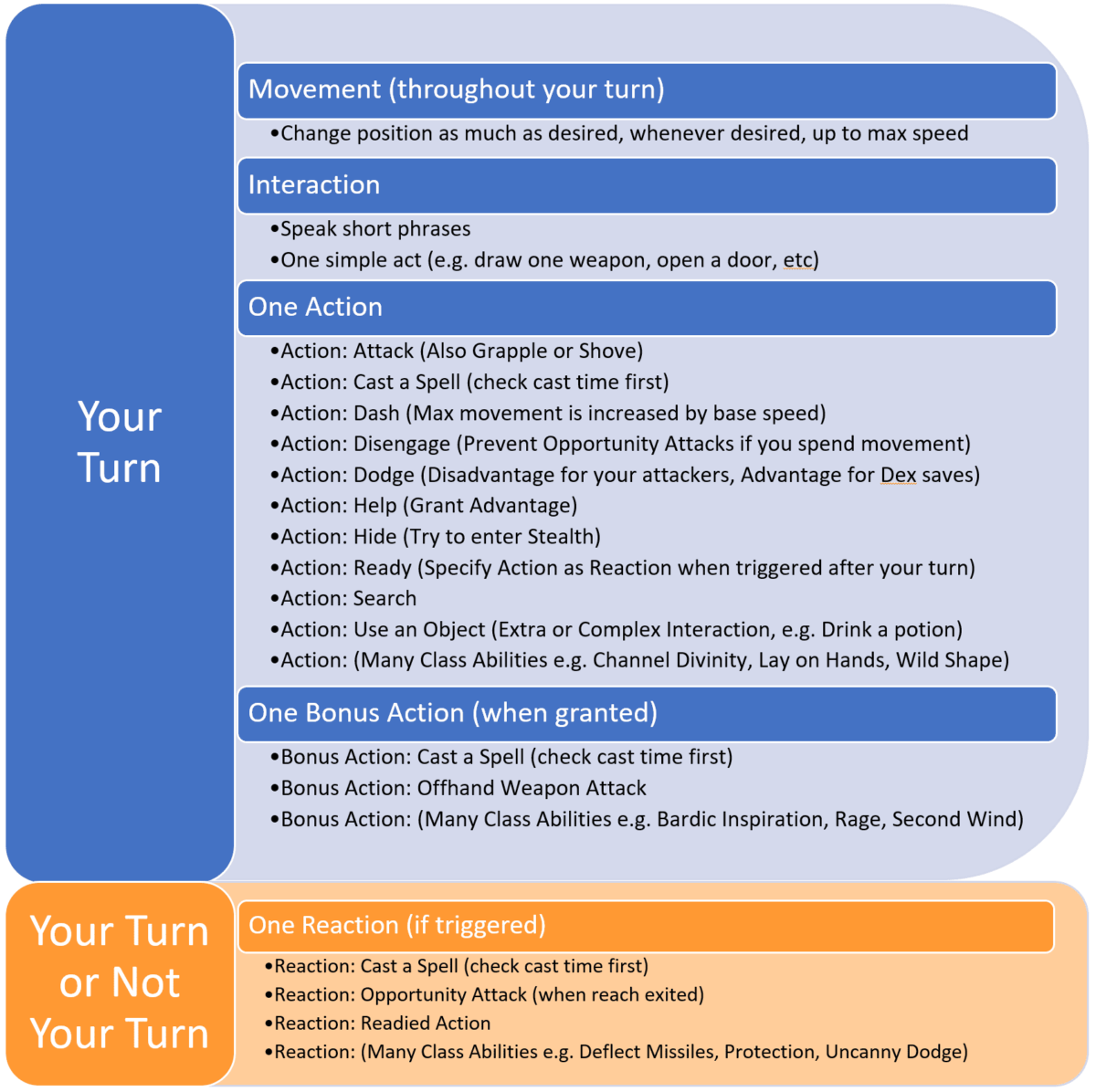
5e Player Action Economy
All the things you can do as a player. Source

In short, the Action Economy is your range and quantity of actions in a round (see above), and implies the need, by extension, to maximize your effectiveness by using as much of that economy as possible.

How do GMs cope?

GMs bitch a lot about this: the boss fight that’s got the arch-critter-demon you’ve had the players trembling about for months … ending with the boss going down in two rounds as the 15 attacks the party can generate per turn (action economy!) overwhelms the 4-5 the boss can. Yeah, the boss is hitting for 80 damage, but four players hitting for 20 damage each (which is kind of low at higher levels) do just as much, and six players hitting for that do even more.

What (just to offer notes) do GMs/module writers do in the face of this?

  1. They add Minions! They’re not just color text — they help balance the “overwhelming numbers vs very powerful foe” equation by mitigating the former so that the latter can get some licks in.  In general, the easiest way to make an encounter more difficult and dangers is not to make the BBEG more powerful, but add the number of minions and lieuts the players have to grind through (and defend against) to get to the boss.
  2. As mentioned, epic-level legendary creatures — dragons, liches, beholders, etc. — can get legendary and/or lair powers, which basically add to their Action Economy (and hurt like the dickens). GMs often add these non-canonically to other bosses, too.
  3. Do other things to add to a boss’s Action Economy. One suggestion I’ve seen that seems to have legs is making bosses, in a sense, multiple creatures (with different capabilities and HP pools and initiatives) presenting as a single creature.
  4. Split the Party.   If the party can’t bring all of its power to bear — because it’s split up (by its own choosing or through an external force), or maybe because the attack vectors are limited (a narrow hallway, perhaps), its Action Economy is restrained.

The converse to all of these can be used (usually by the GM) to weaken a boss that seems too big to tackle.

Does this change in 5.5e?

dnd 5.5/2024As a game design element, it doesn’t. The 5.5e (2024) rules lean on the Action Economy as much as 5e (2014) did.

That said, evaluating changes in 5.5e rules needs to be first and foremost done as considering how they impact the Action Economy. Letting people do more actions (or forcing people to do fewer actions) has a significant effect.

For example, 5e rules about Surprise meant that the surprising party got one to two attacks on the surprised party before the surprised party could attack.

  1. Everyone rolls Initiative.
  2. When a Surpriser comes up in the Init order, they get to do their attack(s).
  3. Until a Surprised comes up in the Init order, they cannot take an Action or a Reaction.
  4. When a Surprised first comes up in the Init order, they can take no Actions (or Bonus Actions), but can after that point take a Reaction.
  5. Surprised cannot take an Action (or Move) until they come up in the Init order a second time.

That’s a massive advantage in the Action Economy — it’s very easy for a Surprised party to be, if not wiped out before they can do anything, be crippled before they can do anything.

In 5.5e, this is (intentionally) changed to just give Surprised individuals Disadvantage in their Init roll. That means that, on average, the Surprisers will get to act first — but everyone will still act in that first round. At most the Surprisers will get one extra attack in, but if any of the Surprised have a high basic Init bonus and/or roll well, they might still wake up / become alert and attack the Surprisers even before they are themselves attacked.

The net impact on the Action Economy is that Surprise is not quite the disaster it was in 5e, though it still means that the Surprisers will usually get at least some of their licks in first.

There are a variety of other 5.5e changes that change that Action Economy, as an attempt to correct for perceived problems in 5e.

Tangential to this is further refinement in what is encompassed by an “Action” in 5.5e.  The changes here look bigger than they actually are, mostly rendering more clearly what can be done as an Action and how that Action is structured (usually by calling out things a character could do and clarifying that they are a full Action):

Action  Summary
Attack Attack with a weapon or an Unarmed Strike.
Dash For the rest of the turn, give yourself extra movement equal to your Speed.
Disengage Your movement doesn’t provoke Opportunity Attacks for the rest of the turn.
Dodge Until the start of your next turn, attack rolls against you have DISADvantage, and you make DEXterity saves with ADVantage. You lose this benefit if you have the Incapacitated condition or if your Speed is 0.
Help Help another creature’s ability check or attack roll, or administer first aid.
Hide Make a Dexterity (Stealth) check.
Influence Make a Charisma (Deception, Intimidation, Performance, or Persuasion) or Wisdom (Animal Handling) check to alter a creature’s attitude.
Magic Cast a spell, use a magic item, or use a magical feature.
Ready Prepare to take an action in response to a trigger you define.
Search Make a Wisdom (Insight, Medicine, Perception, or Survival) check.
Study Make an Intelligence (Arcana, History, Investigation, Nature, or Religion) check.
Utilize Use a nonmagical object.

Note that other Actions are possible, and NPCs may have defined Actions (like “Multi-Attack”) that aren’t listed above.

Again, this doesn’t affect the Action Economy, but does clarify that, yes, trying to Intimidate a creature takes a full Action, as does Searching for something. (This only applies while Actions are being tracked, i.e., after an Initiative roll for some sort of die-rolling conflict.)

Some good articles to check out:

GM counter-tactics (as, ahem, thought experiments):