(Still more reminiscing from Faerie …)
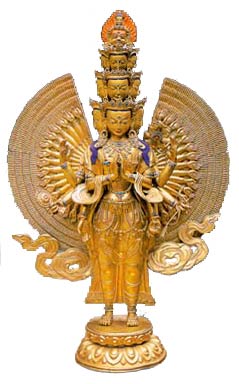 Saturday mid-day was an outing with Mary and Margie & I, joined by Michelle and Jim & Di, to the Bowers Museum, to see a nifty Tibet exhibit. Our good friend Helen is working there as a docent, so she gave us a nice tour of the exhibit (after we ate a very tasty if tardily-served lunch from the nice restaurant there).
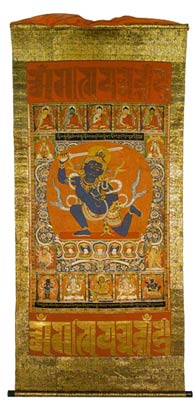
The art displayed was exquisite, and Helen gave us a great quick intro into Tibetan Buddhism. Anyone with any interest in Tibet or Buddhism ought to see this collection.
 The main thing very obviously lacking from the exhibit, though, was anything that related in any way the modern country or anything related to geopolitical or modern historical issues. The Chinese, obviously, are highly sensitive to anything that points out that they’re occupying Tibet, and so no maps are visible to provide context, nor is there any mention (in the exhibit itself) of the current Dalai Lama (indeed, the exhibit, a joint effort by four museums in the US, almost got the plug pulled at the last moment when someone actually mentioned that persona non grata during discussions with the Chinese).
One could argue that, given the large fee paid to the Chinese to get the exhibit to the US, one is actually supporting the oppression of the Tibetan people. On the other hand, the presence of these works increases the visibility and interest in Tibet, so it’s arguably a wash. For the record, though the Dalai Lama has been in Los Angeles while the exhibit was here, he did not, officially, get an opportunity to visit it; when asked what piece he would most like to see, he opined, “I would very much like to see my teacup.” Ironic that I did and he (officially at least) could not.
As an end note to that, at the exit from the exhibit is a guest book, full of the usual gushing praise for the spiffy collection. A number of people had also written in, in various places, “FREE TIBET!” — after which, in turn, other visitors have written their own retorts (a young Chinese fellow who was right in front of me at the guest book took several minutes to write “It’s already free!” next to every one of those exhortations).
Anyway, a very nice exhibit, which travels from the Bowers to opens at the Bowers Museum to the Houston Museum of Natural Science (opening 16 October), thence to the Rubin Museum of Art in New York (8 Feb. 2005), and endnig at the Asian Art Museum of San Francisco (starting 12 June 2005). Well worth the effort to go and see.
I was in Santa Ana for a job interview a couple of weeks ago and had a couple of hours to kill (I scheduled my flight real early so that I would have time in case the flights were delayed for some reason). I was driving around the area, to see what I could see when I came across the Bowers museum. I decided that would be a good way to kill some time, and so I went in.
I have to agree that it was a great exhibit. I didn’t notice the absence of maps or references to the current political situation (isn’t “modern historical issues” an oxymoron?), and I kind of like it better that way. Without those things, the exhibit focusses on the historical and artistic aspects of Tibetan Buddhism, without introducing political distractions.
I was particularly impressed by the presentation. I don’t know much about the Bowers, but I assumed it was a small local museum without a large budget since I’d never heard of it before. The exhibit is top-notch, so if the museum fits my assumptions, it is a great accomplishment. If they actually have money and are a bigger player in the museum world than I assumed, then it’s still a damn fine show.
While I wouldn’t want the exhibit to be a referendum on the Chinese occupation of Tibet, the lack of any info as to modern Tibetan customs, or the current status (or even mention) of the Dalai Lama sort of makes it like having an exhibit of Buddhist art from Afghanistan without mention of the Taliban regime’s depredations — what’s there is there, but there’s no sense of how it’s connected to the rest of the world or modern Tibetan faith.
The Bowers has done some very nice exhibits. It’s certainly a small museum, but worth visiting.
Short of fighting (and winning) a nuclear war with China, a free, Tibetan-ruled Tibet is as dead as Monty Python’s parrot. If people want free Tibetans they should push for legislation making it easy for them to emigrate to the USA, Canada, etc.
That may well be so — indeed, probably is. That’s not a good reason to ignore China’s actions, though, or kow-tow (so to speak) to their “sensitivities” over the subject.
Free Hawaii!
Heh.
Arguably so — though I’d say the statute of limitations has run out on that conquest.
Oh, I’m all for letting them know we think they’re barbarians. They hate that. And we’d better watch them like hawks 24-7, forever, because they play the old realpolitik game — the Great Game — the old fashioned way with no discernable morals to hold them back. If they win the world will be a really sucky place for a long, long time.
But as for Tibet, well, even if it was feasible I wouldn’t vote to spend American lives to reinstate any lame-ass theocracy, no matter how picturesque its trappings.
Agreed, on all counts.