I have a ton of TPBs I need to review, but one Major Mini-Series That Will Change The DC Universe Forever has wrapped, and since I’m not likely to get the TPB of it, I might as well toss in my two cents now.
Identity Crisis. Meh.
(N.B. This 7-part mini-series, written by Brad Melter and pencilled by Rags Morales actually finished in December, but I just got around to saying anything about it.)
Ultimately, what did this series change (and I’ll try to be discreet for those who haven’t actually read the thang)?
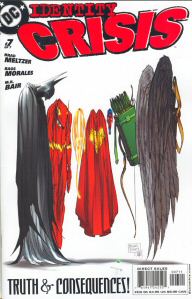 Well, it killed off the popular wife of a second-string (but well-liked) hero. Said killing was particularly brutal, and included much brutal backstory, as was much of the IC series. So we now know that the DCU can be nasty and brutal, including some of the “goofy” villains. Is this a broad editorial decision to make some of the goofier bad guys suddenly seem to be Joker-like psychos? Or will it be forgotten in a year? Do I really care?
It provoked a lot of online debate about Whodunnit. None of which, to my knowledge, was correct.
It brought home the value of secret identities. Everyone’s always nattered on about why masks and the like are necessary. Now we know. To that end, that’s probably the best thing it did.
It proved that Batman doesn’t really know it all. At least not yet.
It showed that even the “classic” warm-fuzzy JLA of the JLA Satellite era could be grim and gritty. At least as now retconned. Problem is, of course, that they weren’t, and trying to impose a grim-and-gritty template on them rankles the trufans, and doesn’t make them any more relevant to more recent-comers to the comics fold. Continuity is a bitch, and I’m not sure where it has to give, but this rewrite just didn’t do it for me (especially since it raises the issue of what else they might have done back in the day, and guarantees that similar revelations will be made, to increasingly less effect).
It showed, nicely, a sort of “super-hero community” (and it’s flip side). It also showed how many people on the inside know each other’s secrets, which may change in the future. Or may not, depending on whether writers pay any attention. That’s a tangle mess, though, as the last three or four Flash reboots have shown, not to mention Iron Man’s career.
It killed off a second-string villain, maybe-for-good. And that was okay, as handled. That said villain now has a vengeful, grim-and-gritty son taking up the mantle … meh.
The conclusion to the tale — the revelation of whodunnit, and how — was passably clever, in that it (a) was logical as to means and opportunity, and (b) was unexpected. It still felt a bit … off. When motive gets trumped by “X snapped and went crazy,” you’ve lost one of your triad of murder mystery prerequisites.
And that, in turn, weakened the whole story. One can deal with a Deep, Dark Conspiracy. One can shrug helplessly at a Twist of Fate. But the “you never know who might be about to go bonkers and kill a loved one of yours” is … well, both unsettling and narratively useless. It makes anyone a potential murderer, which is possibly okay for a paranoid character to get paranoid about, but you just can’t live that way. Nobody — except, maybe, Batman — will be able to go on indefinitely, fearful all the time of who might snap and kill one of their loved ones. And Bats gets around it by not having any loved ones. Which means that the key to a successful story — change in the characters — IC fails. The situation has changed, but except for a couple of very specific (and second-string) characters, nothing much will have changed for anyone else. In six months, a year at the outside, Sue Dibny will be a footnote in the DCU, not an object lesson, a warning sign on the landscape.
And that, ultimately, is a shame.
>Well, it killed off the popular wife of a second-string (but well-liked) hero.
It also orphaned another hero, one popular enough to have had his own title since 1993! And that led to a rift with his “mentor,” causing ripples in multiple related books.
This seemed to be one of those “shock-the-reader” minis, and it certainly did that. Seems like the last page of every issue made me gasp. Some pretty horrifying scenes in there.
Not the best mini, but much better than Marvel’s Identity Disc, a similarly-themed and -titled book which came out the same mont (indeed, the same week) as IC.
And it had some really nice covers, too.
Hmmm. Yeah, you’re right, there, about the orphaning. But that’s all sorta gotten lost in the other recent Gotham brouhaha (which I cared for even less).
Rags Morales art was certainly nice, no surprise. And there were some good “gotcha” moments — though too many of them were clearly for effect (e.g., the ending of #6), not because they really advanced the story.
I avoided Identity Disc, just ’cause.