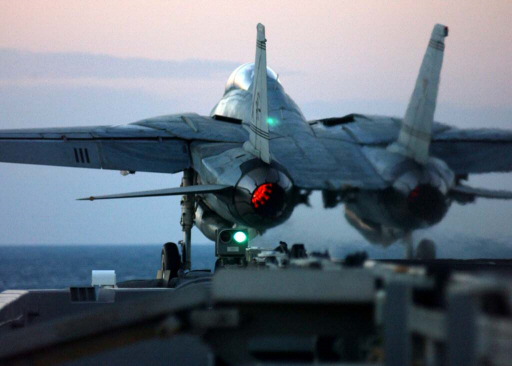
The F-14 Tomcat was the first “modern” fighter for me, replacing the Nam-era F-4 Phantoms. With its twin engines, its sweep wings, it was — and is — just way too frelling cool for words.
And now its on its final legs in the USN.
The Navy’s last two active Tomcat squadrons, the “Tomcatters” of VF-31 and “Blacklions” of VF-213, both based out of Oceana Naval Air Station, Va., are on their final deployment aboard USS Theodore Roosevelt aircraft carrier as the strike group sails to the Persian Gulf to relieve the USS Nimitz.
“As a lifelong Tomcat pilot, it’s bittersweet to see those wonderful airplanes go away,” Rear Adm. James Winnefeld Jr., commander of Carrier Strike Group 2, said Sunday while aboard the Roosevelt as it sailed off the coast of Rota, Spain.
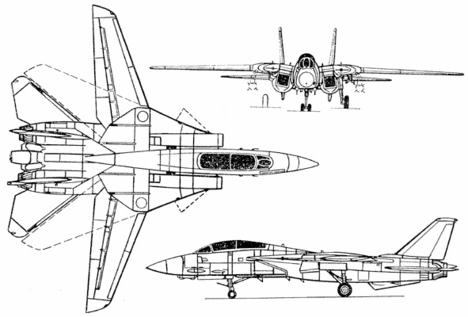
The jet is being largely replaced by the F/A-18 Super Hornet. While a more reliable and less expensive jet to operate (the Tomcat takes 50-60h maintenance hours per flight hour; the Hornet takes 14), it sounds like there’s a lot of nostalgia for the Tomcat among the pilots.
“It is the Navy’s muscle car. The Hornet’s like a Miata,” said Lt. Cmdr. Charlie “Scotty” Brown, who as a former instructor at the Navy Fighter Weapons School, best known as “Top Gun,” has flown both aircraft. “It all depends on taste. Some want muscle, some want a sports car.”
For me — I’ll always have the fondness for the muscle car.
(via Mostly Cajun)