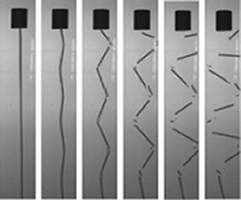
Spaghetti doesn’t snap in half when stressed from the ends — it breaks into three or more pieces. Scientist are studying this, because — well — they don’t understand very much about how things break, and there’s some obvious industrial applications thereto.
Fragmentation occurs in nature on many scales, from subatomic-particle collisions to volcanic explosions to the pummeling of planets by asteroids and comets. Disintegration processes are also an important part of the human realm?for instance, the smashing of windows, the pulverizing of ore, and the deadly detonations of bombs, as well as the benign breaking of spaghetti.
The unexpected incomprehensibility of that last example especially perturbs scientists trying to figure out how all this breakage unfolds.
“This is really the kind of simple question that you can’t help thinking about over and over until you find the answer,” says Sébastien Neukirch of the University of Paris VI, one of the physicists whose new work seems finally to set the bent-spaghetti issue to rest. To illustrate his point, he notes that Feynman isn’t the only Nobel laureate to have been captivated by the pasta puzzle. In interviews on French television 14 years ago, after receiving the Nobel Prize in Physics, popular physicist Pierre-Gilles de Gennes of the College of France in Paris repeatedly alluded to the spaghetti mystery as one of the very simple, yet unsolved, problems of science.
Plus, of course, it’s fun.
(via BoingBoing)