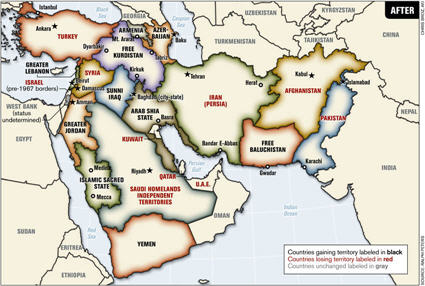
An interesting article in the Armed Forces Journal, speculating on how the borders of the Middle East could be redrawn to (possibly) make stuff a less bloody mess.
In each case, this hypothetical redrawing of boundaries reflects ethnic affinities and religious communalism — in some cases, both. Of course, if we could wave a magic wand and amend the borders under discussion, we would certainly prefer to do so selectively. Yet, studying the revised map, in contrast to the map illustrating today’s boundaries, offers some sense of the great wrongs borders drawn by Frenchmen and Englishmen in the 20th century did to a region struggling to emerge from the humiliations and defeats
of the 19th century.Correcting borders to reflect the will of the people may be impossible. For now. But given time — and the inevitable attendant bloodshed — new and natural borders will emerge. Babylon has fallen more than once.
(Larger map here.)
As an exercise in how the borders of the Middle East were well mangled by Europeans, it’s interesting/amusing enough. I used to play with maps that way, too. As a realistic vision, there’s a greater chance that I’ll be appointed Pope and Grand Mufti and get to wear a shiny hat. Too few folks with an interest in “giving up” anything, and there’s a long-term (and sometimes counter-productive) tendency in the diplomatic community to consider borders inviolate and cast in stone.
But I also reject the knee-jerk “Like can only hang out with Like” mentality behind something like this. Tribalism is a reality, but it’s not an inevitability. One of the long-term disasters in Europe post-WWI was the imposition of unions that could only be maintained by strong-men — Tito in Yugoslavia, the USSR, etc. — and the conflicts that were too easily stirred up once unification-by-force faltered (especially since such force was usually on behalf of one group or another). Heck, it can
be seen elsewhere in Europe, with the de-centralization and autonomization of various regions, from Catalan to Scotland.
But unification can come from common interests, and the realization that a larger, more populous, more diverse state is stronger in the world scene than a smaller, more insular, more limited one. That’s been one of the great challenges (and possible failures) of the whole Iraq War — getting the Kurds and Sunni and Shiite Arabs to see themselves as a nation with common interest, rather than as smaller groupings at odds with everyone else in a zero-sum game. I refuse to agree that the only way toward
peace and stability is by dividing people up into groups — “You kids sit over there, and you kids sit over there.” The history of the world shows that model is not, in the long term, stable either.
Drawing lines on a paper map.
What would the people who live in these places say?
Has anyone shown them this map idea?
Is there any way to draw imaginary map lines that would actually satisfy “all the people?”
What would the people who live in these places say?
Probably, “Why, yes, that should be ours. And, oh, over here, too — that’s where my grandfather lived. And here, too — our people once lived there. And …”
Has anyone shown them this map idea?
No. Nor is it really being presented as a serious policy proposal.
Is there any way to draw imaginary map lines that would actually satisfy “all the people?”
Not a chance.