Since Kitten’s off with the Grandparents, and we’d watchedin the second flick on DVD during the week, we decided on a night out on the town, dinner and a show, and finally catching up with the conclusion of the Pirates of the Caribbean trilogy.
Something happened between the first Pirates of the Caribbean movie, The Secret of the Black Pearl, and the second, extended movie (Dead Man’s Chest and At World’s End). The story and tone morphed from being a light, fantastical adventure romp featuring fierce pirates, broad comedy, and true love, to being a dark and violent tale of monsters, a polemic against corporate greed and loss of civil liberties, with occasional light-hearted rompy bits.
Along the way, the franchise changed from something I would gladly (and have) watched multiple times to something I’m glad I saw and am not quite willing to retcon out of existence, a la Highlander 2, but am not at all anxious to see again.
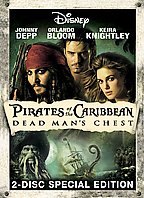
Pirates of the Caribbean: Dead Man’s Chest (2006)
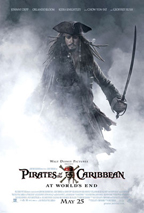
Pirates of the Caribbean: At World’s End (2007)
| Overall |  | Story |  |
| Production |  | Acting | |
Thar be spoilers below …
Story: The original film had the feel of “here’s an interesting set of characters, let’s see what sort of adventure they get into.” The second two are much more, “Here’s a story, let’s run the characters through it.”
First off, while the original film had a fairly convoluted plotline, the second film’s plot is solely to set up the third, and the third becomes so complex (Who’s actually plotting what about which against whom? And did we realize it before this scene? Or are we supposed to be surprised?) that it stops being fun and just becomes annoying.
There are some wonderfully creative bits, especially in the third film. But they are either inspired bits of side action or else just more pretty shinies to push around the game board. The pirate council, for example. Rich and wonderful, but ultimately nothing that actually advances the plot any (except to provide the McGuffins needed to release the Big McGuffin). I lost track more than once of who was who, and the introduction of Jack’s Dad left me utterly confused.
For that matter — are we to believe that both Jack and Barbossa were chiefs in the Pirate Council? Wasn’t Barbossa (in the first film) Jack’s mutinous first mate? That both are actually high honchos is, as more than one character put it, “highly coincidental” (especially since neither character seems aware of it or acting in light of it in the first film).
And then there’s villains. In the first film, pirates were — well — pretty nasty. “Really bad eggs.” The initial raid on Port Royale, albeit by the Black Pearl’s crew, was bloody and violent. But in the second and third film, the villains shift, and the pirates suddenly become heroes — fighting against monsters and ultimately turning into the Rebel Alliance against the Empire, er, the East Indies Company (which, somehow, is busy doing stuff in the West Indies, i.e., the Caribbean). The menace of the Dutchman‘s crew far out-trumps the skeleton warriors of th first — but is, in turn, utterly defanged by the Perils of Corporate Greed in the third (major chutzpah points for a multi-billion dollar media giant making a blockbuster film about the perils of corporate greed …)
But back to the triumph of plot over character in the screenplay. I never really felt for anyone in the second two films, except, ironically, for the two fathers, Will’s and Elizabeth’s. Indeed, the brief scene with Elizabeth’s dad passing by on the boat was one of the most poignant acting jobs in the whole film — and, in turn, served merely to exposit and advance the plot.
Meantime, everyone’s going through the motions — seeking their goal with no real sense of why, or why they sometimes change their mind, or why we should actually care. Norrington, for example, changes from the noble if conflicted commodore in the first film to an object of comedy (and unexpected betrayal) in the second, to just being plain worthless in the third. what a waist.
The biggest criticism one heard of the second film was that it was unsubtle and strictly setting up the sequel, both of which are true. One of the big criticisms of the third film was that it was so long, but that, in turn, is not true. The problem is that the first hour or so — until our players are reunited — is utterly different in tone from anything else in any of the movies. Violent, depressing, then shifting to psycho-drama. I was expecting to hear a chorus from Les Miz early on, and later expecting to see Jack playing chess with a man in a hood …
Things recover some after that, but the movie ends on a somewhat appalling note. Okay, the Barbossa scene was possibly just right, and the Jack setup was okay — but not only was the “resolution” of the Will/Elizabeth relationship just tragically wrong for what the movies purported to be, the final glimpse we have of Elizabeth — the woman with a “destiny,” the “pirate king,” the person who’s shown the most growth and gumption in the entire flick — is of her standing on the shore, pining away. What, does she stand there for the next ten years? Yeesh. That was extremely disappointing.
Other annoying bits:
- So after all the setup of Calypso, what we get is a giant woman, a deck full of crabs, and … a big whirlpool. Big woot.
- Um … you don’t defeat another ship by running along its side. You cross it in front, so all of your guns play on it and none of the other ship’s broadsides can bear.
- Violent, violent, violent. Yes, people died in the first film — but in the second and, especially, the third, the slaughter is wholesale, both of innocent and guilty.
- The alternate Jacks got very tiresome after, oh, five minutes.
- I’m not sure why the armada of a million-zillion ships ran away.
- The repeated use of the magic compass also got a bit old.
- I was annoyed that, after the setup as the Worlds Most Dangerous Critter and Head Menace in the second film, the Kraken is simply dispatched offstage for the third (though its appearance on the beach is kind of nice).
- Similarly, why is it that the Flying Dutchman, which handily destroys any ship it pursues, is so evenly matched with the Black Pearl during the climactic battle?
- Tell me again what the East India Company is doing in the West Indies?
- Vague annoyance at the compression of time — a journey from the Caribbean to Singapore would be a long and dangerous one, taking several months.
- Everybody say it with me: Pirates are not Freedom Fighters.
On the plus side, both films include some fine homages to the PotC ride, including some of Barbossa’s lines, the bayou/firefly scene, etc.
Acting: The actors all did their darnedest best with the limitations of the story and the paucity of actual motivation for what they do. Rush’s Barbossa generally takes the cake, but all of the majors (and most of the minors) have a spiffy scene or two..
Production: Here’s where the films shine. The costuming is fabulous. The ships are phenominal. The effects are as dazzling as ever. The tentacles — whether of the Kraken or of Davy Jones — are amazing. The action sequences are breathtaking — whether it’s the mayhem of close cannon fire on the decks of wooden ships, the ropes-and-rigging dancing of the third film, or the truly awe-inspiring three-way sword fight and millwheel tumble of the second.
Overall: It’s dazzling and fun, but both films — individually or in aggrogate — are so convoluted and plotted mechanically that it makes the first installment look like Citizen Kane. The actors and production values almost keep them afloat, but they’re both taking on way too much water when all’s said and done.
If anything, the second two films make me appreciate the first one all the more for its coherency and fun. Maybe I do want to ignore the later installments after all …
There can be only one (and no Zeist whatsoever).
Heh.