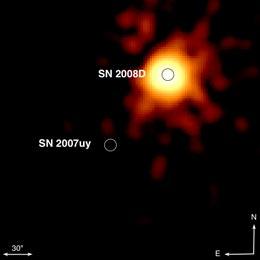
Scientists say they’ve actually caught a supernova in the act.
There is no way to predict exactly where and when in the Universe a supernova will occur, says Alicia Soderberg, a postdoctoral researcher at Princeton University in New Jersey. “It only lasts a few minutes and it is difficult to catch that signal,” she says. Before now, astronomers were only able to look at the afterglows of supernovae.
That is exactly what Soderberg herself was doing on 9 January 2008, when she spotted the explosion. She was using NASA’s Swift gamma-ray burst satellite to observe the remnants of a supernova in a nearby galaxy, when a sudden X-ray burst flared up. The X-ray flash lasted just minutes, but right away, she knew what she was seeing.
“I immediately triggered observations at all the telescopes I could get my hands on,” she recalls. Observatories around the world turned their eyes to the distant galaxy and observed the explosion as it faded. The result is perhaps the most complete record of a supernova to date.
Cool.