Well, just did a live-Twitter of the SOTU. And now for my impressions (which will no doubt be buffeted and tempered by the various pundits over the coming days).
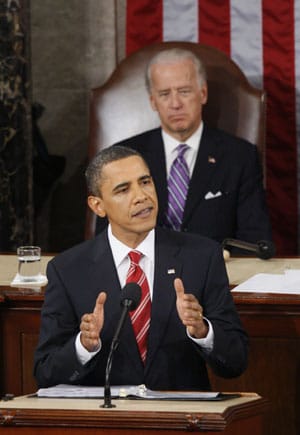
1. Obama remains a hell of a speaker. Compared to the stammering, yammering, good-ol-boy Dubya years, if he does nothing else in his presidency he will have reinvigorated the state of public speaking.
2. He does best when speaking in generalities, as an inspiration, as a leader, as someone speaking of our ideals, reminding us of our values, stern but hopeful. He hit some great populist notes talking about banks, bailouts, and partisan difficulties.
3. He does less well when he gets wonky-policy-bound. Those are the toughest part of any speech, to be sure, and the easiest to critique, but he tends to be a weaker speaker.
4. Policy-wise, it was a mixed bag. Many of the specific items he raised were technical and uncontroversial. His support for health care reform was rhetorically firm but didn’t offer anything new or inspirational to actually make it happen. He “came out” to declare his intent to (work with Congress) to get rid of Don’t Ask, Don’t Tell — but sandwiched it with equal pay enforcement and immigration reform.
The most controversial (previewed) portion of the speech was a freeze on discretionary federal spending starting in 2011. And he followed through with that plan, despite objections from most mainstream economists that during an economic downturn government spending can help fuel a recovery, even if it adds to debt. And even if he thinks it might earn some points from some of the citizenry (despite GOP decifit-mongering), he promptly weakened it by noting that it wouldn’t start until next FY, by which time the recession should (might, maybe) be into recovery.
And, of course, the amount of the federal budget that is actually discretionary, when you explicitly leave out social security, Medicare, Medicaid, and national security, is a tiny fraction, the result is that actual savings tend to be minimal, everyone’s ox gets gored, and nobody’s happy about it.
5. Obama made several stabs at the Bipartisanship meme. It’s a theme he needs to shout from the rooftops, because the American people actually like bipartisanship, and the GOP is hoping they can make them forget that.
Certainly I don’t expect Obama’s pointed comments (ostensibly directed at both parties, but issued facing mostly toward the GOP side of the chamber) to change the tenor of the Republican obstructionists — but they were points well-made, and if the Dems are willing to run on their record (rather than flee from it) and against the GOP “Party of No” (rather than acting like it), they can actually stand a chance next year.
6. CSPAN rocks. No infuriating talking heads blathering on before or after the speech. Just — open camera and live mic. So refreshing. When I become King of the World and wear a shiny hat, every network will be required to cover my speeches like CSPAN does.
7. The “official response of the opposing party” thang will be seen as emblematic of the decay and fall of American Democracy by future historians. You just wait and see. I couldn’t stand them when it was the Dems issuing talking points after Dubya’s SOTUs. I can’t stand them even more now.
8. Twittering the whole speech was interesting. I used the web client (since I suspect the API might be congested), and it worked just fine. It was difficult to digest some of the key points, but it certainly helped me focus on what was being said. Hopefully it was not too annoying to my Twitter followers.
9. Obama is not the progressive change-and-hope candidate I voted for — but he’s also (and by a larger margin) not the far less savory ticket I voted against in 2008. When he speaks of ideals, he’s still got me by the guts. When he turns to policy, his bipartisan – pragmatic – “let’s let Congress live up to what they should be doing” shilly-shallying is frustrating.
This SOTU could have been a clarion call to action, a declaration that, after a year of trying to govern jointly with both parties, it was time to forge ahead to the vision the electorate had when it put him in office. Instead, it was inspiring but safe. It was soaring in generalities and quiet in specifics. That won’t stop the Right from continuing to lambaste him as “the most radical Marxist / Nazi / Muslim / Anarchist / Fascist ever to sit in the White House,” but it will, sadly, somewhat defang that huge majority his party has (on paper) in Congress. Yes, Congressional leadership needs to step up, but even LBJ (a legislator from the git-go) knew the invaluable power that the White House held to sway recalcitrant congresscritters.
In the end, it wasn’t nearly as bad as I’d feared, but nowhere near as good as I’d wished.
And, sadly, it will be back to business as usual in DC tomorrow.
George comments (in his GReader share of the post):
The opposition response, as currently presented by the media (“Here’s what the President has to say. Now here’s what an appointed member of the opposition party’s Congressional delegation has to say in response”) suffers from a variety of flaws:
1. It equates the Executive with the Legislative. If it were a matter of having the Senate Majority Leader answered by the Senate Minority Leader, or the equivalent pair in the House, that would be one thing. Representative or Senator Joe-Bob is not the equivalent of the President. This demeans the office of the Presidency to being, basically, Prime Minister (appointed party leader of the majority party). S/he is not. Which leads to …
2. It makes the President into a partisan position. Now, there’s some truth there, but the President is more than just the head of his/her party. S/he is also the head of state, and the chief executive of the government. S/he represents the entirety of the nation in a way that no congresscritter can. Unless, of course, it all becomes a matter of he-said-she-said in the media’s framing. Whether the President is the same party as hold’s a majority in one or both houses of Congress makes no difference. As either Pelosi or Reid would tell you (candidly), Obama does not necessarily speak for them or for the DNC. He speaks as the President.
3. It plays into the media’s obsession with showing the conflict. Every story has to have opposing views — two opposing views only. Even if it’s describing gravity (“And now, with a skeptic’s view about whether gravity is real …”), the media pushes the he-said-she-said narrative. This is ostensibly to be “fair” — though the media are the last folks to support the Fairness Doctrine. In fact, it’s because conflict makes an exciting story. Repeating what the President said is boring. Countering what the President said with what the Opposing Party Up-and-Comer said in the Official Response is (to the media’s mind) exciting.
The result?
The presidency and the President’s report to Congress becomes solely about partisan politics, and is only of value when seen within the binary yin-yang of Democrat-vs-Republican rhetoric. That’s framing is, to my mind, destructive to the government and society, for all it warms the cockles of news producers’ hearts.
The Founders (who were aghast, during the Constitutional Convention period, at the very idea of parties, though they lived to see them emerge, and, in fact, ended up encouraging them) would be spinning in their graves.
There is plenty of opportunity for the “opposing party” to make their opinion known about the SOTU address. Leaping immediately into the fray is unseemly, unnecessary, and symptomatic of the decay of governance in DC.