So I’ve been pretty good about posting my book reviews to Goodreads, but not so good about (re)posting them here. So …
 The Family Trade by Charles Stross
My rating: 4 of 5 stars
It’s cliche to suggest this book bears a strong inspiration to Zelazny’s Amber (albeit with a bit more economics and a bit less drugs). A woman who discovers she has a blood heritage embodied in a “pattern” on a broach that allows her to travel to another world of medieval lords and feuding families … yeah, hard to argue the basic similarity there.
That said, Stross focuses more on the pragmatic than the phantasmagoric. His protagonist, Miriam Beckstein, finds herself at the center of the plotting of various factions in a world physically the same as ours, but politically (and economically) feudal, with the greatest wealth and mercantile domination coming from the bloodline that possesses the power to cross from their world to ours — a power used to amass wealth and import luxuries, and a power that corrupts in Machiavellian ways.
Stross is, if nothing else, practical, and his analysis of the financials of the other world and its interactions with ours — as well as how the “magic” works — is satisfyingly solid. Miriam, in turn, is neither hapless victim nor shrill critic of the world she finds herself a part of — but she immediately realizes that she can’t accept the role laid out for her, the plans built around her, or the system she’s compelled to be a part of. She’s an admirable protagonist, not a super-woman but a worthy adversary to the folks around her.
The first of a series, and one I plan to read through to its conclusion.
 The Caves of Steel by Isaac Asimov
My rating: 4 of 5 stars
This book was one of my favorites as a kid and, unlike so much else of the Golden Age SF I grew up on (and Asimov’s books in particular), it still holds up well. Sure, some of the technology is quaintly outdated, but Asimov’s basic story of the struggle between anti-robot Earthers and pro-robot Spacers, between a romanticized past and a scary future, between Luddites and Lotus Eaters, and — more personalized — between a police detective and the various forces he’s unwillingly compelled to confront … it all still works.
I’ve always loved the City of New York, as portrayed here — the slidewalks, the underground passages, the community kitchens, and, most of all, how society has adopted/warped to the regimentation of overpopulation and overurbanization.
It’s a decent mystery/detective tale, some classically good SF, and well worth having read again.
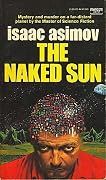
My rating: 4 of 5 stars
Like The Caves of Steel, this is a favorite from my youth, and for the most part it holds up well. Lije Baley returns as the NYC cop in a future where agoraphobic Earthers live in massive, covered-over arcologies, while their Spacer descendants live on a variety of Outer Worlds, both groups viewing the other with contempt and fear.
Unlike the first novel, set on Baley’s home turf of NYC, in this novel Baley’s sent to the Outer World of Solaria, populated by only 20,000 humans and many millions of robot servants and laborers, each human living alone on their own massive estate, usually viewing each other by 3D video, and only rarely (and distastefully) actually being in each other’s presence.
Baley’s detective work is better here than in the first novel, and his being a fish seriously out of water lets us learn outselves the good, bad, and ugly of Solarian society. Lije’s Outer World robot partner, R. Daneel Olivaw, returns as well; though he’s offstage as much as on, Daneel is both more human and more alien than in the first book, serving as both companion and threat to Baley.
Overall both a good detective tale and a good classic SF novel.
 Death by Chocolate by DeAnna Knippling
My rating: 4 of 5 stars
I don’t think I’m smart enough for De Knippling’s books. I always find myself getting tricked by them — expecting the tale to be something just long enough to learn it’s something else, anticipating where it’s going to go next in time for it to veer another direction, understanding who the major supporting cast is just as they vanish from the rest of the story, feeling like I’ve got a handle on a character just before she or he turns around and does something completely different …
But that’s my fault, not the author’s, because those jigs and jags and dekes and dives all make a twisted sense. They represent the real world, where protagonists aren’t two-dimensional and easily graspable and predictable. Real people just aren’t that way. Which makes reading about them more of a challenge.
On the surface, this novella looks like a “deal with the Devil” kind of story, which immediately gets my Rod Serling ears up. A frumpy, isolated young woman, boring and complacently disappointed with her life and stuck for years taking care of her elderly grandmother, is suddenly offered a deal from the Devil: to be made beautiful and immortal, so long as she never eats chocolate. He wants to see if she’s really a good girl, or just boring.
She takes the deal (indeed, it’s practically forced on her), but, of course, it isn’t that simple or straightforward a path for her … but neither is it so simple and straightforward for the reader, either, as the protagonist’s ups and downs make for a roller coaster ride in the dark …
Does she fine true happiness? Revenge on the folks who abused her before? Eternal torment when the she gets tricked into nibbling chocolate?
Well, if it were that simple, anyone could write it.
 Kitty’s Big Trouble by Carrie Vaughn
My rating: 4 of 5 stars
Vaughn’s newest novel of Kitty Norville, werewolfe radio talk show host, is one of the best, and shows the series is still going strong. This one advances the larger metaplot of ancient vampire politics and, in particular, “the Roman,” a very old vampire out to expand his already vast power.
The setting this time is (mostly) in Chinatown, San Francisco, which provides a lot of great opportunity for myth and magic. It also provides the title, since Kitty gets into Big Trouble in …
Vaughn continues to do a great job of modern urban fantasy without stirring in big gobs of torrid romance novel. Not that there isn’t romance in KBT, but it’s a quiet, incidental romance between Kitty and Ben, married and mated and acting like it. Good stuff.
Also unlike most urban fantasies, there’s minimal power/threat escalation in this book. Kitty knows more at the end than she did, and she’s gotten involved in some additionally dire activies for the future — but she hasn’t developed any new powers, picked up any fearsome artifacts, or been revealed to be secretly something additional she wasn’t before. Refreshing.
Indeed, Vaughn almost goes too far in the opposite direction, as [SPOILERS] I don’t believe Kitty shapechanges the entire novel (mostly because she’s stuck in a crowded urban setting). That seemed odd — but it wasn’t that she was passive or under restraint the whole time — she just didn’t do it.[/SPOILERS]
Very solid book, and more sign of Vaughn’s improvement as a writer. Well done.