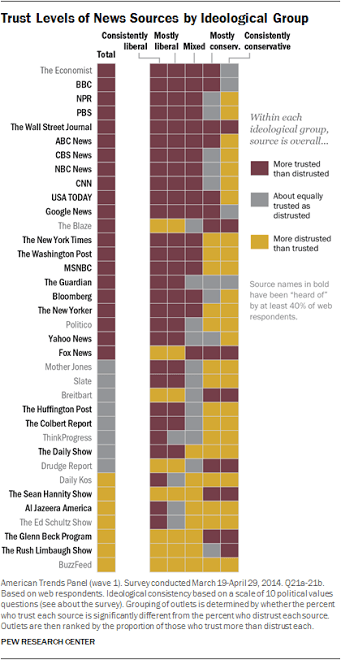
Not a huge number of surprises here about the trust given by people in different parts of the political spectrum to different media outlets / sites:
A few thoughts:
– Liberals tend to trust more sites than conservatives. Is that because the media as a whole are more liberal, that there are more liberal sites, that liberals are more open-minded, or that liberals are more credulous? Probably where you stand indicates what sort of answer you'd give (to that, and to the opposite observation about conservatives).
– I'm not sure how this fits with Fox's claim to be the Most Trusted News Source In The Cosmos (or however they frame it). Or, for that matter, their ratings. Fox News shows up here as (slightly) less trusted (except by consistent conservatives) than ABC, CBS, NBC, or CNN, with a comparable trust spread to MSNBC.
– I don;t have the actual question(s) in front of me, but there's trust and there's trust (and then there's what you do with it the information). For example, there are sites that I trust to give basically accurate information but with a seriously liberal slant in the commentary around the information (ThinkProgress comes to mind); I often use them as a jumping off point to drill down to a more primary (or less editorial) source.
That may be why Buzzfeed is net mistrusted by every group, but is still such a popular site.
– In that same context, not all sources speak with the same voice. There are folk on certain sites I overall trust who make my skin crawl, and folk on sites I overall distrust who I will listen to.
There are also associations that can be harmful to trust. For example, I find Al Jazeera America to be interesting and challenging, and rarely do I find them saying things that are blatantly false (just, sometimes, uncomfortable to listen to). Yet they're right there with Glenn Beck and Rush Limbaugh as untrusted sources, largely because of their associations with Those Middle Eastern Jihad Types, not for what specifically report on.
– The most trusted seem to be the Economist, BBC, and Google News (an aggregator). Though the summary text at the bottom indicates that things have been sorted within each group by the intensity of trust/mistrust overall, so Google News' colors may be misleading if they are only somewhat more trusted by most political demographics.

Some surprises:
More people trust MSNBC and Fox News than distrust them – which means that there are a few who trust both news sources.
The Wall Street Journal is trusted across the ideological spectrum – which probably means that the old view that business is always conservative is fading away.
In 2015, the majority of people have not heard of the Drudge Report. Does this mean that text is dead?
Why isn't WSJ at the top of the list? It got all squares maroon/red colored? The graph itself is biased against WSJ.
+Isaac Garcia The fine print says, "Grouping of outlets is determined by whether the percent who trust each source is significantly different from the percent who distrust each source. Outlets are then ranked by the proportion of those who trust more than distrust each."
Let's say that the WSJ gets 60% trust vs 40% distrust in each cohort. But CNN gets 90% vs 10% for the cohorts who like it, 50-50 on the one that's mixed, and 40-60 on the conservatives who net distrust it. They would CNN would still aggregate have a higher proportion trusting it than the WSJ, even though within each cohort the WSJ is net trusted.
(All of this is complicated by not knowing the populations of the different cohorts and where that comes into play.)