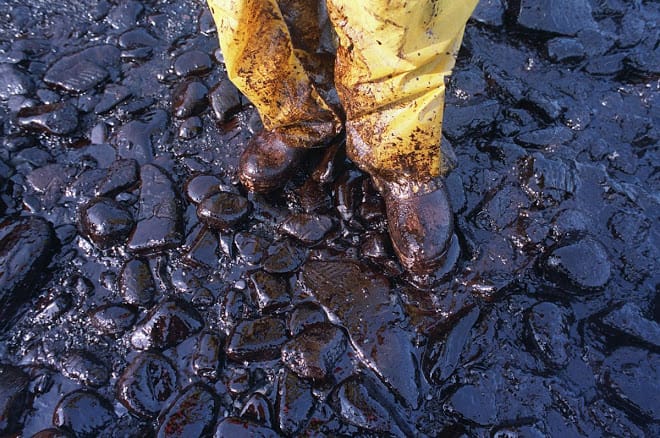
One of the drawbacks to our capitalist, business-focused system, is that we privatize profits, but publicize risks. That is to say, when people make a profit from doing something useful, that profit generally goes to those people / that corporation. But when people cause damage in pursuit of profit, those damages generally get paid for out of the public pocket, due to exemptions, loopholes, insurance, court delays, bankruptcies, or just general cheating. The impact of mistakes (or malice) gets absorbed by everyone.
A fine look at the phenomenon and a variety of examples here:
http://www.stonekettle.com/2016/09/standing-rock.html
Tightly coupled to this is the idea that Shit Happens. Mistakes Are Made. Sooner Or Later, Boom.
If someone assures you that something will never leak, that idiot-proof systems will never fail, that everyone is well-trained in all the proper processes, that nobody will ever be negligent or tired or drunk or complaisant or distracted, that nothing can ever, possibly, go wrong here — then they are either Pollyannaesque optimists, or are trying to take advantage of you, most likely in order to shift the risk of their operations to the public who will have to absorb the costs of clean-up and economic damage to people's livelihoods.

One of the reasons I don't think libertarianism will ever see any success is because it makes a strong attempt to eliminate the systems that assist people and companies that are in crisis. We're a risk-averse lot, and if we didn't have safety nets we'd live and run our companies differently. (elsewhere I just saw: "libertarianism: astrology for men" and am still giggling.)
Libertarianism tends to work best from a position of privilege and wealth. "I've got mine, you can pound sand." For those who don't have the wherewithal to weather the battering seas of fate, libertarianism tends to look like natural selection.
And, circling back to the article, the shallow libertarian would say, "Hey, if my mine tailing retention pond fails, well, heck, that's the downstream folks' look-out. They should have moved someplace else." Libertarianism, by denying any commonweal, simply doesn't understand how the costs of an individual's bad decisions don't just affect that individual, but a huge number of people figuratively or literally downstream.
To some degree, it makes sense for a society to spread out focal risk. Of course, in a sane society, this applies equitably to people of all sorts, not as in America where rich people's risk is absorbed by society, but poor people must bear their own risk.
Not only must poor people bear their own risk, but that of the rich as well (examples too numerous to count).
I would love to see a new definition of government, as the corporation of the people, for the management and protection of the commons.