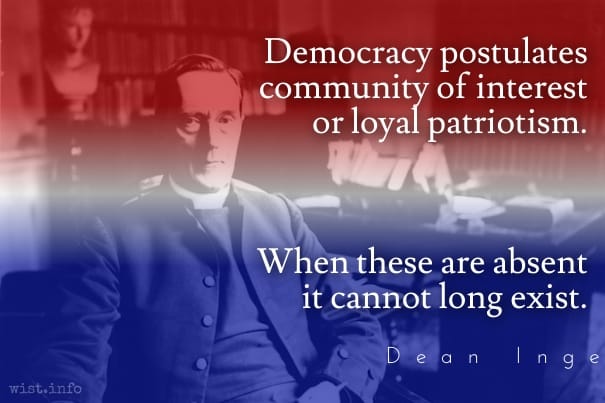
¶ Democracy postulates community of interest or loyal patriotism. When these are absent it cannot long exist.
— William Ralph Inge (1860-1954) English prelate [Dean Inge]
“Our Present Discontents,” Outspoken Essays: First Series (1919)
http://wist.info/inge-william-ralph/31610/
¶ My critique of democracy begins and ends with this point. Kids must be educated to disrespect authority or else democracy is a farce.
— Abbie Hoffman (1936-1989) American political activist
Soon to be a Major Motion Picture (1980)
http://wist.info/hoffman-abbie/11467/
¶ Our trouble is that we do not demand enough of the people who represent us. We are responsible for their activities. … We must spur them to more imagination and enterprise in making a push into the unknown; we must make clear that we intend to have responsible and courageous leadership.
— Eleanor Roosevelt (1884-1962) First Lady of the US (1933-45), politician, diplomat, activist
Tomorrow Is Now (1963)
http://wist.info/roosevelt-eleanor/28931/
¶ For in a democracy, every citizen, regardless of his interest in politics, “holds office”; every one of us is in a position of responsibility; and, in the final analysis, the kind of government we get depends upon how we fulfill those responsibilities. We, the people, are the boss, and we will get the kind of political leadership, be it good or bad, that we demand and deserve.
— John F. Kennedy (1917-1963) US President (1961-63)
Profiles in Courage (1956; 1964 ed.)
http://wist.info/kennedy-john/24340/
¶ The first rule of democracy is to distrust all leaders who begin to believe their own publicity.
— Arthur M. Schlesinger, Jr. (1917-2007) American historian, author, social critic
“On Heroic Leadership,” Encounter (Dec 1960)
http://wist.info/schlessinger-arthur/10567/
¶ At bottom, the court’s opinion is thus a rejection of the common sense of the American people, who have recognized a need to prevent corporations from undermining self-government since the founding, and who have fought against the distinctive corrupting potential of corporate electioneering since the days of Theodore Roosevelt. It is a strange time to repudiate that common sense. While American democracy is imperfect, few outside the majority of this court would have thought its flaws included a dearth of corporate money in politics.
— John Paul Stevens (b. 1920) American lawyer, US Supreme Court Justice (1975-2010)
Citizens United v. Federal Election Commission, 558 U.S. _ (2010) [Dissenting]
http://wist.info/stevens-john-paul/22161/
¶ Democracy is the only system that persists in asking the powers that be whether they are the powers that ought to be.
— Sydney J. Harris (1917-1986) Anglo-American columnist, journalist, author
(Attributed)
http://wist.info/harris-sydney-j/8702/
¶ In a virtuous community men of sense and principle will always be placed at the head of affairs. In a declining state of public morals men will be so blinded to their true interests as to put the incapable and unworthy at the helm. It is therefore vain to complain of the follies or crimes of a government. We must lay the hands on our own hearts and say, Here is the sin that makes the public sin.
— Ralph Waldo Emerson (1803-1882) American essayist, lecturer, poet
“The Individual and the State,” sermon, Second Church of Boston (8 Apr 1830)
http://wist.info/emerson-ralph-waldo/18501/
¶ Democracy demands that little men shouldn’t take big ones too serious; it dies when it’s full of little men who think they are big themselves.
— C.S. Lewis (1898-1963) English writer and scholar [Clive Staples Lewis]
“Notes on the Way,” Time and Tide (29 Apr 1944)
¶ I want to be able to sit down with anyone who may have a new idea and not be afraid of contamination by association. In a democracy you must be able to meet with people and argue your point of view–people whom you have not screened beforehand. That must be part of the freedom of people in the United States.
— Eleanor Roosevelt (1884-1962) First Lady of the US (1933-45), politician, diplomat, activist
(Attributed)
http://wist.info/roosevelt-eleanor/6327/
¶ To oppose one class perpetually to another — young against old, manual labour against brain-worker, rich against poor, woman against man — is to split the foundations of the State; and if the cleavage runs too deep, there remains no remedy but force and dictatorship. If you wish to preserve a free democracy, you must base it — not on classes and categories, for this will land you in the totalitarian State, where no one may act or think except as a member of a category. You must base it upon the individual Tom, Dick and Harry, and the individual Jack and Jill — in fact, upon you and me.
— Dorothy Sayers (1893-1957) English author, translator, apologist
“Are Women Human?”, Address to a Women’s Society, conclusion (1938)
http://wist.info/sayers-dorothy/6309/
¶ No government is perfect. One of the chief virtues of a democracy, however, is that its defects are always visible and under democratic processes can be pointed out and corrected.
— Harry S Truman (1884-1972) US President (1945-1953)
Speech, Joint Session of the US Congress (12 Mar 1947)
http://wist.info/truman-harry-s/15361/
¶ The central tenet of every democracy in the end is trust.
— William Jefferson "Bill" Clinton (b. 1946) American politician, US President (1993-2001)
In Gwen Ifill, “Bill & Al’s Traveling Medicine Show,” New York Times (9 Sep 1993)
http://wist.info/clinton-bill/8330/
¶ In the final analysis, a democratic government represents the sum total of the courage and the integrity of its individuals. It cannot be better than they are.
— Eleanor Roosevelt (1884-1962) First Lady of the US (1933-45), politician, diplomat, activist
Tomorrow Is Now (1963)
http://wist.info/roosevelt-eleanor/5959/
¶ I know of no safe depository of the ultimate powers of the society but the people themselves; and if we think them not enlightened enough to exercise their control with a wholesome direction, the remedy is not to take it from them, but to inform their discretion by education.
— Thomas Jefferson (1743-1826) American political philosopher, polymath, statesman, US President (1801-09)
Letter to William C. Jarvis (28 Sep 1820)
http://wist.info/jefferson-thomas/8320/
¶ The multitude which is not brought to act as a unity is confusion. That unity which has not its origin in the multitude is tyranny.
— Blaise Pascal (1623-1662) French scientist and philosopher
Pensées, # 77 (1670)
http://wist.info/pascal-blaise/8171/
¶ It seems to me that America’s objective today should be to try to make herself the best possible mirror of democracy that she can. The people of the world can see what happens here. They watch us to see what we are going to do and how well we can do it. We are giving them the only possible picture of democracy that we can: the picture as it works in actual practice. This is the only way other peoples can see for themselves how it works; and can determine for themselves whether this thing is good in itself, whether it is better than they have, better than what other political and economic systems offer them.
— Eleanor Roosevelt (1884-1962) First Lady of the US (1933-45), politician, diplomat, activist
The Autobiography of Eleanor Roosevelt, ch. 43 “Milestones” (1961)
http://wist.info/roosevelt-eleanor/28304/
¶ Democracy means, not “I am as good as you are,” but, “You are as good as I am.”
— Reinhold Niebuhr (1892-1971) American theologian and clergyman
The Children of Light and the Children of Darkness, foreword (1944)
http://wist.info/niebuhr-reinhold/5310/

"Whether the earth bares the gold you have hidden – I know not. Where your servants shed their blood will give evidence – and I will return to ask for the currency that Magadha has rights to …" Arthashastra is not about commerce only – it's about the success/failure of commerce to show the meaning of phenomenological and spiritual life –
https://www.youtube.com/watch?v=4oj56rWrPr0&t=510s
https://www.youtube.com/watch?v=4oj56rWrPr0&t=510s
Jefferson and Roosevelt seem to be the closest. However harsh it is – individual lives determine democracy not boot licking.
When the state, power and ostentatious glamour have destroyed the ethics of shastras, who should safeguard them, and the people, but the acharyas [teachers/scholars]?
https://www.youtube.com/watch?v=E-x0W9jglcs
https://www.youtube.com/watch?v=E-x0W9jglcs