¶ The Presidency is not merely an administrative office. That’s the least of it. It is more than an engineering job, efficient or inefficient. It is pre-eminently a place of moral leadership. All our great Presidents were leaders of thought at times when certain historic ideas in the life of the nation had to be clarified.
— Franklin Delano Roosevelt (1882-1945) US President (1933-1945)
In The New York Times Magazine (11 Sep 1932)
http://wist.info/roosevelt-franklin-delano/34290/
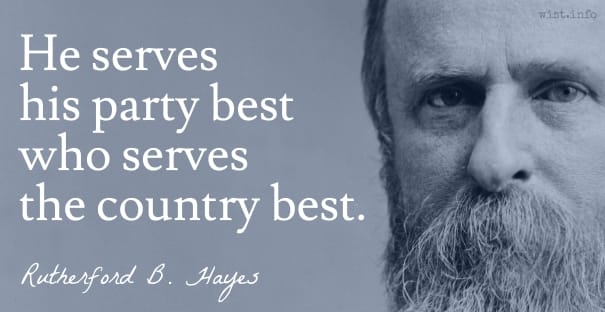
¶ He serves his party best who serves the country best.
— Rutherford B. Hayes (1822-1893) American attorney, soldier, politician, US President (1877-81)
Inaugural address (5 Mar 1877)
http://wist.info/hayes-rutherford/34373/
¶ The legislative job of the President is especially important to the people who have no special representatives to plead their cause before Congress — and that includes the great majority. The President is the only lobbyist that 150 million Americans have. The other 20 million are able to employ people to represent them — and that’s all right, it’s the exercise of the right of petition — but someone has to look after the interests of the 150 million that are left.
— Harry S Truman (1884-1972) US President (1945-1953)
Speech, Press and Union Club, San Francisco (25 Oct 1956)
http://wist.info/truman-harry-s/15099/
¶ The President must be greater than anyone else, but not better than anyone else. We subject him and his family to close and constant scrutiny and denounce them for things that we ourselves do every day. A Presidential slip of the tongue, a slight error in judgment — social, political, or ethical — can raise a storm of protest. We give the President more work than a man can do, more responsibility than a man should take, more pressure than a man can bear. We abuse him often and rarely praise him. We wear him out, use him up, eat him up. And with all this, Americans have a love for the President that goes beyond loyalty or party nationality; he is ours, and we exercise the right to destroy him.
— John Steinbeck (1902-1968) American writer
“America and Americans” (1966)
http://wist.info/steinbeck-john/6571/
¶ When I ran for Presidency of the United States, I knew that this country faced serious challenges, but I could not realize — nor could any man realize who does not bear the burdens of this office — how heavy and constant would be those burdens.
— John F. Kennedy (1917-1963) US President (1961-63)
“Radio and TV Report to the American People on the Berlin Crisis” (25 Jul 1961)
http://wist.info/kennedy-john/17586/
¶ The intoxication of power rapidly sobers off in the knowledge of its restrictions and under the prompt reminder of an ever-present and not always considerate press, as well as the kindly suggestions that not infrequently come from Congress.
— William Howard Taft (1857-1930) US President (1909-13) and Chief Justice (1921-1930)
Speech, Lotus Club (16 Nov 1912)
http://wist.info/taft-william/29959/
¶ My view was that every executive officer, and above all every executive officer in high position, was a steward of the people bound actively and affirmatively to do all he could for the people, and not to content himself with the negative merit of keeping his talents undamaged in a napkin. I declined to adopt the view that what was imperatively necessary for the Nation could not be done by the President unless he could find some specific authorization to do it. My belief was that it was not only his right but his duty to do anything that the needs of the Nation demanded unless such action was forbidden by the Constitution or by the laws. Under this interpretation of executive power I did and caused to be done many things not previously done by the President and the heads of the departments. I did not usurp power, but I did greatly broaden the use of executive power. In other words, I acted for the public welfare, I acted for the common well-being of all our people, whenever and in whatever manner was necessary, unless prevented by direct constitutional or legislative prohibition.
— Theodore Roosevelt (1858-1919) US President (1901-1909)
Theodore Roosevelt, An Autobiography, ch. 10 (1926)
http://wist.info/roosevelt-theodore/34205/
¶ When you get to be President, there are all those things, the honors, the twenty-one gun salutes, all those things. You have to remember it isn’t for you. It’s for the Presidency.
— Harry S Truman (1884-1972) US President (1945-1953)
In Merle Miller, Plain Speaking: An Oral Biography of Harry S. Truman, ch. 15 (1973)
http://wist.info/truman-harry-s/33998/
