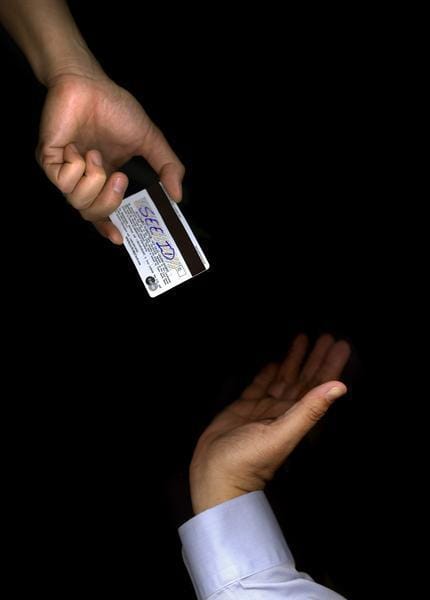
 Most merchants don’t actually follow-up, and in fact it increases their liability if they accept charges on cards marked that way. While signature lines are pretty shoddy security (they’re frequently not even checked, and there are any number of transactions that don’t even require them in this swipe / chip / online world), technically credit cards are not valid without a signature on the back.
See ID? Don’t do it!
See ID? Don’t do it!
99 view(s)
“In reality, criminals don’t take the time to practice signatures,” Visa rules state. “They use cards as quickly as possible after a theft and prior to the accounts being blocked.”
“Our relationship is not with the consumer but with the issuer, the financial institution,” Harrall said. “A merchant cannot refuse the card without an ID. If it’s signed, according to our rules, he must accept the card on its face.”
These two lines right there are why See ID should theoretically work better than any signature. What this article is essentially saying is, Your accounts will be drained either way and you're leaving the merchant that accepted the stolen card on a hook for it.
To which I reply, "Aww, shucks".
I’m fascinated – people in the US actually do this. Why.
To be honest I’m somewhat bemused by the ongoing arguments in America about cards. Is the chip and pin argument still going on? We’re on contactless now, you can even use them instead of an Oyster card on London transport, and there’s a daily cap, so no matter how much you use, there is a maximum charge. It’s brilliant for small purchases, and I’m pubs it’s great.
'Your accounts will be drained either way and you're leaving the merchant that accepted the stolen card on a hook for it.' — except that the article also notes in the Q&A:
'If the card is signed and a fraudulent purchase occurs, the card issuer is liable, not the merchant.'
All of this represents yet another reason for a chip-and-pin system, it seems to me, but that's a different debate.
From an end user perspective, I couldn't care less whether it's the merchant or the issuer who picks up the tab. I'm concerned with cutting the fraud off at the point where it occurs, the register.
Because of the expedited turn around of credit card fraud, it is less likely that a thief has generated a fake ID and it's easier for the (probably 16 year old) cashier to verify the identity of the card holder.
As it stands now, a lack of signature on a card will never come into play unless there's a fraudulent charge. If the merchant refuses heed my request to check ID in order to match the name on the card and the photo with the person standing in front of them, they deserve to be liable.
Chip and Pin is great but needs to be implemented better. C&P in Europe (and here for new debit cards) depends on the pin being encrypted onto the chip. That encryption has proven fallible.
The pin needs to be checked against an issuer maintained encrypted database in real time. That way, the pin is stored in a location that is all but impossible for thieves to access. If they do manage to hack the issuer, the entire pin database can be rotated rather quickly. The slow down at the register is a small price to pay to cut the fraud industry off at the knees.
a) yet another reason the US needs to toss out this useless bit of history, especially now that they have the chip cards finally and go to the straight chip and pin system.
b) most of the cards that cloned come from skimmers and sniffers.
Nick, card fraud has dropped significantly in the UK since chip and pin, it’s just harder for card thieves. Stolen cards are used by watching people at ATMs putting in their PIN
them stealing the card. It takes more planning and is more difficult to execute.
Yes people still commit fraud, but it’s reduced dramatically