This article is correct in its core assertion:
If an applicant for a powerful lifetime position cannot provide the needed documents to vet him, the answer is not to drop the vetting; it is to nominate another person, who can provide what reasonable process demands. Vetting is a constitutional requirement, not an obstacle to be dodged. If the people’s representatives can’t vet Kavanaugh, then the president should bring them a nominee they can vet.
Which may suck for a perfectly reasonable and wonderful and trustworthy nominee who, in the nature of their previous service, did some critical things that cannot be publicly revealed. But … well, them’s the breaks and thank you for your service and sacrifice.
The article is also perfectly correct in its assertions that there is no ethical or public policy justification for rushing through this nominee’s hearing process to the extent that even the fraction of background documents that have been deemed as acceptable for the public and Senators to know cannot possibly be reviewed in time.
But here the author misses the point (or is unwilling to acknowledge it directly): this process is not about ethics or public policy: it is solely about getting a serious conservative onto the Supreme Court ASAP and conclusively, so as to tip the political balance of the court firmly to the Right for decades. To that end, the GOP Senators and committee members don’t care if there’s an objectively defensible rationale — they already have their political rationale, and have (probably) the votes to make it happen, so why risk anything that might cause a problem?
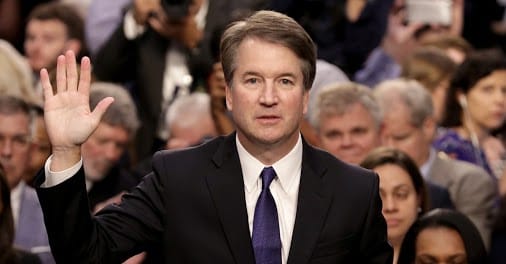
A Judge Who Can’t Be Vetted Shouldn’t Be Confirmed
If Brett Kavanaugh’s extensive paper trail can’t be fully and publicly disclosed, the simplest solution is to nominate someone else.

And some more well-thought-out reasons for acting with more deliberation during this confirmation hearing … which will again fall on deaf ears among GOP Senators because that's not at all what they care about here.
https://www.politico.com/magazine/story/2018/09/04/kavanaugh-hearings-recuse-himself-supreme-court-219635
McConnell actively violated the constitution when he refused to allow the Senate to advise and consent. He even bragged about it as his proudest moment. (This was his second active declaration of war by the legislative branch against the executive.)
I don't think something as minor as not following a legitimate process would slow him down for a second.
+Greg Stockton And clearly isn't.
+Dave Hill Pardon my ignorance, but is there a way that a SCOTUS judge can be removed at a later date, for a reason such as the vetting process was not followed correctly? Or is the position sacrosanct in order to stop every President from shuffling the deck?
+L Gorrie Not per se, but …
"The Constitution provides that justices "shall hold their offices during good behavior" (unless appointed during a Senate recess). The term "good behavior" is understood to mean justices may serve for the remainder of their lives, unless they are impeached and convicted by Congress, resign, or retire.[96] Only one justice has been impeached by the House of Representatives (Samuel Chase, March 1804), but he was acquitted in the Senate (March 1805).[97] Moves to impeach sitting justices have occurred more recently (for example, William O. Douglas was the subject of hearings twice, in 1953 and again in 1970; and Abe Fortas resigned while hearings were being organized in 1969), but they did not reach a vote in the House. No mechanism exists for removing a justice who is permanently incapacitated by illness or injury, but unable (or unwilling) to resign."
Impeachment only appears to apply to behavior while in office, which means, in theory, any irregularities in the nomination and confirmation process can't be held against him.
On the other hand, what constitutes an impeachable offense to depend on what the House wants to indict on and what the Senate is willing to convict on.
https://en.wikipedia.org/wiki/Supreme_Court_of_the_United_States#Tenure
+Dave Hill Thanks.
So lying to get the job might be a reason for later impeachment, providing both House and Senate can agree. It's sensible, but cumbersome.
+L Gorrie The impeachment process in US law is maddeningly vague as to what counts (treason, bribery, "and other High Crimes and Misdemeanors"), perhaps because it has to serve as a catch-all. It's not a normal court that says, "You are charged with being in violation of the following statutes." It's more "you've done highly improper stuff that amounts to unfitness for office."
It's also something that, traditionally, people have been largely reluctant to invoke, if only because it's a nuclear option that depends on reluctance to keep from blowing things up altogether (it could in theory be abused to kick out any minority-party President, for example), which is one reason its use against B. Clinton was so controversial.
Whether it can actually be applied to someone for actions taken in pursuit of a public office from which one can be impeached is actually unclear. I've heard arguments on both sides, but I don't know that there's actual case law for it (IANAL). While most of the references are for specific failures to properly use public power (which a candidate does not yet have), there's also some references to betraying the public trust, which might go to actions taken to obtain office.
In the specific case of Trump, I suspect any hypothetical articles would not be for pre-election issues (to avoid having to litigate that portion before the Supreme Court), but would be over obstruction of justice and actions taken to deny or avoid revlation of such misdeeds while in office. As they say, "It's not the crime that gets you, it's the cover-up."
In the case of Kavanaugh, I honestly can't say whether misdeeds during confirmation — lying under oath, for example — would be sufficient to allow impeachment. Could the Senate could come up with a reason to subpoena Kavanaugh while still in office, to investigate such allegations, and compel him to speak to the matter? If he then lied under oath, that would be an impeachable offense. But if he took the Fifth (invoked the constitutional right against self-incrimination), or confessed to the crime, would that be grounds for impeachment? If he were convicted of perjury for an action performed before his confirmation, would that be impeachable? Or would the Founders' expectation be that a person in such a situation would, of course, resign.
Much of our system is held together by a sense of propriety and shame. As has been demonstrated over the last decade, when dealing with shameless folk willing to game the system, it has some surprising gaps in its defense.
https://en.wikipedia.org/wiki/High_crimes_and_misdemeanors#United_States