https://buy-zithromax.online buy kamagra usa https://antibiotics.top buy stromectol online https://deutschland-doxycycline.com https://ivermectin-apotheke.com kaufen cialis https://2-pharmaceuticals.com buy antibiotics online Online Pharmacy vermectin apotheke buy stromectol europe buy zithromax online https://kaufen-cialis.com levitra usa https://stromectol-apotheke.com buy doxycycline online https://buy-ivermectin.online https://stromectol-europe.com stromectol apotheke https://buyamoxil24x7.online deutschland doxycycline https://buy-stromectol.online https://doxycycline365.online https://levitra-usa.com buy ivermectin online buy amoxil online https://buykamagrausa.net

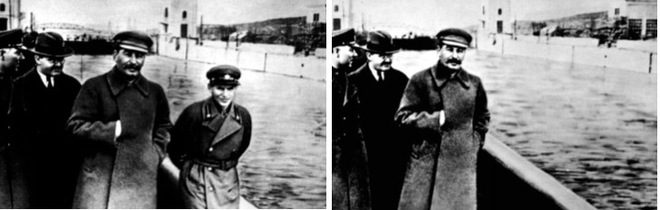
Now you see him …

A spiffy site on the Soviet Union, the careful control of news and the historic record, and the quiet manipulation of photography to enforce same. The young commissar of…

A spiffy site on the Soviet Union, the careful control of news and the historic record, and the quiet manipulation of photography to enforce same. The young commissar of water transport at Stalin’s right, Nikolai Yezhov, was executed in 1940, and his image removed from the historical record thereafter (ironicallly replaced by a nice expanse of water …).

Like Winston Smith, the Soviets had this down to a fine science, even in the pre-PhotoShop days. I recall some similar photos from Maoist China, where various travel partners of Mao were vanished from the historical photos as they were, themselves, booted out of favor and power.

(via Table of Malcontents)

98 view(s)  

3 thoughts on “Now you see him …”

  1. Correction: Yezhov was head of the NKVD, (KGB) not commissar of the water transport. As head of the NKVD in the late 1930s, he played a large part in the Great Terror, where millions of comrades were executed. Alas, he knew too much and as the executioner had to get a bullet in the head himself. Good riddance!

  2. Apparently, he was both: http://en.wikipedia.org/wiki/Nikolai_Yezhov

    He was known as a determined loyalist of Joseph Stalin, and in 1935 he wrote a paper in which he argued that political opposition must eventually lead to violence and terrorism; this became in part the ideological basis of the Purges.[2] He became People’s Commissar for Internal Affairs (head of the NKVD) and a member of the Presidium Central Executive Committee on September 26, 1936, following the dismissal of Genrikh Yagoda. Under Yezhov, the purges reached their height, with roughly half of the Soviet political and military establishment being imprisoned or shot, along with hundreds of thousands of others, suspected of disloyalty or “wrecking”. Yezhov also conducted a thorough purge of the security organs, both NKVD and GRU, removing and shooting many officials who had been appointed by his predecessors Yagoda and Menzhinsky, but even his own appointees as well. He maintained that it was worth having ten innocent people suffer rather than letting one spy get away.

    The apex of Yezhov’s ascendancy was reached on 20 December 1937, when the party hosted a giant gala to celebrate the 20th anniversary of the NKVD at the Bolshoi Theater. Enormous banners with portraits of Stalin hung side-by-side with those of Yezhov. On a stage crowded with flowers, Anastas Mikoyan, dressed in a dark caucasian tunic and belt, praised Yezhov for his tireless work. “Learn the Stalin way to work”, he said, “from Comrade Yezhov, just as he learned and will continue to learn from Comrade Stalin himself”. The crux of this line was every soviet citizen should be an NKVD agent. When presented, Yezhov received an “uproarious greeting”. He stood, one observer wrote, “eyes cast down and a sheepish grin on his face, as if he wasn’t sure he deserved such a rapturous reception”. Stalin himself observed the scene from his private box.

    When he was also appointed to the post of People’s Commissar for Water Transport on April 8, 1938, maintaining his other posts, his role was gradually diminishing. On August 22, 1938, Lavrenty Beria became the deputy and partner to Yezhov and took over the governance of the Commissariat. When Stalin and Vyacheslav Molotov criticized heavily the work and methods of the NKVD in their writing of November 11, 1938, he was relieved of his post as the People’s Commissar for Internal Affairs at his own request on November 25, 1938, and Beria succeeded him.

    Though I agree that his role as NKVD head was a bit more important.

Leave a Reply

Your email address will not be published. Required fields are marked *