https://buy-zithromax.online buy kamagra usa https://antibiotics.top buy stromectol online https://deutschland-doxycycline.com https://ivermectin-apotheke.com kaufen cialis https://2-pharmaceuticals.com buy antibiotics online Online Pharmacy vermectin apotheke buy stromectol europe buy zithromax online https://kaufen-cialis.com levitra usa https://stromectol-apotheke.com buy doxycycline online https://buy-ivermectin.online https://stromectol-europe.com stromectol apotheke https://buyamoxil24x7.online deutschland doxycycline https://buy-stromectol.online https://doxycycline365.online https://levitra-usa.com buy ivermectin online buy amoxil online https://buykamagrausa.net

Colorado Ballot Initiatives 2026 (and how I’m voting on them)

Citizen initiatives were one of the great changes made by the Progressives, over a century ago.

I do these each election cycle: listing and opining on Colorado state ballot measures — statute and constitutional, citizen-initiated and legislative.  Colorado has a big bundle of propositions this year, so let’s see what they look like.

If you want more Official Info on any of these, the Colorado secretary of state’s office has got you covered a couple of different ways.  There also useful info over at Ballotpedia. I’d also recommend some of the coverage at the Colorado Sun and CPR.

Amendment 81 – NO
Law Enforcement Communication with Federal Immigration Authorities

This would add to the state constitution (!) the requirement for law enforcement to notify ICE whenever someone (whose legal presence in the US isn’t “determined”) is charged with a violent crime, or with any crime if there’s a prior felony conviction.

Bah.

Nothing is defined here as to how citizenship is to be “determined,” and the default is “assume they need to be reported to ICE unless they can prove otherwise.”  How much will procedures vary from place to place or DA by DA? What does seem certain is that, inevitably, people with a lawful basis to be here, but who look, y’know, like the wrong kind of foreigner, won’t be able to prove they are citizens to whatever level the locals is satisfied with.  Instead, they will get quickly thrown into the ICE system, to who knows what end.

The system seems designed to make mistakes, all on the side of deportation action.

Further, this new constitutional amendment comes into play when someone is just charged with a crime.  Not convicted. Presumption of innocence and due process is thrown out the window (substituted by “presumption of illegal presence”), which is just wrong. It will further incent arrests, regardless of probable cause, by some law enforcement of folk who don’t “look” right.

The folk backing this are the usual suspects. Let’s not.

Amendment 82 – NO
Constitutional Right to Purchase and Sell Natural Gas

Gives a constitutional right to buy natural gas for cooking and heating, and business to distribute and sell it.

The only thing positive to say about natural gas is that it is arguably less bad for the environment and climate than, say, dirty, ugly coal. Which I can only imagine the people pushing this proposal would like to provide a constitutional right to use and sell as well.

It’s very easy to see this amendment not only preventing some not-yet-seen armageddon, but being used by natural gas providers to fight in court all sorts of environmental and safety regulations that violate their “constitutional right” to transport and sell natural gas.

I don’t approve of forcing folk to get rid of natural gas already installed in their house … but nobody’s actually doing that. If municipalities or the state want to restrict use of natural gas appliances for new sales or new houses — I think that’s up to them (and their voters), not something in the state constitution.

Amendment 83 – NO
Constitutional Right to Hunt and Fish

This would provide a constitutional right (!) to hunt and fish and require the wildlife management authorities prioritize hunting and fishing as means of wildlife management.

I’ll admit that I’m neither a hunter nor fisher, and actually kind of disapprove of both pastimes — but I don’t consider my disapproval sufficient to agitate for banning such hobbies. But nobody else is proposing that, either, and that would be an appropriate time to float such a constitutional amendment.

I also think this is a trivializing use of the state constitution. But maybe I don’t have enough appreciation for the idea of hunting and fishing warranting protection as a constitutional right, right next to religion and due process and the like.

There are also concerns that such a “right,” as defined, could override previously passed constitutional language that prohibit certain methods of hunting, such as leghold traps, poisons and snares.

Finally, the state constitution shouldn’t mandate about something technical like wildlife management.  Bah.

Amendment 84 – NO
Mail Ballot Voter Identification

Colorado mail-in ballots currently require a signature, which is checked against a database to validate the submission. This would additionally require some sort of ID number — Social Security (last 4 digits), state driver’s license number, or some other of a set of ID provided.

But, like the signature, these IDs will go on the outside of the envelope.  I understand that’s to protect the principle of a secret ballot … I don’t want my DL number, let alone my SSI number (even the last four digits) on the outside of an envelope I’m mailing in.  That creates too much opportunity for ID theft issues, without having demonstrated any significant problem of fraudulent mail-in ballots.

By adding an additional requirement, it also make it more likely that mis-writing, or mis-reading, will force an otherwise legit ballot to be rejected, and will slow down an election process that critics already says is too slow to provide results.

No, this strikes me as just an effort to drum up fear and paranoia about mail-in ballots, both as presuming them as risky for election security, as well as making people worried about using them. Bah.

Amendment 85 – NO
Plain Language Ballot Titles

Requires (in the state constitution!) that ballot titles and question language be written in plain language at an 8th grade reading level.

Colorado already has requirements for plain language in such things. This adds in an “8th Grade reading level” requirement, without actually providing how that’s to be determined (having been in the ed biz in the past I know that reading level indices can vary quite a bit depending on what they focus on).

I see this amendment as (a) a way to challenge ballot propositions that people don’t like, and (b) a way to force ballot propositions to be non-technical (which probably most impacts funding / taxation propositions).

Looking at who supports it is even more reason to oppose it. Bah.

Amendment 86 – No?
Requirements for Off-Cycle Congressional Redistricting

This would set up a process for defining redistricting outside of the normal decennial process, using the state’s Independent Congressional Redistricting Commission to determine how redistricting is being done and preventing it from being used for partisan purposes.

Sigh.

I am deeply offended by gerrymandering. I am very big into independent redistricting commissions. Manipulating electoral districts for partisan advantage bugs the fuck out of me, and represent one of the biggest challenges to democratic principles we have.

That said …

When the GOP got the green light from SCOTUS to Do as thou willt with electoral maps under its gutting of the Voting Rights Act, and GOP-controlled states, under Trump’s encouragement, started passing redistricting legislation to gerrymander the shit out of their states to favor the GOP … well, what can you do? It’s matter (for the Dems, and for pretty-blue Colorado) of playing by the rules while the other side gets free license to cheat. It’s a matter of values vs. pragmatic strategy.

So while I largely support this proposal on principle, I consider the partisan issues (and the principles at stake there) to trump (ha!) my deep distaste for gerrymandering — and see it as strategic protection of what I consider vital national policy and governance needs.

And, yes, in its absence, a shift in the political winds in Colorado could mean I’m making it easier for a GOP in charge to exploit that same tactic here. It’s a calculated gamble.

Urg. I could be possibly convinced otherwise, but I think I’m voting against this. I’m only encouraged further in that course as I look at some of the folk behind and supporting it.

Amendment 87 – YES
Graduated Income Tax

Changes Colorado income tax from a flat 4.4% (under TABOR) to a graduated one that translates to a tax reduction for those with income under a million dollars and an increase to those above.

The cost of a dollar of tax is higher for those with lower income, and less with those of higher income, so graduated or progressive income tax has been how we do things on a federal level for a loooooong time.

(Put another way, the $210 reduction that someone making $50K will be much more significant to that person than the extra $13,914 will hurt the person making $5M.)

I am less thrilled by the amendment’s dedication of the next increase of income tax income for (worthy) causes like K-12 education.  Dedicated revenue streams from unrelated taxation is a stupid way of doing things, and ends up with someone saying “Oh, we can therefore reduce the general fund contribution to those causes since they are getting that dedicated money”.  If K-12 education isn’t getting enough funding, the state legislature’s feet to be held to the fire over it, not dealing with it by further complicating the tax and budget process.

But the overall principle of graduated income tax makes it worth passage.

Proposition NN – YES
Keep and Spend Money for Education and Other Purposes

This would require K-12 public education to get a 2% bump up every year for the next decade (countering Colorado’s abysmal education spending). It would do this, not through new taxes, but by doing a TABOR claw-back, exempting that amount of money from the amount that would have to be refunded to taxpayers.

(TABOR, the “Taxpayer Bill of Rights,” requires the state to refund all income brought in beyond a calculated cap, factoring in for inflation and population growth, which has basically throttled state government and prevents any sort of strategic investment or saving. “De-TABORing” is highly popular in state propositions.)

So I just got done saying I hate dedicated taxes-to-cause schemes, and I still do. But I love de-TABORing (not least for the way it makes certain folk get apoplectic), and it is for a worthy cause, so I’m probably a YES here.

(This statue proposition was put on the ballot by the state legislature. Why didn’t they have the guts to pass it themselves?)

Proposition 132 – NO
Increase Penalties for Fentanyl Crimes

This one is basically a big ramp-up of definition of drug possession and drug sales when it’s related to fentanyl, including adding minimum prison sentences.

Not that fentanyl isn’t bad stuff, but should it actually be treated worse than cocaine? Heroin? Why does this particular drug need its to have its net cast wider and its punishments ramped up, aside from it being the Problem of the Day.

This isn’t going to reduce fentanyl addictions. It’s not going to actually discourage fentanyl drug dealing (the existing penalties are pretty onerous). So why pass it except to make people feel that Something Is Being Done?

Proposition 133 – NO
Penalties for Human Trafficking of a Minor

This one’s about expanding human trafficking law related to what is considered sex trafficking of minors, and throwing in some mandatory life-without-parole penalties.

So nobody can be against penalties for sex trafficking minors. I mean, on one level, if this proposition said, “… shall be dragged down the road over broken glass” for traffickers and customers, my gut would probably be in favor.

But aside from that emotional response … what is the actual problem being dealt with here. What are the cases where these monsters are not being convicted or properly punished for sex trafficking of minors? Is this actually going to deter such heinous crimes? Is there anything being gained here except for making people feel that Something Is Being Done?

Mandatory sentencing is also, as a rule, crappy law. Reality is more difficult than huge hand-waving Tough On Crime initiatives. That’s why we have judges, not computers, passing sentences. It’s been noted by some opponents of this proposition that victims themselves who are coerced into cooperating with their captors/abusers could find themselves swept up into some of these mandatory life penalties, which sounds like a bad result, no? There are also some concerns whether the redefined wording could be extended to prosecute those who help a minor travel to Colorado for an abortion from a state where it is illegal; and I would not be at all surprised if some DA or judge out there in the hinterlands tried that.

In short, this just feels like performative getting-tough against a (justifiably-hated) target, with ill-considered ramifications. Why is this change from the current situation actually needed?

Unless …

Weirdly enough, the main groups I see pushing for this proposition are the ones supporting the next two (134 and 135), and are widely advertising for all three measure to pass.  This couldn’t possibly be a way to try to conflate “protect children from sex trafficking” with “we have to protect children from those evil trans people” … could it?

Proposition 134 – NO
Male and Female Participation in School and Collegiate Sports

This would require K-12 and collegiate sports to be segregated between male-only, female-only, and coeducational, and limit participation in the first two categories to kids whose bodies are defined as sperm-producing vs. egg-producing.

Or, as the pro-134 folk put it, “Protect Girls’ Sports!”

This is, admittedly, one of the more complex and sensitive touch-points around trans rights (which are, as the slogan goes, human rights). I don’t pretend to think that I know the best course for all its different aspects, let alone how to deal with it in context of the American obsession about SPORTS being some sort of holy fixture in the educational firmament that must, must, be kept pure and holy and center-stage at all times.

But I do know that:

  1. While written as applying to both men and women, it’s clearly really meant to focus on women‘s sports and the idea that sniggering probably-rapist men calling themselves trans are being given permission to hang out in the girls’ locker room. Nobody’s expressing any concerns about trans-boys competing in male sports.
  2. There are ways (international sports have adopted them) to deal with the presumed physical inequality (not as significant as one thinks) between trans girls and cis girls. I get it that we put a huge amount of prestige (and scholarship money) into sports achievement, so any sort of “unfair” advantage is controversial … but I see in this a lot more attention being given to  trans girls having some sort of “advantage,” vs. girls whose parents can afford private trainers and dedicated training time and sport camps and etc. having some sort of “advantage.”
  3. Women’s sports have always been under-funded, under-attended, under-appreciated — and efforts to focus on it were always “that’s really woke, nobody cares about that” opposed by the same folk who now claim to consider women’s sports as holy and sacrosanct and absolutely in need of legal protection.
  4. I have known girls involved in school sports. I’ve also known trans kids. Anyone who wants to make this about simple issues is intentionally or unintentionally wearing blinders.
  5. The number of trans kids, let alone trans kids who want to compete in sports, is passingly small.  That means both that it can be argued that only a small number of people are being blocked from sports they want to compete in … and also that only a small number of cases need to be accommodated to treat folk equally by their identified gender. And there are plenty of ways to make sure that slavering cis teenage guys won’t grab an opportunity to invade girls’ locker room.

In short, I acknowledge this is a complicated situation. It’s not a situation I’m willing to thrown trans kids under the bus for, as things stand.  Casting this into law may (as the proponents argue) make things consistent, but this is an area I think that inconsistency and experimentation may be of greater value.

Proposition 135 – NO
Prohibit Surgery on Minors in Response to Perception of Sex or Gender

This would prohibit surgery on minors for altering biological sex characteristics, prohibit people from providing such surgery, and prevent public and private insurance from funding such surgery.

Well, that seems to cover all the bases.

Except this is a case where people are demanding a presumptive prohibition where nobody has demonstrated an actual problem. Surgery on minors for affirming gender is nearly, if not wholly, non-existent.

It’s worth noting that the proposition explicitly excludes surgery on minors to deal with biological sex characteristics from genetic issues (e.g., hermaphrodism). It also explicitly excludes male circumcision (because, you know, that’s natural, not weird!).

It also leaves alone cases where minors get breast reductions (or, augmentation) for cosmetic or convenience reasons.

Which makes me think this is less about “minors cannot choose and must not be forced into such surgery by parents and doctors” and more about “trans stuff is icky and sinful and we don’t want people being trans.” Which, in turn, makes me think that this is the proverbial camel’s nose under the tent flap, and the next step will be to ban non-surgical gender affirmation treatments (such as puberty blockers and counseling) and then extend the prohibitions to adults, too. Because the real point here isn’t about protecting minors, its  about stamping out people being transgender.

Proposition 136 – NO
Income Tax Rate Limit

This would cap the state income tax rate at 4.4%.

Which is where it is now, but it would conflict with Amendment 87 (see above), which would establish a graduated income tax that would include rates higher than 4.4% for upper income payers … thus teeing up endless litigation to keep rich Coloradoans from (gasp) paying taxes! 

That’s pretty much the goal here.

(Just a note for our studio audience. I am upper income myself, by most measures, and I don’t particularly enjoy paying taxes, but I don’t carry that around like a fetish or insist that taxation is theft or that the government shouldn’t provide any services except keeping illegal immigrants out.)

Proposition 137 – NO
Direct Sporting Goods Sales Tax Revenue for Conservation

This would do what is says on the tin: redirect the sales tax for sporting goods (from hunting rifles to footballs) to water and land conservation efforts.

I support water and land conservation efforts.

I think funding them through a semi-arbitrary hijacking of sales taxes for sporting goods (even if those goods have nothing to do with what such efforts protect) is stupid.

The lege should do its job in funding such things. Propositions that complicate the tax and budget code with special carve-outs are ultimately counter-productive.

Ballot Issue 7A – YES
Front Range Passenger Rail 

Should we add a 0.333% sales and use tax in a special rail district for the proposed Colorado Connector (CoCo) passenger rail service?

I think that the service sounds like a fine idea, so guess I’ll put my money where my mouth is.
Is the Lesser of Two Evils also Evil?

Yes, but it is by definition, lesser. Vote strategically.

Well, yes.

And no.

Well, as long as that’s settled.

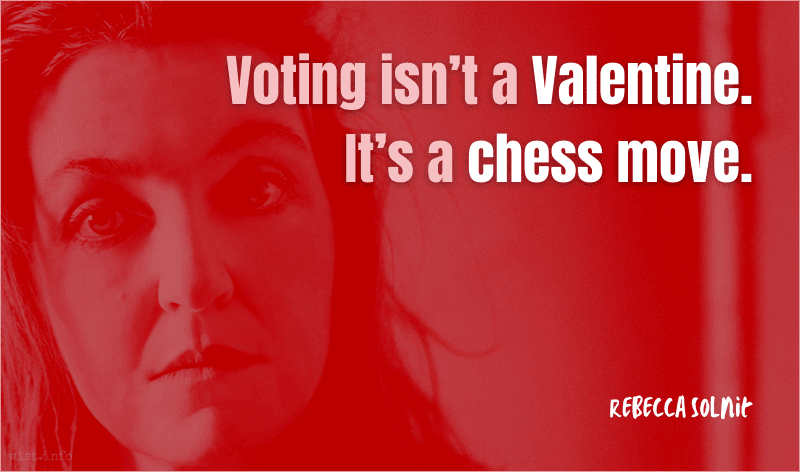
Elsewhere on the interwebs, someone posted a meme based on some not-so-long-ago comments by Rebecca Solnit, which may or may not have resembled this one:

Build movements. Vote with your values, but vote strategically. Voting isn’t a Valentine. It’s a chess move.

This is a call for strategic voting (casting one’s vote in a way to further particular strategic political aims) and a rejection of idealistic voting (voting for a candidate that meets your values and ideals).

That led to one commenter (and I’m not going to link back into it for a variety of reasons, at least some of them technical) commenting (in not quite these words):

Strategic voting is a massive problem. It’s not acceptable; it shouldn’t be normal. Voting for a candidate should be endorsing that candidate. We should never settle for the lesser of evils. The lesser of evils … is evil.

So, having set up a straw man (the individual isn’t here to defend themselves), let me knock it down. Because I think this is important, if not existentially important, today, here, right now, in the United States. It’s been critical for several elections, for that matter, but going into the 2026 Mid-Terms and toward the next Presidential election in 2028 (assuming either of those actually happen), it’s yugely important to think this through.

Let me group my arguments into four points.

1. We do not have infinite choices

In any democracy, the choices are limited — to the candidates running and/or the parties putting forward candidates.  In the US, our winner-takes-all election system has brought us to a rigid two-party system. That’s awful, but that’s the reality.

A two-party system means there are just two viable candidates, one from each party, for major contests.  Trump vs Harris. Biden vs. Trump. Trump vs. Clinton. Obama vs. Kerry. Etc. You either choose one, or the other, or you are effectively handing the choice off to others to choose one or the other (choosing not to participate in the system is part of the system itself, and is an action with moral consequences).

Don’t suggest third parties will make a difference here. The institutional roadblocks to such parties (which the two in-power parties have seen to) are nearly insurmountable. Moreso is the psychological issue; not only anger enough to get a winning proportion of voters (and financial supporters) to move from one party or the other or “independent” status to supporting a new or previously insignificant party, but courage enough to believe that they aren’t throwing their vote away on a protest candidate. This last is something which the dire straits we face makes even less likely, especially since it’s an effort that would need to be sustained for multiple election cycles, which means it would be effectively throwing a vote away during that period.

(Side note: “Independent” voters are a misnomer, by the way, even as they’ve become the plurality in many areas. Most “independent” voters actually vote very consistently for one party or the other. Many of them are “independent” out of dislike of the system, or of the party structure whose candidates they still support, or even just out of not wanting partisan phone calls during election season.)

So, in nearly all ways that matter, in the US, today, the choice is between the Republican or the Democrat for each of the partisan races. You might get some “independent” or third party candidate winning here or there, but nothing that’s going to require the media to come up with a new color for that faction.  Such candidates much more often act — knowingly or unknowingly — as spoilers.

So that’s the choice. You have to endorse (with a vote) the Dem, or you have to endorse the GOPer, or you have to endorse letting everyone else making the decision for you.

2. We aren’t voting for a candidate, but for what they will do

In a representative democracy (which is what the US ostensibly is, and can argue the point further down), we elect representatives, from the smallest village council to the President of the United States. We are choosing people to make political choices for us, since all of us crowding into a room to vote on everything isn’t practical, and we all have day jobs anyway.

Do I have to love the candidate I am voting for? I mean, sure, I might really like them. They might seem like a nice person, or a kind person, or a charismatic speaker. They might have done things in their lives — service to others, charity, climbing out of difficult origins — that are admirable.

But is that who I am voting to represent me in Washington?

Or am I voting for someone to pursue my policy preferences and goals?

What if it’s someone I don’t like?  They abandoned their spouse and children. They stole from charity. They were dishonorably discharged from military for cowardice.

Well, I probably would be less likely to vote for them, both because I don’t like them and, even more importantly, I probably can’t trust what they are saying they will do once in office.

But what if that nogoodnik was able to demonstrate that they agreed with and, in fact, had previously supported the government policies I care about — following the course and methods I agree with on, let’s say, four out of five of the top issues I think our government needs to be tracking?  Would I vote for them then? Or do they have to pass the “love to have ’em over for a beer and barbecue” test?

I’d love to think my president is a swell person. But it’s not — it should not — be a prerequisite for being my representative, any more than it’s a prerequisite for my dentist, or my auto mechanic, or my grocery clerk. If they do the job I am wanting them to do, and do it better than the alternative … I think it’s clear who I should pick.

3. The “Valentine” quote isn’t ignoring values

We’ll be going over what “endorsement” means in a bit, but while the shorthand (Valentine vs. Chess) makes the whole thing sound like some nightmarish realpolitik of leaving all values to the side, the quote itself includes the admonishment, “Vote with your values, but …”

The values in a voting choice extend beyond whether candidate X is a good or bad person. There’s an array of value-based policy desires — around welfare, around defense, around international relations, around climate change, around economics — that people prioritize differently. If you think the most important matter facing the US today is not enough gold-foil on our monuments, then voting for that value means voting for the candidate you think is most likely to pursue that policy, weighed against how they are likely to do about your second-, third-, and etc.-important policy goals.

Voting for someone shouldn’t be because you think they a paragon, or that they will do everything you want done. Both of those are a mook’s game. It’s about what you want done and who is more likely to do more of it better.

That segues into …

4. Every candidate is an evil

That’s a bit harsh, but I believe it’s true. And I’m not even talking “kicks puppies and steals from the collection plate” evil, or “is beholden to Big Business Group X for all the money they’ve given him” evil. I’m not even talking about a Fallen Humanity / Original Sin theological evil.

Every candidate is going to pursue policies I don’t agree with. Or fail to pursue policies that I support. Or pursue those policies, but in a way that I dislike.

For that matter, every candidate, as a human being, will have feet of clay about something. Maybe many somethings. There are no paragons. There is no Savior on a White Horse coming to rescue us by doing everything right and effectively (and if one shows up, I will be extraordinarily skeptical about what they are hiding).

It is literally impossible to find a candidate who I completely agree with, unless I am being lied to or their positions are so vague that I can’t actually discern what they are. Any candidate put forward, especially in the extremely limited universe of “someone who is nominated for President from one of two parties,” is going to be a compromise.

I am going to have to compromise my values to some degree, or else allow the majority (very roughly speaking) decide how my values will be offended. I’m going to choose to vote for a Bill Clinton, no matter what a mess his personal life is and how bad his “Third Way” welfare policies are, because I think, net-net, voting for Pappy Bush would be (would have been) worse.  I didn’t support Biden’s primary candidacy in 2020; he wasn’t my preferred “compromise” when there were other choices, and there were things he espoused or pursued or supported I didn’t agree with — but I voted for him in a hot second over Donald Trump in the final election because I believed he would be better (and still would today, even knowing the areas where he disappointed me during his presidency).

Any candidate is a compromise. Sometimes the compromise is even of the nose-holding variety, a compromise that will allow some evil to happen, but (one judges) less evil, less virulent and destructive evil, than the alternative.

I don’t have to love the candidate I support for trying to protect / advance the policies my values support. It’s not a Valentine, it is a chess game. I have to choose the candidate who will best protect / advance those policies without, in my judgment, doing other things so egregiously bad that they make that strategic “win” a net loss.

Hell, if Donald Trump supported and advanced my political agenda for the federal government — let’s say leading the charge for renewable energy and climate change mitigation, working to improve the lives of the poor, engaging positively with world governments to pursue values of freedom and collaboration, making law enforcement protectors of civil rights instead of their offenders, crafting a welcoming and constructive immigration policy, espousing the virtues of diversity, letting women choose, letting trans folk transition as they need to — if he did all those things, or maybe even half of them vigorously enough, rather than the reverse on all of them, I’d have a lot more patience for his crappy aesthetic sense, his egotistical sense of entitlement, his endless lying and slander, and his philanderous love life. I’d be willing to let him redecorate the White House to make it look like a Poor Man’s Versailles, if he he was actually making the rest of the nation, and the world, a better place.

Yes, the lesser of two evils is in fact, evil, and we should continue to find ways to make future choices less evil-requiring.  But that’s not the choice we’re faced with when we mark our ballots (unless you are voting for someone who has a comprehensive plan for political campaign reform and can actually get elected to do something about it). We are faced with choosing the lesser of two evils (or letting everyone else choose for us), with the belief that, at the very least, they are less evil, and that can be a moral, values-driven decision, too, even if sometimes distasteful.

This last point leads to the last.

4. There is always a difference

This sort of discussion always seems to devolve to, “Well, both parties are crooked, both candidates are bad, and the corporations control everything, so why bother?” It’s not a matter of lesser evils any more, it’s about it’s all evil.

And there’s something to that argument.  Corporations (as “people” with equal “free speech” (contribution) rights) do have huge control over things. The party organizations often have crooked, or power-hungry, or just bad people in them. And, as we’ve discussed, no candidate is actually a paragon; both will make bad / wrong / evil decisions and pursue bad / wrong / evil policies, at least in my judgment.

But …

That doesn’t mean they are the same. I’m thinking presidential candidates here, but the same is true for any political contest. Yes, the two candidates may toe the line for industry X or billionaire Y in a very similar fashion. They may both buy into and protect a society and economy that rewards the already-rich, punishes the already-poor, and provides huge dividends for investors in defense contractors and petro-chemical conglomerates.

You can look at both candidates and see them as the products of a corrupt system, and therefore decide that choosing to vote one way or the other is an exercise in futility, so why bother (or, worse, get personally dirtied by voting for one or the other of them).

But …

I can agree that the system is (largely) rigged, and the choices (roughly) vested into that system.  But saying there would be no difference in the nation or the world if Hillary Clinton had been elected in 2016, or Donald Trump re-elected in 2020, or Kamala Harris had been elected in 2024, seems unsustainable to me. I’m not saying that voting against Donald Trump in each of those instances meant I thought we would be on a clear course toward paradise … but I refuse to agree that things would be as bad as they are this moment, or that there wouldn’t be things better than the alternative of Trump winning in any given one or two of those matches. Which is, in fact, what we got, because too many people thought voting for Hillary, or Kamala, would be a compromise of their values, a vote for the “lesser of two evils,” disregarding what Donald Trump was saying.  And, sure, neither Clinton nor Harris (nor Biden) were ideal; all three had records before (and after) with actions and policies I didn’t like …

… But I don’t like Brussels Sprouts, either, even if I dislike Okra more; the strategic question is, which choice for an obligatory serving of greens is going to get me the dessert I want out of the meal.

(Yes, some people voted for Donald Trump, in all three of those elections, believing he would be a positive good or that the alternatives would be greater evils. The argument works both ways, and is inevitable in a democracy.)

What I’m getting at is that either you work with the system you have (including trying to use it to change it), or you allow the system to roll onward without your participation and opportunity to reform it. Staking out some sort of moral high ground by asserting that “strategic voting” is evil because it leads you to vote for “the lesser of two evils” which means you’re actually supporting evil, and that you should only vote for a candidate if you fully, whole-heartedly, completely endorse and support them and their actions … is deeply misguided and unsupportable idealism. It doesn’t work in the real world because it’s based off of hypothetical absolutes — there are perfect candidates, there is either good or evil and nothing in-between, voting makes no difference in the system — that don’t align with reality. It’s all-or-nothing thinking, a cognitive distortion.

And to the extent it leads people to let greater evils be elected by primly standing “above” the fray, it is in itself evil.

Anyway, that’s what I think.

Propositioning and Good Government

Wherein I rant a bit too much about ballot proposals and their need and their dangers and national political hypocrisy about them.

This is a long article on the plenitude of ballot measures Colorado voters will be facing at the polls this November — a record-breaking 15, which is even more noteworthy for this being a mid-term year.

Once the ballot is set, I’ll probably comment on the proposals being made, but I want to natter about the whole ballot measure process in general, and some weird (and aggravating) trends in it.

The idea of voters being able to directly put (by petition) changes to state law or to the state constitution is from the Progressive era, around the turn of the 20th Century. It was an attempt to break the power of state legislatures — or, rather, the power of monied interests which could easily dominate a state legislature. It was the same movement that gave us direct election of US Senators at large, rather than having that position elected by the state legislature.

It’s one of those ideas that has been messy, but, to my mind, valuable. Yes, as in any lawmaking process, results occur that I don’t like. But the principle involved, of a means of direct democracy by the voters, rather than representatives, is a valuable one.

In recent years, criticism of the ballot measure has most often come from the Right. This has been a direct result of conservative-dominated state legislatures being frustrated by popular measures on controversial culture-war subjects like reproductive rights. They’ve been especially angry about these things being installed into state constitutions where the lege has a much more difficult time thwarting them.

Well, duh. There have been far too many cases, in every state with such a process, of the voters putting forward a new law that the state lege wouldn’t, only to have the state representatives pass a new law invalidating it.

Part of the problem here comes from, in the US, our engrained two-party system. It allows for the populace to feel one way about a particular issue (say, reproductive rights), but still be voting in as representives folk who feel the other way about that issue. Voting by party becomes an all-or-nothing matter — vote for the GOP for fiscal conservatism, get social conservatism as part of the package deal (this is analagous to the Democratic side). The ballot proposition mechanism allows for a finer granularity of popular opinion — I can vote for Smith because of their position on taxes while overriding their paranoia about gay marriage through a ballot proposition if need be.

Anyway, what we’ve been seeing in recent years is the Right pushing back on the ballot proposition — either calling for it to be gotten rid of, or requiring some sort of super-majority to pass changes (particularly to the state constitution). The idea is to rein in those messy voters, though it’s usually framed as “keeping state constitutions neat and tidy” and “putting the brakes on radical proposals.” Scratch the surface, and you get arguments about how the law and the constitution are complicated things and how voters aren’t really qualified to understand tax or social policy and how ballot propositions are often sloppy in their wording and therefore have unexpected impacts and …

It all boils down to “Trust the Elected Legislature, not the Popular Citizenry. They’re qualified to vote for us (once we’ve gerrymandered the districts properly), but not to vote for actual laws and amendments. We have analysts, and legal experts, and lobbyists to tell us how things should be done; the hoi-polloi are not to be trusted, because they vote with their emotions, not based on what the party leadership dictates.”

Now, I have actually made some of those same arguments at times. Usually in complaining when folk I disagree with have put forward broad, sweeping, sloppy propositions that would do things I don’t like. Democracy (and representative democracy) is messy. And it’s true that the citizenry doesn’t have (easy) access to expert testimony and advice in these efforts. It’s true that really sloppy things that have unintended consequences get written into state constitutions. It’s true that emotional appeals to the voters (“think of the chlidren!”) sometimes lead to bad policy.

But it’s also true that these are sometimes the only way that the voters really have a voice in a particular matter. Our two-party system lacks nuance or the idea that I might like Jones for four out of five of his positions, but strongly disagree with him on the fifth, but I can’t elect just 80% of him. And while the voting population can be swayed by emotional appeals, that’s still a more legitimate basis for governance than the flood of money that washes over state governments (the federal one) from interest that want certain things, regardless of how the population feels. And, let’s be honest, elected representatives are not dispassionate icons of wisdom and justice; they seem just as likely as Joe Six-Pack to let knee-jerk emotionalism dictate their positions as lobbying money or party diktat, and none of those make for good government.

Anyway, that’s not why I started writing this.

One of the fascinating and/or aggravating things about the Denver Post article is that while the trend to somehow disarm or restrict or do away with ballot propositions has, nationally, been coming from the Right … in a very blue state like Colorado, we see the opposite. The conservative activists and organizations here see ballot propositions as the only way to advance focused-issue changes. The liberals, on the other hand, are the ones bemoaning poorly-educated voters and poorly-written proposals. The arguments are flipped, because the power balance here is different than in places like Florida or Texas or Louisiana. Change who has the institutional power, and you change the stake-holders in challenging it.

In other words, such arguments are not a matter of principle for too many of the folk quoted, left and right. They’re about expediency and interest. If I have power, I don’t want it taken away. If I don’t have power, I want to have it. If my pet issue (guns, LGBTQ rights, reproductive rights, taxation, civil rights, immigration) is not being managed the way I want, I want to be able to change it. If it is, then I want to protect it from people who want to change it.

It’s hypocritical, and therefore annoying. Because I’m naive enough to feel that we should be basing governance (including how we manage the laws and constitutions) on principles — those high-fallutin’ things we talk about each Fourth of July, like justice, and equal protection under the law, and the voice of the majority, and the rights of the minority. We should not be basing it on “how can I most get what I want”. Unless you want selfishness and self-interest as the basis of governance, and I think we have too much of that already.

I don’t want to trivialize those “pet causes” by making them out to be just about self-interest. People feel passionately about such single issues, especially when you get into culture war matters. Indeed, that’s why ballot proposals are so important, because they give an outlet to that passion that the normal course of representative government does not. And that makes things complicated and messy and sometimes very disappointing.

But saying “We want this governance mechanism enhanced because it give us what we want on issue X” and then, while still maintaining that feeling about issue X, changing to “We want this governance mechanism to be done away with because it threatens to take from us what we want on issue X” — well, that is only logically coherent and defensible if any government, in any form, that aligns with you on issue X is acceptable to you. “I don’t mind if we have a dictatorship, as long as I get what I want on issue X; I don’t care who else, including myself, gets hurt doing it, as long as we take care of issue X!”

And that’s how you get a Donald Trump. Or any other demagogue who runs roughshod over the republic and how it’s run. Or worse.

Good governance doesn’t guarantee the results you want on any particular issue. But bad governance is an even worse way, because it makes it all the more likely that a whole bunch of issues will be settled a way you don’t like. Governmental mechanisms, be they ballot propositions or direct election of Senators or how we carve up voting districts, or filibustering, or anything like that, should be based on principle, not “how do I get power,” because if nothing else, power is always shifting, and pushing for what is expedient to you today will mean someone else in power can turn it on you tomorrow … unless you plan to rig things to never let others have power again.  Which is not good principle or good governance.

“We are in the hands of an adolescent”

The US is at the mercy of an immature, asocial, egotistical, angry, ruthless being of terrifying power.

Charlie X

In the first-season Star Trek (TOS) episode “Charlie X,” the Enterprise takes onboard a castaway teenager, Charlie Evans (played with lovely creepiness by Robert Walker, Jr). Long story short, it turns out the disembodied-nigh-god inhabitants of the planet he’d been marooned on as an infant had given him nigh-god powers over reality to help him survive — powers that, in the hands of an unsocialized, hormone-ridden, stereotypical teenager makes him an existential menace.

And, as that is becoming clearer — that Charlie can and will, with the power of his mind, control the ship, make things and people disappear (or change them into iguanas, or steal their faces), break bones, compel people to speak or be silent — Spock says to Kirk the line in the title of this post.

The US is in a Charlie X moment.

We have an elected president who does pretty much whatever he wants. If he has the people willing to do it, it gets done. If they aren’t willing, he fires them until he gets some who are. Law?  He’s the president — law is something he uses as a weapon, not is hampered by as a restriction.

  • When you’re nigh-omnipotent, who can tell you no?

    Ego-driven monuments and building renamings? Sure.

  • Enrich himself, his companies, his family?  Naturally!
  • Lie, hyperbolize, exaggerate, without any apparent sense of shame, double down when corrected, and never, ever, admit you were incorrect? Sounds like a plan!
  • Militarize law and immigration enforcement? Sounds fun! Shit on international allies? Why not?
  • Throw decorum, tradition, civility, politeness, and norms out the window as irrelevant wussiness that keep him from doing whatever he wants to do?  Tradition and politeness are for wussies!
  • Roll back a century of social and legal advancement, and securing of civil rights, by anyone who’s not a white Christian man?  Hold my nuggets …
  • Look to fire anyone he doesn’t like, whether he has authority or not, and disassemble the civil service that was put in to keep government from operating on the spoils system?  Gilded Age, baby!
  • Engage in wide-spread wielding of the Justice Department, et al., as weapons of vengeance? Damn straight. 
  • Call for the imprisonment, banishment, or execution of his political enemies?  Naturally!
  • Pander to any conservative wish list that comes from a person or group who sufficiently kow-tows and/or donates? Outstanding! 

Declare anyone, or anywhere, he wants as “terrorists” or a “terrorist organization,” which he can then use his expansive “emergency” powers (granted to the President by successive generations of Congress) to outlaw, imprison, shoot, or bomb?

Who’s gonna stop me?

Ultimately, that’s Charlie X’s line — once he learns that he doesn’t have to follow the rules, that he doesn’t have to put up with Kirk’s advice, then orders. Who can stop him?

Who going to stop our nigh-omnipotent adolescent?

Not the Courts — not, ultimately, when he’s got a hand-picked Supreme Court majority that believes that the Executive gets to execute pretty much anything it wants, and that stare decisis is for suckers.

Not Congress — his GOP allies are either wildly enthused about how their ideological G-spots are being scratched, or else terrified of being primaried by his MAGA machine and its multi-billionaire backers. The only pushback from them has come where he’s bumped against their prerogatives, and even there it’s been hit or miss.

His Democratic opponents, meanwhile seem to feel that if they squawk nicely-worded protests and make pro forma (but always fragile) moves to provide a bit of publicity-worthy friction to his advance — well, that’s all they can be expected to do, amirite?

Did I mention Charlie doesn’t have good boundary awareness with women?

Trump’s often compared to a senile old man, and anyone who claims to not see his cognitive decline is, at the most charitable, simply not looking / wishfully thinking. But the comparison to an adolescent seems also compelling. An adolescent who has always lived a life of entitled privilege. An adolescent who has always bought or legally evaded any significant consequences to his actions, from stiffing contractors to fomenting mob violence. An adolescent raised by an abusive father to never apologize, never compromise, always go for the throat, that losers are anyone who doesn’t win everything, and losers should be curb-stomped to make sure they learn their lesson.  An adolescent raised in “the power of positive thinking” — that you can make your own reality, your own truth, if you stick by it, deny anything that denies it, double down on it when in trouble, and never, ever, admit you were wrong.

An adolescent who is now arguably the most powerful person on earth, surrounded by minions who eagerly do whatever he wants and who stroke his ego that anything he wants is the right thing to do, while also surrounded by ego-stroking villains who see his willfulness and willingness to do whatever he wants can be steered to their own ideological ends, leaving him to think it was all his own idea.

And then, today …

And today he announced that he’d (a) kidnapped the leader of a foreign nation, and his wife, to be shipped back to America for a “fair” trial (note the word “fair” was never actually used; “show” may be a better word), and (b) meanwhile, the US would be running the country, with “boots on the ground,” so as to (c) build a new, democratic, and American-allied country, because that always works and was never criticized or run against by the guy now doing it, and (d) by the way, it’s open season for American (with priority) oil companies to move in and take over the petroleum resources there.

As a bonus, our Sect’y of State was out there winning hearts and minds telling the leadership of Cuba that they might be next.

Don’t be me wrong — Maduro is a piece of work.  He’s a petty dictator who’s relished using American hostility as a way to leverage dictatorial power in his own country, and who’s arguably at best turned a blind eye to narcotics cartels shipping goods to a (ever-willing-to-consume) US. If he’d fallen over dead with a brain aneurism, I wouldn’t be mourning his passage.

This whole thing is quite different.

The US President, after saber-rattling and threats for quite a long time, decided to simply declare drug smugglers as an invading military force, and therefore subject to military force in return. Not surprisingly, the US Navy and Air Force and whomever else he wanted to show off  were pretty effective at blowing up (what he said, with no evidence given, how dare you question his integrity?) narcotics boats.  But not so effective that they couldn’t commit a few text book war crimes — denied, then angrily quasi-justified, then just handwaved off.

That got enough applause (or acquiescence) from the usual suspects to move on to declaring a shipping embargo on Venezuela. It wasn’t all that well-enforced, I’ve seen reported, but it did make for some big publicity moments, which was even more important to show Trump how big and powerful he was.

Charlie works his angry magic

But no immediate craven surrender by Maduro was forthcoming, and our adolescent is an impatient adolescent — and one that really gets off on compensating for something by the size of his military.  This is the guy who was jealous of all those military parades in other countries, so got one for his birthday. This is the guy who wants everyone to be cowed by his hand-designed battleships. This is the guy who’s happy to throw his “America First” isolationist campaign principles out the window  in order to, yes, potentially start a foreign war (It’s not foreign, its on a continent named after our country!) with boots on the ground (such big boots! shoot to kill!) to do some hopefully-favorable nation-building (after attacking the very of nation-building for the last decade or more) (but I can do it right!).

I mean, this comes across as someone sending Trump an article buttonholing Trump at a Mar-a-Lago party and waxing lyrical about how in the Gilded Golden Age* the US used to invade Latin American countries all the time, overthrowing governments to put in friendly puppets, and installing American companies to extract everything they could.
*Though not just in the 19th or early 20th Century, of course.

Of course, that’s why so many people in Latin America still think the US is an imperialistic power, driven by money and ego to attack them as it pleases. That’s why a lot of countries, no matter how much we have, at times, helped them, mistrust at best and hate at worst the US.  And Trump seems determined to prove them right — indeed, to double down by not only doing this, but making it clear he has the personal right to do it because he can.

When in doubt, change reality to suit yourself.

And for all the people warning about how this will drag the US’ reputation and any moral high ground it carries around the world down into the mud? He doesn’t care. Moral high grounds are for wimps. The US owns the Western Hemisphere, so it can do anything it wants there — just watch!  As for the rest of the world, they’re all shit-hole or doomed or ego-stroking countries, so who cares about them.  Letting Russia and China do what they will? As long as he looks good (put up another triumphal arch!), it sounds to Trump like a fabulous plan.

The follow-up with Cuba is meant to tell the entire world — from Cuba, to Greenland, to Iran, to the UK — that, if they don’t say nice things and give nice concessions, the nigh-omnipotent adolescent in charge of the US military machine might invade their place next.

Nice country you got here — shame if the Marines were to invade it.

Is that the might-makes-right, organized crime approach to foreign relations that we really want to represent as the norm for us, or for our enemies (who will be ever-growing in number?


Stray thoughts that my writing above might provoke (or that come to mind, since it’s been quite some time since I spoke broadly about Trump).

He was elected President

He sure was. None of that makes the above justified, or legally or morally defensible. People wanting a dictator doesn’t make having a dictator any more legal.

Yeah, but he’s better than Biden or Harris!

Even if so, see above.

He’s making America great again!

Only in a Hobbesian “nasty, brutish, and short” war of all-against-all sort of way. Which is not likely to end well for anyone, including America.

That said, I don’t think Trump cares about the long-term reality. He wants a strong/great America  because he wants to be the Dear Leader of a strong/great America. It’s about him, not us. Sure, he’d love it if people put in statues and monuments and triumphal arches to him for centuries to come — but he’s much more into them doing it now, while he’s around to bask in the adulation.

If it all goes to shit the moment he’s dead? I don’t think he gives a damn.

What about the US invasion of Panama?

Yes, one could argue that 1989 attack to arrest Noriega and end his dictatorship had the same justification (or, on the other hand, lack of it) as Trump’s actions in Venezuela. One could handwave about how Panama had formally declared war on the US, that American citizens (in the Canal Zone) were in danger, or that the Panamanian Defense Force had killed an American Marine, but that’s not much.

But even so … so? I’m not sure a 37-year-ago precedent — and not a particularly admirable one at that — means much.

It’s all just Trump Derangement Syndrome!

I’m old enough to remember when Democrats dismissed wild, weird conspiracy theories about Clinton(s), Obama, and Biden as “Derangement Syndromes,” which seemed quite credible, given the utter craziness about what was being said (e.g., Pizzagate, Operation: Jade Helm, etc.).

Trump, of course, is always happy to project what he and his are doing onto others — thus now everything is dismissed as “Trump Derangement Syndrome” (no matter what sort of criticism or concern it is).

Indeed, the TDS label is just what Trump likes, because he can just say it, rather than countering arguments being made against his actions and plans. It’s a lovely ad hominem — one of his favorite things.

If it’s worthwhile, I don’t think this invasion was a Wag-the-Dog to distract from the Epstein Files. Or from the economy. I might be convinced that he’s looking for a topic for that big triumphal arch he’s having built in Washington for the 250th of American Independence (irony is not Trump’s strong suit).

I do think that the minor reason for all this is that Maduro didn’t bow down to him when he demanded it (adolescents want respect, earned or not), and the major reason is that he wants to be a War Leader and ride in a parade, and maybe make sure that it’s his name on that triumphal arch (adolescents love ego strokes).

Oh, he’s just joking about Subject X

This is commonly said by Trump’s enablers when he says something particularly grotesque, hurtful, threatening, or a bit cray-cray.

Never mind that some jokes just aren’t funny or appropriate, given his position. If I had my family over to your house and, on your way out, said, “Hope your granny doesn’t slip and break her hip and die a painful, lingering death,” would it become “okay” if the rest of my family (not me, of course) insisted it was just a joke, ha, ha, ha, he’s so high-spirited and outspoken …

For that matter, is there a single thing that Trump has joked about doing that, when he came to it, he didn’t actually do? Sometimes its to stroke his own ego, sometimes because its what he wanted, and/or sometimes because he knew it would outrage his impotent opposition. But way too many of those jokes have turned into a twisted, Joker-like reality.

Don’t worry, it’ll all be over soon

At best, Trump is President for another three years. He’s hinted enough times that he wants a third term, of course.  Is he that to:

  • encourage folks to figure out a legal way to bypass the Constitution?
  • see how much popular support the idea draws (either as a way to make it happen or because of the ego stroking it provides)?
  • get off on making his opponents angry?
  • normalize the topic so that when he does it (emergency powers!) people won’t be shocked?

But even if he doesn’t make a grab at that brass ring (and if he does, do you think the other two branches, under his control, will really stop him, given their acquiescence and support to date?), he’s still around for three years (since we know, because he’s told us, he’s in Perfect Health, Much Better Than Has Every Been Seen Before).

Charlie was a bad loser

How much more damage will he do in three years?

How much more pollution and climate damage and opening up of wilderness to mineral extraction? How many more civil rights will he take from how many more people? How much will he Make America White Again?  How much damage will he do to our national reputation, or our national norms, or our national identity, or even the idea of us being a nation any more?

And that all assumes that we don’t get President Vance taking office in 2029.

Sitting back and trusting that things will snap back to “normal” in three years, if we just hold on … doesn’t seem like a smart idea. A lot of damage, pain, and death stands in the balance.

We’re in the hands of an adolescent. What are we going to do about it?

Charlie gets taken away (hopefully not returning four years later).

The Enterprise is only saved because the disembodied-nigh-gods realize their mistake and come to take Charlie away where he cannot hurt anyone, even if it means that he’ll be isolated from humanity for the rest of his life. In his case, it’s a tragic ending to the story.

In our case … I don’t think can’t count on that sort of divine intervention.


It’s annoying to think that I wrote a post with the same title — and about the same person — almost nine years ago.