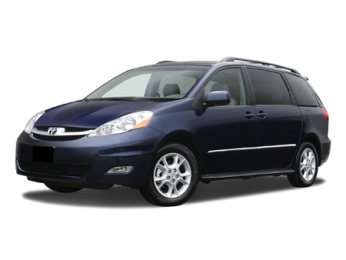
We took advantage of my folks being in town to go look at cars — in particular the two somewhat-oranges-to-apples cars we’re considering, the Toyota Sienna with AWD, and the Subaru B9 Tribeca. Bear in mind our prerequisites for the new vehicle. We test-drove a Tribeca Limited and a Sienna LE.
Minivan vs. Medium-sized SUV … fight!
Ride: Both cars have various stabilization and traction and compensation widgets out the wazoo (including, of course AWD — a variation on the Toyota, an intrinsic on all Subarus). Both were, overall, fine. The Toyota felt a bit zipper from zero, and rode more smoothly; the Tribeca feels the road better, and I had a vague sense maneuvered a bit better. Local rides would probably have a sportier feel in the Tribeca; a drive to California (or around the block) would probably be a bit more comfy in the Sienna. Advantage: Sienna (a scosh)
Fuel economy: Remarkably — annoyingly — it’s a wash. The Tribeca and (AWD) Sienna are both 18 mpg street, 23 mpg highway.
I’d like something more — but the other features we want (reliability, AWD, seating/space) make it hard to get something — yet — that will get much better. I have to acknowledge our “carbon footprint” and fuel expenditure, as well as the added budgetary cost to us to weigh against the other things we want. I like to think we have a bit more justification than wanting a Big Yuppiemobile, but it’s still something I have to acknowledge. Advantage: Tie
Widgets: Both cars had rear DVD players with wireless headphones and lots of jacks. Both had back-up sonar that gave a warning if backing into something. Both had jacks for an MP3 player and six-CD changers.
The Sienna had front seat warmers. It had both AC power jacks (a/k/a cigarette lighter outlets) and at least one DC “normal” outlet, which is nice. It had more cup holders front and back. The dashboard is less purty, but more functional and usable than the Tribeca. Nicer color combos interior/exterior.
The Tribeca had a front navigation panel screen (which, at a stop, could show the DVD being played), with both a map navigation package, various computer readouts and all that. The screen also served as a rear-view for parking — very nice (and very necessary, given the limited sight lines). It had independent climate control in the front. It had “puddle lights” (downlights at each door to see what you’re stepping into at night). The MP3 player jack (and two of the power outlets) are in the between-seat console, which makes it convenient for charging cell phones and MP3 players, too. It has fog lamps standard (the Sienna has it standard on the XLE).
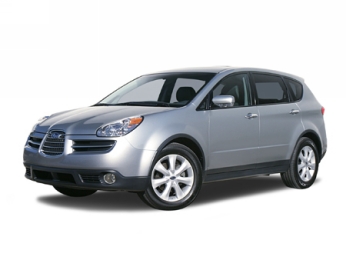
The Sienna is less feature-rich and whizzy — at the LE level, at least — than the Tribeca. Question is, are those differences really valuable differences? Advangage: Tribeca (a bit)
Size – Exterior: Our old Sienna is 193.50” long, 73.40” wide. The new one is 201″ long (an extra 7.5″!) and 77.4″ wide (an extra 4″). That doesn’t sound like much — but it’s very tight quarters in our garage (in both dimensions), and that makes it all the tighter.
In comparison, the Tribeca is 190″ long (3.5″ less), 73.9″ wide (0.5 inches wider) — a small improvement in length, and an insignificant difference in width, though note that with opening doors rather than sliding doors, that makes getting in/out a scosh more difficult. Advantage: Tribeca.
Size – Interior: A mixed gig here. The Sienna second row is Captain’s Seats (one of which can be slid left to make it all into kinda-bench seat); the spacing is comfortable. The third row is a 40-60 split bench. The third row is cozy, but not cramped.
The Tribeca has a bench second row that can be dropped down 40-20-40. When the third row is open, the second row seats are restricted in how far they can go back, making them a bit cramped (not helped by a hard bar at ankle height: with the third row closed, the second row has plenty of leg space. The third row is very much an expediency for either kids or for “we have to fit an extra adult in somehow.” I wouldn’t want to travel more than 20-30 minutes in it.
The question for us, of course, is how much we’d use that third row. In the Sienna, more, because the second row only accomodates two; if we have five passengers (we three plus two grandparents, for example), that requires spill-over to the back-back. If we were in the Tribeca, though, three can sit comfortably in the third row (if Katherine’s one of the three, and she remains 7 years old), reducing the need for third row use.
Headroom-wise, the Tribeca is two inches shorter in the front seat than the Sienna, but I could wear my hat in both of them. I could do so in the second row, too, though it brushed the ceiling in the Tribeca.
In the third row, the same differential maintains, but headroom is down to 36″ in the Tribeca, 38 in the Sienna.
(Interestingly, the Sienna moon roof takes up an inch more than the Tribeca’s.)
The general interior space — shoulder room and such — is a distinct advantage for the Sienna, at the cost of the exterior space.
Cargo-wise, the Sienna’s cubic feet behind front, second, and third rows are 150, 95, and 44 cubic feet; the Tribeca is 74.4/37.6/8.3 cubic feet. Serious advantage for the Sienna here — but I need to do some follow-up measurements. How wide is the read hatch? How deep is the Sienna with the third row down and the second row tumbled forward vs the Tribeca with the third and second rows down?
Regardless, the Sienna definitely has more room. The question will be is the extra something that we need? Advantage: Sienna (somewhat)
Company imponderables: We’re big fans of both Subaru and Toyota, from past experience. I trust Toyota to do things right — but I trust Subaru more with AWD technology (in particular, with being AWD from the ground up, rather than modifying the Sienna design to have an AWD version). Advantage: Tie
Price: Pretty close. The particular package and options features make it tough to know until you get to the final vehicle as-is. That said, the Tribeca Limited (the upper of the two packages) MSRP starts at $32.5K; the Sienna XLE (the second-toitiest of four versions) AWD starts at $33.3K; the LE (third-tier) AWD is $29.3K. So one way or the other, depending on what car we decide on, it’ll be a big chunk of money. Advantage: Tie
Bottom line, either car would suit us fine. Both would have advantages and strengths. Both would have weaknesses and things we’d be mildly irked by — but neither car is likely to give us much grief and both cars are likely to be a lot of fun.
So it’s mostly (unless we’ve missed something) a matter of minor differences that need to be weighted to the point where the question is settled.
As an aside, rather than Burt dealerships, who we visited on our last outing, we went to the Go (formerly John Elway) dealers on Arapahoe. Much nicer operations. Our Toyota guy was an young Russian, our Subaru guy was an old American, but they were both pleasant, professional, non-pushy. I hate to recommend car dealers, but I didn’t feel either predated or slimed upon when we left, which is saying something in the car sales biz.
I had a thought on your storage issue with the Subaru. The make covered plastic cargo carriors that mount on the roof. Removable and they can carry quite a bit. You might want to look at the options listing to see what the sqft is for one.
Honestly, the cargo issue is not the sort of thing that a cargo carrier would handle — e.g., luggage, etc. Instead, it’s 8×12 sheets of plywood, or 12-foot 2x4s, or things like that. Or large appliance boxes.
But a thought worth considering, anyway.
Dude, the Tribeca is way cooler looking. It reminds me of a Porsche Cayenne, without the bad mojo of being all overpriced and stuff.
Also, both names are about equally dumb. But at least they’re not made-up words! Imagine if you had trouble deciding between the (non-existent) Agreno and the Intelectua, for instance. :p
Toyota has long experience with 4×4 systems in their Land Cruiser models since 1954. Subaru may have more experience with AWD, but I think Toyota’s AWD is as trustworthy as Subaru’s due to Toyota’s long experience with 4x4s, a very similar technology.
They also had AWD (or was it 4WD?) on the Sienna predecessor, the Imprevia (an equally nonsensical name, but still quite commonly seen here in Colorado). The question there would be the nature of the technoogical adaptation for the Sienna — to what extent the Sienna AWD is a modified 2WD train or something specifically developed by Toyota for the Sienna.