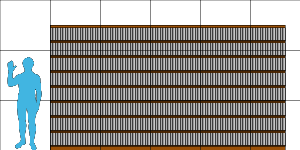
So if you were going to make a print version of Wikipedia — leaving out tables and images — how large would it be?
Pretty darned large, according to Nikola Smolenski.
Using volumes 25cm high and 5cm thick (some 400 pages), each page having two columns, each columns having 80 rows, and each row having 50 characters, ≈ 6MB per volume. As English Wikipedia has 4.4GB of text (October 2006) ≈ 750 volumes. Note that this is a conservative estimate, as it doesn’t include images, tables etc. which take up more surface than the text which describes them.
A far cry from the 20-volume Colliers Encyclopedia I grew up with as a kid.
Granted, insert controversy over public-managed data (triviality, bias, fabrication) here. But that’s still a massive amount of information, bias is not restricted to public-managed data sources, and I find 99.9% of the data I find in Wikipedia is reliable (and the remaining 0.1% is a matter for critical thinking rather than just accepting it at face value).
(via BoingBoing)