Via BoingBoing we get reports of the new front in Creationism/”Intelligent Design,” one that uses a old philosophical idea: Cartesian dualism.
Schwartz and Beauregard are part of a growing “non-material neuroscience” movement. They are attempting to resurrect Cartesian dualism – the idea that brain and mind are two fundamentally different kinds of things, material and immaterial – in the hope that it will make room in science both for supernatural forces and for a soul. The two have signed the “Scientific dissent from Darwinism” petition, spearheaded by the Seattle-based Discovery Institute, headquarters of the intelligent design movement. ID argues that biological life is too complex to have arisen through evolution.
In August, the Discovery Institute ran its 2008 Insider’s Briefing on Intelligent Design, at which Schwartz and Michael Egnor, a neurosurgeon at Stony Brook University in New York, were invited to speak. When two of the five main speakers at an ID meeting are neuroscientists, something is up. Could the next battleground in the ID movement’s war on science be the brain?
Well, the movement certainly seems to hope that the study of consciousness will turn out to be “Darwinism’s grave”, as Denyse O’Leary, co-author with Beauregard of The Spiritual Brain, put it. According to proponents of ID, the “hard problem” of consciousness – how our subjective experiences arise from the objective world of neurons – is the Achilles heel not just of Darwinism but of scientific materialism. This fits with the Discovery Institute’s mission as outlined in its “wedge document”, which seeks “nothing less than the overthrow of materialism and its cultural legacies”, to replace the scientific world view with a Christian one.
If you can’t measure it, observe it, test it, or even demonstrate it’s there, how is that science?
Or, put another way: Does my cat have a conscious mind? How about that fly buzzing around over there? Or that orchid on the counter? What about this table? How do I know, one way or the other? How do I detect it (or its absence)? (And it gets even sillier to argue when you treat “consciousness” as a code word for “soul”.)
Or, to take another example, if we do finally get a computer that can pass the Turing Test — will that be a proof that it has consciousness? If not, what is the qualitative difference between that computer’s outward expression of consciousness and my own?
Or, put another way, if consciousness is an immaterial thing, when does it develop in human beings? At what point in the womb, or beyond, does it develop? How/why does an immaterial quality have to “develop” at all? Does it actually grow? Does it actually start at the point of conception, or with the first splitting of cells, or what? And how do you know it or point to it or prove it?
Don’t get me wrong: my own self-image and philosophical belief is that “I” am more than a very complex series of firing neurons and squishy bits in my skull. But that’s my belief; I don’t claim that it’s scientifically proven, or should be the basis for scientific conclusions about reality. I believe in more than the material world; that belief doesn’t constitute proof of same, nor does it mean that scientific models of the material world are wrong or that they need to be changed to include my belief in a consciousness/soul that transcends the confines of the body, any more than my belief that osso bucco is one of the most fabulous foods on Earth mean that everyone on Earth has to eat it, or that cookbooks or cultures that don’t like it as I do to be “overthrown” as clearly not recognizing some intrinsic quality of osso bucco that cannot be pointed at, only “known.”
And despite that deeply held belief, I am not willing to rule out that everything we recognize outwardly as consciousness isn’t a complex interaction of millions of neurons and brain chemicals (which doesn’t mean that there’s no soul; but that’s another discussion). We simply can’t explain it all at this point save in very general terms — but, then, a century ago people didn’t understand about subatomic particles and Strong and Weak Forces and the conversion of matter into energy — but that ignorance of how, say, the sun actually worked didn’t mean that it was really powered by glowing angels or anything immaterial — it meant that we didn’t know, yet, how it worked.
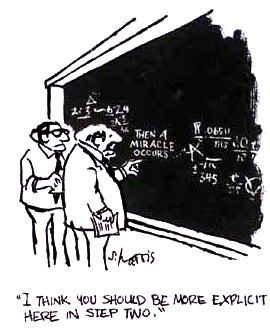
All the immateriality argument seems to contribute is a more comforting legend for the map than “LANDS UNKNOWN” or “HERE BE MONSTERS.” It’s a magical black box argument — “and then a miracle occurs!”
(More on Dualism here.)
(via Ginny)
=D
It’s like it was lifted straight out of Anathem in a dialog between one of the followers of the two major schools of phylosphy. Yes, I do mean that there was a section just like that in the book.
Some things are better left unexplained. If everything can be explained then we would all be ‘angels’ or some entity on the ‘higher ground’. Just my thought.
…’and then a miracle occurs’ – nice line.
I don’t think there are things better left unexplained. Or, rather, i don’t think we shouldn’t continue to try figuring things out. I don’t think everything *is* understandable or explainable, but I think the point is the search, not the final acquisition.
But the right tool for the right task — that’s basic craftsmanship. I wouldn’t use science to figure out about God. I wouldn’t use religion to figure out about how to split the atom, either. Science doesn’t explain or prove (or disprove) the soul. Religion doesn’t explain neurochemistry.
The folks who use religious faith as a scientific argument are like people who use a pair of scissors for a hammer. They won’t drive very straight nails … and eventually they won’t cut very well, either.
But science has explained many things that, thousands of years ago, were in the domain of religion. Those points of light placed in the firmament? Huge nuclear reactors, some with planets orbiting them! Those thunderbolts God hurled in his wrath? A release of electrical energy between clouds and the ground.
Just because science hasn’t yet explained something doesn’t mean that it can’t explain it. If God exists, there must be a set of rules that science would be capable of explaining if we can gather the necessary data.