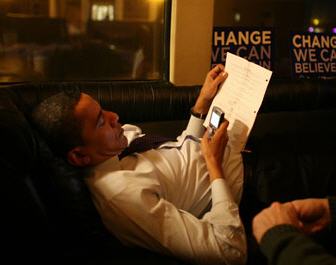
A few articles out of late about the issues around Barack Obama’s penchant for … well, communicating, and some of the potential opportunities, and tensions, that’s creating.
First, there’s discussion about how Obama’s been a willing addict on his own Crackberry … but how that era is likely now coming to an end.
For years, like legions of other professionals, Mr. Obama has been all but addicted to his BlackBerry. The device has rarely been far from his side — on most days, it was fastened to his belt — to provide a singular conduit to the outside world as the bubble around him grew tighter and tighter throughout his campaign.
“How about that?” Mr. Obama replied to a friend’s congratulatory e-mail message on the night of his victory.
But before he arrives at the White House, he will probably be forced to sign off. In addition to concerns about e-mail security, he faces the Presidential Records Act, which puts his correspondence in the official record and ultimately up for public review, and the threat of subpoenas. A decision has not been made on whether he could become the first e-mailing president, but aides said that seemed doubtful.
For all the perquisites and power afforded the president, the chief executive of the United States is essentially deprived by law and by culture of some of the very tools that other chief executives depend on to survive and to thrive.
This is kind of sad. I understand concerns over security, and I also understand concerns about legal accountability. And, heck, I’ve railed against the Bush Administration’s desperate flopping around to avoid (with dubious legality) either using subpoenable souces (by using non-governmental computers) or refusing to turn over (or conveniently “losing”) records they don’t want seen. But it’s a two-edged sword — if we need to have transparency in administrations I don’t trust, it will perforce lead to some restrictions on administrations I do (well, that I do more).
It’s sort of sad that Obama needs to move into a bubble.
On the other hand … maybe we’re talking about a paradigm shift here.
What is new is that Obama is the first President with that “facebook generation” mindset of constant, open communication, as opposed to a bubble-boy, smoke-filled back-rooms, secretive types that the previous 43 Presidents were. The laws, customs and trappings of his new job are going to be conflicting with his modern instincts towards openness. And people are starting to talk about a potential need to alter these out-dated laws in order to allow Obama to lead a more transparent government.
We’ll see. Obama’s also up from Chicago politics, so it’s not like he’s going to be a political naif about all this. I do think he’ll be working harder at improving communications, inside the Administration and between the Executive and the People … but I have to confess the last eight years will make me leery about anything that smacks of pulling back transparency, even if (especially as) it’s been only given lip service in the last eight years.
I’m sorry, but EVERY government agecy is equired to keep e-mail correspondence as records. That the President has to is NO change to what he, as a Senator, was required to do. Is the length of storage longer? Yup, but that’s the only change. Using his Blackberry should be no issue from a records retention point of view. The far bigger issue for Obama having to refrain from wireless communications is data security.
Within the administration I hope that OBama puts his foot down and uses e-communications.
Go for it Barack!
I submit that the interest level in the president’s e-mail, vs. a senator’s, and the potential (mis)uses of it by investigations are almost certainly greater.
Absolutely! And that’s why there’d be no purging allowed, but to disallow it altogether? That seems inane. As it stands many companies record ALL e-mail traffic into and out of their business. Setting up a similar archive for the PResident’s communications seems like a very small problem . .even if it would require a big server (yum Terrabytes!).
Well, one concern has been that confidential/secret/embarrassing items might end up on public display. I think that’s somewhat less likely under Obama — but it’s easier (far, far easier) for snappy conversational messages (as in IM or BB emailing) to be too easily taken out of context.
It’s one reason why my company has no formal IM policy — because any time anyone thinks about it, they want to do all sorts of stuff like prohibit any archives of it. Similarly, we have a 90 day email retention policy — after that point, unless it has been consciously archived into a public project folder, it gets deleted. That saves tremendous amount of internal resources (storage, backups, staffing for same), as well as making discovery processes much more straightforward (by consolidating formal project docs).
I think that the we are already seeing that change
http://www.youtube.com/watch?v=Zd8f9Zqap6U