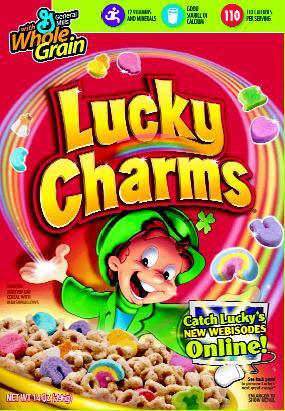
Kay’s experiment for her school Science Fair was to test whether people accurately gauge how much sugar is in cereal — particular “adult” cereal vs. “kid” cereal.
She chose Lucky Charms, Cheerios, Raisin Bran, and Quaker Oats Granola.
The survey subjects were shown bags with a cup of the cereal, and told that a packet of sugar or a sugar cube is about 4g of sugar. So, how many grams did the people think was in a cup of each of the cereals.
(Note: serving sizes vary — the Granola, for example, has a 1/2 cup serving size.)
After that, then they got to taste each one, and guess again.
Kay’s hypothesis — that people would over-estimate the sugar in the kid cereals and under-estimate the adult cereals — was confirmed. That Granola? Double the grams of sugar of the Lucky Charms (plus a lot more fat). No wonder it’s so good …
Adults at the Science Fair were fascinated by the experiment; there were a lot of comments that (a) proved the hypothesis and (b) demonstrated that adults really long for the sugary cereals of their youth.
Margie assisted Kay with the experiment. I helped a bit with the display. But she did the bulk of the work. And got a blue ribbon “1st place” for the effort (everyone got either a 1st place or 2nd place; Kay’s project was one of the more interesting and well presented ones, if I say so myself).
Past years:
Go Katherine!!! I think we misjudge the calorie content, sugar, fat and fiber content of almost everything we eat. I’m putting my recipes into a software package that can calculate the nutritional content and, whoa, am I surprised at the calories in some of my favorites. People were panicking last night when they heard there was 4 T. of butter in the Turkish yogurt soup (and, I might add, full fat Greek yogurt), but the final fat and calorie count is right around 150 calories for a 2 c. serving. That was a case where people thought it tasted too good to be low in fat and calories. That is definitely the exception!
Hah! My strategy of eating Cap’n Crunch’s Peanut Butter Crunch and Count Chocula (not necessarily together) doesn’t look so bad now, does it?
Just stay away from the granola, man. And thirds. 🙂
Even for the physicist, the description in plain language will be a criterion of the degree of understanding that has been reached. Werner Heisenberg (Nobel Prize winner in physics)