ENDA (the Employment Non-Discrimination Act) is a proposed law that would make it illegal for nonreligious employers to discriminate in hiring and firing based on sexual orientation or gender identity. That’s pretty much it — nothing weird or bizarre about the mechanisms involved (we have plenty of other non-discrimination laws), only controversy over whether those evil gays should be protected from losing their job.
 The US Catholic Bishops — three of them in particular, Bishop Blaire of Stockton, Archbishop Cordileone of San Francisco, and Archbishop Lori of Baltimore, but writing on behalf of the full United States Conference of Catholic Bishops — have sent the US Senate (which is considering ENDA) a letter expressing how “seriously concerned” they are about all this.
So, Your Graces, what do you have to say?
All people are created in the image and likeness of God and thus possess an innate human dignity that must be acknowledged and respected by other persons and by law. Furthermore, “work,” as Pope Francis recently said, “is fundamental to that dignity.” Thus the Catholic Church has consistently stood with workers in this country and continues to oppose unjust discrimination in the workplace. No one should be an object of scorn, hatred, or violence for any reason, including his or her sexual inclinations (see Catechism of the Catholic Church [CCC],no. 2358).
All good, even laudable, so far, Your Graces. I’d almost think you’re about to come out in favor of ENDA.
Our dignity as children of God extends to our sexuality. Being a male or a female is a reality which “is good and willed by God,” and this complementarity is essential for the great good of marriage as the union of one man and one woman (CCC, no. 369). Sexual acts outside of marriage serve neither these goods nor the good of the person and society as a whole.
At the risk of seeming disrespectful, Your Graces, sez you. Short version of the above seems to be: “Anything sexual out of marriage, as the Catholic Church recognizes it, is without any worth or good.” To which I, again, say, “Sez you.”
(Actually, I probably say something a bit stronger, since one could argue that, in the eyes of the Catholic Church, my un-annulled first marriage, in the Church, still technically exists, so my current marriage is invalid and my relationship with my current wife adulterous, representing a sexual act outside of fully recognized Catholic state of marriage. I don’t personally know a single Catholic who would — to my face, at least — seriously assert that, but they could. Would you, Your Graces, and so suggest that there’s no good to myself or our society in my current relationship?)
Regardless, I see where you’re going. If there’s no value, no “good,” to non-marital (as you see it) sexuality, then there’s no value in protecting people based on their sexual orientation, “object of scorn, hatred” language already quoted notwithstanding.
Given these principles, the USCCB continues to promote the dignity of both work and marriage and to oppose unjust discrimination on any grounds, including those related to homosexual inclination or sexual identity.
But wait! You’re back on the side of protecting gays, etc., against “unjust” discrimination! So why don’t you like ENDA? Well, you then (after some introductory language) spell out a set of problems with the law:
Lacks a BFOQ exemption. ENDA does not include an exemption for a “bona fide occupational qualification” (BFOQ), for those cases where it is neither unjust nor inappropriate to consider an applicant’s sexual inclinations. This omission also elevates “sexual orientation” discrimination within Title VII to the same and, until now unique, level as race discrimination (which allows no BFOQ), and above religion, sex, and national origin discrimination (which do).
Oh my God! Gays are being protected more than Catholics!
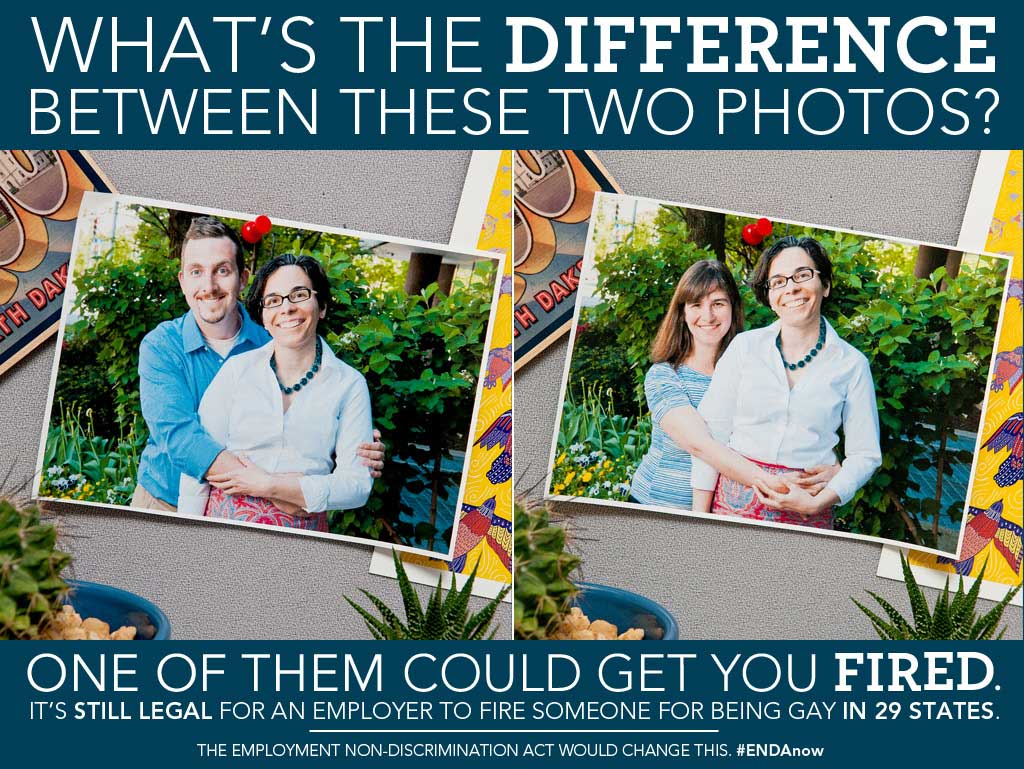 Except, what would the Bishops consider a BFOQ for sexual orientation? Race has that because we’ve decided there’s no time or reason when it’s at all an acceptible criterion for whether someone can fill a particular job. When is it okay to fire someone (or not hire them) because they’re gay?
Maybe the answer is that the other classes shouldn’t have a BFOQ. I’d certainly be willing to hear arguments about that — but criticizing the law because it protects sexual orientation more than other groups doesn’t mean the law is wrong, but perhaps some of the others are. Without examples, it’s impossible to say.
Lacks a status/conduct distinction. ENDA’s vague definition of “sexual orientation” would encompass sexual conduct outside of marriage, thus legally affirming and specially protecting that conduct.
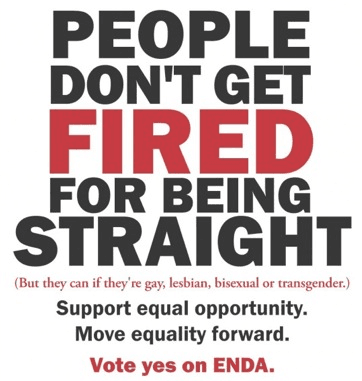 I’d want to read the language itself before I agree. That said, I’m not sure that’s the worst thing in the world — not so much that I’m inclined to specifically protect everything, but I tend to think that behavior outside the workplace is not germane to the workplace — and cannot think of examples where legal sexual conduct outside of “marriage” should be a firing offense.
Or is this simply a way of finessing with that whole sin/sinner thing? In other words, you don’t think people should be discriminated against for being gay, but if they act on it, which is de facto “outside of marriage” (as you define marriage), then that shouldn’t be protected. Love your fellow man, but don’t hold his hand, or else you can get fired. Is that it?
Supports marriage redefinition. Based on experience in state courts, it is likely that ENDA would be invoked by federal courts to support the claim that, as a matter of federal constitutional right, marriage must be redefined to include two persons of the same sex.
Hmmm. Just like the Civil Rights Act supported the claim that, as a federal constitutional right, marriage must be redefined to include two persons of different races? I’m trying to see the down side here.
Rejects the biological basis of gender. ENDA’s definition of “gender identity” lends force of law to a tendency to view “gender” as nothing more than a social construct or psychosocial reality, which a person may choose at variance from his or her biological sex. This provision also fails to account for the privacy interests of others, particularly in workplace contexts where they may reasonably expect only members of the same sex to be present.
 Issues of gender identity are thorny ones, though I think that anyone who says gender is solely about mind or solely about body is seeking for way too simple an answer. That said, I really don’t think transexuality involves a passing fraction of the population, and I don’t think making it protected for employment purposes is going to lead to a flood of people deciding to live out lives as the opposite sex (though, if it did, I’m not sure I’d be all that alarmed).
More to the point, why is there always this crazy paranoia about guys sneaking into the girls bathroom (or vice-versa)? I have a lot of problems seeing lots of people pretending to be transexual in order to ogle the folks in the other locker room … disregarding that cross-dressing would allow such a thing today, even without ENDA. And if it’s a matter of people feeling “uncomfortable” — well, some white people felt “uncomfortable” sharing bathrooms with blacks, too, and somehow civilization hasn’t fallen.
Threatens religious liberty. ENDA could be used to punish as discrimination what many religions — including the Catholic religion — teach, particularly moral teaching about same-sex sexual conduct.

Has the Civil Rights Act legally punished any churches for moral teachings about miscegenation or how the White Man is God’s True Blessed Creation? Or about how Jews are going to Hell, or Muslims are demon-whippers, or Christians are cannibals? Or that Catholics are idolatrous followers of a false prophet of the Whore of Babylon, who worship a pagan goddess and will all be sent directly to the Fiery Furnace? Or how women shouldn’t work and just keep pushing out babies? Because I’m not seeing how ENDA would magically do more than that regarding this matter, though it sure makes for some scary, spooky, ominous fearmongering.
Moreover, the bill’s religious freedom protection, which is derived from Title VII, covers only a subset of religious employers, …
Given that the Catholic Church believes that any “company” (based, I guess, on the owner, or president, or chief stockholders, or a vote of the board of directors) that thinks birth control is a moral ought not be exempted from providing insurance coverage for it, the Church’s desire to enshrine a wider category of “religious employers” seems suspect to me.
… and as a result of recent litigation, is uncertain in scope.
I.e., some appeals courts have ruled that a private, for-profit, non-religious company may not claim a right to religious freedom. Eek.
Recent experience also shows that even exempted employers may face government retaliation for relying on such exemptions.
 I’d love to hear some examples of “government retaliation”, your Graces. Are we talking Branch Davidian-style raids on compounds, or jail time in reeducation camps, or (worst of all) stripping of tax-exempt status?
As long as the Westboro Baptists are still walking around, with all that they teach and preach, it’s hard for me to worry about the Catholic Church being “retaliated” against.
On the other hand, if you mean that government procurement regulations prohibit subcontracting to companies that act in a discriminatory fashion, cry me a river.
While we must oppose ENDA for the above stated reasons, the Conference stands ready to work with leaders and all people of good will to end all forms of unjust discrimination, including against those who experience same sex attraction.
Wait, really? Pull the other one, Your Graces. You’re dead-set against unjust discrimination, but you want to leave plenty of wiggle room for what you consider just discrimination. You want to be sure that there are “bona fide” loopholes, that more companies can claim a religious exempton, that various terms are specified narrowly enough that nobody sneaks through with something you consider immoral (like actually acting on that “same sex attraction”), and that the law enshrines what your religious teachings say about Real True Marriage™.
We are grateful to live in this country where every group enjoys the right to hold to its beliefs, organize itself around them, and argue for them in the public square in the service of the common good. We therefore invite further discussion with you and your staff on how we might move forward in a way that addresses the various concerns raised in this letter.
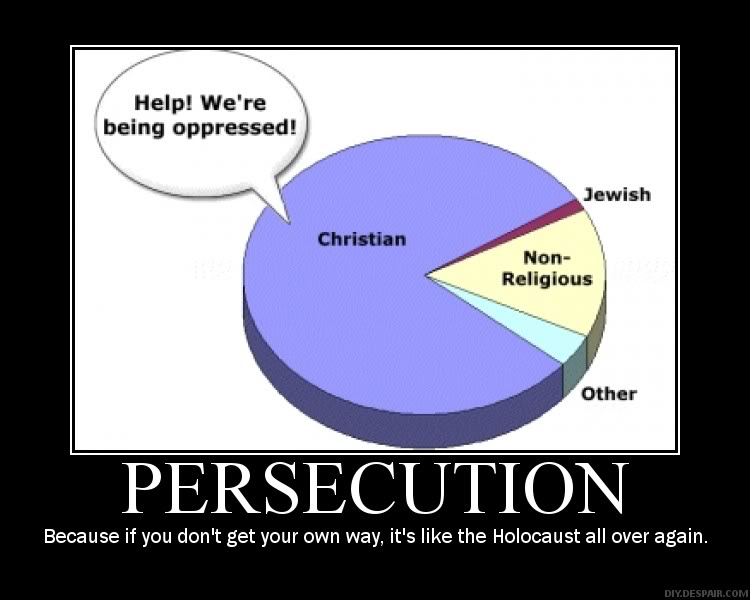 I’m grateful I live in such a country, too. But when it comes to acting on beliefs, we’re restrained by trying to work together in a country where such beliefs come into conflict. You would heartily support a law that protected Catholics from employment discrimination, I’m sure. You would argue against letting companies off the hook if they objected to Catholicism. You would debate against people claiming that calling Catholicism “Christian” is a meaningless expansion of the term. You would fight against the perception that it would mean legal recognition and approval of “un-Biblical” behavior. And you would certainly consider it worthless if it only protected believing in Catholic dogma, but not actually being “caught” going to Mass. And certainly you wouldn’t agree that to pass such a law would infringe on the religious rights of the Protestant majority.
That you’re unwilling to see how your own arguments could be used against your own interests shows a blindness to what those interests truly are, as well as a grave misunderstanding of what this country is that you’re so grateful for.
If bigger numbers means you can’t be oppressed then you have no understanding of the definitions. Only atheists are the ones going around filing court cases because they get offended by every little religious thing.
In general, @David, majorities oppress minorities. The recourse of minorities in a constitutional nation is through appeal to majority-established protections for minorities (such as the US Constitution). There are cases where minorities oppress majorities, but only in very authoritarian regimes (e.g., the Sunni minority, led by Saddam Hussein, oppressing the Shiite majority in Iraq).
I am not an atheist, but I recognize that our society remains pervaded by “every little religious thing.” If I were a Christian living in, say, Saudi Arabia, I, too, might be offended by governmental declarations of Allah being all-powerful and Mohammed being His one true prophet; by having references to Allah and Mohammed on currency and on courthouses; on having my tax dollars spent on recreations in statuary or city hall lawn displays of the flight from Medina or the revelations to Mohammed in the desert cave. I might be further irked and offended when politicians came out and said that only a Muslim can be a truly patriotic citizen, that only a Muslim should be voted for in office, or that non-Muslims were immediately suspect and only due the rights that Allah and the government decided to grant them.
The reason atheists turn to the courts for protection is because that is the situation they (and other religious minorities) find themselves in here in the US. The difference being from Saudi that we don’t have laws against proselytizing away from Islam, or for blasphemy, or for not being a faithful member of the majority faith, but we do have a constitution that prohibits entanglement between the government and religion. Which, I think, is a good thing.