No, I'm not getting into some sort of political correctness debate here, but pass ing on a very cool article by +Andreas Schou about St Nicholas and his historical origins in the Mediterranean, and whether the question of the original bishop / saint being of African origin is as off the wall as it seems. No polemic here, just a fun look at history (etc.).
("Santa Claus" per se, as known by folk in the US and cultures to whom we've exported our imagery, is a creation of Clement Clarke Moore, Currier & Ives, Coca-Cola, and Hollywood, built on various overlays of myth and legend from Europe, including stories about a 4th Century bishop of the lost city of Myra.)
Originally shared by +Andreas Schou:
Was Santa Claus Black: A Weird Answer to a Weird Question
I saw this go by in my stream the other day. It seemed completely implausible, and particularly implausible because it was political. A lot of these questions are completely off-base — clearly wrong from the moment the question was raised.
Interestingly, though, this question wasn't clearly wrong. It's at least a little plausible, and the way in which it's plausible says a lot about the complexity of the Mediterranean in late antiquity. So: to the evidence!
Q: Wait. Santa Claus is real?
A: Sort of? Santa Klaus is an English corruption of the Dutch word "Sinterklaas," meaning "St. Klaus." Klaus is a Germanic shortening of the Greek name "Nicolaus."
The actual St. Nicolaus was the bishop of Myra, in southwestern Anatolia, in the early 4th Century We know a couple of things about him: he was born to wealthy parents with Greek names; he was staunchly Orthodox; he was one of the earliest saints of the Orthodox church.
Q: That doesn't sound particularly promising, in terms of "was the dude black."
A: You're right. It isn't. Africans were pretty common in the Western Roman Empire — merchants, citizens, travelers, slaves, emperors*, et cetera — but don't seem to have been very common in the Greek parts of the empire. Most sea trade was controlled by Greeks. Most of the connections to Africa were via Egypt. Most of the immigrants were Syrian. Most of the slaves were Bolgars and Slavs.
Q: So why would anybody suspect that he was?
A: Well, for starters, he's depicted as being pretty dark in Byzantine art. That gives us a start, but that doesn't get us very far.
Q: Why?
A: Because St. Nicolaus is a very early saint, and Byzantine saints tended to get darker over time.
The pigments the Byzantines used to depict human skin-tones were a mixture of iron oxide and manganese oxide. When first ground, those pigments come out fairly light. As the pigments dehydrate, they darken. Soot from oil lamps and candles adds an extra layer on top. And so when artists went to made copies of the icons, they could never quite determine whether they'd gotten the pigment color right.
Which means progressive darkening of saints' skin tone everywhere sienna and umber were used as the pigment.
Q: Okay, so the depictions — pretty much a dead end, right? We're done here?
A: Not yet. What do you know about Myra?
Q: Never heard of it.
A: That's because it doesn't exist anymore. At some point between St. Nicolaus and this post, a plague caused its total abandonment. But before it was abandoned, it was the major connection between the heartlands of the Roman Empire and Egypt. The port was huge, and the grain ships from Egypt were unloaded there for transport to the rest of the Empire.
Q: So, that gives us a plausible connection to Africa. But the people who lived there were still Greek, right?
A: Sure. Originally Lycian, but also Greek, Syrian, and Egyptian — anyone who might reasonably show up on a ship. Including Somalis, particularly from the major trading hub of Sarapion.
Q: That still seems weak. It's a cosmopolitan area. But why would you suspect a family with Greek names of plausibly having African members?
A: The Greeks didn't care much about race. They cared a lot about whether you spoke Greek, but if you behaved like a Greek, liked Greek things, and participated in Greek culture, they didn't care much whether your great-grandparents had been Greeks.
Part of being Greek was taking a Greek name — not that you had much of a choice. If you didn't have a Greek name, something which sounded like your birth name would be forced on you. But it's not like people didn't notice race. We have records of a lot of Africans living in the Hellenic world, and they tended to attract nicknames like "Aethiops" or "Melanos." (Literally, "burned-face" or "the black.")
There's a fair amount written about Nicolaus. But no one pointed out that he was Somali. In the cultural milieu of the time, that's a thing which people would've pointed out. So while we're getting closer to plausibility, we're still stuck with a pretty implausible hypothesis.
Q: Okay, so, we're stuck on the historical record about Nicolaus itself. Do we get anything else out of Myra?
A: Well, the Greeks seem to think that Myra was named after the myrrh tree. This would be really surprising, considering that the myrrh tree isn't native to anywhere nearby.
The name is actually Luwian, a language which was a distant Anatolian cousin of Armenian and Farsi. Unfortunately, the language died out and was replaced by Greek, so we have no idea what it means.
Q: Where's the myrrh tree native to?
A: Somalia, Yemen, Eritrea, and Ethiopia. And the Greeks were dead certain that Myra was named after the tree.
So, let's take a look at the geography. If you wanted to ship myrrh to the eastern Roman Empire, where would you ship it to? Up the Nile, and it's a straight shot north to Myra. And there's plenty of other things which you could ship using the same route: gold, ivory, grain, cinnamon.
Q: Wait — isn't cinnamon native to Asia somewhere?
A: Yup. Generally, cinnamon was shipped from India to what the Romans called Arabia Felix, and what we call Yemen, and then trekked across the Arabian peninsula to Nabataea. From there, it would be brought through Syria to the rest of the Roman Empire.
Except that the Romans had historically had huge problems with Arabia Felix. They were periodically embargoed by the city-states of South Arabia. This only gave them one good place to get involved in the cinnamon trade: Sarapion, a Somali city just outside of modern-day Mogadishu. Throughout the century preceding St. Nicolaus' birth, Somali traders had alternated between having formal and informal monopolies on cinnamon trade with Rome.
Which finally puts us in the realm of "hypotheses which are probably wrong, but not literally crazy."
Q: Except… wait. How do Somalis get to the Mediterranean? Look at where Somalia is: it's nowhere near the Mediterranean! And there wasn't a Suez Canal!
A: First, it's not a priori impossible for Somali sailors to be sailing out of Egyptian ports. We know that Sarapion was on good terms with the Roman empire, that immigration was not well-controlled — but that's all really weak evidence, and certainly not a good way for a lot of Africans to show up in modern-day Turkey.
Second, you're right: there wasn't a Suez Canal. But Ptolemy II built a canal from the Nile to the Gulf of Suez, separated by locks. There were plenty of small Somali ships sailing up the African coast to the Gulf of Suez, then cutting across from the Gulf of Suez into the Nile. From there, Myra is a really good target port.
Q:Yeah, still not great evidence. We need actual African heritage in Myra, if we want to say anything generally about the people living there.
A: Okay, how about genetics?
We're pretty sure that the gene for sickle-cell trait, which defends against malaria, originates in Africa.* It's not generally endemic to European populations unless those populations have both (a) endemic malaria, and (b) longstanding contacts with Africa. It's most common in two places: Sicily and Lycia.
In other words, Sicily and the province where St. Nick was from. Unfortunately, if our hypothesis is that longstanding contacts in the cinnamon trade made it plausible for upper-class Myrans to have recent African ancestors, this doesn't really help with that specifically: sickle-cell trait is endemic to most of Africa, but not Somalia. In other words, the genetic evidence seems to point toward Myra being a port with longstanding African trade contacts, but we're still not closer to any specific hypothesis-confirmation.
Q: If only we had St. Nicolaus' skeleton!
A: Oh. Wait. We do.
Q: Why didn't you say that up front!
A: Because I didn't go looking for it until pretty late. Usually, you'd just break a saint up for scrap and sell every individual knucklebone as a relic. St. Nick avoided that fate, because — uh — there's a monastery draining rosewater out of his tomb* and selling it to pilgrims. And it turns out his skeleton is still in there.
Q: So, is he black?
A: You can't tell that from a skeleton. But there are cranial discrete traits that correlate pretty strongly with skin color: wide skull bases, wide nasal bridges, blunt nasal sills, and you probably would have coded as black to a modern American.
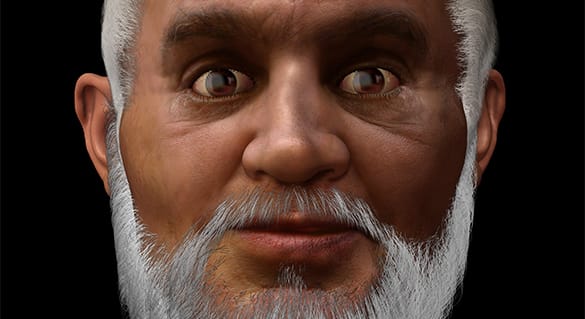
And yeah. With some caveats, not even his skeleton rules it out. He had a badly broken nose and pretty severe osteoporosis, but it does look like he plausibly had some African ancestry. His personal background and the region he's from make it not an insane hypothesis, and nothing in his skeleton is inconsistent with it.
Take, for instance, the reconstruction of his face, built off of his actual skull.
Q: Which gives us — what?
A: Not confirmation. But certainly a much, much better hypothesis than the hypothesis that any randomly-selected 4th century Anatolian was black.
(1) Yes, the Roman Empire had African emperors: Septimus Severus, who was Libyan and Syrian, and his two sons. Whether they would have been considered "black" if Americans were looking at them is not a question I want to even vaguely get into answering.
(2) There's a second cluster of sickle-cell trait in eastern India. It's probably an independent mutation, though. The European sickle-cell trait seems to have come from Africa.
(3) There is probably not rosewater draining out of St. Nicolaus' tomb. It's either water, or not from the tomb. But a monk's got to make a living.

Yeah