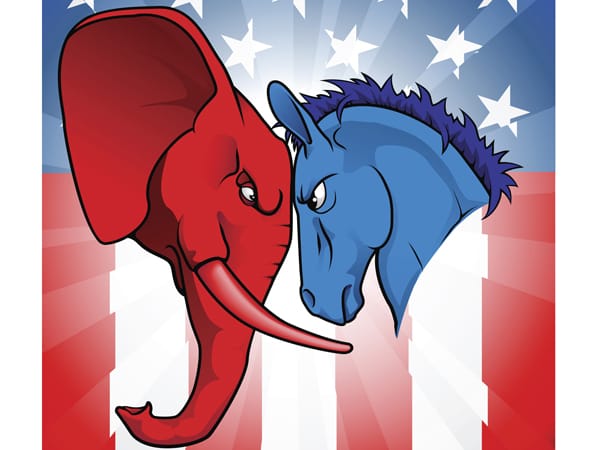
A very good article here on how protest votes for President (votes to "send a message," votes for third parties, votes for write-ins, or just staying home) are pretty much futile because they don't actually succeed in doing much of anything except leaving the voting up to the folk who are voting for one of the two major parties, which parties are largely unlikely to actually hear, let alone react favorably, to such messages.
https://medium.com/@cshirky/theres-no-such-thing-as-a-protest-vote-c2fdacabd704#.oms5e6xio
'Throwing away your vote on a message no one will hear, and which will change no outcome, is sometimes presented as ‘voting your conscience’, but that’s got it exactly backwards; your conscience is what keeps you from doing things that feel good to you but hurt other people. Citizens who vote for third-party candidates, write-in candidates, or nobody aren’t voting their conscience, they are voting their ego, unable to accept that a system they find personally disheartening actually applies to them.
The people advocating protest votes believe they deserve a choice that aligns closely with their political preferences. With 130 million voters, hundreds of issues, and just two candidates, this idea doesn’t even make mathematical sense, much less political sense. No matter who you are, voting isn’t about you. You are not promised a candidate you love, or even like, because no one is guaranteed that. Presidential voting is an exercise in distinguishing the lesser of two evils. Making that choice is all that’s asked of us, and all that’s on offer.'
(Emphasis mine.)
The article notes — correctly — that in a democracy you can have it pretty much of two ways. Most countries have multi-party setups, which end up in coalition governments which is where the compromising takes place, amongst the politicians. A voter can vote "their conscience" for the party that (mostly or more so) aligns with their particular policy set or priority, and then let the politicians dicker and bargain over how to create a governing majority.
The alternative is what the US has: two parties where the voters themselves are asked to make (or approve of) the compromises up front. There are a wide array of Democrats, and a wide array of Republicans, serving in the federal (and state) governments; while there has been some ideological narrowing over the past few decades, both parties are still significantly big tents, and the voter in a US election has to decide to vote for one, or the other, or leave it up to everyone else (and live with the consequence).
Is one system better than the other? That's a separate debate, but it's been 150 years since we saw a rise of a third party, and it didn't spring full-blown from the presidency but started at the local level (largely cannibalizing one of the existing parties). If people really want a new third party — or want to effect a change in the nature of one of the existing parties — it needs to start at the bottom, with local races, cities, counties, school boards, state legislators; those are the folk who then influence (or are) the state party leaders, and then have an influence on national party politics. That's how the GOP social conservative movement became such an influence on its party, from the grass roots up.
But whether you are looking for a third party, or a revolution within one of the existing ones, a protest vote to "send a message" isn't going to change anything. It's merely going to leave the rest of us to make the decision for you.
(The same could be said, I suppose, for someone already coming into this election thinking that the Libertarian Party or the Green Party is the bee's knees and planning on voting for them. While I can admire what at least appears to be an actual analysis and decision, the effect is much the same, i.e., little to none.)
(And, long-time Green or Libertarian fans aside, if you honestly think there is no substantive or effective difference between — in the case of the presidential campaign — Donald Trump and Hillary Clinton, then there's probably not much else that can be said, because our worldviews are way too different. I can wish there were more difference, in a variety of ways, and I can wish that my candidate of choice were more closely aligned with me in a wide array of policy issues. But if you really think a Donald Trump presidency will be effectively the same as a Hillary Clinton presidency, then I think you are taking an extraordinarily myopic view.)

I find this article just so much hippie punching from the right (as usual from the Dems) and wrong for two reasons.
As someone who has worked 5 former Dem presidential campaigns (84 – 00) only to either not vote for the winner of the Dem primaries 4 of those times (either not voting for pres or voting for third party), I have found that change only happens in parties by forcing the party to accept the change that the young want sooner than later.
The second reason the article is nothing but yet another Clinton attack piece is that it completely ignores the TEA Party forcing the GOP to go the furthest right any mainstream US party has ever been.
+Stan Pedzick But the TP didn't exert influence by boycotting presidential votes, or voting for Lyndon LaRouche, or writing in Ron Paul. They did it by flooding the local races, by putting up (and voting for) candidates in local and Congressional primaries, and, when that failed, doing the same the next time, and the next.
(Ignoring the extent to which the TPers themselves were astroturfed by various interests.)
'… I have found that change only happens in parties by forcing the party to accept the change that the young want sooner than later.'
Right. But how do you "force" that change? How did your not-voting for the winner of the Dem primaries change who got elected or, moreover, change who was nominated the following cycle? The loss by Kerry, Gore (or, hell, Humphrey) didn't cause the DNC to tack to the left, but arguably the reverse.
The only thing I've seen make a difference in decades (because the DNC has basically and stupidly ignored most local campaigns) is Sanders, but I agree with the original poster that if Clinton loses because Sanders supporters boycott or vote Trump or Stein, it's not going to make anyone in the DNC say, "Boy, we should appeal to the Sanders folk," but, "Boy, we need to appeal to more Republicans to make up for that unappeasable Left fringe that won't support our candidate even if their guy endorses her."
+Dave Hill perhaps, but always going right (like appealing to the 16% of Hillary PUMA's that voted for McCain in 2008 or ignoring the 300k Dems that voted for W in 2000 to instead punch the 50k hippies that voted for Nader) sends a message after awhile that the left is not necessary after the primaries and all that matters is capturing the mythical center. If the Dems are not going to anything but GOP lite, why support them or vote for them in the general?
The only reason this is even a thing is, as South Park put it, it's an election between shit sandwich and giant douche. Both side are campaigning fear, which usually benefits the GOP.
Should be an interesting few months.
+Stan Pedzick I have no hesitation criticizing the PUMAs that voted McCain. That was idiocy on their part (and, given the similarity on position between Obama and Clinton, presumably racist).
I'll note the article (and other analyses I've seen) minimize the impact of the defections to Nader in 2000.
One could reasonably make the argument that both parties largely, institutionally,minimize the fringes / outward factions once the general election starts; certainly a lot of evangelicals and TPers would make the argument on the Right, and the Left could make a similar case. I'm not sure that's necessarily a bad thing per se, except to the (non-trivial) extent that the Center's Overton Window has continue to shift Right over the last thirty years.
'If the Dems are not going to anything but GOP lite, why support them or vote for them in the general?'
Because if the alternative is Donald Trump, practically anything is a better alternative.
And if we're talking a step down-ticket, having a Dem majority in the Senate, or even the House, is still appreciably better than a GOP majority there.
It's not perfect, but while the phrase can easily be abused, the perfect should not be the enemy of the good. I have no doubt I will be irate over some decisions Clinton will make, but I have no doubt I would be much more irate (if not dead) from decisions Trump would make. Similarly, while Obama has been a disappointment to me in a number of areas, I still think his presidency has been far better than a hypothetical McCain or Romney one.