Is Trump the "safer" candidate because he's an isolationist businessman and will do more to keep us from war than Clinton? In short: no. In long:
http://slatestarcodex.com/2016/10/01/he-kept-us-out-of-war/
Which included this passage:
'Actually, I have a theory which I think explains a lot about Trump’s foreign policy positions: he doesn’t like losers. He supported the Iraq War and the Libya intervention when it looked like we would probably win. Then we lost, and he said they were stupid and bungled. He supports counterfactual invasions of Iraq and Libya where we “kept the oil” because that would have counted as winning. He supports invading ISIS because he expects to be in charge of the invasion and he expects to win. Under this theory, Trump’s retrospective non-support for failed wars doesn’t predict that he won’t start new ones.'
I wouldn't say that he doesn't like losers; like and dislike seem to have little to do with it.
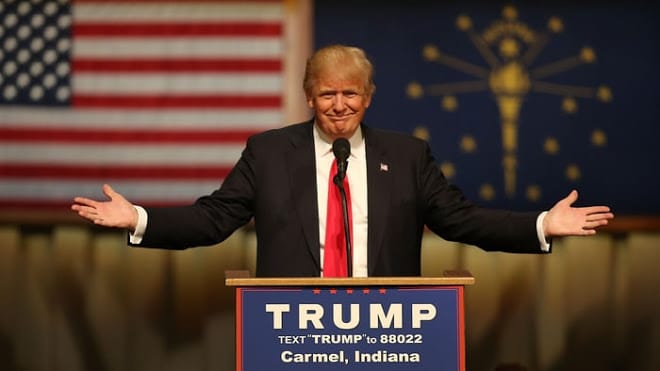
Trump is all about respect, of the preening, arrogant, macho, strutting, appearance-focused, "king of the mountain" kind. He doesn't respect losers. He doesn't respect people who aren't successfully clawing to the top. He doesn't respect POWs that get captured. Things like that.
Putin, on the other hand, is ostensibly successful. Successful power grabbing. Successful country invasion. He is the bare-chested-riding-a-grizzly-bear epitome of machismo. Trump respects that, much more than a nuanced, realistic, pragmatic, realpolitik policy in which sending in the Marines when someone flips us off is an unthinkable escalation, rather than an appropriate response to disrespect.
Because for Trump, success is not about the US protecting freedom. It's about the President of the United States looking like the biggest, baddest, most-respected sonofabitch in the world. While he's not alone in this (it's been a theme in Republican politics for many decades), he is perhaps that idea's greatest expression to date.
Which is why his personal reputation and the respect he thinks it should engender is so important to him. Why tax records have to be kept secret. Why critics need to be insulted, or sued. Why lies, ever-escalating series of lies, all intended to build up that reputation even in the face of the facts, are reflexive and essential. Why spending money on appearances, personally as well as in business, is par for the course. Why business failures or not paying taxes or personal scandals are all about being "smart."
And when he feels he is being disrespected, Trump's first instinct is to the insult, to disrespect in return. The accusation and its reality are less important than staying King of the Mountain, and if he's being pulled down, he has to pull down the other person faster. "Hillary said something critical about me, so let me all her names. USA Today said something mean, but they're an awful paper. CNN didn't fawn all over me, but, hey, who watches them, amirite?" Listen to him respond to any "attack" — it always involves a token denial, a more vicious attack on the accuser, and a deflection to some other area of success. Every time.
It's sort of the Untouchables "Chicago Way"[1], except instead of being about a determined fight against an implacable foe, it's about a pathological need for respect, for being the Big Man on Campus, for being the head of the gang.
Trump's been called a bully, and that's certainly a big aspect of the bully's behavior.
So what does that mean for world peace and America's military role? If the above understanding of Trump is correct:
– We would see a major US arms build-up (as Trump has promised), but with a focus on flash — lots of aircraft carriers, lots of modern-looking weapons, new ICBMs, new bombers, lots of things to roll out on parade, whether or not they are what we really need.
– We would see fewer formal alliances (as Trump has suggested regarding NATO). We would encourage, even expect, our ostensible allies to back our play in actions we take, with consequences if they don't, but any alliance structure that obligates us to others would be seen as diminishing US autonomy and leadership.
– Military involvement would be based as much on face as anything else. We would attack if it seemed safe and if it would establish US dominance. If it was unsafe, we might settle for shows of force short of previously promised invasions. If we found ourselves sucked in unwisely into a prolonged war, Trump would do whatever he could do to get us out while still trying to look like a winner; he would definitely be the sort to
"blame the generals" when things went pear-shaped.
The problem there is that treating foreign conflicts like a kid in a schoolyard (especially a bully) may lead to unexpected backing down if things look too dire, but may also lead to being trapped into diving into (or doubling down on) a conflict in order to save face, to gamble unwisely as Trump has multiple times in business, around appearances and garnering that elusive respect, rather than dealing with actual risk analysis and long-term goals and cutting short term losses.
There is no "bankruptcy court" for a nation that does that.
Not that this would necessarily be anything new with the US — there have been plenty of times when national honor / pride / ego / "face" has driven us into (or away from) ventures in ways that were unwise. But Trump seems to take this position to an extreme, and in a reflexive and capricious and egocentric way that is risky in and of itself. Too risky, I firmly believe.
—-
[1] http://www.imdb.com/title/tt0094226/quotes?item=qt0439713
[h/t +Steven Flaeck]

I'm surprised that people haven't focused on the REAL revelation from the New York Times leak of Trump's tax return.
The real revelation isn't that he could legally avoid taxes for years.
The real revelation is that Trump lost almost a billion dollars one year.
For a Charlie Sheenish "winning" figure, that is a humiliating number.
+John E. Bredehoft Yup. In fact, I just posted on that (and have commented on it previously).
The way it's come out, he's almost been able to spin it as a positive thing. "Pay no attention to that massive set of losses; just notice how I turned it to my advantage. Smart!"