The tragedy is that it doesn’t exist, but some Christians in the US are convinced it does.
Speaking as both an American and a Christian, here’s what I see.
Christians do still hold tremendous power in this country. They hold positions of influence. They have tremendous privilege. The national holidays, the public symbols, the social structure is all built around Christian traditions and Christian values and Christians beliefs.
But …
Some of that is changing. Christians are being told there are other people who want to sit at the table. Not just the Jews (who were, sometimes, tolerated), but Muslims. Hindus. Buddhists. And, heck, people who don’t believe at all.
And Christians aren’t automatically deferred to, or respected, or treated as not just the norm but the core of what it means to be American. People make jokes about Christians. People want other holidays off. People question whether churches should be tax exempt. People question Christian teachings on things like divorce, or abortion, or sex, or the role of women, or homosexuality, or the origin of the universe, or the existence of God.
Sure, there are a lot of Christians who have little to no problem with those things But the Christians who are most certain that they are the True Christians, the Real Christians, the Ones Christ Would Feel Were Truly His Followers …
They’re not always the undisputed top dogs. They’re not the center of respect. They can’t simply assert their opinion (God’s opinion!) as to what is Right and what is Wrong and expect it to be followed.
And that fall from complete, utter, and total social hegemony is perceived as … persecution.
“I don’t get to shun and fire and refuse to serve immoral people any more.”
“I don’t get to put monuments to my religion in the public square any more.”
“I don’t get to have my prayers read in classrooms any more.”
“I don’t get to forbid stuff, and shame or imprison the folk who do forbidden things, any more.”
“I don’t automatically garner respect and deference for being the epitome of morality and righteousness any more.”
“I don’t get to assume everyone is a Christian, and that they are Baptized, and that they have Read the Bible, and that they Celebrate the Same Holidays as me, and that they Believe The Same Stuff I do any more.”
“I’m being persecuted.”
The word “privilege” gets tossed around a lot, and it makes a lot of people uncomfortable, but that’s exactly what this is: *Christian Privilege. And it’s being challenged. And some Christians simply cannot stand that.
Some Christians see any threat to their being Number One as being persecution. Some Christians see any challenge to their being the undisputed bosses of America as being persecution. Some Christians see criticism, jokes, disrespect, as being persecution.
Again, speaking as both an American and a Christian: suck it up, Buttercup.
Jesus didn’t promise any of his followers that they would be in charge of things here on Earth. He didn’t say that they would get a country that would follow all their religious dictates. He didn’t say that everyone would respect Christians, or treat them as the top dogs in society.
In fact, he pretty much said the opposite. And he said that was okay, at least according to the Bible.
Now, I’m not recommending that Christians should want to be persecuted. Or that any religious (or irreligious) group should be persecuted.
Heck, I’m not even saying that I don’t get peeved when people post stuff that says that Christians / Theists of Any Sort are deluded idiots who are responsible for all the ills of this world.
But that’s not persecution. That is, at best, a debate between worldviews, and, at worst, people being asshats. Being a Christian doesn’t threaten my job, doesn’t threaten my owning my home, threaten my kid being able to go to school, threaten my ability to go to church, doesn’t threaten my ability to vote or buy stuff or participate in society or eat in restaurants or stay out of jail. There are countries where that’s the case; this isn’t one of them.
Christians aren’t being persecuted in this country. They’re simply not the undisputed lords and masters. And, frankly, that bit of humility and need to actually sell the message of Christianity, vs. imposing it by rule of law and social diktat, is actually a good thing for Christians. Because, again, looking at the Bible, being the people in undisputed charge of things is not what Jesus recommended to his followers.
No, Christians do not face looming persecution in America – The Washington Post
The media should challenge conservative Christians on their politics of paranoia.

religion poisons everything.
+Bob Mama I respectfully disagree.
These GOP politicians are not Christians, they're hypocrites and are demons in disguises. They're not being presecuted at all. Moreover, they're spoiled brats are persecuting Americans.
Ditto
+Ivan Wiley I'm generally reluctant to call people not Christians (as folk have used that as the basis for persecution in the past). But I'm more than happy to agree that a lot of these folk do a lot of things that I don't recognize as being at all Christian in effect or motivation.
All the pluses.
That’s sort of the core of “privilege” — having to consider that people are not like you (in whatever way), and that not being like you doesn’t mean they’re wrong.
It’s a headtrip, especially for people who never travel.
+Jesse Cox It makes them motion sick.
Thank you for your compassion and understanding.
Seems like you are living your path.
Our country was first settled by Christians who had to dare a wilderness to find a place to live.
That strain of fanatasim with its extreme hatred of everything not them rears its ugly head from time to time.
There is a habit of indoctrination that lasts from cradle to grave and powerfully shuns any member who fails to prevent any other philosophy from entering their perfected dogma.
I appreciate the faithful who, when exposed to other is not threatened.
I believe the lesson of the christ was tolerance and love.
+Dave Hill well said.
+Melody Peters Our country's settlement was complicated — religious refugees looking for a place where they could be free (and, with rare exceptions, could shun anyone who didn't believe as they did), prisoners, economic refugees, opportunists, would-be landed gentry.
On the positive side, the confluence of the Enlightenment and the long history of religious wars in Europe (and particularly in England) made some of them sensitive to the religious prejudices that came over the Atlantic, and convinced them that they needed to create a legal framework for tolerance. That framework hasn't always functioned as well as it should, but it's done pretty decently.
I usually reject "Religion is the root of all evil" thing because it's too narrow a vision. Ideology is the root of evil, as it elevates philosophical ideals above the value of individual humanity (or, rather, focuses on collective belief as a higher value than individual belief). That can be religion, absolutely, but it can be non-theistic "religious" — political ideology, economic ideology, social ideology, where the idea is treated as received, absolute truth, and those who disagree are heretics who deserve burning at the stake.
Mao's Cultural Revolution was no better — and no worse — than the French Revolution's Terror or the Spanish Inquisition.
Ideology is dangerous because of how it meshes with humanity's genetic urge toward tribalism, Us vs Them. Where religion, or politics, or economics, or any other social construct goes down that fetid rabbit hole, suffering results.
'I appreciate the faithful who, when exposed to other is not threatened.
I believe the lesson of the christ was tolerance and love.'
Anyone who says they have all the answers is either suffering from massive hubris (which, sooner or later, the gods always punish), or is trying to sell you something.
I have my beliefs about what the universe is and how it operates, but none of them are such that persecuting or attacking those who disagree with me makes any sense, or accomplishes anything.
I don't know that I would say Christ [as recorded in the Gospels] taught tolerance; rather, he taught that, regardless of where one is on their spiritual journey, what was important was how one acted toward one's fellow person, one's neighbor. Love, compassion, caring for the poor, feeding the hungry, clothing the naked, visiting the prisoner — these aren't religious dogma or theological doctrines; they are instructions on how to live, not how to cogitate. That's how I try to approach my Christianity, flawed as it must be from my own flaws.
People who start with doctrine and theology and rightthinking as the key to their religion (or ideology), whatever the label that religion has, are the people who usually end up with dead bodies around them.
Part of what irks me about American Christian snowflakes is that there are actual Christians being actually persecuted in various places around the world. Try building a Christian Church, or trying to convert people to Christianity in Saudi Arabia. It doesn't end well.
That's what persecution looks like. Being told you need to bake cakes for gay people the same way you bake cakes for straight people isn't persecution. In fact, it's kind of the opposite.
In the 1980s there were people saying that the white, Christian, heterosexual male was an endangered species. Considering world population trends, they weren't wrong. As the Russian saying goes; in a thousand years, who will care?
+Travis Bird Except those demographic trends don't really say that.
"White"? Well, racial mixing is a reality (and, to be fair, always has been), but only in general and global terms is white dominance (vs African or Asian populations) a demographic issue.
"Christian"? The numbers of self-labeled Christians continue to rise globally — though not necessarily as "white" populations.
"Heterosexual"? Increasingly open acceptance of LGBT folk in the West has not led to some massive turning against heterosexuality. There still seem to be, world-wide, preponderance of male/female coupling in the world, with no sign of that going away.
Those persecuted-out-of-privilege Christians I tend to describe as "people who can't tell their insides from their outsides".
I'm an atheist and generally antireligious because, even though a small percentage of believers believe responsibly, like Dave, the vast majority don't. The evils perpetrated in the name of religion are numerous and ongoing and I don't see any way to stop them as long as the practice of holding irrational beliefs is considered normal.
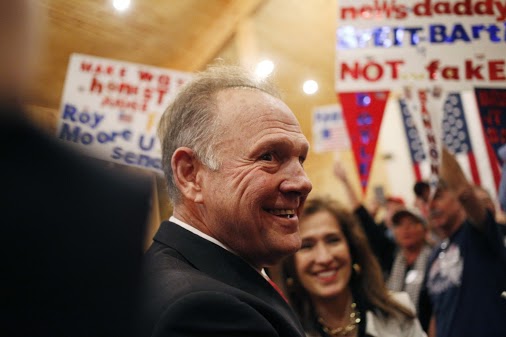
Not all conservative Christians voted for Moore. Interestingly enough, the writer echoes a sentiment similar to the WaPo article: not operating out of a place of fear and persecution.
http://thehill.com/business-a-lobbying/365170-pride-and-the-fall-why-young-evangelicals-rejected-roy-moore
I grew up believing being persecuted was to be blessed. And why would anyone want to refuse or flight a blessing?
+Simon B Yeah, if only there were a Gospel passage or something about it …
https://www.biblegateway.com/passage/?search=Matthew+5%3A10-12&version=KJV
I'm now in Persecuted=Blessed vs Persecuted=Harmed vs Blessed=Harmed. The latter is simplest, since "Blessé" is a plausible French translation of "Harmed". #pardonmyfrench