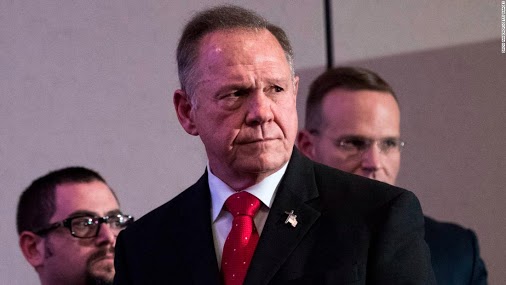
And in another fun bit of Roy Moore trivia, in a 2011 appearance on a whackadoodle conservative radio show, he opined that getting rid of all those amendments to the Constitution beyond the first Ten would “eliminate many problems.”
His spokesfolk have come out and declared that, no, he really only meant the 14th and 17th Amendments. Or maybe more, but those are the ones he’s really peeved at.
It is kind of weird, though, that he’d just be interested in getting rid of two when agreeing with the show host about voiding all the amendments after the first 10 he said, “That would eliminate many problems.” I mean, that would include 17 other amendments, not just two. Why wouldn’t he say, “Well, I disagree with a couple,” so that people didn’t think he wanted to allow slavery again, or undo women’s suffrage, or get rid of extending the vote down to 18, restricting a president to two terms, barring poll taxes, or barring denial of the right to vote based on race?
Anyway, let’s assume for argument that he only has a mad-on about 14 and 17.
17 is a bugbear for conservatives, calling for US Senators to be voted for by a state-wide election, not by state legislators. Moore really dislikes that one, apparently because he doesn’t trust the state citizenry, or else because he liked the problem that progressives sought to fix with this amendment, that state legislators are easily bought off, and therefore by extension so are the US Senators they are selecting.
14 is the real kicker here. That post-Civil War amendment [1] was designed to make it clear that: (a) freed slaves — in fact, all African-Americans — born in the US were US citizens, (b) all US citizens have a right to due process under the law, including state and local laws, and that (as interpreted by the Supreme Court), the provisions of the US Constitution trump those of state constitutions and local laws, and (c) all people in the US must be treated equally by the law: federal, state, and local.
Moore just doesn’t like it because it means states don’t have ultimate rights.
The danger in the 14th Amendment, which was to restrict, it has been a restriction on the states using the first Ten Amendments by and through the 14th Amendment. To restrict the states from doing something that the federal government was restricted from doing and allowing the federal government to do something which the first Ten Amendments prevented them from doing. If you understand the incorporation doctrine used by the courts and what it meant. You’d understand what I’m talking about.
Looking at the quote … I have no idea what he is talking about, except that the 14th Amendment lets the feds restrict what state governments can do. That seems to be a cardinal sin in Moore’s book.
For example, the right to keep and bear arms, the First Amendment, freedom of press liberty. Those various freedoms and restrictions have been imposed on the states through the 14th Amendment. And yet the federal government is violating just about every one of them saying that — they don’t they don’t — are not restrained by them.
Yes, how horrible that those Bill of Rights rights have been “imposed on the states through the 14th Amendment.” Yet, somehow, Moore thinks that the federal level is (or is claiming it is) not subject to the Bill of Rights, which is kind of weird given that they are part of the federal constitution and are litigated in federal courts all the time.
But let’s stick a pin in this:
- Roy Moore doesn’t think the citizens of Alabama should be voting for him; he’d prefer if the Alabama state legislature had that right.
- Roy Moore thinks that “equal protection under the law” and “due process” should be the choice of each state.
- Roy Moore thinks that other federal protections in the Bill of Rights should be up to the states, too.
Roy Moore might believe some other things, based on his broad dismissal of Amendments 11-27 … and he said a lot of really interesting things in those radio shows … but I think focusing on the above is sufficient.
——
[1] Because he last felt that America was great at a time when “despite slavery” we were somehow a bunch of united families. That implies that after the Civil War ended slavery (as confirmed by the 13th Amendment), America was no longer great.
Roy Moore in 2011: Getting rid of amendments after 10th would ‘eliminate many problems’ – CNNPolitics
Alabama Republican Senate nominee Roy Moore appeared on a conspiracy-driven radio show twice in 2011, where he told the hosts in an interview that getting rid of constitutional amendments after the Tenth Amendment would ‘eliminate many problems’ in the way the US government is structured.