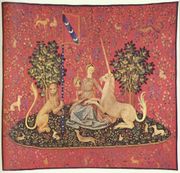
It occurst to me that if the King James Version of the Bible were the word-for-word infallable word of God that some folks tout it to be, one would either have to assume that unicorns are real, or one wouldn’t need to go through various gyrations to deduce what the KJV translators translated as “unicorns.”
71 view(s)
If memory serves, Isaac Asimov explained in an essay that the word for “wild ox” was changed to “unicorn” because one of the horns of the beast had already been removed to trumpet a significant event, leaving only one horn to be sounded on Judgment Day. (If this is wrong, blame me rather than the author; it’s been decades since I read the article and my memory is quite fuzzy.)
I have always been bothered by the structure of a unicorn’s head; it is in every other respect apparently a horse from which head a long single straight horn has grown. No indication of thickened cranium or reinforcing cranial chambers, or pronounced neck musclature like an elk. Such an animal would have difficulty galloping, so say the least, and would have to live out in the open as dense underbrush would be a trap.
OK, sometime I’ll write a grumpy post about the anatomy of assorted mythic vertebrates. As for the KJV, surely you know those references are there to test our faith?