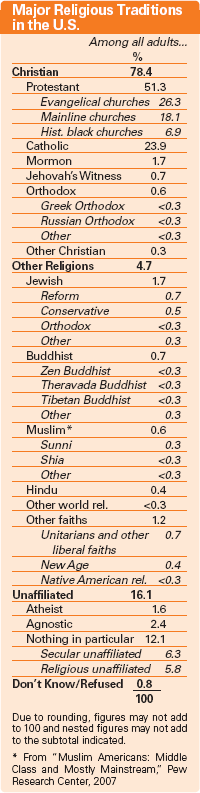
Les points to a new, massive Pew Research report on the state of religion in the US. Bottom line: it’s a diverse picture, and getting moreso over time. A few highlights:
More than one-quarter of American adults (28%) have left the faith in which they were raised in favor of another religion — or no religion at all. If change in affiliation from one type of Protestantism to another is included, roughly 44% of adults have either switched religious affiliation, moved from being unaffiliated with any religion to being affiliated with a particular faith, or dropped any connection to a specific religious tradition altogether.
The survey finds that the number of people who say they are unaffiliated with any particular faith today (16.1%) is more than double the number who say they were not affiliated with any particular religion as children. Among Americans ages 18-29, one-in-four say they are not currently affiliated with any particular religion.
[…] The Landscape Survey confirms that the United States is on the verge of becoming a minority Protestant country; the number of Americans who report that they are members of Protestant denominations now stands at barely 51%. Moreover, the Protestant population is characterized by significant internal diversity and fragmentation, encompassing hundreds of different denominations loosely grouped around three fairly distinct religious traditions — evangelical Protestant churches (26.3% of the overall adult population), mainline Protestant churches (18.1%) and historically black Protestant churches (6.9%).
[…] While those Americans who are unaffiliated with any particular religion have seen the greatest growth in numbers as a result of changes in affiliation, Catholicism has experienced the greatest net losses as a result of affiliation changes. While nearly one-in-three Americans (31%) were raised in the Catholic faith, today fewer than one-in-four (24%) describe themselves as Catholic.
It’s an interesting picture. I don’t think of it as alarming, nor am I particularly thrilled by it. Diversity, changes in the younger demographic, etc., all point to some serious social changes over the next decade or two — hopefully one that involves respect for others (and a willingness to learn), rather than sectarian strife and demonization of the (un)believers.
These bits of info are interesting:
– The Midwest most closely resembles the religious makeup of the overall population. The South, by a wide margin, has the heaviest concentration of members of evangelical Protestant churches. The Northeast has the greatest concentration of Catholics, and the West has the largest proportion of unaffiliated people, including the largest proportion of atheists and agnostics.
-People not affiliated with any particular religion stand out for their relative youth compared with other religious traditions. Among the unaffiliated, 31% are under age 30 and 71% are under age 50. Comparable numbers for the overall adult population are 20% and 59%, respectively.
Plus the little interactive page is just oodles of information.
Of course, there is always the other side of the perspective:
Thank you So Called Liberal Media…
Because folks, remember, unless you have god in your life you are just a murdering barbarian, void of concept of right and wrong. Heck, you may even be an Untermench.
It is an odd comment as written. I am sure that there are *some* who have a concern about a “secular, morally void America” (though “secular” and “morally void” are by no means synonyms). But are there “many” concerns? Is there a survey out there somewhere indicating how many people are “concerned” over changes in American beliefs?
Goofy.
As someone who considers herself to be a secular humanist in many ways, that seems like a needlessly insulting comment. They could have easily said “secular, badly dressed America,” or “secular, unsure of what to do on Easter America.”
And the words “secular” and “morally void” are not synonymous nor even closely related except to those who think all who do not believe in a higher power are amoral. Did they not ask the secular responders about their moral code? Wouldn’t that have been somewhat relevant and pertinent to the study?
I think it would be reasonable to paraphrase the italicized phrase in BD’s quotation as “secular and morally void America”. I don’t see any suggestion that the author regards “secular” and “morally void” as synonyms (if he or she did regard them as synonyms, then I think the journalistic imperative for concise writing would have led to one or the other being edited out of the sentence). It may be that many people think that being secular causes one to be morally void (I assume that phrase means “without morals”), but I do not think this claim is mentioned in the passage BD quoted. While I’m as concerned as anyone about the tendency many people have to connect those who are not explicitly religious with immorality, that wasn’t what bugged me about the passage BD quoted.
The thing about the quotation that attracted my attention is the implication that the survey demonstrated that most Americans are “deeply religious.” The table that Dave included in his original post doesn’t seem to me to support that claim. Perhaps some of the other data does, but I’m suspicious of this claim because “deeply religious” seems quite vague to me, and I worry about how they measured that.
David, I think they simply looked at the 84% v the 16% and took that to mean “Deeply Religious”.
David.
Reading back through it and the language used in the piece, it my perception that it “secular, morally void America” was used as intended. That unless you are “Deeply Religious” you have no morals.
It is the same thing as the Presses “Values Voters” v “Dirty frelling commie pinko hippies” narrative that the keep going on about. Deeply Religious equals Morals and Vaulues and Secular equals Morally Void and lack of Values.
BD, do you think they meant that the two terms are synonyms or that the group of people described by the term “secular” happens to be the exact same group of people described by “morally void”?
The phrase “creature with a heart” is not synonymous with “creature with a liver” (they clearly do not mean the same thing) but as a matter of fact the two phrases describe almost exactly the same group. In philosophy, we say the two phrases are coextensive.
My claim is that the author doesn’t think the terms are synonymous, but he or she may think they are coextensive.
I’m not sure I understand the distinction, or how it applies here, David. As I read the paragraph (and the story about it), it’s clear that there is a connection drawn in the phrase between “secular” and “morally void.” It may be (for purposes of the idea presented) that there are secular folks who aren’t morally void, or morally void folks who aren’t secular, but there are clearly a substantial number (a “society” even) who, it is feared, are both.
I, too, cavil at the false alternatives of “secular/morally void” vs “deeply religious.”
I also seriously question whether “religious affiliation” is the same as “deeply religious.” The Pew article notes that the religious affiliation was self-identified, and did not take into account, e.g., regular churchgoing or anything to figure out how “deep” the affiliation was.
** BD sees the words “philosophy” and “coextensive” and decides that he really hasn’t had enough coffee to yet to deal with them yet **
The more I read that sentence, the more I realize how poorly it’s written. I think the author wanted to say something like – “The study counterbalances the prevailing attitude that America is moving toward greater secularism with data that shows that Americans are still affiliating with and attending church in large numbers.”
That said, the “morally void” comment was really unnecessary and possibly telling of the author’s bias since the study did not address people’s morals only their religious affiliation. Since other studies have highlighted how little American’s know about their own religious traditions, do people actually know what tenets their churches hold?
Okay…
First off, I need a better definition as to how you view the word “Coexistive” to be defined, since I do not see the difference between it and “Synonymous”.
Synonymous:
Baby/Infant
Child/Kid
New York City/Los Angeles
Or are you saying that Coexsitive is like:
Baby/Cub
Child/Boy
Gotham/New York City
Similar but not exactly the same?
Starting at the Macro and working my way down.
In this country, for at least as long as I have been alive, there has been a narrative that “Moral” is synonymous with “Deeply Religious” so that is the antonym is “Secular” meaning “Morally Void” by definition. It is the same argument as Hollywood being Immoral and the spewer of evil filth that is poisoning the nations (worlds) youth. While most of that the Hollywood = Immoral bias started because of the general under current of anti-Semitism (using the third definition versus the #1 and my preferred definition “The peoples of the Levant”), but has now morphed over the years to be used as a cudgel against the “Liberal Elite” (again, a clever little word trick really meaning the same thing). As I noted above, this holds true with the Medias fixation with “Values Voters” where they pander to those of the Religious Right and deem them to possess “Values” as opposed to those on the on the unstated left who are seen to possess “No Values” by virtue of not being Religious.
So, in this article where the only possible biases for the use of “Deeply Religious” is that 84% of the US professes some sort of belief in a Religion, since the study itself provides no actual data to back up that claim, it is very easy to see that the reporters bias is that “Secular” is synonymous with “Morally Void” and that they wanted to make this point clear by stating:
And yes, Mary is correct in saying the reporter should have said:
Synonyms are words that mean the same thing. Baby/Infant and Child/Kid are synonyms (I assume you’re not talking about goats). New York City and Los Angeles are not synonyms. The phrase “New York City” has a completely different meaning from “Los Angeles.”
Words or phrases are coextensive if they refer to the same set of things. Synonyms are by definition coextensive, but some words or phrases that are not synonyms are also coextensive. Baby/Cub and Child/Boy are not examples of coextensive terms. Gotham and New York City are synonyms and coextensive terms, if (as I believe) “Gotham” is a kind of nickname for New York City.
An example of two phrases that are coextensive but not synonyms is “creature with a heart” and “creature with a liver.” Having a heart is having an organ that pumps blood. Having a liver is having an organ that filters blood. As a matter of fact, every animal that has a heart has a liver, so the terms are coextensive, but they don’t mean the same thing. Another example would be “Governor of Texas from 1995 to 2000” and “President of the United States from 2001 to 2009”. These phrases clearly mean different things, but they happen to be coextensive since they refer to the same person.
Some words or phrases are defined by the set of things to which they apply. If you’re thinking of such cases, you might assume that every pair of coextensive terms are also synonyms. But for words or phrases that are not defined in terms of the set of things to which they apply, it is possible for a pair of coextensive terms not to be synonyms.
Sorry to be so pedantic. Being inappropriately pedantic is an occupational hazard for professors, I think.
Oh, no problem David, I am enjoying myself…pedant away! ;P
Okay, so Synonym and Coexistive words are about how you perceive the meaning of the word and the context that it is used in, gotcha.
I say this since to me New York City/Los Angeles are Synonymous since the are both big cities and New York City and Gotham are not since one is fictional, but they can be used to mean the same thing depending on with whom you are having a conversation with.
Same thing with “Creature with a liver” and “Creature with a Heart”. If your perspective is that the both refer to the Organ considered to be the wellspring of Love from different cultures then they are Synonymous. 🙂
Except it doesn’t counterbalance it. The study actually indicates increased secularism and nonaffiliation, trending moreso when age cohorts are examined. That says, it shows that *at present,* there is a greater level of religious affiliation than some who worry about such things might think.
Very little — but, then, American religious traditions for the last century or more have been much more focused on the *state* of believing than in the details of that belief. Who cares what transubstantiation means, or the vagueries of the doctrine of infant damnation so long as you’re jumping up and down and believing in Jesus (whatever that belief actually means)!
That’s an oxymoron in these here parts.
True, except that that was not the point the reporter was trying to make Dave. Mary is correct in that that it should have been written the way she wrote it since that is the point the reporter was trying to make. You are correct in that that was not what the data from Study indicates, but again, that was not the point that the reporter was trying to make.
The reporter was trying to point out that contrary to the popular belief held by the “Deeply Religious”, the Godless Dirty Frelling Hippies are not taking over, but that instead the US is a “Deeply Religious” country since 84% of its citizens believe in some sort of god.
“… the US is a “Deeply Religious” country since 84% of its citizens believe in some sort of god.”
Well, no, actually 84% of its citizens consider themselves part of a formally recognized religious club.