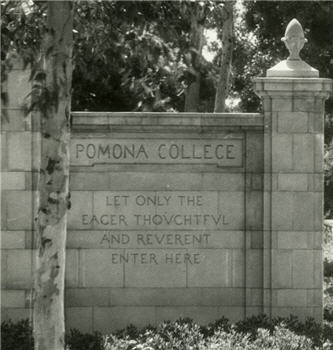
I am a graduate of Pomona College in Claremont, California (Class of mutter-mutter), and it’s been with some fascination that I’ve been watching the brouhaha over the school’s Alma Mater tune, “Hail, Pomona, Hail.”
As a college song, the lyrics are innocuous enough (and uninspiring save to those who’ve actually attended the place):
Hail, Pomona, hail!
We, thy sons and daughters, sing
Praises of thy name,
Praises of thy fame.
Til the heav’ns above shall ring:
To the name of Pomona
Alma Mater hail to thee!
To the spirit true
Of the White and Blue.
All hail Pomona, hail!
Nothing earth-shattering in the category of Alma Mater tunes there, to be sure. And the tune it goes to (which I can sing both the melody and the bass line) is fine enough, but, again, hallowed only by tradition (you can listen here).
So why is this song suddenly on the outs, banned from this year’s Commencement or Convocation at the college? Simple — because of some research that indicated that the song was originally — in 1909 or 1910 — composed as the finale of a show that included a blackface minstrel act, held at Pomona to raise money for athletic uniforms. Which automatically, in some folks’ eyes, makes it Utterly Unacceptable as Any Sort of Tune We Want Played Around Here, Because It’s Racist, Don’tcha Know?
Um …
Okay, folks, this isn’t the Confederate battle flag here. The Alma Mater wasn’t created as a symbol of racism (or even “states rights”), it contains no racist message intrinsic, and it’s not being currently used as a paean to racism by college racists.
If it is unutterably tainted by its association with a minstrel show, then so, too, is the college said show was held at, which ought to be shut down, and whatever building was the site of the show should be torn down (okay, that was Holmes Hall, so I guess we’re safe there). The student composer should be stripped of his degree (well, in point of fact, he withrdrew from the school after a year — but he did win a music award, the first Trustee Medal of Merit in 1972 for composing several college songs, including the Alma Mater — so clearly that award should be done away with, the Music Dept. closed, and the Trustees all fired, and the scholarship in his name should be eliminated, and those who received it should have their degrees revoked, too, as fruit of a tainted tree).
(There’s actually some question, by the bye, as to whether the song actually was written for and sung in the show in question — but the commission appointed to examine the whole kerfuffle decided that indications to the contrary were incorrect, for reasons not made clear.)
Similarly, we should ban “Oh! Susanna” (composed by Stephen Foster and first appearing in minstrel shows), “The Star-Spangled Banner” (a song glorifying war and sung to a drinking tune associated with a British men-only club), and “My Country, ‘Tis of Thee,” (sung to the national anthem of Britain, that greatest of Imperialist powers).
Anyway … harrumph.
The latest word from the college president, David Oxtoby, is that the song’s suspension as a tune around campus is now lifted: it will still be allowed for various purposes — but at some of the key official college functions it will not be allowed for the time being (and, at others, will only be allowed if the organizing students agree to it). It remains the Alma Mater, but sort of a (if you pardon the expression) second-hand citizen of one.
First of all, I have decided to confirm Hail, Pomona, Hail as Pomona’s Alma Mater and to end the suspension of performances at official College events such as Alumni Weekend. Given the divisive nature of the controversy over the song on our campus, however, it will not be included in the programs for Commencement or Convocation for the present. In doing this, I have chosen to replace a compromise put forward by the Committee with a compromise of my own. The Committee recommended that Hail, Pomona, Hail should no longer be our Alma Mater but should remain as a college song, to be sung only by our alumni. They also recommended that a new Alma Mater should be composed to take its place.
My decision to confirm the status of Hail, Pomona, Hail as our Alma Mater, rather than replacing it, is based upon a conviction that traditions—like people—should be judged on their merits, not on the basis of historical associations unconnected to their actual character. All are agreed that there is no harmful meaning in either the words or the music of Hail, Pomona, Hail. The question is whether the context of its possible first performance should be determinative.
Three things concern me here. First, there is the inconclusive nature of the evidence. While research conducted by two students and an alumna taught us much about the minstrel show that took place here in 1909–10, it also revealed that the evidence for a connection between that event and Hail, Pomona, Hail is contradictory and open to interpretation. Second, there is the troubling idea that all things associated with an imperfect past should be considered tainted even if there is nothing inherently objectionable about them. And finally, there is the false sense of closure provided by getting rid of something so that we no longer need to talk about the issue that it calls to mind. The Alma Mater still has things to teach us, and the people who cherish it should not be constrained in any way from honoring it.
While I am pleased that the song has not been banished to the Netherworld, I’m less pleased that (a) it still has an officially probationary status (which means it will be sung less which means it will inevitably fade away, solving the “problem”), based on (b) guilt by association — even leaving aside the question of whether the accusations are true, it’s the same sort of conflation of the artistic creation with the circumstances or personalities around its creation that led to the big Dixie Chicks brouhaha, only with even less reason. After all, one could argue that, whether or not the Dixie Chicks’ songs were good or bad, buying their CDs was supporting their ostensibly Evil Unpatriotic Beliefs … whereas I can’t find any indication of anyone actually saying that singing “Hail Pomona Hail” supports blackface minstrel shows and racial jokes.
So when Pres. Oxtoby says …
It is clear that many of our current students—including students of all races—would now find it uncomfortable to be asked to stand and sing the Alma Mater during Commencement or Convocation. Indeed, in solidarity over these concerns, the Associated Students of Pomona College voted this year to recommend that the Alma Mater be decertified. Commencement belongs to our seniors, who are celebrating the culmination of their college years, and Convocation is where we welcome a new class into our midst. In these special, student-focused settings, unity and a sense of mutual respect are paramount. For that reason, we will not sing the Alma Mater at these events for the present
… it strikes me as missing a huge educational opportunity — to fully discuss the connection between art and the circumstances around its production, and the extent to which the connection exists (doesn’t deconstructive theory actually claim that there is no connection?), or the division (or what division there may be) between creators and the creation — do the political or social or religious or ideological beliefs of a composer, writer, actor, director, conductor, performer of a work have an intrinsic influence (good or bad) on the work itself, regardless of what others may see in the work?
Instead, the message seems to be, “Hey, this makes you uncomfortable, so rather than challenging that sense of aesthetic or intellectual discomfort, we’ll simply go along with it for the time being and let it trump any other factors in the matter, possibly including things like Reality and Truth. All that matters is that someone is believed to be offended to make something unacceptable to us.”
Pity, that.
Reading some of the comments from alumni is also fascinating.
[L]et me urge you, as the dust settles, to give priority to hearing the voices of those to whom the history of this song brings pain. In matters such as this, it is not up to the majority to decide what is or is not hurtful to the minority. Rather, it is up to the majority to hear and honor the pain expressed by the minority.
Certainly pain should be heard and, I guess, “honored” (not quite sure I understand what that means) — but to argue that the “pain” from the history of the song should trump all other considerations is to take a Least Common Denominator of Offense approach to culture. If I feel pain whenever I hear Handel’s Messiah because I sang it in the choir with my first wife, does that pain mean it should be forever stricken from the the college repertoire? Whose pain “wins” here, and why?
Now that I learn from David Oxtoby’s letter that it may have hurtful associations for some in the community, I won’t hear it again in the same way. A disquieting thought will creep into my mind whenever I hear it, and my warm and fuzzy thoughts will be conflicted. …
O noez! Warm and fuzzy thoughts might be conflicted! Ban it! Burn it, I say!
The silences in the song, though, reveal opportunity. “Hail, Pomona, Hail” says nothing about what it means to be a Sagehen. Imagine, instead, an inclusive, community building alma mater reminding us to be “eager, thoughtful, and reverent” and to “bear [our] added riches in trust for mankind.” Let’s eliminate the racist taint with a new song or at least with new lyrics. Let’s take this opportunity to create a truly inspiring alma mater.
Right! But I insist on full background checks for all committee members in the Alma Mater collaborative effort, not to mention the initial performers of said work. I also insist on extensive consumer research panel discussion on any such song, and if anyone is in the least offended by anything, it should be immediately, and unquestionably, stricken from the tune. That may leave a single, mournful kazoo note from a three year old child … but that’s better than someone feeling sad about something about the song, today or a century from now, right?
Meantime, I’ll treasure (and listen to) the CD I have of the Pomona Glee Club singing the Alma Mater (as well as the also–controversial “Torchbearers” tune). I do so with no offense or denigration or intentional nose-thumbing intended toward any particular ethnic or social group — I just enjoy the music and the (decidedly non-racist) associations with my own college days.
“Pres. Oxtoby”? Isn’t “toby” a racial slur? And I’m sure that combining it with a word for a big dumb animal doesn’t improve its meaning any.
They should move this up on their action list!
“Varsity, varsity
U rah rah, Wisconsin
Praise to thee we sing
Praise to thee our Alma Mater
U rah rah, Wisconsin.”
Not terribly inspiring on paper, but very inspiring in Camp Randall during a packed home game. GO Badgers!
Oh, and I agree with you completely that looking to hard at the history of some of our traditional songs, etc. is a terrible error. WHile looking for over racism within some of these traditions themselves is valid, but looking for a guilt by association is soooooooo stupid.
Ummm, wow, that is truly odd.
I mean, what with the KKK’s rise to power throughout the country in the teens and twenties I am sure that there are a ton of things throughout California that could be renamed rebuilt because of what was done by members of the Clan back in the day.
The closest CU had to this “controversy” was back in the ’80s one of the halls was renamed because it turned out that it was named after one of the founders of CU…Who just happened to participate in the Sand Creek Massacre?
How does the saying go? The fight was so vicious because the stakes were so low?
And yes, if you look at anything in this country that happened say prior to right now, you are going to find some sort of associations to some group, belief, or idea that is UTTERLY UNFORGIVABLE…right now.
So let’s think back to that period in history…that was about the time that it was wrong for Booker T Washington to not only dine with the President, but to enter through the front door.
So yes, if I was a member of the Alumni I would demand that the Hall where the song was sung be torn down, because all of the pain I would feel every time I saw it, any thing bought or funded by the fundraiser be barred from the school (so all athletic teams be banned from here on out since I am sure seen a uniform is painful too), anyone who attended Pamona at that time have their diplomas revoked, etc. I am sure I would have a great time raising every possible stink I could to point out the silliness of the whole thing…or cause large amounts of damage. 🙂
“University politics are vicious precisely because the stakes are so small.”
— Henry Kissinger
This was clearly a difficult situation and I think Oxtoby made a good choice. I know that other alums have strong warm feeling about the song, as do I (I have less warm feelings about Torchbearers, which is clearly not PC, in many ways). The creation of the song is clearly ambiguous, although the consensus is that it was connected to the minstrel show near its inception (the song that is). Using the song at alumni events makes sense; it resonates with that group.
I am not offended by the song’s origins, but I am not a 20-year old college student who has very different feelings about some of racial these issues than I do. As much as alumni love is important to the success of the school’s mission, the mission is clearly the students on campus right now. Having read the whole report, I think the suggestions about incorporating more school history that is very pertinent to the school’s mission – a teachable moment. But since these students only see the song with its racial overtones, it’s hard to ask them to put the genie back into the bottle and sing with gusto.
As much as I loved Pomona, it has grow and change or it dies. I remember how much I hated the building that replaced Harwood Dinning Hall. But my nostalgia for the Pomona I experienced cannot be more important that the students on campus having a place to sleep (prison-like though it is). The critical factor is the ‘experience,’ not that all things remain the same.
You may recall that in the years previous to our attending Pomona, the senior men took the measurements of the incoming freshman girls, a feature which died in the middle 60s I believe. Harmless fun, right? Not if you’re the one being humiliated. Women at that time couldn’t eat in Frary Dinning Hall or have male visitors in their rooms. And though the alma mater issue is different, would you suggest that our expectations of student interactions shouldn’t have changed with the times?
The increase in diversity in education has meant that some traditions have had to be updated or removed. We used to be the Huns, remember?!
Please excuse the length of my discourse – I went to a liberal arts school.
Heh.
My argument is not that sexist, racist, or otherwise derogatory traditions and messages should not be addressed and eliminated just because of “Tradition!”; it was appropriate, for example, to change the school seal/logo from its original (along with the motto, “Our Tribute to Christian Civilization”) to something non-exclusive.
The problem I see is that the contretemps is all about muddle-headed thinking. The alma mater may have been composed for a show that included a blackface minstrel act. It (along with other school songs) were certainly sung at minstrel shows at the campus. But it is not, itself, in any fashion racist, and has not been used for racist purposes (it was not arguably used for racist purposes at the show in question, either, any more than the clothing the audience was wearing or baseball uniforms acquired through the fund raiser).
That the original association is (sincerely, I believe) having such a negative impact today should be a teaching moment, not a reason to simply wash our hands of the song for everything but alumni purposes (which means, over the next decade or three, it will die out entirely).
(I’d feel more comfortable, though perhaps as discouraged, if the matter were put to a campus vote — or perhaps a series thereof.)
(“Torchbearers” is a more problematic case, though I’d be inclined to cut it some slack.)
Tradition cannot be the be-all and end-all, even in an institution with an active alumni. But it is also not something that can or should be discarded lightly or irrationally if it can be avoided, as it does serve to make the institution more than just a series of transactions but a part of one’s culture. I think Pres. Oxtoby’s solution is clever, a fine political compromise, but wrong.
I have no emotional attachment to the alma mater. I don’t recall singing it, and I don’t recall hearing it, though I’m sure I did at some point.
I do not particularly like most efforts at “political correctness.” While I think the motivation is good and admirable, I think the execution often becomes comical. I also do not like careless thinking. As you point out, ***Dave, the problem with the song is a matter of guilt by association, which is a common kind of careless thinking. I also firmly believe that no one has a right not to be offended, largely because it is so easy for people to be offended for bad reasons.
I think that Oxtoby is trying very hard not to offend anyone, and thus he is giving in to comically careless thinking motivated by “political correctness.” Thus, I think Oxtoby is making a big mistake. If those who find the song offensive are not intellectually able to recognize the problem with their reasoning, then that’s their problem, not the college’s problem.
Unlike the tradition of measuring the freshman women and possibly Torchbearers, the song itself is not discriminatory. As you point out, unlike the Confederate flag, the song is not and never was the symbol of those who practice discrimination. As near as I can see, the only reason to ban the song is guilt by association, and as you point out, if we take this motivation seriously, there are many other things we should ban as well.
I’m sorry that Pomona has given in to the prevailing social pressure for intellectually bankrupt political correctness. It further diminishes my respect for an institution that played a central role in my life.
If every institution in the US which had such a tangental association with racism was to be donw away with there would be nothing left.
Lets see- the US army was used to put down slave revolts and attempts to free slaves prior to 1860- ergo the US army is an instrument of racism- disband it.
The original writers of the constitution debated banning slavery, and decided against it. Tear up the constitution.
All those places that banned non whites- raze them I say.
Okay, so I just listened to the Song “torchbearers” and I am not seeing what the problems with it is.
According to what I’ve read (which has been somewhat unspecific):
1. It references what is likely one of the Indian “Ghost Dances,” which were considered sacred and not something to mangle about in a college song.
2. It is written from a gweilo “our stern forefathers who turns this land into a civilized paradise” kind of stance.
3. It refers to “brave” as a generic for Indian males, though the local Indian tribes described did not have a warrior / brave class.
4. The Indian language chorus is not fully (if at all) translatable, and so is seen as sort of a gobble-gobble “let’s throw in some Indian-sounding words” kind of thing (it is supposedly what the witnesses wrote down, but …)
5. There are some there bits of embarrassing / inappropriate language in there, though I’m not sure what (note Pres. Oxtoby’s call to have the language edited) (though his reference to the rewrite of the lyrics in the 30s isn’t quite the same — that was to change a school pep song to something rather more stern and solemn).
6. It’s a song about Native Americans written by Gweilos. It is thus intrinsically problematic and most likely racist.
Ahhh, okay.
So it’s kinda like all the songs sung at summer camps across the country, gotchta.
Something like that, yes.
Bearing in mind that there is no group who can be more lackadaisical *or* more impassioned about various matters (often beyond “reason”) than college students. On the whole, that’s not necessarily a bad thing, just a sign of growing up.