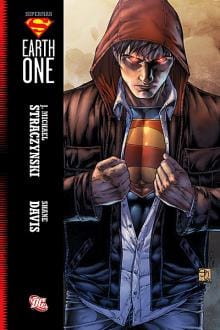
 I finally got around to reading Superman: Earth One — the new graphic novel written by Joe Straczynski and illustrated by Shane Davis. Which means I can now comment on some statements by Bill Donahue of the Catholic League for Religious and Civil Right, as quoted by the Christian News Service.
“It looks like the new Superman should have great appeal to the Columbine crowd,” Bill Donahue, president of the Catholic League for Religious and Civil Rights told CNSNews.com.
“After all, he’s moody – not pensive, but moody – and he’s got that hood on him. I think people who want to shoot up innocents in high schools will look at him and say, ‘He is hip.’”
Donahue said there is clearly an attempt to portray the new Man of Steel as looking more like he leans towards evil than good.
“Which certainly goes to show how intellectually bankrupt these people are. They can’t create a new figure and make him appeal to the Columbine crowd,” he said. “What they have to do is to hijack and to crib off of an image which people all over the workld can identify with in a fairly happy way. But they don’t want to make him happy. They want to make him moody. So it obviously suggests that there’s something about our age that they think this might appeal. It doesn’t say anything positive about our culture to think that young people might be drawn to a character who looks like this.”
It’s hard to get a grip on Donahue’s arguments here because there’s about eleven kinds of crazy here. But let me try.
- This the “new Superman.”
- This is designed to appeal to the “Columbine crowd” because he’s “moody” and wears a hoody.
- Superman is being designed here to look evil.
- It’s bad enough these “intellectually bankrupt” (what does that mean, anyway?) can’t come up with a new character to appeal to the “Columbine crowd,” but they have to “hijack” a “happy” character and make him “moody.”
- If any young folks are drawn to a character who looks like this, it’s a bad thing.
Wow. Where to start?
Regarding #1, this is a parallel reimagining of the mainstream Superman character. It’s sort of like seeing someone do a modern interpretation of a Shakespearean play. My understanding is that we may well see more of this particular iteration of Superman (and maybe a world around him), but it’s not intended or anticipated that this is going to replace the “real” Superman.
That said, it’s also clear that Donahue has very little knowledge of anything about the world of comics. I suspect he still thinks of Superman as he was back in the 50s and early 60s, the “Big Blue Boy Scout,” fighting bank robbers and the occasional colorful opponent like Lex Luthor (between prison terms) and Braniac (who looked like Lex Luthor, except he was green).
Remarkably, comics have evolved in some ways since then. They are less designed for 9-year-olds, for one thing. And they attempt (in varying degrees of success) to deal with more mature themes. In some cases, it’s simply being more violent and/or sexy. In other cases, it’s being more psychological, more philosophical, more contemplative of what it means to be unique, or powerful, or to face evil, or to be a vigilante. Superman himself, in recent years, has had to deal with a variety of personal problems.
If someone were to recreate Superman today, is it unreasonable to think that he might not simply be a grinning idiot who stands in front of an American flag and boxes the ears of miscreants? Even the 1978 Superman: The Movie dealt with issues of Supes figuring out his place in the world — what it meant to discover his alien origins; how his step-parents, the Kents, loved and guided him; trying to figure out what he should do with his life, how he could fit in, whether he could or should have a relationship.
All of which echoes what this graphic novel is all about.
The fact is, I doubt very strongly that Donahue actually read this. He read a synopsis (“Hey, did you hear they’re making a new Superman, and he’s in his 20s and moody. Look at this picture!”) and he was away at the races.
That’s the only way I can think of that he might entertain any vague idea that this might appeal to the “Columbine crowd.” Now, to be sure, I’m not quite sure what group he’s talking about here. The Columbine shootings were eleven years ago. I’m not aware of any organized cluster of school-shooting nihilists still on the rampage today, let along a major comic-book-buying demographic.
Donahue seems to think that “moodiness” and wearing a sweatshirt with a hood is a sign of impending bloodbaths. If so, given current teen fashions and perennial teen moodiness, I’d expect to hear about school shootings on an hourly basis. Strangely enough, I don’t.
By the way, my daughter wears a hoody. She also enjoys skull-and-crossbones motifs and the Addams Family. As far as I know, she is not planning on shooting up her school. (Or, to be honest, reading Superman).
The idea that Joe Straczynski is out to somehow appeal to the “Columbine crowd” is laughable beyond imagination. His Superman may be conflicted, but he’s a good man, who takes the lessons of his step-parents to heart, and who acts positively and constructively to defend the planet and the people of Metropolis. I’m sure that some would prefer a Superman that never has any doubts or questions or uncertainty … but I kind of like one who is, dare I say, human.
In short, Donahue’s accusations — this is a replacement of his beloved Superman with some sort of gang-banging, cranky school shootist, as part of an intellectually bankrupt effort to appeal to that particular demographic — would be merely a giggle if Donahue weren’t the self-appointed protector of all that is Christian and Catholic and Good. And that there are people who actually listen to him.
Now, Donahue isn’t the only person making silly comments in this story, but his are sort of the centerpiece of the article. Some of the other commentary (both quoted and through the article’s writer) worth poking fun at:
The creators also portray the new Superman as politically correct — refusing to become “an instrument of politics or policy” of the United States, saying things like: “I was raised in this country. I believe in this country. Does it have its flaws? Yes. Does it have its moments of greatness? Yes. Bottom line is, it’s my home and I’ll always carry those values around with me. But if I do what I can do just for the U.S., it’s going to destabilize the whole world. It could even lead to war.”
I think that concept has been floating around in comics for, oh, a quarter of a century or so. They were a centerpiece of Alan Moore’s Watchmen. And they’ve been addressed in Superman (and other comics) for at least as long.
But for some people, it’s not enough that Superman should love his adopted country, should feel affinity to its values and desire to protect it — he has to be a gung-ho jingoist, out to be “an instrument of politics and policy” of the US. Maybe we should send him into Afghanistan, or Iran, or Korea — or China, or any of our economic competitors. What could go wrong?
Adam R. Holtz, senior associate editor of the youth culture magazine Plugged In, told CNSNews.com that the re-design was obviously spurred by the success of the movie “The Dark Knight,” which re-imagined Batman in a much darker way.
“We have to look at ‘The Dark Knight’ as sort of a template for what they’re trying to do with these superheroes,” Holtz told CNSNews.com. “Unfortunately, it seems like ‘dark’ and ‘brooding’ – and everything that goes with that – sells.”
Note that Plugged In is a production of Focus on the Family, which should tell you where it’s coming from in terms of examining and evaluating “youth culture.”
Actually, I could see Superman: Earth One as a great movie. But, really, was The Dark Knight that much darker of a “re-imagining” than Tim Burton’s psychologically twisted Batman/Joker pairing? Regardless, SEO doesn’t actually break a lot of new ground in terms of what’s been going on in discussing Superman, or Superboy, in comics terms over the past decade. I’d say that TDK was actually a reflection more of the culture and violence/grittiness, as inspired by comics, than the other way around.
Comic book characters both reflect and shape how we look at our time and culture, Holtz said. Disturbingly, the newly re-envisioned Superman is a good metaphor for this particular day and age in America, he said.
“Truth, Justice and the American Way are all under attack, pretty much however you would like to look at it,” Holtz said. “A lot of people don’t believe in Truth or Justice anymore, and the American Way used to be something that we would fight for, but now there are a lot of people who would say the American Way is inherently a problematic thing – and so it gets deconstructed in popular culture.”
Give me a break. Lots of people believe in the Truth as a goal — they just don’t believe in facile presentations of it by dint of authority, or that the Truth is simple and something that can be easily gleaned from a book, a Sunday sermon, or a political speech.
A lot of people believe in Justice. They just don’t think that it, like Truth, is as simple as pointing to evil-doers and punching them out.
As to the American Way — what is that, exactly? Democracy? Capitalism? Care for the poor? Opportunity for the rich? Equal opportunity? Never give the sucker an even break? Tolerance? A Christian nation? What American Way are we promulgating overseas? What are we teaching it to be here at home? Come up with a common definition, I’d be more than happy to comment about whether it’s “a problematic thing.”
Maybe it is a problem that we don’t have a common definition for it. I suspect that Mr. Holtz has an idea of what he thinks the American Way represents. I strongly suspect it doesn’t match mine.
And maybe that’s why it gets “deconstructed in popular culture.” Is that actually a problem?
* * *
So … what did I think of the book?
Not bad. Young Clark being a bit angsty is, as mentioned, nothing terribly new, though it’s nice to see it addressed so directly.
Some of the new plot elements are interesting — the idea that Krypton’s destruction isn’t just a random happenstance, and the idea that Kal-El’s presence here on Earth might constitute a danger to the planet, as well as being a matter of interest to the military. It’s not radically new, but it’s presented well, and creates some interesting conflicts I look forward to being further explored.
The art is serviceable — a bit stiff in places, but well-rendered.
It’s not the most faboo comic of all time. Nor is it the Comic Book of the Beast. I’m glad I read it. If only Bill Donahue actually had.
George commented on GReader: “If Superman weren’t conflicted, he’d be really, really dangerous.”
A good point. Really powerful people who feel no doubts, no uncertanty, no awareness of temptation or darkness, no desire to examine their motivations or premises or feelings … aren’t healthy. You can see it in socipaths. You can see it in megalomaniacs.
But that’s what some people think a Good and Virtuous Person would be — completely secure in how they felt, never doubting or questioning, possessed of infallible knowledge with nothing to restrain them from acting on it. I’m sure Donahue wishes that Superman was a clearer and less ambiguous Christ figure — but, heck, even Christ had periods of self-reflection and doubt (his 40 days in the desert; his evening in Gesthemene; his crucificion). And even St Paul acknowledged his own flaws and conflicts and failings.
But some people look for the simple, easy, unthinking, uncritical Good Guy.