The Sensuous Curmudgeon wrote about this zany WorldNetDaily article, and then Les commented that it could use a good fisking, but it would be hard to do justice to it …
… well, who can resist?
It’s a sweet little opinion piece titled “Atheists don’t have no songs,” by famed (well, at least former) SNL comedian Victoria Jackson. That she’s a comedian means sometimes it’s difficult to tell where she’s being serious and where she’s just being funny and where she’s being passive-aggressively serious covering it up as funny (“Oh, you folks just can’t take a joke” kind of thing). But let’s give it a try.
Victoria starts off with a shout-out to fellow comedian and one-time SNL guest-star Steve Martin. (You can tell they know each other, because she pointedly includes a picture of the two of them from SNL.)
Steve Martin is a comedy icon. He has a new banjo album out containing his new ditty, “Atheists Don’t Have No Songs.”
Actually, Martin’s a fascinating character, having gone far beyond his arrow-through-head routine. And here’s the song she’s talking about:
Now, I happen to think that’s pretty amusing. Not only is the music darned good, but the lyrics are pretty funny. And it raises an interesting issue. Certainly religious music has a core role in Western Culture across the centuries, and even today music is a key part of most religous worship services — hopefully inspirational and beautiful, but even with mediocre still a source of common worship and tradition.
So what can atheists, lacking that ideological tie to that musical expression, do? Enjoy the music per se, regardless of its origin? Create their own? Find other forms of cultural expression?
Steve Martin says, “I thought there should be at least one gospel song that represents those who might not be religiously inclined, even though I think of this song as quite neutral.”
As I said, amusing.
It is wise for an entertainer to stay neutral on politics and religion. You don’t want to lose half your audience.
Well, maybe (that kind of makes it sound like an even “us” against “them” kind of thing). Entertainers, though, especially comedians, often run risks around being offensive, even in areas of religion and politics. You’d think a former SNL comedian would remember that.
This is difficult for Christians, though, because God commands us to “proselytize” – “Go into all the world and preach the gospel to every creature” (Mark 16:15, Matthew 28:19).
The Great Commission does say that Christians should spread the Good News. Of course, what that Good News is, and how one goes about doing so, is open to some interpretation.

There are those who feel that the Gospel is a checklist of specific orthodox doctrines, and that they can only spread it by hammering folks over the head with Bible passages, taking over schools and legislatures to teach Bible lessons, and denigrating non-Christians (and those who don’t qualify as True Christians) as tools of Satan.
And there are those who think the Good News is that we are cared for by God, and are called to care back, and who believe in preaching the gospel through actions, by loving God and by loving their neighbors as themselves.
Though philosophy major Steve Martin may see his song as neutral, I detect a hint of atheism, …
Um … what?
I mean, the song doesn’t really say anything about religious truth. It amusingly suggests that, while atheists don’t share in the rich musical traditions of religious faiths, at least they get to sleep in on Sundays and watch football. That’s hardly a ringing endorsement of atheism. It is, in fact, kind of a truism.
And, even if so … so what?
… and so does magician and outspoken atheist Penn Teller here.
Actually, that’s not “Penn Teller,” it’s Penn Gillette. Get that billing correct, Victoria! It’s something you show biz types are supposed to be big into!
For the life of me, though, I can’t figure out how what Gillette is saying here has anything to do with Martin’s song having “a hint of atheism.”
In the video above, Penn says he respects Christians that proselytize. He says that if you truly believe John 3:16 and don’t tell people, you must “hate” them. Penn insists that he has not converted yet and is still an atheist.
Actually, um, what he says is that he doesn’t respect Christians who believe in Hell for unbelievers not doing what they can to convince those unbelievers (atheists, Jews, Jains, whomever) to convert, putting it in terms of seeing someone about to be hit by a car and what one is morally compelled to do.
Yes, there’s something to be said for that position. If you really believe that someone is in mortal (or perhaps immortal) danger, then as a moral person you’d have to act, right? Even if they don’t like it.
Of course, nobody can be compelled to convert (unless you’re proposing an Inquisition, of course, ha-ha-ha), and being overly, um,vigorous about proselytizing can be, in fact, counter-productive to promoting actual faith. We’ll leave aside the temptations of power and domination that Taking Over the Kingdom of Earth for Christ can cause, and simply suggest that we might better consider God’s mercy both toward those who don’t meet the doctrinal checklist and those who have the arrogance to think they actually have the doctrinal checklist to eternal salvation.
I can think of some atheist songs: “Imagine” (John Lenin), “My Way” (Sinatra), “Go Where You Wanna Go” (The Mamas and The Papas) and mine, “The Atheist Song”:
“Imagine” is often used a celebration of atheism:
Imagine there’s no Heaven
It’s easy if you try
No Hell below us
Above us only sky
Imagine all the people
Living for todayImagine there’s no countries
It isn’t hard to do
Nothing to kill or die for
And no religion too
Imagine all the people
Living life in peace
I’ve never been fond of the song, to be honest, though less for the lyrics than just because I’m not a big John Lennon fan, musically.

I don’t think I’ve ever heard Sinatra’s “My Way” (Paul Anka wrote the lyrics to the French tune) described as an atheist song, though I can understand it.
And now, the end is near,
And so I face the final curtain.
My friends, I’ll say it clear;
I’ll state my case of which I’m certain.I’ve lived a life that’s full –
I’ve travelled each and every highway.
And more, much more than this,
I did it my way.
I guess, because it’s not “I did it God’s way,” it’s a paean to atheism. Ditto for the radical anti-God (um, not really) lyrics of “Go Where You Wanna Go“.
As to Victoria’s song …
… um …
… I’ll let you click through to if if you want. Suffice it to say it’s a vague attempt at a humorous ditty about how an atheist who is an arrogant know-it-all, and who, whose intellectualism and disdain/hatred of God is something she “talks about it all day long.”
Get it? Atheists don’t think God exists,, so all they do is talk about God “all day long”! Those wacky atheists!
Ha!
Don’t call us, Victoria, we’ll call you.
On the 2 freeway between Glendale and La Canada there is an Adopt-A-Highway sign, “Atheists United.”I’ve always wondered what a group like that would sit around and talk about …
“… Yep! No god.”
“… Yep. No god.”
“… How long you been an atheist?”
“Couple years.”
“Did you see the Congressman Weiner photo?!”
Get it? It’s hi-larious! Because, you see, atheists are defined by not believing in God, so all they must do when they get together as a group is talk about … not believing in God! It’s zany!
Of course, I’ve known some church groups that talk, occasionally, about things that are not, in fact, about church.
But, again, aside from the cheap laugh … so what?
My husband, daughter and I went to Julia Sweeney’s play “Letting Go of God,” about her journey from Catholicism to Atheism. My daughter was about 11 at the time. At the end, she said, “Mommy, it’s like a testimony – but the opposite.”
Imagine that — a story about how someone comes to a belief decision (even if it’s a decision to step away from a belief), and it sounds like … an belief decision. Wow.
At the end of her play, Sweeney looks up at the stars in awe and says something pithy and reverent about … science. Aha! That is her god.

Ah, the tired old “Science is the God of Atheism” meme. But, of course, there are folks who believe in God who believe in the process and knowledge of Science. It’s not an either/or decision. True, some atheists think it is. Sadly, even more religious think so as well.
“They exchanged the truth of God for a lie, and worshiped and served created things rather than the Creator” (Romans 1:25).
Zing! You know Science (the False God) is False (a False God) because the Bible says so! Woot!
When Julia became an atheist, I couldn’t understand her passionate obsession with it. Why would someone be excited about “nothing”?
While not claiming the attitude as my own, I suggest that she might have been exultant about being freed from an mindset and ideology she found oppressive, destructive, and guilt-ridden. One might as soon ask why a slave might be “excited” about lack of ownership.
Her website, blog, play, movie, new friends and then speeches across the country lent themselves to more of a movement or cult than a simple realization that there is no God.
Of course, it’s also true that people who undergo a big change or reform in their life are often enthused by it, sometimes to excess. Think of ex-smokers. Or think of folks who find religion. They can, sometimes, be insufferable, no matter how worthy the cause, and will almost inevitably seem that way to those they left behind.
Not to say, of course, that Julia isn’t hopping on some sort of movement bandwagon. That happens, too, with causes both worthy and un-. But I don’t know her well enough to say.
We both appeared on “Politically Incorrect” in the ’90s:
Just in case you forgot that Victoria was/is a star, popular enough to show up on PI.
I’ll pass on the clip. You can watch the ten minutes if you like. It’s pretty goofy in general, and Victoria in her little-girl voice in particular. Let’s get back to what Victoria is actually arguing.
As to Mahr’s comment and my flub on the gospels – the gospels of Mark and Luke do not name their authors, though church leaders as early as A.D. 125 and 175 assume it’s Mark and Luke. Church tradition has the disciple Matthew writing his gospel and the apostle John his around 90 A.D.)
I missed the “flub” — but it doesn’t seem important. You can read more about the history of the four Gospels — their authorship and when (and by whom) they were actually proposed for inclusion in the Biblical canon — here, among many other places.
In answer to my question, “Why be so passionate about something non-existent,” …
Leaving aside that whole question of perceived value of freedom and truth, of course.
… Kenneth Samples offers this explanation for the recent interest in atheism: 1) Rising radical Islam and terrorism make “religion” seem dangerous. (They forget that atheists Stalin and Mao killed more people than any other religion); …

An interesting thought of how an aggressive, dominating religion can discredit religion in general. Something some Christians might want to consider.
As for the ol’ “Stalin and Mao” meme — yeah, they were (so far as we know) atheists. But their killings weren’t in the name of atheism. They were in the name of power, and of their particular nationalist/political ideology. Killing in the name of the State, or the Motherland, or the People, or the Proletariat is not an act of atheism.
In theory, an atheist — well, a rational atheist, one that is consciously, skeptically, trying to judge a reasoned course — would reject ideologies of all stripes. Few humans are quite that good, of course.
… 2) Reaction to Intelligent Design (ID); …
I questioned this one, until I read what Samples wrote on the subject, claiming that ID was seen as an imposition/invasion by religion-based science (ID) on atheistic-based evolutionary science’s turf, and use politics, not the scientific method, to make it so. Defensive, Samples argues, the atheists become uber-atheists, further egged on by too many anti-science Christians mocking their scientific worldview itself.
Um … okay. I’m not that impressed by Samples’ suggestion.
and 3) “Ultimate concern” – every person, including atheists, identifies and seeks out an essential issue or source of value in life. For those who reject belief in a transcendent, personal God, this ultimate concern may be attached to an imminent, impersonal matter, such as hedonism, ethnicity, politics, or science.
There may be something there. It does seem that humans like to latch onto something, a higher cause or power, theistic or not. That doesn’t validate, or invalidate, any particular ultimate concern. Nor does it speak to the value of what may have led to some such identification of “ultimate concern.” I think we’d all agree that not all such concerns are of equal worth, nor are all as reasoned or reasonable.
I’m watching “The Religion of Evolution.” Gary DeMar points out that evolution (atheism) contains the four components of a religion: 1) What am I? 2) Where did I come from? 3) Where am I going? 4) What should I do on the way?
Now, see, that’s just silly. Evolution <> Atheism. There are folks who believe in evolution who are theists, and I imagine there might be folks who are atheists who don’t believe in evolution (though probably fewer of the latter).
Nor does evolution speak, beyond biology, to “where I am going,” and certainly not “what I should do along the way.” In fact, in only in a high-level and not very meaningful way does it discuss “what am I.”
Nor does atheism do so, per se. People may adopt ethical systems atop of a disbelief in god(s) that might speak to some of those questions.
But, honestly, what Victoria seems to be doing here is trying to paint atheism as, well, a religion. I guess you could suggest that on some level, to the extent that it consists of a conclusion about the nature of the universe (based on a lack of evidence otherwise). On the other hand, calling someone an “atheist,” and drawing conclusions from it, isn’t necessarily any more meaningful than calling someone a theist — bearing in mind the latter encompasses everything from Christians to Shintoists to worshipers of the Greek Gods to the various faith traditions of the Native American tribes. In some ways, the meaningfulness of atheism comes more from what one decides to believe as a basis for behavior after that.
Michael Ruse, author of “The Darwinian Revolution,” “Darwinism Defended” and “Taking Darwin Seriously,” says, “Evolution is promoted by its practitioners as more than mere science. Evolution is promulgated as an ideology, a secular religion – a full-fledged alternative to Christianity, with meaning and morality. I am an ardent evolutionist and an ex-Christian, but I must admit in this one complaint … the literalists (i.e., creationists) are absolutely right. Evolution is a religion. This was true of evolution in the beginning, and it is true of evolution still today.”
I would suggest that Ruse (a “philosopher of biology,” whatever that means) is mistaken. Evolution is a natural biological and econlogical process, described and studied by scientists in a variety of fields. It doesn’t have “practitioners” or act as a “secular religion.”
Now, if you told me that some folks take it as such, as an ideological anchor in emotional opposition to others — well, yes, I’d believe that. But I’d suggest that this is no more “evolution” than, say, astrology proves that astronomy is a religion.
Nor, I’ll add again, is evolution the same thing as atheism, no matter how many times Victoria suggests it.
As Kenneth Samples notes, “In direct opposition to the biblical view that God created humankind, atheists insist that humankind created God.”
See! Atheism is just another religion! It’s no more rational or believable than Christianity is! Um, wait …
No, I got it! Since atheists aren’t any different from theists, they shouldn’t get any more respect than them! Um, wait …
No, hold on! Since atheism is just another religion, and since atheists are against religion, they’re really against themselves! So they’ve just dis-proven themselves! So they should all become good Christians again! Woot! We’re Number One! We’re Number One!
Let me put the above another way. Theists have failed to provide a convincing argument to atheists that God exists. The correlary to that conclusion must be that God is a human invention. That this is in “direct opposition to the biblical view” is, well, meaningless. It’s like saying, “You can’t deny Communism! That would put you in direct opposition to Das Kapital!”
I’m watching “Collision: Is Christianity Good for the World?” It’s a debate between famous atheist and journalist Christopher Hitchens, who calls Christianity a “wicked cult,” and Pastor Douglas Wilson, who says, “There are two tenets of atheism. One. There is no God. Two. I hate him.”
Goofiness. It’s a restatement of the “Atheists are just believers who are angry at God” idea. Which is kind of like saying “Christians are just Jews who are angry at the Sanhedrin.”
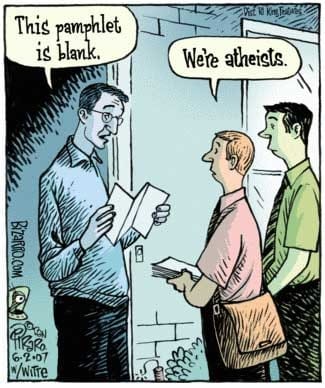 I’ll accept that there is one fundamental tenet of atheism: a disbelief in God. Some leave it at that — while they might think that they’re more in touch with the truth than some others (if not, why believe it?), but they take a live and let live attitude.
Others look at religion — and what evils are, in fact, committed in religion’s name (as well as concerns over the whole basis of a belief system they think is based on error) and are more vigorous (if not aggressive) in their criticisms. Hitchens is, of course, one of them.
I find it off-putting, even when I can understand it, just as I think rabid Christians alsso do a disservice to their own cause. That won’t be any surprise to anyone who reads my blog, I’d think.
But Wilson has it wrong here: The second tenet is not “I hate God” (which would make no sense), but “I hate what belief in God does to people and society.” I disagree with both tenets — but I can definitely understand where people would hold both.
Heck, I look at what’s been done — and is still done — ostensibly in the name of Jesus, and it makes me ill. Torture, abuse, war, killing, execution, things that seem to me completely antithetical to Christ’s teachings, as I understand them (and for which understanding I’m certain that I myself would be the target of under the right circumstances). If people, claiming to be Christ’s followers, can twist what he said to justify the auto-da-fe, the Crusades, witch trials, forced conversions, enslavement, can anyone be surprised that folks like Hitchens think it’s “a wicked cult”? Especially when Christianity claims to save people from evil, to make them better and more in line with God’s will?
Sure, I can, and do, handwave some of that away as, “These aren’t folks working Christ’s will — they are folks working their own will and using Christ’s name as cover for their greed, lust, selfishness, anger, hate, and pride.” But that doesn’t really help, now, does it? Certainly it doesn’t weaken Hitchens’ argument.
Hitchens now has stage-4 esophageal cancer and as he faces death, has sent out a rallying cry to his fellow atheists: “Remain united and carry on the secular revolution.” If atheism is not a religion, why rally?
Um, in the name of truth and against oppression, as he sees them?
Ironically, one of the scientists that designed the experimental cancer treatment Hitchens is using is an evangelical scientist, Francis Collins.
There is a certain irony there, but, then, there are certainly many scientists who are Christians, and vice-versa. Ironically, there are probably some prominent Christians who have benefited from medical treatments developed by atheists, too.
My prayer for Hitchens is that in his final hours, God will give him the gift of faith (in Christ) (James 1:17, Ephesians 2:8-9).
If God gives him the gift of faith, and that’s what’s necessary to save him … then what’s the point, if it’s a gift of God? That’s kind of silly (or manipulative).
See, my prayer for Hitchens would be for peace and comfort. And, if it makes a difference, God’s grace on him in whatever afterlife we all will face.
Science is not healing Hitchens, but Hitchens chooses to keep his faith in science.
To be fair, God doesn’t heal quite a number of people — good people, Christian people, praying people — every day. But people keep their faith in God. Some of them do, at least. Any thoughts on that, Victoria?
But Hitchens’ “faith” in science is not like a “faith” in God. Rather, it’s an expectation that, if anything can help cure his condition, it will be something developed by medical science, because medical science has discovered the causes of and cured so many other conditions. It’s the faith that sends one to the doctor in the first place, rather than simply praying for good health.
Hitchens is also well aware that science is hardly omniscient or omnipotent. Nor does anyone claim that science is.
Both atheism and Christianity require faith.
I don’t think Victoria’s proven a point that “atheism … require[s] faith.” If I say, “I have seen no indication that there are not invisible tharks roaming the plains of Mars,” my saying so isn’t an act of faith.
The religion/worldview you choose influences every decision you make, including and especially what and who you vote for in elections.
Well, that’s true. And, in itself, the act of voting is perhaps a truer indication of your values (from your worldview) than anything you articulate in a book or creed.
“The fool has said in his heart there is no God” (Psalm 14:1).
Well, yes, one would hardly expect the Bible to say otherwise (or that something that said otherwise would still be in the Bible), would one?
Apologist Jerry Johnson has a great article,“The Blind Faith of Atheism.”
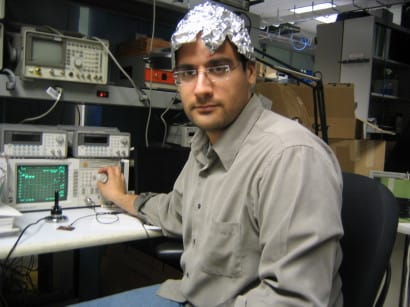
Actually, it’s a bloody stupid article, with the tired old myth of a public “debunking” of a stereotypical straw man atheist academic, outwitted by Godly students. Just to raise three points about it:
- It doesn’t actually prove anything about God, just that one oughtn’t make categorical statements about reality.
- It doesn’t deal with the fact that the same argument could be made to demonstrate the falsehood of statements like, “There are no unicorns,” “There is no advanced civilization of cosmic bees living inside of the Moon,” “There is nobody watching you, invisibly, RIGHT NOW.” “Odin’s eye is upon you and you will be judged by how many enemies you take to Hel with you.”
- God — as Victoria and most Christian apologists frame Him — doesn’t exist in a vacuum. He isn’t a complete unknown, shrouded in that 99%. His behavior and attributes, if accurately and inerrantly described in the Bible, should make Him a demonstrable truth, something inside of that “1%”. If God is not demonstrable within that 1%, that doesn’t mean God cannot possibly exist, but it does mean that our understanding of God is probably not very accurate, in which case criticizing someone for not believing in something that doesn’t behave in a knowable fashion is sort of unfair, don’t you think?
So, in the final analysis, a rational atheist would not assert there is no God, but suggest instead that if there is a God, He does not behave in the way God would be expected to behave based on the Bible or other recognizable “rules”; He may or may not exist, but it seems unlikely that the Bible is a good guide to Him, and until His existence is made manifest, the only logical thing to do is to act on the basis that He doesn’t actually exist, just as we do with unicorns, monsters under the bed, Chthulhu, and invisible friends.
“Human beings can reject belief in God, but they can’t shed inbuilt religiosity due to their being created in God’s image” (Kenneth Samples, Genesis 1:26-27).
Samples takes a leap from indicating that everyone has an “inbuilt religiosity” (“ultimate concern”) to indicating that’s because everyone was made in God’s image. I mean, it’s a pretty picture, but it’s no more founded in demonstrable fact than the suggestion that we have inbuilt religiosity because we are programmed that way by mind control rays hitting us before birth from invisible orbiting alien satellites.
So, ultimately, what have we learned?
- Victoria has been on TV! Multiple times!
- Victoria loooooves painting atheists as snooty, prideful intellectuals.
- Steve Martin sings better than Victoria Jackson.
- A lot of people are confused (willingly or not) between atheism and evolution, but in either case, they don’t seem to have a good idea about what either means.
- Victoria, in thinking all of this proves something profound, is a dolt.
Four kind of un-related comments:
I have always been fond of XTC’s song “Dear God”, which I think is clearly an atheist song much more than Martin’s song is, and which I like because it expresses a philosophical argument in the form of a pop song. It’s the argument from Evil, if you’re curious, and I don’t think it proves what it sets out to prove, but it’s fun to see something I taught in Introduction to Philosophy made into a pop song.
As a comedian, shouldn’t Jackson be aware when something is comedy and when it isn’t? Martin’s song seems to be to be a piece of comedy, not something to be taken as a serious claim about atheism. Whether Martin was a philosophy major or not is completely irrelevant, and when she mentions this, it seems to me to be a kind of ad hominem argument that relies on anti-intellectualism for its force.
I am familiar with one philosophical attempt to argue that ethics is an evolutionary adaptation. This sort of thing doesn’t make evolution into a religion, and I think people who claim that evolution is a religion are conflating the social mechanisms of religion with the belief systems of religion. This sort of conflation is what I think leads people to say science is a religion or secular humanism is a religion or Marxism is a religion. They may conflate the two unintentionally because they don’t understand the concepts or intentionally for political purposes. I think such claims involve the fallacy of equivocation. I’ve seen some stuff online that suggests that Ruse is aware of the distinction, and this leads me to think that Jackson has quoted Ruse in a way that makes it look like he commits that fallacy when in fact he probably does not. So I think Jackson is committing the fallacy of equivocation and is quoting Ruse in a way that shows her failure to understand what he’s said. (Not that I like Ruse or his views, but I don’t think he’s guilty of this equivocation.)
Philosophy of Biology, by the way, is a sub-field of the Philosophy of Science in which philosophers examine the fundamental assumptions of biology — the ones that can’t (yet) be subject to experiment or observation. Morton Beckner, who was in the Philosophy Department at Pomona when we were there had some early influence in the field.
I had not know that about Philosophy of Sciences. Interesting … thanks.
(Not to take a way from any of the rest — good commentary all around.)