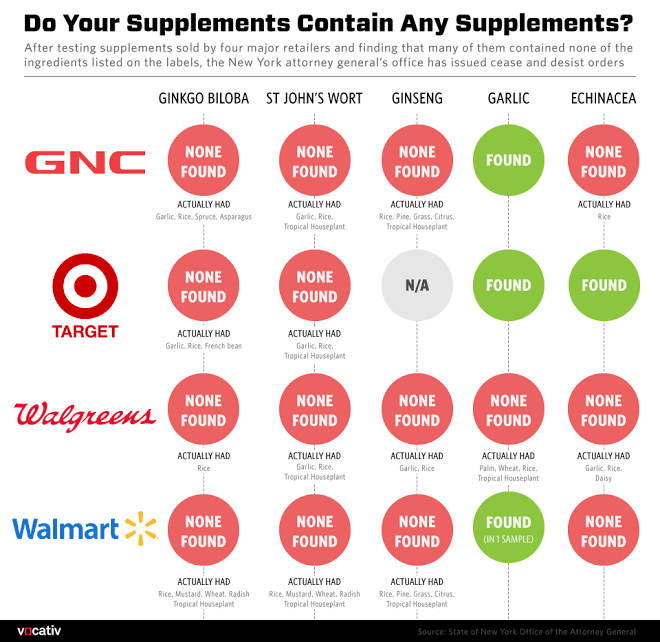
And I'm not talking here about the dubious efficacy of herbal supplements, but how many herbal supplements are completely lacking in the herbs they are advertised to have.
Of course, such supplements are not regulated as food or drugs, because FREEDOM, so nobody has had to prove that they are efficacious. Apparently now one has to wonder if they are even existent.
Or, put another way, while they may be lacking in the key ingredients on the label, they have a full day's supply of your needed placebo supplement.
(h/t +Kee Hinckley)
Originally shared by +Thomas Baekdal:
This is just insane. It turns out that when you buy herbal supplements, you are not actually getting what it says on the label (in the US at least).
Just stop and think about this for a moment. Imagine what happened at the meeting where they decided to create a product where they are listing ingredients that aren't actually in the product at all. What kind of sick person would do that?
Take the GNC “Herbal Plus” Echninacea. The New York State attorney general found that instead of Echninacea (a type of flower), "Five test identified oryza DNA (bamboo). One other yielded the DNA of pinus (tree) or ranunculacae (a completely different flower). And 14 test detected no plant DNA of any sort in the product."
Or what about the "Walgreens “Finest Nutrition” St. John's Wort"? Out of 15 tests, only three contained any DNA, but none of them was St.John's Wort (another type of plant). None!
What did they have instead, you ask? Well… "The tests showed that pills labeled medicinal herbs often contained little more than cheap fillers like powdered rice, asparagus and houseplants, and in some cases substances that could be dangerous to those with allergies."
Specifically: "At Walmart, the authorities found that its ginkgo biloba, a Chinese plant promoted as a memory enhancer, contained little more than powdered radish, houseplants and wheat — despite a claim on the label that the product was wheat- and gluten-free."
This is a scam, and it's done by massive businesses and sold by huge retailers.
I could somewhat understand if they exaggerated a little bit. Like when the ingredient on the label isn't actually the dominant one. I don't approve of that, but I can understand why that happens.
But, in these cases, none of the ingredients listed on the labels were found in the products. None!
What the frak?
Source: http://www.nytimes.com/interactive/2015/02/02/health/herbal_supplement_letters.html

And the annoying thing is, some of these herbal remedies do actually work in proper dosages. But with no way of knowing if what you're buying is the real deal, there's no point in bothering.
I feel like I should be surprised, but I’m not.