Actually, the more Romney's supporters keep defending the "non-issue" of Romney's odd semantics changing "Syria is an ally of Iran and could serve as a base for Iranian naval vessels in the Mediterranean" into "Syria is Iran's route to the sea", the odder the assertion gets.
In the National Review Online's analysis, what it really means is, if the US and Iran go to war (which is the Romney foreign policy team's end game), then:
'As you can see, all of the routes to the sea favored by The Daily Kos military experts are what you might call “blocked” by the U.S. military. If Iran is attacked, their routes to the “sea” will be cut and supply from Syria will be one of their few options.'
Because, of course, in case of a US/Iran war, Iran will be able to rely on supply lines from Syria across the Kurdistan area of Iraq or across NATO ally Turkey. Because, of course, in case of a US/Iran war, material support from Syria is how they will stay afloat. Because, of course, in case of a US/Iran war, neither the US, nor the NATO bases in Turkey, nor the Israelis would ever even think of "blocking" any significant convoys from Syria into Iran. Because, of course, in case of a US/Iran war, the Sixth Fleet would sit on its thumbs regarding Iranian warships that happened to be docket in Syria. And because, of course, in case of a US/Iran war, we're talking about a conventional land war.
'So, once again, Mitt was right.' NRO concludes.
Does any of that make sense? I mean, it makes less sense than Romney's initial statement. If I were them, I'd be hoping that folks would simply forget about it, rather than trying to defend it.
Embedded Link
Fact-Checking Romney’s Comment: Syria is Iran’s ‘Route to the Sea’
Greg Pollowitz writes on NRO: The Left is giddy at Mitt’s latest alleged gaffe, pointing out that Syrian and Iran do not share a border, thus Syria can’t be any sort of “route to the sea.” The Daily K…
'Secondly, Syria's an opportunity for us because Syria plays an important role in the Middle East, particularly right now. Syria is Iran's only ally in the Arab world. It's their route to the sea. It’s the route for them to arm Hezbollah in Lebanon, which threatens, of course, our ally Israel. '
On the face of it, I wasn't too terribly inclined to get all up in arms about Mitt's naming Syria as Iran's "route to the sea". A slip of the tongue, a tangle of concepts, that sort of thing happens in debates. It's a Ford "Poland" gaffe, or an Obama "57 states". Good for a chuckle, but not something I consider critical.
On the other hand …
– Mitt's been going on and on and on, at length, about Iran, about the threat of Iran, about Iran wanting to take over the world, and we need to be ready to attack it, and aircraft carriers and all that jazz. Certainly his Neo-Con foreign policy advisors have been ready to attack Iran for the last decade. You'd think he'd be at least somewhat familiar with the geography of Iran, who it borders, and what sort of coastline it has. I mean, this isn't a trick question about Kazakhstan or Benin.
– Mitt's also been going on and on and on, at length, about Syria — though in more contradictory terms (currently it seems to be "We should be doing more!"). So you'd think (ditto ditto ditto) …
– This isn't the first time Mitt's raised this turn of phrase as a talking point, so it's not just a slip of the tongue.
Now, Syria and Iran have been, kindasorta, allies. Insofar as Iran has any allies, and insofar as Assad can trust that Iran's not one of the backers of the "freedom fighters" in his country. So there are political ties there.
And the maps (like the one below) mocking Mitt's geographical bewilderment tend to overreach (access to the Caspian Sea doesn't really mean a whole heck of a lot, folks).
And maybe he means Mediterranean Sea, even though that ignores that Iraq (and the Kurdish areas thereof) and Turkey are in the way, and begs the issue of why Iran wants to get to the Mediterranean. Well, there's shipping to Europe and N Africa, but that can, and does, go through the Suez canal. And there's the possibility of oil or gas pipelines in the future, with the cooperation of Iraq and/or Turkey.
(Do people still actually use the term "The Levant"? Does Mitt talk about "Levantines," too?)
That's still a very odd meaning to ascribe to the phrase "route to the sea" by Romney. It's not a route. And it's a place on the sea, not to the sea. But I have to assume that's what he actually, clumsily meant. Because I can't believe he quite so stupid as to think that the conventional meaning of "Syria is their route to the sea" is actually the case, and the only other alternative is that he thinks the American people are too stupid to realize that.
Embedded Link
Flunking Geography 101
Way back in February, I remember hearing Mitt Romney claim that Syria is Iran's
One of the "zingers" from last night's debate was apparently Romney complaining that under Obama "our Navy is smaller now than any time since 1917." Leading to Obama's retort that "we also have fewer horses and bayonets because the nature of our military's changed."
Since that point is self-evident, all the Right Wing punditry can do is distort Obama's statement to make it sound like he claimed we have no horses or bayonets in the US military, and that, so, neener-neener, Obama was wrong! He was lying! Romney wins!
Except, of course, that's not what Obama actually said. Nor does it actually address the point he was making, nor advance the debate about the nature and use and needs of the US Navy in 2012, nor even further discussion of the "sequestration" mess that Congress came up with.
But, hey, it's not like "quotations" or "facts" make a lot of difference in some quarters.
Conservative Cavalry Bayonets A Straw Man
Right-wing media figures are trying to change the focus from Mitt Romney's deceptive debate comments on the size of the U.S. Navy by distorting President Obama's statements on the changing nature of t…
This is the one making all the national news: Legalized Marijuana.
(UPDATE: Thanks, Stan, noting that it’s Amendment 64, not 24. Corrected.)
Amendment 64 could be a lot of things, but I’ll be honest up front that it’s a kitchen sink combination of marijuana legalization, taxation, hemp production, etc. and so forth. And that’s probably it’s biggest weakness. We’ll get to that further down.
The state constitutional amendment does the following:
Regulates “growth, manufacture, and sale” of pot in state/local-licensed establishments.
Allows 21-year olds to “possess, use, display, purchase, transport, and transfer” pot in quantities of 1 ounce or less.
Allows 21-year olds to have up to six marijuana plants.
Requires the state to set up an excise task, primarily oriented toward school construction.
Requires the state to enact legislation about growth, possession, and sale of industrial hemp.
Unfortunately, our national drug policy hasn't gotten any less rational than this.
Now individually, I have no problem with any of these provisions. I don’t use pot, and have no particular desire to, but I don’t see it as being particularly better or worse than alcohol or tobacco, with analogous health, behavioral, medical, and practical risks. Conversely, the failure (and high costs in dollars, lives, economic ruin, prison population explosion, personal life disruptions) of the War on Drugs (Pot Sub-Campaign) is demonstrable and unquestionable. Legalizing pot seems a relative no-brainer (cue stoner jokes, yeah, I know).
And, yeah, you restrict it to age 21+, you control the amount that can be possessed, and all that jazz. Just like you do with alcohol. Except no-smoking bans will keep it out of restaurants.
And industrial hemp? It’s just darned crazy that hemp production is against the law, for no other reason than that it’s kind of like marijuana, even if unusable as a drug. Hemp production used to be a vital, useful, industrial crop. It can be again, to everyone’s benefit.
Arguments again the proposition boil down as follow:
It will still be against federal law. True. Colorado has already approved medical marijuana growth and sale, and that’s led to some interesting conflicts with the federal government. But the idea that fighting for legalization of marijuana should therefore be done at the federal level instead turns federalism on its head (even if many of the traditional “states rights” folks are against the idea of states legalizing pot). If Colorado — and other states — take this step, the chances that the federal government will follow suit go up significantly.
Pot is bad for you. Discussed above. Will pot usage increase? Probably (though it might well substitute for alcohol usage amongst some), but I don’t suspect by much. And the law has clear age 21 restrictions; yes, just as under-age drinking occurs now, under-age pot smoking will occur — as it does now. Will it increase? Possibly, but not necessarily. And we’ll be able to talk about it in a much more open and straightforward fashion than the absolutism and zero tolerance of the current War on Drugs regime.
There are a lot of moving parts in this ballot proposal. A lot of stuff — tax requirements, business regulations, etc. — that shouldn’t, on principle or even from a practical fashion, be locked into a constitutional amendment. Fair enough, and probably my biggest objection. Ideally, I’d rather see a law that was much broader in principle and less restrictive in how the legislature makes it work.
Plus, the benefit of dissipated youth orgies to keep our young people off the streets.
On the other hand, in this era when government budgets are considered the highest moral priority in the land, this is a huge winner. Not only does it reduce the spending in our police and judicial and penal systems spent on cracking down on pot in an absolute fashion, but it actually raises sales and excise tax revenue. And the flow of some of that same money into criminal organizations will also drop, which is a good thing.
This is not the ideal marijuana legalization amendment, but I don’t think its problems rise to the level of causing the perfect to be the enemy of the good. I support a “Yes” vote on Amendment 64.
Really tempted to skip watching the final Obama/Romney debate tonight, except that (a) foreign policy is an interest of mine, and (b) I really don't want to depend on highly partisan analyses in the morning as to what was said.
On the other hand, I'm still really tempted.
Embedded Link
The final debate
Will Barack Obama and Mitt Romney fill in the blanks on foreign policy?
For too many people, "Republican = Christian". From the outside of Christianity, Christians get identified with conservative Christian evangelical types, many of whom are Republican … and who, themselves, mistake their particular flavor of Christianity with Christianity as a whole (and, thus, their political affiliation with The Only Party a True Christian(TM) Can Belong To).
As a non-theist I often keep company with people who write off all Christians on the basis of the religious right – which is admittedly the loudest branch of that religion in this country. But it is important to recognize that within Christianity is a broad range of human values, from inexplicably Ayn Rand-ish and hating gays, to OT prophet's concern for the poor. Here's a well-reasoned essay from a Christian who explains why she is a Democrat. It is sad that any Christian or any person for that matter should have to explain…
Embedded Link
Why I am a Christian Democrat
A friend recently watched, helpless and aggrieved, as her husband—a philosophy professor at a conservative Christian university—was pummeled online for co-writing an essay with a fellow professor on w…
Because according to Mitt Romney, biological plumbing determines some things are "rights", and other things are "privileges" granted by states.
Wow. So by that rationale, gays who hold a believe that God has granted them equal rights as His creation only get to exercise freedom of religion to that end as long as the state they are in agrees to grant them that privilege.
And if gays want to publish pamphlets or newspaper articles supporting their positions, well, that "freedom of the press" is a provisional privilege that individual states should certainly be able to decide yea or nay on.
And, by that rationale, one could decide that freedom of religion is a "right" for Christians, but a "privilege" for non-Christians (Bryan Fischer's position). And freedom of speech is a "right" for, say, men, but a "privilege for women. And freedom of the press is a "right" for, let's say, English-language press, but a "privilege" for anyone else.
If you let 'tradition" or "majority rule" or "what I feel comfortable with" alone define what is a right and what is a state-granted privilege, then you really aren't talking about "rights" at all. Because as soon as someone else becomes the tradition-holder, or the majority, or the folks who define what's "natural", then using that rationale any right can be taken away.
Or, rather, it rejects Romney, in an editorial called "Too Many Mitts". Conclusion:
'In considering which candidate to endorse, The Salt Lake Tribune editorial board had hoped that Romney would exhibit the same talents for organization, pragmatic problem solving and inspired leadership that he displayed here more than a decade ago. Instead, we have watched him morph into a friend of the far right, then tack toward the center with breathtaking aplomb. Through a pair of presidential debates, Romney’s domestic agenda remains bereft of detail and worthy of mistrust.
Therefore, our endorsement must go to the incumbent, a competent leader who, against tough odds, has guided the country through catastrophe and set a course that, while rocky, is pointing toward a brighter day. The president has earned a second term. Romney, in whatever guise, does not deserve a first.'
The Trib isn't the LDS-owned Deseret, and it did endorse Obama in 2008 — but it also endorsed Dubya the previous two outings. Again, it's not clear if such endorsements have any significant effect, but to the extent they may reflect some thinking in their community, it's an interesting observation.
There is a saying: "If the Vicar says there's a God, it's all in the way of business. But if he says there isn't, you'd better listen."
In other words the unexpected is more interesting. For example it would not be news if some flaming liberal on Facebook endorsed Barack Obama. But if the Salt Lake City Tribune, right in the heart of Mormon country, endorsed Obama, THAT would be darned curious and worthy of close attention. I read their endorsement and encourage you to do the same. They make very solid points, and I can scarcely imagine the courage it took for them to do it. I would not be surprised if it sinks their
;Gas prices have remained stubbornly high well past their traditional Memorial Day weekend peak, due largely to supply shortages and refinery woes on the West Coast and Midwest. But with oil inventories rising and production issues ebbing, prices have been easing the past week, a trend likely to accelerate. "This is very much gravity at work,'' Kloza says. "The faster prices soar, the more prone they are to panic sell-offs."'
Cue "Obama is manipulating the market to win!" whinging in 5 … 4 … 3 …
More bad news for Romney: Gas prices could drop 50 cents a gallon
Embedded Link
Gas prices could soon drop 50 cents a gallon
Motorists are about to get a big break on gasoline prices, which could plunge as much as 50 cents a gallon by November. Gasoline prices have remained stubbornly high past their traditional summer pea…
If here’s one thing that can stir the blood as much as a presidential campaign, it’s a nice raft of juicy ballot propositions. Our are a bit thin on the ground this year, but include at least one really nice zinger to catch national news attention.
To be honest, I do these blog posts for two reasons. One is to advocate. But the other, frankly, is to contemplate. Like the article last night said, actually having to explain why a policy position works tends to slow one down, moderate views, and really make you think about what you’re saying. Or it does for me, at least.
Amendment S affects the Civil Service provisions of the Colorado Constitution. The Civil Service was put into most governments at the dawn of the 20th Century as a reaction to the Patronage system. Patronage basically said, “Hey, My Guy just got elected, so let’s see if he’ll give me a job.”
If you win today as, say, governor of Colorado, your department heads and chief advisors and “inner circle” are basically yours to play with, but get down a couple of levels and people are protected by the Civil Service (or the State Personnel System here in Colorado). They can’t just be fired at will and replaced with political cronies and people you want to reward for their campaign support. Under the Patronage system, certainly at a national level, much of a President’s first year was taken up with an endless stream of job applicants for any federal job under the sun, and it used to be the same story at the state level.
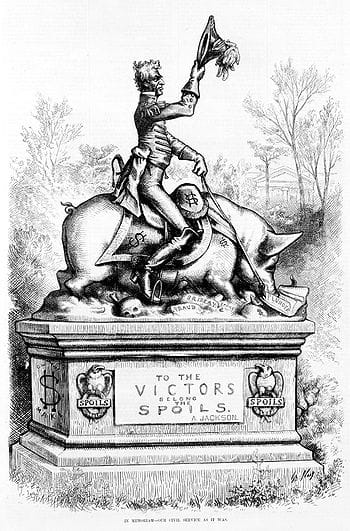
To the Victor Belong the Spoils
The Patronage system was also known as the Spoils system — as in, “To the victor belongs the spoils.” The reward of winning office was not just the power of the office itself, but the power of awarding other office-seekers (and their friends and families) jobs.
Colorado’s Civil Service dates back to 1918, with a big update in 1970 (at which time it was renamed the “State Personnel System”). It covers around 32,500 jobs in mostly the executive branch and offices around the state. There are currently about 41,000 “non-classified” state employees, folks uncovered, by definition, from civil service — mostly judicial, legislative, and state college employees. Mostly higher-up positions in the state government –policy-makers, “managers” — are non-classified. The Civil Service rules require that employees by hired and promoted by merit and fitness, applicants be scored by competitive exam with hiring decisions made from the high scorers, that positions be filled by Colorado residents, and that applicants have a year’s probation before they become part of the system.
Prior to the Civil Service (and, no, this isn’t a binary all-or-nothing decision, but …), all non-elected positions in the state government were effecitively at will, which meant that a new Governor could name his friendly next door neighbor (or the guy who contributed $250 to the campaign) to some nice state government job. And, usually, did. Because once everyone’s a political appointee, then it only makes sense get rid of your predecessor’s appointees (esp. if they were from the other party) and replace them with your own. That doesn’t do much for government efficiency of course, but it does encourage political favors and campaign contributions.
Amendment S works to weaken these provisions in a variety of ways, some more or less defensible. That always makes me a bit leery, to be honest, since I always approach that kind of thing with a cui bono (who profits) attitude. The power to grant “spoils” is a corrupting power, antithetical to the purpose of the state to serve the people. That was the purpose of the Civil Service system, and anything that weakens it had best provide distinct advantages.
Here are the changes in Amendment S:
Ah, for the good old days, when new governors and presidents spent all their time filling offices in return for past and future favors
More political appointees: Amendment S lets the state personnel director designate an additional 1% of classified jobs from the Civil Service, making them at-will political appointee positions. Most departments currently have just one exempt position — the manager a the top. Now you can have more — the assistant director, finance and HR managers, etc. It’s not a huge number, but it strikes me as a camel’s nose under the tent flap. It makes more managers/administrator’s into potential political patronage targets for the Governor.
But because it’s such a small number, and presented as the most prominent part of the proposal, then it will probably promote shrugs. It’s not a huge number, but … who benefits by it?
Less stringent testing standards: To fill a Civil Service position, you have to test and rank all the applicants, and then choose from the top three scorers. The amendment lets you come up with other “professional” and “objective” ways of ranking applicants — search committees, etc. — and then lets the hiring manager choose six candidates for the final decision, even if they are not the top scorers per the testing (which thus become a guideline, not a requirement).
The public rules for this will be set by the Governor-appointed state personnel director, rather than the State Personnel Board (see below).
The argument here seem to come down to flexibility (should Department X be able to figure out the most desirable way to pick candidates) vs. objectivity (should Department X be allowed to select candidates with pretty much no restrictions). The Civil Service rule should, in theory, set objective criteria across the state for a given type of position. In practices, that’s not necessarily ideal for a given hiring manager, office, location (and doing well on a test may not be the best way to figure out who is the best hire). On the other hand, depending on how the Governor’s state personnel director sets the rules, this would let the rules be change to allow more patronage to take place.
A bit more preference to veterans: Currently, a veteran (or surviving spouse) gets a “bonus” to add to their test score (5 point in the 100 point exam; 10 points for a disabled vet), but only gets to do this for the first successful hire, after which they can’t apply it to a new position applied for. The Amendment lets vets carry that bonus on to other applications all their lives.
This provision is probably a good one. While one can argue whether it creates a little inefficiency (in theory it could help a less qualified vet beat out a more qualified non-vet), it seems a reasonable trade-off to reward for such service.
It’s definitely the sweet spot of the legislation, in fact. I mean — who could possibly turn down something that helps veterans?
Which makes me suspicious, in fact, because it is a very clear sweet spot. And to my mind, if I look more closely here, it’s actually a lot less meaningful of a reward than it seems. Because per the previous changes, the test scores aren’t nearly as critical any more. Hiring managers can also pick candidates from a wider pool of “highest-ranked” people, regardless of that test score bonus.
It’s bait and switch — here’s something that looks more valuable (under the current system) but is actually less valuable (under the proposed system).
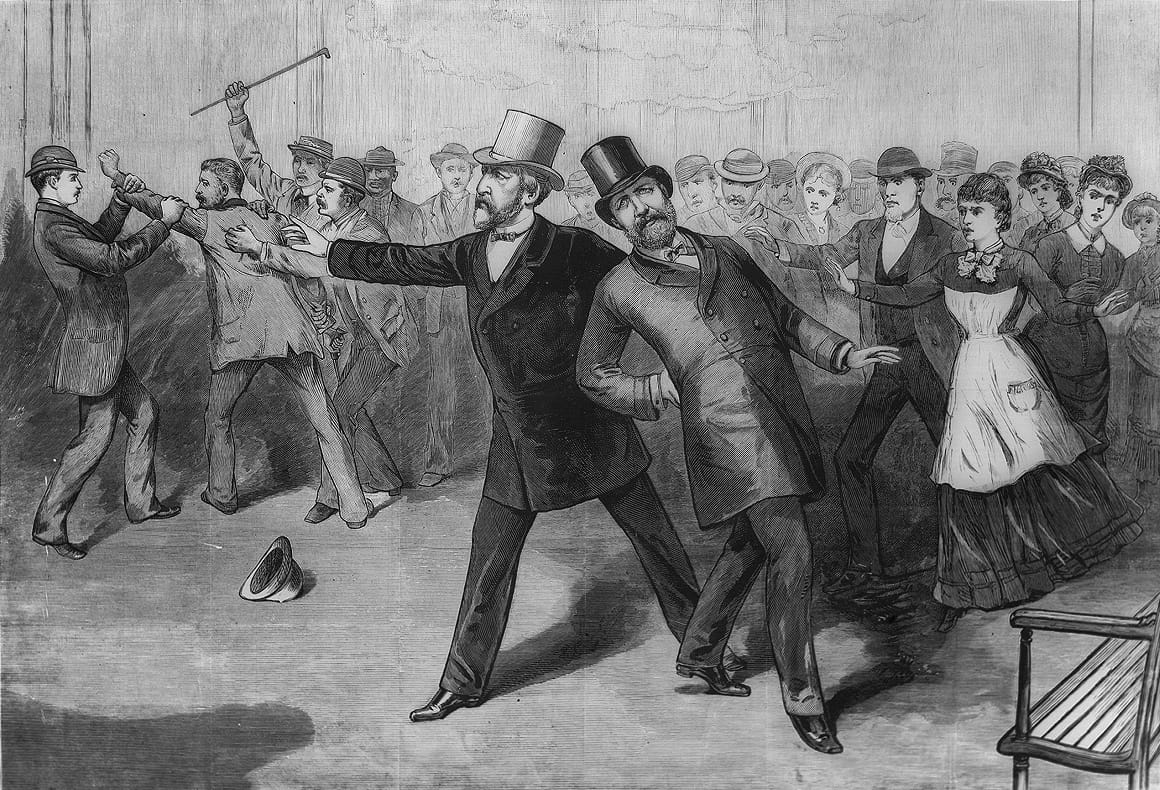
Sometimes disappointed unrewarded office-seekers in the Spoils system got a bit tetchy
More temporary employees: Currently, temps can only be brought into a Civil Service to fill short-term / urgent hiring needs for a maximum of 6 months in a 12-month period. The amendment extends that to 9 months per 12-month period.
The arguments for say this will allow for better being able to meet “seasonal demands” — but, crikey, if you’re talking 3/4 of the year, that hardly seems “seasonal” to me. It might end up letting some one-off projects operate more efficiently with contractors, but is also means is that state offices can fill permanent positions with temps if they can get by with a 75% FTE for the position, saving money and turning more regular jobs with benefits into temp positions. I don’t think that’s a good thing.
More out-of-state employees: The current system says that all state Civil Service jobs be filled by state residents (unless it requires special qualifications and a Colorado resident can be found with them).
Amendment S provides a little flexibility to eliminate the residency requirements if the position is located within 30 miles of the state border. Since most of our state borders are fairly sparsely populated, that’s not a bad idea.
On the other hand, the Governor-appointed state personnel director also gets to waive residency requirements for any position in the system. Arguments for say this allows for more flexibility again for special jobs. But there is already a provision for making exceptions; this just makes it easier to appoint an out-of-state supporter to a government position without their having to establish residency. Maybe that sometimes gets you a better person. Maybe that sometimes means rewarding a political contribtor.
Reduced Civil Service oversight: Policy for the Civil Service system is handled by the independent State Personnel Board, none of whom are in Civil Service, which includes 3 appointees by the governor and 2 elected by the classified employees. They are currently elected or chosen for 5-year terms, and cannot be removed from office by the Governor. The amendment reduces terms from 5 to 3 years, term limits them to 2 terms, lets the Governor remove two appointees at “pleasure”, shifts rule setting for the hiring process (including residency requirements) to the Governor’s state personnel director.
This is both the policy-wonkiest and most insidious of the provisions. It seems to significantly weaken the independence of the Civil Service system both by removing big chunks of power to a direct Governor’s appointee, and by making its management much more beholden to the Governor’s whims. It’s less important what the rules are, if the folks administering and setting the rules are more subject to direct influence.
Summary: Pro-S folks basically seem to say, “Run state offices like private businesses. Just as a private business can hire anyone they want, from wherever they want, and fire them if they want, state positions should adopt that same flexible, efficient, responsive model.”
The problem is, state government isn’t the same as private business. Private business runs on profit, which means efficiency, which means conservation of employees. If a new boss takes over as president of the company, it’s not in her interest to replace all the employees with her friends (most of which didn’t play any role in her taking over the business), just, perhaps, and business-cautiously, some of the top jobs. There’s no benefit to her to replace other groups that are doing well.
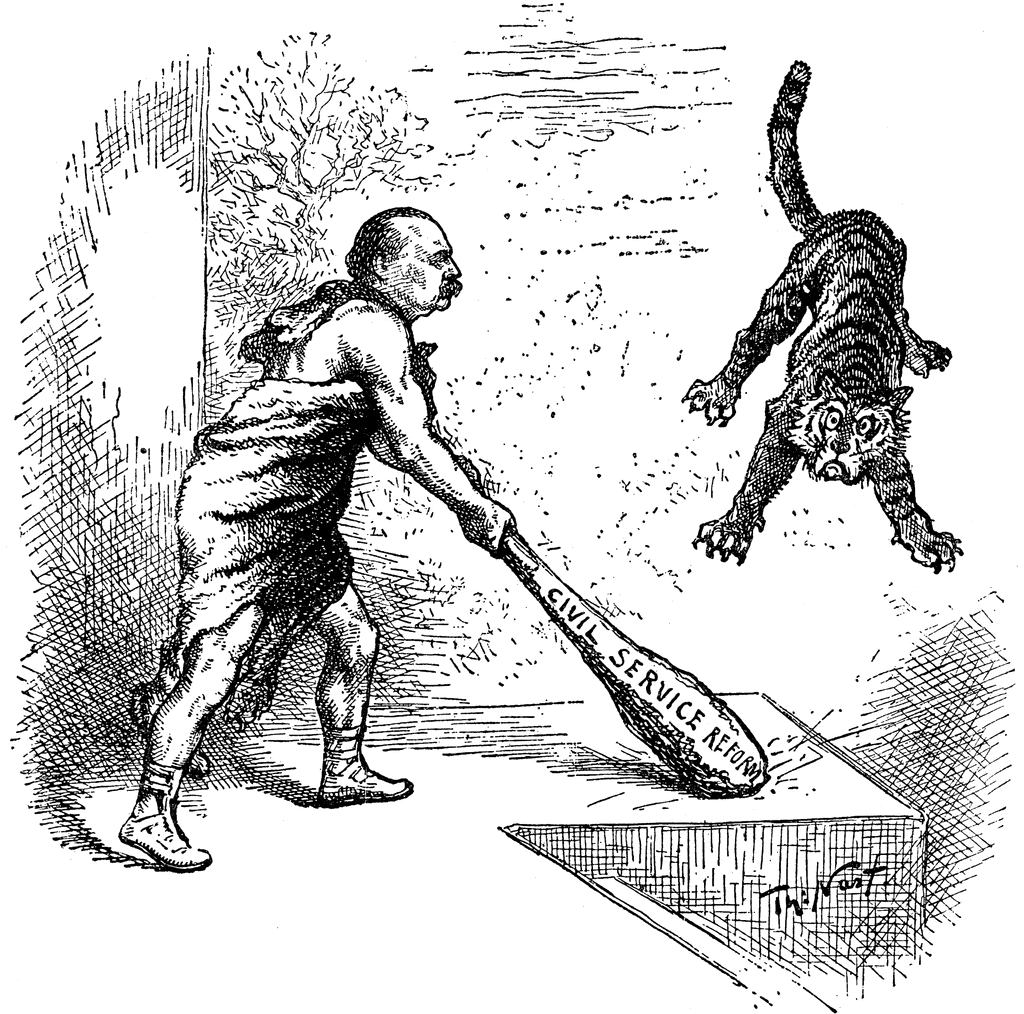
You'd think civil service would have been settled since Grover Cleveland helped usher it in
State offices don’t run on profit, they run on providing services and represent an exercise of state power. In the case of the state, the top boss may change every four years, and may have very different ideas as to what services should be provided and how to exercise that governmental power (and on whose behalf). The Governor may be much less interested in whether the citizens served by a given group are getting what they need, as much as the benefit of appointing a friend or contributor (or friend or family member thereof) to a nicely profitable position. This isn’t hypothetical slippery-slope stuff here — this is how the system was before Civil Service came in.
I know that if I were a hiring manager within the state government, I’d probably find a lot of the Civil Service rules annoying and less than optimally efficient. But more important, if I were an incoming Governor of a certain mind-set, I might find it really annoying that I couldn’t pack more offices with cronies and contributors, and pay off campaign debts by handing out more positions to my partisan allies.
To my mind, that latter is a greater demonstrable risk to the fairness, effectiveness, and representation of government.
Or so says Rep. Joe Walsh (R-Ill), saying that anti-abortion laws don't need to include exceptions for the life or health of the mother because "modern technology and science" render such exceptions obsolete. "Absolutely"
Um … what?
"Because, y'know, pregnancy and birthing is always so easy, and nothing ever goes wrong with gestation, and even if it does then Dr. McCoy can wave his tricorder and have Scotty use the transporter to move the fetus into a life support tube easy-peasey because it's all about science! And science is great when it comes to removing the need for abortion, but don't listen to it about climate change and evolution and other stuff. Oh, and magical medical technology that avoids any need of abortion doesn't require insurance, either, especially not Medicare, which is a good thing, because we have to cut it."
(That last paragraph is not a real quote, but is the only thing within waving distance of a justification for this kind of doltery.)
Amazingly enough, with such progressive and insightful positions, Walsh is actually behind his opponent, Tammy Duckworth, in the polls. Maybe there's yet home for humanity.
Embedded Link
Rep. Joe Walsh: Abortion never saves mom's life – Kevin Robillard
Abortion bans don’t need exceptions for the life of the mother because of “modern technology and science,” Rep. Joe Walsh (R-Ill.) said Thursday. “With modern technology and science, you can’t find on…
"Mitt's gonna keep those promises. I know, because I have his day one schedule right here:
Jan 20th, 2013
8am-noon — Inauguration 12:30 — Appoint cabinet 1:00 — Take photo for White House ID card 1:07 — Retake photo 1:45 — Repeal Obamacare 2:30 — Examine remains of Roswell aliens 3:00 — Unwrap Oval Office label maker 3:15 — Label China a currency manipulator 4:00 — Pick nuclear launch codes — (Maybe zip codes plus Ann's birthday?) 6:00 — Take down Biden's old Erik Estrada posters 6:15 — Get everyone in America a job 8:00 — Activate self-deportation 9:00 — Immigration solved 10:00 — With presidency completed, resign and attend an inauguration of President Ryan." — Stephen Colbert http://on.cc.com/QwuV1M
This is actually pretty interesting, since the Denver Post is considered a center-right paper. On the other hand, it makes sense, since a lot of people consider Obama a center-right (or at least) center candidate, and much of the DP's criticism of Romney is for not running as a centrist.
I'm not thrilled by all the reasons the DP likes Obama — but they're mostly in areas that I'm not thrilled by Obama, either, and the only viable alternative is far worse in all of them.
I have no idea to what degree such newspaper endorsements carry any electoral weight any more, but given Colorado's status as a "swing state" this year, it certainly can't hurt.
(Cue HYPER-CAPITALIZED and heavily-exclamation-pointed!!!!! attacks on "this liberal rag" in the newspaper site comments in 5 .. 4 … 3 …)
Dragged kicking and screaming by two federal court decisions (and a rejection from SCOTUS) to reinstate rull early voting for all voters, Ohio GOP Secretary of State John Husted is playing around with the hours of early voting centers to make it more difficult to find out when voting is possible.
'Ohio Secretary of State Jon Husted swiftly limited early voting hours on those crucial three days to 8 am–2 pm on Saturday, November 3; 1–5 pm on Sunday, November 4; and 8 am–2 pm on Monday, November 5. That means Ohio voters will have a total of only sixteen hours to cast a ballot during those three days. And before the weekend before the election, Ohio voters will still not be able to cast a ballot in-person on nights or weekends.'
I'm sure that folks who are trying to encourage and enable early voting will be letting folks know about those mish-mosh hours. I hope they are also monitoring to ensure that there are enough (working) polling machines to meet the crowds that are expected to turn out.
I've seen reports of this lately, and while I understand the outrage over it, I'm not quite sure it's necessarily outrageous per se.
If one assumes I am acting in good faith, then if I really expect the business climate or particular promised legal changes to occur under a particular prospective Administration, then I think I have an ethical duty to inform my staff of that. E.g.,
"Mitt Romney has said that Program XYZ is wasteful and will be eliminated under is presidency. If you haven't noticed, Program XYZ provides us with 80% of our revenue. If Romney were elected and Program XYZ were terminated, we would be hard pressed to keep the doors open."
I think that would be perfectly legitimate.
Of course, those initial "ifs" are the key here. And it's definitely up to each employee to consider their employer's motivation, and the certainty of what's being predicted (either in general business climate terms, or in terms of specific campaign promises from a candidate).
Indeed, the impact that a particular presidential candidate will have on their job is something workers should already be considering. On that basis, what their employers say becomes one more bit of info to consider. Including, then, the basis for their employer's expressed opinion.
Y'know, I'd really like to believe this is just a simple clerical error. I mean, I know (believe me, I know) how easy it is for typos to make into documents, even documents that have been vetted and reviewed by multiple eyes.
On the other hand, given the Arizonan GOP government's less-than-glorious relationship with its Hispanic population, when the Spanish translation of a major county's voter registration data has the wrong (and a later) date for when the election is to be held … in a county with strongly dominated by the GOP …
If you take what he said last night as canon — cut income taxes 20%, cap deductions at $20K. Result (avoiding any discussion of social or economic costs of deductions thus invalidated):
'Romney is $257 billion short, and the rest of his plan (eliminating the estate tax, eliminating investment taxes for middle-income earners, lowering the corporate tax rate) just makes things even worse. One way or another, Romney has a whole slug of revenue he needs to make up. '
Fair and balanced.
So, either …
(a) Deductions/credits must be capped much lower. Meaning people who rely more on deductions/credits more end up not seeing that "20% tax cut." I believe that impacts the middle class a lot more, as a proportion of income, than the 5%.
(b) Spending must be cut by hundreds of billions of dollars a year. Hmmmm … wonder where Mitt will suggest that come from.
(c) The deficit will climb. Well, we know that's the greatest of all possible evils.
So my bet is on (a) and (b).
Embedded Link
Here It Is, the World's Simplest Tax Analysis
Earlier today I promised you that an analysis of Mitt Romney's tax plan from last night would be a lot easier than an analysis of his earlier plan. As you recall, his previous proposal was to cut rate…
1. Bragging about increased oil production (and from federal lands) and "clean coal." 2. Weak tea discussion of gun control. 3. Denying that government creates jobs.
As the article notes, those are all (currently) centrist positions, and from a campaign perspective they were smart ones to trumpet.
But they support what Progressives have been saying for a long time, that Obama's not only not the Extreme Commie Radical that the Right likes to pump him up as, but he's not really on the Left much at all. Put him back in the 60s, 70s, even 80s and he'd be a mainstream moderate Republican.