 Part of an ongoing series of 5e (2014) Rules notes. See the end of the post for notes on 5.5e (2024) rules.
If we all remember the Golden Rule of D&D Rules — This Is Not A Physics Simulator — then the weirdities of how 5e runs “Size” will … be a little less weird.
Let’s Start with a Table!
| Size | Space | Example | HD |
|---|---|---|---|
| Tiny | 2.5 x 2.5 feet (4/sq) |
Imp, Sprite | d4 |
| Small | 5 x 5 feet (1 sq) |
Giant Rat, Goblin, Halfling, Gnome | d6 |
| Medium | 5 x 5 feet (1 sq) |
Orc, Werewolf, Human, Elf, Dwarf, Dragonborn | d8 |
| Large | 10 x 10 feet (2×2 sq) |
Hippogriff, Ogre | d10 |
| Huge | 15 x 15 feet (3×3 sq) |
Fire Giant, Treant | d12 |
| Gargantuan | 20 x 20 feet (4×4 sq) or larger |
Kraken, Purple Worm | d20 |
So that shows all the size categories, the space they take up on a (square) battle map grid, and some examples … as well as what, in general, their Hit Dice look like.
Most Player Characters are Medium in size — though some races drop down to Small, and a couple of outliers are Large.
How About Some Pictures?
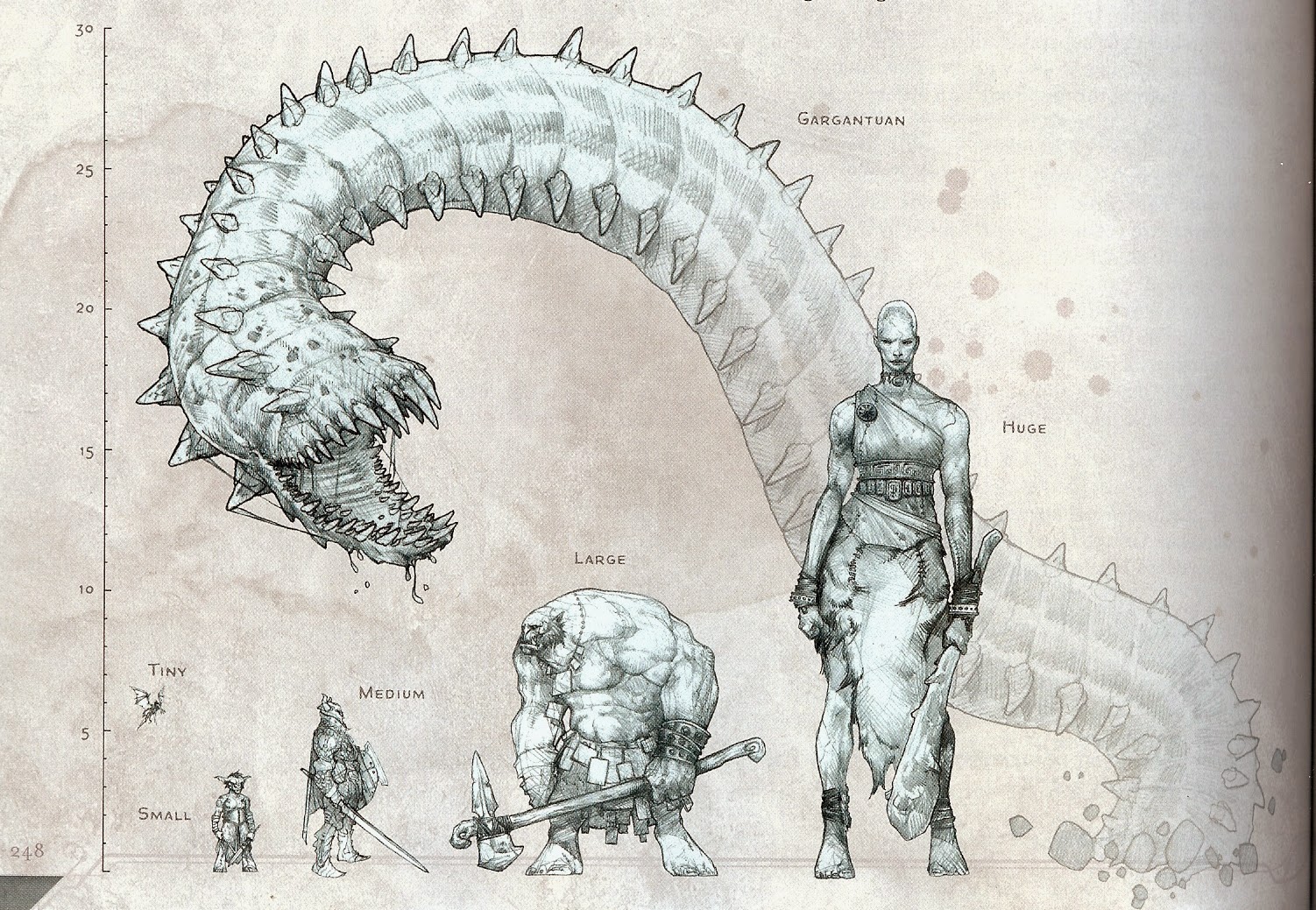
Yes, that’s straight out of the book, but it is so pretty. I will take it down if Hasbro asks me to.
Size and Space
The space described in the table above is that personally controlled by the creature. A human is not actually 5×5 feet, but effectively occupies that space, and rules on passing into or through space apply to all squares so controlled.
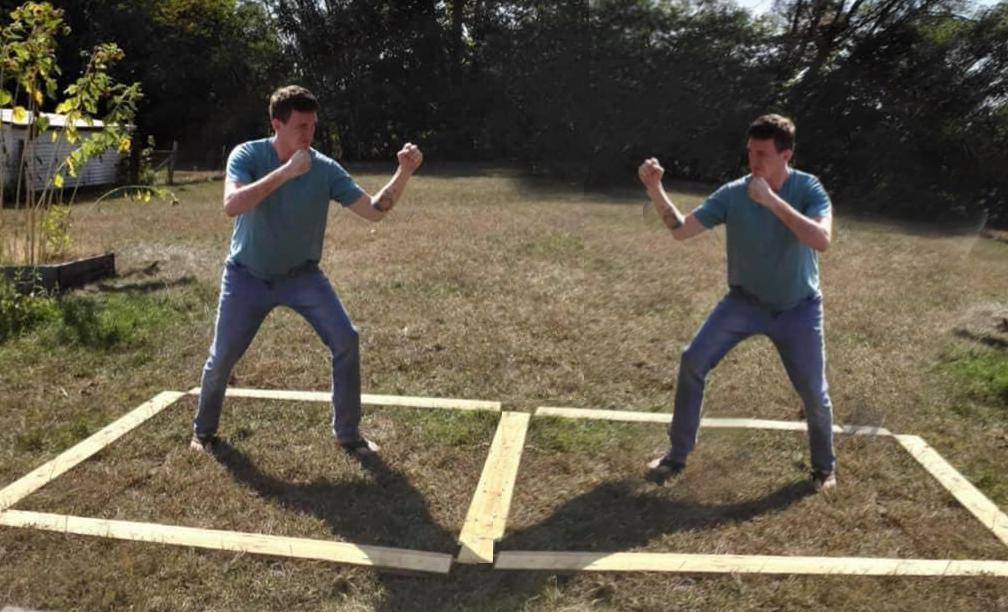
You can pass through an enemy creature’s occupied space (ducking past them, under their legs, etc.) if you are 2+ sizes smaller than them. Note that it’s still considered Difficult terrain (double cost), and if you continue on past their reach they will get an Opportunity Attack. So Halflings can duck past an Ogre this way, while Humans could dodge around a Fire Giant’s legs.
(See also: D&D 5e Rules – Moving Through a Hostile Creature’s Space! – Blog of Heroes)
Note also that some creatures (typically those larger than Medium) may have physical melee attack reach of more than the normal five feet.
Surrounded!
Spaces taken by creatures cannot overlap. That means, for example, if you as a Medium humanoid are surrounded by enemies, how many enemies that is depends on their size. You could be surrounded by eight Medium enemies, but only four Large enemies could surround you. Similarly while you and your Medium friends could surround a Medium Orc with only eight of you, that Large Ogre would need to be surrounded by twelve Medium opponents.
Grappling and Shoving
You only grapple something no more than 1 size larger than you. When grappling, your speed is halved unless the grappled creature is 2+ sizes smaller than you.
Thus, as a Medium Human, you could grapple an Ogre, but not a Treant. Similarly, an Ogre could grapple a Halfling and move off with them at full speed.
You can also only try to Shove something no more than 1 size larger than you.
Getting Small
A creature can squeeze into a space one size category smaller. So a Large creature could squeeze through a 5 ft square opening or 5 ft wide corridor.
When doing so, it counts as Difficult terrain (double movement cost), and the squeezing-through creature has Disadvantage for attacks and Dex saving throws, and attackers have Advantage on attacking them.
What Else Does Size Do?
Not a whole heck of a lot. In 3.5e, small creatures got an AC boost, larger creatures an AC deficit, but this no longer exists in 5e.
Size does have an impact on the Encumbrance load that can be carried, but I try to avoid Encumbrance rules.
How about with 5.5e?
 Not a lot of differences here. The lovely size comparison drawings are lost, alas, though the table of what sizes mean still remains.
Movement
There is a note that “A creature’s space is the area that it effectively controls in combat and the area it needs to fight effectively,” which is useful clarification.
Cover
The squares with the diagrams are also missing on 5.5e (which seems to not like visual rules). Instead, we have a table to define it:
Half – Offered by another creature or an object that covers at least half of the target.
Three-Quarters – Offered by an object that covers at least three-quarters of the target.
One could argue that’s the same as obscuring 1-2 (half) of the square corners of the target, or 3 (three-quarters_ of the corners, but it’s still a bit loosey-goosier. (I will probably continue to use the corners picture).
Grappling and shoving
Grappling remains only possible if the target is no more than one size larger than the grappler. The same is true for Shoving.
Getting Small
While moving through a space “sized for a creature one size smaller than you” remains Difficult Terrain, there is no mention made of combat Advantage or Disadvantage around it. This might be because the rule was moved into the Glossary for “Difficult Terrain,” but it seems an odd change. It might be implied by Size language around the space needed to combat effectively.
One thought on “D&D 5e Rules – Size!”