D&D 5.5e Rules — Hiding and Cover and Surprise and Initiative

Some clearer rules on this would be great. Alas, things are fuzzier than ideal.

dnd 5.5/2024This post is just focusing on D&D 5.5e (2024) rules.  This general category is so messy, I don’t dare try to simultaneously describe  the 5e (2014) variants.

Some of this material is already covered (so to speak) in my posts on Cover and Surprise.  At some point in time I should probably integrate it together, but, until then …

Surprise

5.5e significantly changed the Surprise rules.  Gone is the “you’re frozen until your first turn, then you’re still gimped until your next turn” stuff, in exchange for being at Disadvantage on Initiative.  5.5e also tried to normalize the Hiding / Cover aspects of Surprise, in part by making being Hidden the functional equivalent (and called it by the name) of being Invisible (i.e., having the Invisible condition). Which sometimes makes for odd situations, but …

After a session where things got a bit complicated, I did a re-read of the 5.5e rules (links for all this are down below).  The rules, as always, look straightforward, a framework that should make sense, whether it does or not.  The devil, as always, is in applying it to an actual combat situation.

I’ve linked to some of the rules at the bottom of the post, and [footnoted] to them in what I’ve collected below.

At any rate, fundamentally Surprise happens under a combination of two conditions:

  • when a combatant is “caught unawares by the start of combat” [3] or, as phrased in the 5e rules,  “doesn’t notice a threat.”
  • in a case where being covert (in movement / positioning (Stealth), or in behavior (Deception)) is better than a target’s awareness (spotting someone (Perception), or being aware of their motivation (Insight); this is likely a Passive check, since you only Actively try to perceive such things when you are already aware of the risk/threat of the situation, and so aren’t prone to Surprise because of the first condition).

That second condition is mechanical — dueling skills of various sorts. The first is a bit more subjective and narrative, and requires some adjudication. Can a guard who is watching for an attack be caught unawares? If you’re creeping down a dungeon corridor, looking for an ambush, are you aware that there is a threat (even if you don’t know it specifically)?  How long can you be actively alert for such stuff (that guard might be flagging by the end of the third watch)?  What if the type of combat or threat is itself unexpected (the goblins drop down through the illusory ceiling)?

That’s all why they pay DMs the big bucks.

Something that may tie into both of these aspects is Travel Pace[7].  This often comes up in overland travel from Point A to Point B, but can be applicable within a dungeon — and both affects some of the rolls above as well as the attitude:  e.g., if the players say they are walking at a fast pace to get to the dungeon ahead, there are mechanical effect on their senses, but it’s also an implication they aren’t expecting an attack.

Walking Pace

Feet/min MPH Miles / day Notes
Fast 400 4 30 DISadvantage on Percept, Survival, Stealth
Normal 300 3 24 DISadvantage on Stealth
Slow 200 2 18 ADVantage on Percept, Survival

Surprise is also individual — the Surprise status of each creature on one side or the other can vary depending on the above factors.

Our focus here is mostly on the Surprise that comes from an Attacker being physically Hidden, but bear in mind that it can be broader than that is useful.

Hiding = Invisibility

A potential Attacker can use the Hide action, making DC 15 Stealth check while out of the Opponent’s line of sight, and while[2]

  • Heavily Obscured
  • behind Three-Quarter Cover
  • behind Total Cover

… to effectively become Invisible.[2] (The D20 check rolled by the person Hiding is the DC for someone to Perceive them[2]).

This can be for teeing up an ambush, or mid-battle sneaking about. To get all the advantages of being Hidden, though, you have to have explicitly taken the Hide action; otherwise you’re just getting protection from cover.

Rolling Initiative

First off, Initiative is rolled when combat starts.[4]  Not after someone gets in the first blow or their sneaky alpha strike from cover, but when attack dice are about to be rolled.

  • If an Attacker is initiating the combat (“Okay, team, I’m going to be in front and cast Fireball!”), the Attacker gets (DM’s discretion) Advantage on their Initiative roll.[6] (This one is hidden in the DMG as an option, and is the sop to the “But nobody is supposed to move until I cast my spell” issue.) This rule holds regardless of being Hidden or Surprised or not (yes, the guy who throws the first punch in the bar brawl rolls Initiative on Advantage to do it), but often comes up in context of an ambush or bursting into the enemy’s room.
  • If an Attacker is Invisible (Hidden and unknown to be there by the target), the Attacker gets Advantage on their Initiative roll.[1]
  • If the Opponents are Surprised (they didn’t know the Attacker was there and weren’t in “expecting combat” mode), they roll Initiative with Disadvantage.[3,4]

So let’s say Bob wants to get the drop on an Orc heading off to sleep. He positions himself around a corner (in Total Cover), and explicitly Hides himself (makes sure nothing is showing, tries to stay quiet, etc.).  The Orc figures the hallways is safe and isn’t expecting any surprises, and their Passive Perception isn’t enough to meet the Stealth roll Bob made when he Hid.

Bob gets Advantage on Initiative for starting things, and would also get Advantage on Initiative because he is (until he attacks) Invisible. Advantage only adds once, of course.

The Orc doesn’t know Bob is there, and has no reason to be worried, so they get Disadvantage on Initiative. If the Orc knew that Bob had run away in this direction, and were watching out for him, they would roll Initiative normally.  Ditto if they heard a noise from ahead and advanced cautiously.

Results of Initiative

If, after Initiative is rolled, there are allies who go before the Attacker initiating combat, then if they want the Attacker to get that first strike off, they need to Dodge or Help (if that applies) or, more likely, Ready an action.  (This seems counter-intuitive, as it seems to penalize quick-reflexes folks; a Readied action isn’t as robust or useful as one normally taken. But that’s how it goes; the alternative is to blow the plan for that initiating Attacker to actually initiate the attack.)

If, after Initiative is rolled, any of the Opponents (even Surprised ones) still get a better Initiative than the hidden Attacker, they are (on the honor system) aware something is about to happen and can, within limits, respond first.  Effectively, they are reacting to the Attacker popping out of hiding, even if they can’t directly do anything about it this turn. Faster Opponents can Dodge, try to Perceive the hidden attackers, warn their fellows, throw up magical defenses, etc.

In other words, those Opponents are still reacting faster than the Attacker, even if they can’t see them or directly attack them (yet).

The faster Opponents could, theoretically, Ready an action to shoot anyone who shows up “where I heard that noise.” If the Attacker is effectively Hidden / “Invisible,” that Readied action would not go off until after the Attacker did their thing, because that attack (see below) is what technically drops the “Invisibility” they have.[2]

Okay, so that handles Initiative … how about actual attacks (and counter-attacks)?

Attacks from Hiding

If the Attacker is Invisible (Hidden and unknown to be there by the Opponent):

  • the Attacker gets Advantage on their Attack (this can be any time in the battle, not just on the first round)[1]
  • their Opponent attacks a still-Invisible target with (at best) Disadvantage.[1,5] If where the Opponent says they are attacking is not where their target is, the attack automatically misses.[5]

Note that if the “Invisibility” only comes from being behind Total Cover  (the Attacker has not taken a Hide action, too):

  • the Attacker will not get Advantage for their attack
  • the Opponent can’t see them to target them in turn

The Attacker’s “Invisible” condition from Hiding ends immediately after an Attack roll (or a Verbal spell, or making a sound, or if the Opponent finds them).[2] (In other places it says after an “attack hits or misses,” but I think that’s effectively the same thing.[5])

  • Which, as written, implies that an Attacker with multiple attacks (e.g., Fighters at 5th Level) only get that Advantage to hit on their first attack roll, not on subsequent ones. The condition ends after an Attack roll, not an Attack action.
  • If the Attacker wants to get “Invisible” again, they must duck behind cover and do another Hide to regain that “Invisible” condition.[2]  Just moving back behind Total Cover would give them physical protection, but the Opponent still knows they are there, so the Attacker won’t get Advantage on their next attack (“I know he’s behind that tree so I’m keeping an eye on that”).

Certain spell effects, like Greater Invisibility, can cause the Invisible condition to be instantly restored, or never actually lost, without having to Hide; these are a really annoying complications, just saying.

Net-Net

Is all this complex? Yeah, especially given player and DM cleverness and the wide variety of spaces and situations to which it could apply.  Could it be simplified?  Maybe, but only by handwaving more and more things that “should” be considered important in a combat.

I’ve tried to tie the material above to actual rules, but there is some DM interpretation going on.  If you aren’t sure, discuss it with your DM first; they may have different interpretations than I do.

Would you like to know more?

Here are the rule links for the [footnotes] above.

  1. The Invisible Condition
  2. The Hide Action
  3. Surprise
  4. Initiative
  5. Cover: Unseen Attackers and Targets
  6. DM’s Toolbox: Initiative
  7. Travel Pace


D&D 5.5e Rules – Doors and Locks

Getting from here to there sometimes means going through a thing in-between.

Know the RulesPart of an ongoing series of 5.5e  (2024) Rules notes.  

This one is mostly written from a 5.5e (2024) perspective,  as I needed to clarify all of this for a 5.5e game I was running. Plus, it seems like 5.5e does a bit better job of defining all this stuff, vs. an array of official and unofficial rules around how these things all work. If you’re not sure how it all works in 5e, you could do worse than adopting some of the (backwards-compatible!) 5.5e approaches.

What if I want to break a door?

If a door is barred or locked (always check first!), here’s how you can get through it by brute force. There are two options, one using magic, one using your bodily strength in some fashion.

  • Use the AC / HP for an Attack or (damaging) Magic action against a Medium door. (In theory, you could also use a physical attack against it, though as a DM I’d probably prefer you try with an axe, rather than with arrows.) And, no, the damage type is not spelled out — you can use Psychic as easily as Bludgeoning damages.
  • Use the DC for a Utilize action against a Medium door with a STR (Athletics) check.
Door Type AC to attack HP if attacked* DC to Break Open with an Athletics check*
Glass 13 4 10
Wood 15 18 15
Stone 17 40 20
Metal 19 72 25

* for larger doors of this type, HP x2 or x3, DC + 5.

What if the door is locked?

Time to try and Pick That Lock!

  • Simple locks take 1 Action to try to pick
  • Complex locks take 1 Minute to try to pick

The DC against picking is based on the quality of the lock:

  • Inferior lock is DC 10
  • Good lock is DC 15
  • Superior lock is 20.

Locks can only be picked by someone using Thieves Tools. The basic roll is a DEX (Sleight of Hand) check against the quality DC.

Thieves Tools DEX (Sleight of Hand) Roll
Not Proficient Not Proficient Sleight of Hand
Proficient Not Proficient Sleight of Hand + Proficiency Bonus
Not Proficient Proficient Sleight of Hand (PB is baked in)
Proficient Proficient Sleight of Hand at ADVANTAGE

Note that this follows the 5.5e general rule pattern about tools and the skills using them. Note also that under those rules that it is possible to get Expertise (double Proficiency) in a skill, but not on a tool set.

What about a portcullis?

Portcullis Size DC if Iron DC if Wood
Medium (8′ tall x 5′ wide) 20 15
Large (10′ tall x 10′ wide) 25 20
Huge (20′ tall x 15′ wide) 30 25

If you can’t get to the winch, then the DC is what you need with a Utilize action for a STR (Athletics) check.

If you want to destroy the portcullis, use the AC and HP of a large Metal or Wooden door (above).

Note that targets within 5 feet of a portcullis have 3/4 cover (+5 AC) from attacks from the other side; if further away, they have Total Cover.

Secret Doors!

Difficulty to find:

  • Barely hidden secret doors are DC 10
  • Standard secret doors are DC 15
  • Well-hidden secret doors are DC 20.

A Search action will let you search a 10-foot square section of wall with a WIS (Perception) check against the door’s DC; success means you spotted the door and know the means to open it.

You can also use an INT (Investigation) check if the clues are visible (scrapes on the floor where the door has rubbed it, for example) but need to deduced from or understood.

D&D 5.5e Rules – Weapon Mastery!

How is a sword not a mace or a spear? Depends on how much work you want to do.

Know the RulesPart of an ongoing series of 5e (2014) and 5.5e (2024) Rules notes.  

Something I often joke about here is how D&D is not a physics simulator, and, in fact, is a very mediocre tactical combat simulator.  All games, more or less, are, both because drama is more exciting than reality, and because reality is really hard to simulate

One of the things that D&D 5e (2014) brought to the mix was the KISS principle. Gone was to be the crunchity-crunch-crunch of multiple bonuses and penalties on rolls from the 3.5e period.  Gone was the slick but somewhat joyless tactical detail of 4e. Instead,  5e tried to keep it simple while at the same time making it fun.

By and large, not a bad job. Lots of abstractions, lots of handwaving about Advantage and Disadvantage, pretty good show.

dnd 5.5/20245.5e (2024) for all its plusses and minuses, added a new element to combats by somewhat-popular demand — and which has turned out to be a lot more controversial than I would have expected.

Weapon Mastery!

A Longsword does 1d8 slashing damage.

A Flail does 1d8 bludgeoning damage.

A Morning Star does 1d8 piercing damage.

Are these the same?

weapons
Damage is damage, amirite?

Well, obviously not. A flail slams weights against its target.  A longsword slices and dices (and pierces, but we’ll ignore that for D&D). A morning star pokes little pokey bits backed by weight into its victim. The damage type is different — bludgeoning vs slashing vs piercing — but there is very, very little in the rules were that actually means anything (skeletons being vulnerable to bludgeoning weapons is the only thing that comes to mind).

Abstraction is useful, even necessary, to deal with real-world details that could easily overwhelm.  But too much abstraction is equally problematic. I once abandoned a super-heroes gaming system because there was no mechanical, in-game difference between someone attacking with a telekinetic blast, jet of flame, or lightning bolt. The same, to an extent, is true for weapons and their use.  If a flail = a longsword = a morning star in every way that counts except for your character picture — is that too much abstraction?

5.5e says, “Yeah, let’s see what we can do about that.”

Weapon Mastery?

The Weapon Mastery rules consist of two parts: What It Is and How To Get It

What Is Weapon Mastery?

Weapon Mastery is an additional aspect to weapons that certain characters can get by becoming “masters” of that particular weapon and learning to use its more interesting features.

If you look at the Weapons table, you can see the Mastery column that indicates how a trained user of the weapon can do something extra. That something extra, as spelled out by the rules, includes (with some weapon examples):

  • Cleave: Once a turn, on a hit, the attacker does a follow-on attack on another target within 5 feet of the first and within reach. Damage on that second attack does not include the Ability modifier (unless negative). [Greataxe, Halberd]
  • Graze:  If the attack misses, it still does damage equal to the attacker’s Ability modifier. [Glaive, Greatsword]
  • Nick: When the attacker make an extra attack because the weapon is Light, they can do it as part of your Attack action, not using up their Bonus Action. [Scimitar, Dagger]
  • Push:  On a hit, the attacker can push the target 10 feet away if size Large or smaller. [War Hammer, Heavy Crossbow]
  • Sap: On a hit, the target has Disadvantage on its next attack roll. [Longsword, Morning Star]
  • Slow:  On a hit with damage, the target’s Speed is reduced by 10 feet until your next turn (no stacking). [Club, Light Crossbow, Longbow]
  • Topple:  On a hit, the target makes a CON Save vs DC (8 + attacker’s Ability Modifier + attacker’s Proficiency Bonus) or go Prone. [Maul, Quarterstaff]
  • Vex: On a hit with damage, the attacker has Advantage on the next roll against that creature before the end of their next turn. [Short Bow, Rapier]

How Do I Get Weapon Mastery?

  1. Various martial classes (Barbarian, Fighter, Paladin, Ranger, Rogue) automatically get at a Level 1 the Weapon Mastery class feature. This lets you use the Mastery feature of some (the number varies by class) simple or martial weapons of your choice. You can swap out for another one of these each Long Rest.  For some classes, the number of Weapon Masteries increases as levels go up.
  2. The Weapon Master feat gives you an ASI and (to the point) lets you use the Mastery of one simple or martial weapon of your choice (which can be swapped around after any Long Rest) if you have Proficiency for it. This basically opens up the ability to non-martials.

Pros and Cons

The plus and minus of Weapon Mastery as a game rule is the same: It’s one more thing to do stuff with.

As a plus? It sets apart martials a bit more; it allows additional tactical elements in combat; it improves flavor by keeping flails and longswords and morning stars from all being the same.

As a minus? It slows down combat while tactical decisions are made (do I want to use the push-back? what path? does that mean it would be better to attack this other opponent? etc.); the mapping between the Masteries and the actual weapon is a bit sketchy, so the verisimilitude is strained.

I don’t have a net-net here, until I see how it works in actual gameplay.  To the extent that it adds some additional flavor to folks like Fighters (beyond “I hit him with my sword. And again. And again.”) it seems like it would be a good thing, but it’s easy to understand why some folk think it represents a creeping re-complexity for D&D combat.

D&D 5e/5.5e Rules – Exhaustion!

Slaying dragons is tough. So are 12-hour days and burning heat and bitter cold. And those have consequences.

Know the RulesPart of an ongoing series of 5e (2014) Rules notes.  See the end of the post for notes on 5.5e (2024) rules.

Exhaustion is a special set of escalating conditions that occur when rest or nutritional intake are inadequate, or when environmental conditions (heat, cold) are life-threatening.

Exhaustion consists of 6 levels:

Level Effect (Cumulative)
1 DISADvantage on Ability Checks
2 Speed halved
3 DISADvantage on attack rolls and Saves
4 Hit point maximum halved (HP reduced, if necessary, to the new max)
5 Speed reduced to 0
6 Death

Yeah, not fun. The term “death spiral” literally fits here, since each level of Exhaustion can make it more difficult to remove oneself from the causes of the Exhaustion.

These effects are cumulative, e.g., a creature at Exhaustion level 2 has its Speed halved and a DISADvantage on Ability Checks.

If a creature that already has a level of Exhaustion suffers another effect that causes Exhaustion, its current level goes up by the number described.

A creature suffers the effect of its current level of exhaustion as well as all lower levels. For example, a creature suffering level 2 exhaustion has its speed halved and has disadvantage on ability checks.

Effects that remove Exhaustion reduce the level as they describe. When Exhaustion drops below 1, the creature is no longer exhausted.

A Long Rest will reduce Exhaustion by 1 level, as long as the resting creature has been able to eat and drink. Being raised from the dead also reduces Exhaustion by 1, though that’s kind of the hard way to do it.

Okay, how does this change in 5.5e?

dnd 5.5/2024Though the 5e (2014) rules are pretty simple, 5.5e (2024) makes them even simpler

Exhaustion is cumulative / stackable. You still die if your Exhaustion level is 6. When you have any level of Exhaustion:

  • Your D20 Test rolls are reduced by (2 x elevel).
  • Your Speed is reduced by (5′ x elevel).

So, if you are at Exhaustion Level 3, your D20 rolls (attacks, saves, ability checks) are all reduced by 6, and your Speed is reduced by 15 feet per turn.

Exhaustion can be alleviated by finishing a Long Rest, which removes 1 level. When you reach level 0, you are no longer Exhausted.

D&D 5e/5.5e Rules – Conditions!

This shortcut for describing bad things that can happen to you is pretty handy.

Know the RulesPart of an ongoing series of 5e (2014) Rules notes.  This also covers 5.5e (2024) rules.

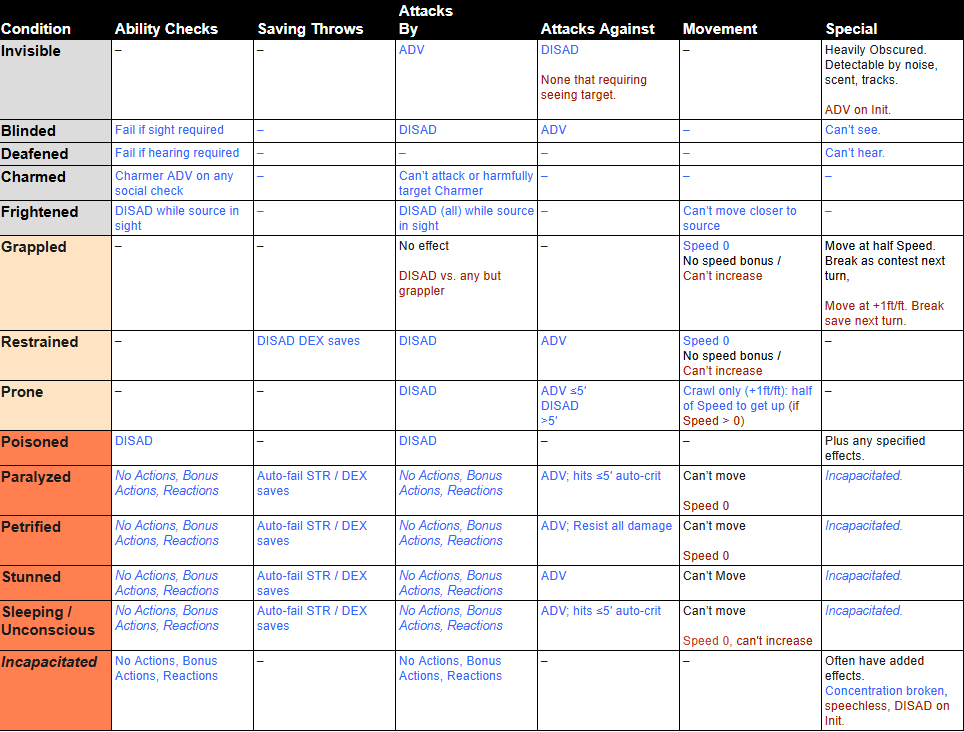
D&D 5e uses common Conditions as a modular way of showing the results of various attacks, spells, environmental issues, etc.  By defining what it means to be “Blinded,” the rules can say that Condition is applied to someone without explaining what it means.

5.5e (2024) continues this, but modifies some of the Condition meanings, as well as adding a few new ones. See here and here.

In the table below, 5e (only) notes are in black, 5.5e (only) notes are in red, and notes common in both editions are in blue.

Conditions in 5e and 5.5e
Click to embiggen

Note that for the Incapacitated-related action restrictions, while 5e did not specify “no Bonus Actions” in the Condition descriptions, elsewhere in the rules it did note that if Actions were not allowed, it was the same for Bonus Actions. The notes of this sort in italics are inheriting it from the Incapacitated Condition.

Note also that Exhausted is another type of Condition, and is the only one with effect that can stack.

D&D 5e/5.5e Rules – Weapon Juggling!

Drawing and sheathing weapons, whilst changing what weapon you are using, gets a little … complicated.

Know the RulesPart of an ongoing series of 5e (2014) Rules notes.  See the end of the post for notes on 5.5e (2024) rules.

This is one that the tables of our gaming group generally do wrong — or, at least, not Rules as Written (PHB 190) for quite some time:  what it takes, action-wise, to change from one weapon to another.

When describing what you can do on your turn, the rules say:

You can also interact with one object or feature of the environment for free, during either your move or your action. For example […] you could draw your weapon as part of the same action you use to attack. If you want to interact with a second object, you need to use your action.

And, under the rule on interacting with objects around you, it says:

draw or sheathe a sword

In other words, you can on any given turn, for free, (a) draw a weapon, or (b) sheathe/put away a weapon … but not both. This means the (very common) “Hmmm, with which of my array of weapons am I attacking with on this turn?” maneuver doesn’t work (RAW).

Round 1 – I plonk the bad guys with my bow.
Round 2 – Ooh, a bad guy is in my face, I stab him with my sword.
Round 3 – I shoot the guy across the room with my bow.
Round 4 – I charge in and stab that guy with my sword.

Nope. Essentially, switching weapons takes a full Action (putting away one weapon for free, Use an Object for your Action to draw the other one), meaning no attack that round.

This also complicates life for thrown weapon players. If drawing one of your throwing daggers takes up your free object interaction, then even if you have multiple attacks for your Attack action, you won’t have a way to draw additional daggers / shuriken / etc.

A couple of ways around this if you want a quick weapon change (one-way):

  1. Don’t put your weapon away. Just drop it (as you would a torch), which takes no time, and then lets you use your free interaction to draw your new weapon. Except in exceptional circumstances, there’s no call to worry about damage to the weapon. Dropping something takes no no time, and then you can draw your other weapon.
    Getting that weapon back to use again in the battle seems like it would be dodgy, but the rules do let you pick something up just as easily as drawing from a sheathe, for that free object interaction. Of course, if you have to flee the battle, the weapon might be left behind. Or, more seriously, the bad guys could grab the weapon you dropped, too.
  2. You can also, if you really don’t want to lose your weapon and maintain maximum flexibility, do something along the lines of (Turn 1) Attack-Sheathe then (Turn 2) Draw-Attack as a way of switching weapons, but it’s not something you can do every turn, and it does leave you empty-handed (for Opportunity Attacks) elsewhere in that turn.
  3. Rogues (Thieves) can use Fast Hands on their Bonus Action to Use An Object. That totally works for this (free action to put away a weapon, FH>UAO to draw a new one, then Attack). That’s doubtless why Legolas took a couple of levels of Rogue at one point.

Frankly, all of this strikes me as Not Fun. Which is why we’ve tended to drop this from our games, as DMs are allowed to do. But that has some consequences.  The design idea behind this restriction, among other factors, seems to be

  • Drawing that distinction between archery fighters and melee fighters, and balancing between them (archery fighting is generally considered a bit OP in 5e; this means archery fighters dealing with guys getting in their faces have to decide between retaining their bow and being at a Disadvantage for shooting at folk at 5 feet, or switching weapons and being slowed down after their attackers are gone before resuming plonking at range). It reduces the homogeneity of folk swapping instantly between being ranged fighters and melee fighters.
  • It also breaks the “video game weapon-swap” meme a bit.
  • And it addresses the RL aspect that sheathing a sword and unlimbering a bow and drawing and shooting really does take more than six seconds (though, of course, RL considerations only go so far).

Lastly, of course, there are Feats and Sub-Class Features that explicitly allow faster drawing / sheathing of weapons; playing without that restriction renders them less useful. (I.e., the game is already built around the restriction, so removing the restriction theoretically unbalances things.)

Would you like to know more?

Weapon jugging in 5.5e

dnd 5.5/20245.5e (2024) shakes things up a bit here, by explicitly (PHB Appendix C, p. 361, and the Free Rules) allowing a draw or sheathe/stowing of a weapon as part of an attack within the Attack action, either before or after an attack, and not necessarily with the same weapon.

Equipping and Unequipping Weapons. You can either equip or unequip one weapon when you make an attack as part of this action. You do so either before or after the attack. If you equip a weapon before an attack, you don’t need to use it for that attack. Equipping a weapon includes drawing it from a sheath or picking it up. Unequipping a weapon includes sheathing, stowing, or dropping it.

This lets you juggle weapons much more easily, especially as you get, e.g., Extra Attack, coming along.

It also appears that this Equipping / Unequipping rule is distinct from the Thrown property on weapons in 5.5e, which separately notes you can draw-and-throw as part of the attack. That means you could (if you can attack twice during your Attack action:

  • Attack 1:
    • Attack with my sword.
    • Sheathe my sword (Unequipping) for free after that first attack.
  • Attack 2:
    • Draw-and-throw a dagger
    • Draw my sword again.

Note that the previous free “interaction” from 5e has been, if not dropped, then scattered a bit. There is now an explicit Utilize Action for when an object requires an action to use it. If you are doing something with an object as part of a different Action, that interaction should be free, as with the Equipping / Unequpping text above.

That said, it does still exist, noted under Interacting with Things in combat:

You can interact with one object or feature of the environment for free, during either your move or action.  For example, you could open a door during your move as you stride toward a foe.
   If you want to interact with a second object, you need to take the Utilize action. Some magic items and other special objects always require an action to use, as stated in their descriptions.
   The DM might require you to use an action for any of these activities when it needs special care or when it presents an unusual obstacle. For instance, the DM might require you to take the Utilize action to open a stuck door or turn a crank to lower a drawbridge.

It’s unclear to me if you can do that free Interaction for an initial draw/sheathe of a weapon, which would make things even more flexible.

D&D 5e/5.5e Rules – Wands and Attacks!

Is attacking someone with a wand the same as casting a spell? Is it an attack? Or is it something else?

Know the RulesPart of an ongoing series of 5e (2014) Rules notes.  See the end of the post for notes on 5.5e (2024) rules.

Use of a wand in combat is not an Attack, or a Weapon Attack, or anything you could put into the chain of attack actions that a higher level martial character (like a Fighter) can use.

The Magic Missile wand, for example (and other wands use similar language), says:

While holding it, you can use an action to expend 1 or more of its charges to cast the magic missile spell from it.

Using a wand is an Action (more specifically, a Use an Item Action).  You get one Action per turn (and one Bonus Action and one Reaction), with very few exceptions.

This doesn’t come into play with the Fighter’s Extra Attack feature at higher levels. While the nomenclature is confusing, that lets a fighter do multiple attacks within a single Attack Action (it isn’t adding to the number of Actions, it’s adding to the, if I can coin the phrase, sub-actions under the Attack sort of Action).

I.e., a higher level Fighter may be able to swing a sword at an opponent three times in a round, but they can still only fire off a wand a single time.

Using a wand also not casting a spell. That is a particular type of action (quite literally, the Casting a Spell Action). If it were, then it would affect the limitations of only one leveled spell cast per turn. If a magic user uses a wand, they can still cast any level spell is cast as a Bonus Action.

The edge case exception here is that Action Surge gives a Fighter an extra Action — which Action could, in fact, be used for Using a [Magic] Item. I.e., getting two shots off the Magic Missile wand.

Wands and 5.5e

dnd 5.5/2024Things are mostly the same under the 5.5e (2024) rules, though with slightly different nomenclature. 

Using a wand (or any magic item) is done as the newly named Magic Action, as is spellcasting and the like. Unfortunately, the new rules also are quite clear that you cannot use Action Surge to take an extra Magic Action, so we’re back down to a single use of the wand per turn.

On the other hand, allowing use of a wand as a Magic Action still doesn’t forestall using a leveled spell via a Bonus Action or Reaction (5.5e calls them “slotted spells”).

D&D 5e/5.5e Rules – Surprise!

Ambushes and surprises are a normal part of D&D sessions. How are they handled in the current rules?

Know the RulesPart of an ongoing series of 5e (2014) Rules notes.  See the end of the post for notes on 5.5e (2024) rules.

Since it comes up periodically and I Here are my notes on how Surprise works in D&D 5e — at our table, at least, given the complexities of Active vs. Passive skills and variations under different DMs.

When Does Surprise Happen?

Surprise occurs when two parties (1+) meet and one of them is unaware of the other until action has begun.

Two thoughts on this:

  1. A situation where there is obvious risk can’t engender surprise unless an attack comes from a completely unexpected direction.  If are aware of danger, and are taking normal precautions for it, you cannot easily be surprised (you can be ambushed, but you won’t suffer the consequences of surprise).
  2. Trying to be and stay aware has limitations. Even if you know you are in a combat zone, you can only spend so much time and energy watching for bad guys above, below, and in all directions.

Note that “action” usually means “combat,” given D&D’s proclivities, but it doesn’t have to.

The basics are encapsulated thus (broken into points for clarity):

So what happens when the parties meet?

The PHB says (broken into points):

The DM determines who might be surprised.

(Though he’ll try to be fair about it and as impartial as possible.)

If neither side is trying to be stealthy, they automatically notice each other.

E.g., “You round the corner and there is a party of dwarves walking toward you. Both sides stare at each other for a moment … but after that joint moment of, yes, startlement, each party remains on an even footing with each other.”

Or it’s even, both sides are approaching the corner, chatting with each other, hobnailed boots clattering, and they become aware of something around the corner at about the same time. In either case, surprise is moot.

Otherwise, the DM compares the Dexterity (Stealth) checks of anyone hiding [or otherwise trying to be stealthy] with the Passive Wisdom (Perception) score of each creature on the opposing side.

The caveat I added is important; the rules (and a lot of discussion) has to do with one party laying in wait for the other, but it could as easily be trying to creep up on another group. There’s also sort of an arbitrariness here — it’s easy to think of a situation where both sides are trying to be stealthy while listening for trouble … the thief sneaking up on a corner while a guard is waiting for someone to step around the corner, but is unaware of when it will happen. Who gets to make the Stealth check vs the Perception check? Hmmmmm …

Also, note that comment on Passive Perception. We’ll get back to that.

Any character or monster that doesn’t notice a threat is surprised at the start of the encounter. […] A member of a group can be surprised even if the other members aren’t.

There’s a bit of artifice here. While there is a remarkable amount of argument about “a threat,” essentially it means that if you hear any of the orcs who are laying in wait ahead, sufficient to put you on your guard, you will not be surprised by any of them — even, arguably, by the orcish assassin coming up from behind (because there’s no facing, so your presumed awareness is 360° once you’re on the alert).

This last is is important, and is further clarified in the Sage Advice Compendium :

You can be surprised even if your companions aren’t, and you aren’t surprised if even one of your foes fails to catch you unawares.

Surprise, then, is an individual thing for characters (and, to a more limited degree, for opponents): I, as a character, have to detect any of the other side to not be surprised (if I hear one person’s chain mail jingling, I become alert and won’t be surprised).  But my not being surprised doesn’t affect my fellow players.

That can seem kind of weird, depending on the timing. But if we’re walking into a trap, my detecting someone is deemed a last-second thing; I can’t shout out, “Hey, it’s goblins! Don’t be surprised!” (Though circumstances can allow that — I’m trying to spot something on the trail ahead, and there’s a glint of metal three switchbacks up the hill … I am allowed to warn my friends in that case.

How Does Surprise Get Determined?

This starts getting into that whole Active and Passive Skill thing.

  • Active Skills are when you roll 1d20 and add your Ability and Skill Proficiency scores.  They represent an active effort on your part (“I’m trying to do X”).
  • Passive Skills are just “what you do most of the time,” and they are served by basically replacing that d20 roll with a 10 (i.e., making it a perpetual average role).

Some DMs out there argue that it also represents the minimum you can get on an Active Skill  roll, but I disagree; actively looking for things can allow someone to get distracted (while I’m focusing on telling whether that glint ahead on the trail is steel or a shiny rock, I miss the tripwire across the path I might otherwise have seen).

(See more on Passive Perception here.)

The problem with Passive Skills is that they are meant to represent two things: (1) the “average” background ability and (2) a way for the DM to save time. Rather than have everyone roll Perception (or the roll it themself behind the screen), it’s far easier (and less alerting to the players) for the DM to know that Bob’s Passive Perception is 12, so they will always see a hidden thing with DC10, and always miss one with DC15, unless they are actively searching.

Easier, but kind of dull. “Oh, this floor of the dungeon appears to be populated by DC10 traps. Bob strolls through it with no chance of being caught by any of them.”

And the “easy” aspect is dubious in  Roll20 (or any VTT): I can click on a pre-set macro and roll everyone’s Active Perception any time I want. Not only is it hidden from the players, but it allows for variation — someone other than the highly perceptive Rogue can spot the trap once in a while (though, on average, it’ll still be the highly perceptive Rogue), and it means that if the highest Passive Perception is 15, DC20 traps aren’t automatic hits.

As a general rule, and for DM convenience, the “who rolls this, the Players or the Monsters” is usually focused on the Players (which is more fun for them, but also a lot easier for the DM). So a way to do this is that the Orcs, as they lay in wait, all use their Passive Stealth (effectively the DC number), while the Players all roll their Active Perception (or the DM rolls it for them) — or, if the ambush is on the other foot, the Orcs all use their Passive Perception and the Players all roll their Active Stealth. While the bad guys relying on Passives is kind if dull, it’s much simpler.

Two examples:

Characters Surprising Monsters

E.g., “Hey, here come some monsters, lets ambush them!” (Or perhaps, “There’s a monster camp up ahead, let’s creep up on them.”)

In its most basic form, the players prepare their ambush, and each rolls a Stealth check. It gets compared to the Passive Perception of the target monsters. The problem here is that the big fighter wearing plate mail is always going to have a crap Stealth roll, meaning the monsters (who all have the same Passive Perception) will always hear them.

An alternative, especially if the party has a chance to collaborate and plan and are aware of what the bad guys are doing, is to roll a Group Check (PHB 175, and more written here):

When a number of individuals are trying to accomplish something as a group, the DM might ask for a group ability check. In such a situation, the characters who are skilled at a particular task help cover those who aren’t.

To make a Group Ability Check, everyone in the group makes an Active Ability Check. If at least half the group succeeds, the whole group succeeds. Otherwise, the group fails. That lets the stealthy Rogue counter the noisy Fighter (“Pssst — watch out for that twig you’re about to step on!”). The success usually has to be against a unitary number/difficulty, though, e.g., the Passive Perception of the opposition.

Group Checks can be used for anything, but they’re really designed for when a single individual failure would mean the whole group fails.

Monsters Surprising Characters

This sounds like it should be the same thing, and, ideally, it is, but pragmatically, it’s usually handled a little differently.

So, for example, rather than the DM rolling (Active) Stealth for each of the monsters (fine for one or two, a real problem with twenty), the suggestion is to use the Passive Stealth (10 + DEX bonus + Stealth bonus).

The only problem with using the Passive Stealth there is that a Player who misses (either Passive Perception or an Active Perception roll) misses against all of them, and someone who makes the needed number succeeds against all of them. Unfortunately, that’s the kind of abstraction that is inevitable in this kind of simulation.

Using Active Perception rolls for the Players is probably better (and, if the DM has a macro set up for it, easy).

What Happens When Someone Is Surprised?

Pre-5e there was the concept of a “surprise round” — a round in which the surprisers get to act, and the surprised don’t.

5e changed this a bit. When the first action of an encounter takes place, Initiative gets rolled by everyone (even folk who are surprised). If you are deemed surprised, it means you:

  • cannot Move or take an Action (including a Bonus Action) on your first turn
  • cannot React until after your first turn

So the band of goblins gets the drop on all your party. Everyone’s initiative rolled and likely intertwined, but as each party member’s turn comes up in the   first round, they cannot do anything during during that turn. But once each their turns has come up (and been squandered as they recover from surprise) they can React (e.g., take an Opportunity Attack, cast Shield, etc.).

E.g. Susan and Bob surprise Goblins 1 and 2. They all roll Initiative, and it goes in the order Susan, Goblin 1, Bob, Goblin 2.

  1. Susan runs past Goblin 1 (who cannot React with an Opportunity Attack because they are surprised) and stabs Goblin 2.
  2. Goblin 1’s turn comes up; they cannot take any Move or Action and just stand there, agog with surprise.
  3. Bob decides to finish off Goblin 2. He runs past Goblin 1 … but since Goblin 1’s turn this first round has passed, Goblin 1 Reacts, taking an Opportunity Attack to stab Bob.
  4. Goblin 2’s first turn comes up; they, too, cannot take any Move or Action … but once their turn is over, if Susan tries to run back to help Bob, Goblin 2 can try an Opportunity Attack, too. And when Goblins 1 and 2 come up in the next round, they will be Moving and Acting as normal.

Would you like to know more?

Surprise in 5.5e (2024)

dnd 5.5/2024We’ll evaluate at a later time all of the Active/Passive stuff above (the stuff that determines if there is surprise). The meat here is how the effects of surprise 

Surprise in 5.5e has been significantly simplified — maybe a bit too much.

Surprised creatures roll Initiative at Disadvantage.

That’s it.  No special Surprise Round. No differentiating between types of actions. Roll Init at Disadvantage.  Quick characters will (likely) still be pretty high in the Initiative order (but maybe not).

Though it’s worth noting that if the attackers in ambush are successfully (through Hide (with Stealth) or Invisibility) hidden, they get Advantage on the Init roll. Which widens the gap in Init still more.

The upshot of this, though, is that Surprise matters a bit less. Everyone will get to do something Round 1; you won’t have surprisers who effectively get two attacks in, which, in an Action Economy, can be deadly.  This is a Good Thing if it’s your party being surprised; it’s a Bad Thing if you’re doing the surprising.

Arguably, this almost takes too much of the sting out of Surprise. The surprisers will still get the first blows in, but the surprised will spring back quickly.

It will be interesting to see how folk end up in their evaluation of it.

Lurching toward D&D 2024 (5.5e)

Some thoughts on the new D&D semi-edition.

So I’ve been neglecting my work on this website for a while, and want to play a little catch-up, especially as our gaming group starts encountering the new semi-edition of D&D.

One D&D logo
Branding Past

First, some nomenclature. The new semi-edition was originally called “One D&D,” so as to imply that it’s the system we would have forever.  For some reason, that was then changed to calling it “D&D 5th edition (2024),” with the previous version now being referred to as “D&D 5th edition (2014)” (the parentheses indicating the year it first came out).

This is cumbersome, so most references are to just “2024” vs “2014.”

Personally, I think this is still kind of confusing, for two reasons:

  1. “2014” and “2024” look very similar. They are the same length, 75% the same characters, and the only difference is in the same place.  Easy for the eye to mistake them, and I find myself doing that almost every time.
  2. These are not the same game.

Not that they aren’t very similar, mind you.  And there is a very rough comparability between them.  And you can do some mixing and matching — with work — between the systems. But the implication that these are both “5th edition” is a pleasant fiction design to deflect accusations that WotC just wants to sell more books.

dnd 5.5/2024So I’ll be generally using the alternate terminology that a number of sites have adopted of referring to the older semi-version as 5e and the new semi-version as 5.5e (see keen little icon I drew up to the right).

So from what I have read (and which we are now encountering in the Real World), here are the answers to some basic comparability questions.

Some questions

Can I use 5e characters in a 5.5e campaign?

In theory, yes, though there is a sense that 5e characters are a bit less powerful and usable than 5.5e, so doing a character built in 5e as a 5.5e character, without making any other changes, it’s suggested to just give them an extra feat.

But … it’s also clearly stated that if you run a 5e character in a 5.5e campaign, you really need to use as many of the 5.5e rules as possible; a 5e character in a 5.5e campaign must use the 5.5e rules on Surprise and Inspiration, etc.  Just like a running an old 1950s Ford operating on a 2025 freeway, you can do it, but finding leaded fuel and a mechanic that can service it, etc., might be difficult, plus you run risks with not having a third brake light or daytime headlamps, let alone full-blown seat belts front and back (which you might be required to install after the fact). It’s a bit hazy what to do as your 5e character levels up — should they use 5e leveling rules for their class, or 5.5e?

An alternate option is to rebuild your 5e character in 5.5e.  This is probably the cleanest solution, especially if you try to be diligent about keeping a similar growth path and set of options (which hopefully haven’t been annoyingly nerfed in 5.5e).  It’s biggest advantage is that there is no question but that it is a 5.5e character when you are done, and you can easily move on from there.

UPDATE: In revising all of my 5e rules posts to also reflect 5.5e rules, my overall analysis is that while most of the major game subsystems are the same (sometimes a bit simplified), the biggest changes are in the details: Spells, Feats, etc. Any conversion from a 5e character to 5.5e is supposed to use the latter’s rules, which means reviewing all those spells very carefully and seeing what you maybe need to tweak.

Some sites that go into changes between the semi-editions:

What if I am bringing over from 5e, or using from 5e, a class or  subclass that 5.5e doesn’t support yet?

One of our players wants to run an Artificer in a new campaign. Artificers haven’t been formally added to the 5.5e rules yet (a play test draft has been released, but with unpleasant, I am told, differences from 5e, and further changes are expected until the new class is published).  The same can be true for certain subclasses.

The guidance is if you are building fresh, you take the manual process of building the character as  5.5e one, with timing of class features as in 5.5e (subclasses always come in at 3rd level), but adding the spells and (sub)class features that 5.5e uses.

If converting over from 5e character, and you don’t want to rebuild the character … the rough guidance is to just give them an extra Feat.  Talk with your DM.

What if I have a 5e character of a race (species) that hasn’t been written up for 5.5e yet?

The guidance here parallels that of class/subclasses that haven’t been converted over yet.  Go ahead and use the 5e race with its features, but build it under 5.5e rules (regarding stat bumps, backgrounds, when species features come in, etc.).  Talk with your DM first, of course.  When WotC sells you a new book down the line with the revised version of the species, decide whether to backfill the new changes, or just stick with “classic.”  It’s not going to break the game.

The exception here is for races that will not be converted, in particular, hybrids or “half-” creatures like half-elves and half-orcs, which WotC has decided are too problematic (not without some justification). The recommendation is to choose one thing or the other (make your half-elf either an elf or a human; make your half-orc either an orc or a human, etc.).  If you need backstory around it, have them be adopted.

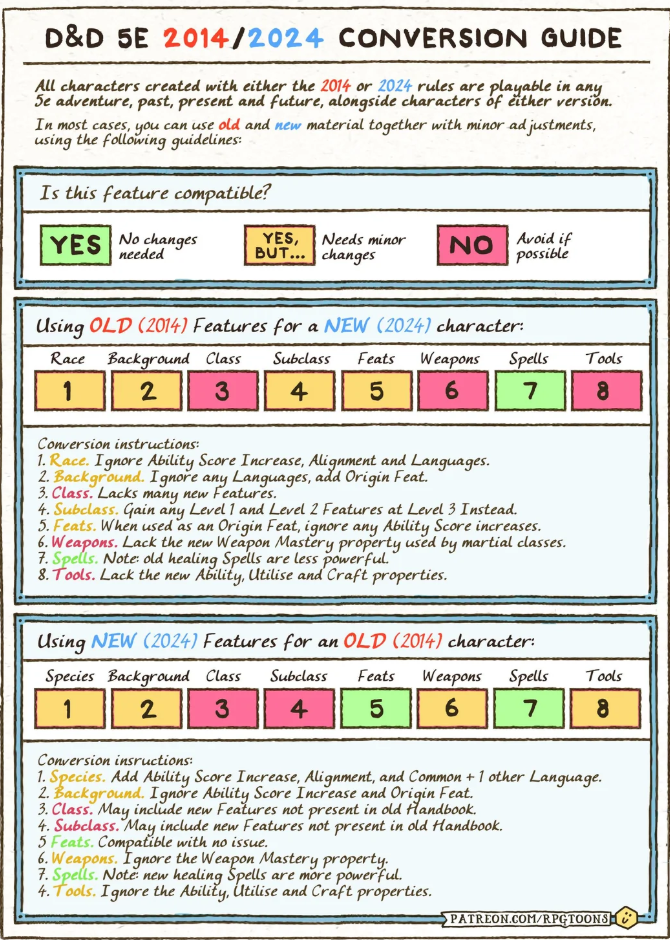
Here’s a nicely done guidelines of the “minor” things that have to be done differently to use 5.5e to build 5e characters, or 5e rules to build 5.5e characters.  The author has a different threshold of what’s a significant compatibility problem (and glosses over some major spell changes), but it’s another way of looking at this information.

Using D&D 2014 and 2024 characters and rules together
A lot of red and orange there
Can I use a 5e scenario / module in 5.5e?

Yes, but …

The module materials will all be written up with 5e rules and versions of monsters and NPCs and 5e spell lists and 5e mechanics.  You can Just Do It as written, or you might want to take the time and effort to update some or all of the material to take advantage of the new way 5.5e handles things like monsters that cast spells, monster races with multiple “classes”/roles, etc.

What about VTT issues?

This is where we get an added layer of complexity. I can’t speak to VTTs other than Roll20, but here’s what I’ve learned so far about 5.5e and that VTT. This centers on the character sheet system, as that is the only place where the system rules are embedded.

  1. Implementation of 5.5e into Roll20 is still dodgy.  Or so I’ve been told by at least one player. Not all species / classes / feats that have been brought into 5.5e have made it into the character sheet and advancement features in Roll20.
  2. Working in a mixed campaign — one supporting 5e and 5.5e characters and/or NPCs — causes problems.  This is because Roll20 implemented its 5.5e character sheets with a new tech stack, different from what was used with 5e.  The new tech stack removes a ton of cruft from the old one, and is much more easily modifiable as 5.5e progresses, but it doesn’t have the same hooks and API variable names or exposure that the old 5e character sheet had. Thus, macros you have written for 5e may not work with 5.5e characters or NPCs (and vice-versa)

This last is particularly a problem when you want to run with 5.5e rules and characters, but are using a 5e module, as all of its NPCs will be using the 5e character sheet (for NPCs), which Roll20 will get indigestion over (and, again, some macro issues will crop up).  Converting all the monsters to 5.5e would be a huge lift.

I spent about a week trying to overcome those issues. I didn’t come up with a great answer, most of the macro stuff can be worked around (esp. if the only 5e characters are NPCs, meaning the NPCs run with their own set of macros, which often happens).  The best answer may be to hold off running a 5.5e set of characters until (a) more 5.5e material is published and brought into Roll20, and (b) Roll20 makes their 5.5e implementation more robust.

Net-net

All of the above issues are, fundamentally, compatibility issues. They are very similar to what came up when D&D went from 3.0 to 3.5, which is why it’s frustrating for WotC to pretend that there are no significant compatibility issues.

Mixing and matching 5e/5.5e stuff is going to be something of a pain for the next few years. Ultimately, the 5e stuff will die out or be successfully converted (for VTT purposes, if nothing else).  For our table, at least, we’re just going to stick with 5e for the moment, and see where things are in a few years when the next campaign kicks off.

Is D&D 2024e backwards compatible? Call me dubious.

The 2024e edition is a new set of rules. WotC doesn’t want you to believe that.

One D&D logo
Or whatever it’s being called this week

WotC has been insistent, insistent I say, that the new edition of D&D is not, in fact, a new edition. This is not D&D 6e! This is not even D&D 5.5e! This is …

Well, they call it 2024e, because that is not at all confusing with what 5e is being called now (2014e).

But, of course if it were not a new edition, why would we need to refer to it differently?

Or, to look at it another way, why not just call it D&D with new optional rules like have shown up in things like Tasha’s, etc.?

Because then they wouldn’t sell new books, amirite?

But we’re not to call it a new edition. It is simply rule changes that are completely compatible with the older, um, previous, er, differently-numbered-year edition not-an-edition set of numbers.

A Caveat

Note: the changes in rules from 2014e / 5e to 2024e are not necessarily bad. In fact, a lot of them sound kind of interesting. But are they backwards-compatible? Do they not imbalance encounters and conflicts in earlier modules? Will players in a given campaign be able to change to 2024e without making any difference? Will 5e characters be as good against new 2024e campaigns? If some players want to switch but others do not, will that work well? Will various Virtual Tabletops handle mixed parties and/or modules?

Two examples that got a fair amount of play in my reading today:

Surprise in 2024e

In 5e / 2014e, when a group or individuals are Surprised, they roll Initiative as normal, but are unable to take any Actions or Reactions or movement through their first turn, after which they can only React until their  next turn.

So that’s pretty harsh. Surprised foes (or friends) are at a serious deficit here. In an Action Economy,

In 2024e, Surprised individuals … roll Initiative at Disadvantage.

That’s a much simpler mechanic, but it’s also a lot easier mechanic.  Rather than missing out on an entire turn, you just tend to come late in a turn.

Either alternative is arguable. But are they the same? Can you have a mix of players choosing a different version, for themselves or their opponents? Can you seamlessly change the rule to match previous challenges? Does it just become another option?  Is it a significant enough change to actually alter how an encounter ends?

Inspiration in 2024e

Inspiration is an optional rule in 5e / 2014e. The DM (with input from the players) can give someone up to 1 point of Inspiration. That Inspiration can be turned in (in advance) for Advantage on an attack roll, saving throw, or ability check.

Okay, pretty straightforward. A D20 roll can be rolled with Advantage.

The 2024e version changes the mechanic and the name. It’s now “Heroic Inspiration,” and it allows instead a re-roll on any roll a player makes — an attack, a damage roll, a healing roll, whatever.

A key here, from the designers, was the sense that too much adds Advantage. That’s kind of ironic, as Advantage was intended as a way of simplifying the endless plusses/minuses of 3e, 3.5e, and 4e. But there was here a sense that too much was being simplified and rolled into a trinary Advantage/Disadvantage mechanic.

In addition to that rather significant change, there are now a variety of mechanical ways to gain “Heroic Inspiration,” including a Fighter subclass that just basically gets their point refreshed every turn.

It’s an interesting design choice, and I can see a lot behind it. It can make for more ways to leverage Inspiration (through broader dice rolls, and also by taking out of the unstackable Advantage bucket). It also makes, through its expanded Inspiration, a more reliable way of getting it.

On the other hand, it introduces Yet Another Mechanic. And it weakens that RP focus of the current Inspiration mechanic.

Good? Bad? I can see arguments either way. But it’s a very distinct choice, and something a table will need to decide One Way or The Other. Unlike the Surprise mechanic, I don’t think it changes balance — but does that make it Backwards Compatible?

Just call it a new edition, fergoshsakes

People who have bought 5e, will have three choices.

  1. Change to 2024e, either mid-campaign, or next time there’s a module change (and upgrade any 5e-era modules to use the new rules).
  2. Stick with 5e, and hope they can “backwards compatible” the mechanics of 2024e-era modules into those rules.
  3. Mix and match — in existing campaigns or in new ones, evaluate the 2024e  rules that have changed and depending which ones to pull in and which to continue using (and where players can select different conclusions).

Option 1 is pretty standard for a new actual edition. Option 2 might be possible with an actual edition change, but it would be a bit of work.   Option 3 only is possible if that “backwards compatible” notion is real.

These sneak peaks (the first 2024e volume only comes out in September) make me think that WotC has tried to come up with something better enough and different enough to justify getting a new set of books (or virtual add-ins to the VTT … or both!) while pretending that it’s just a set of optional improvements.

I resent that.

I will almost certainly get the new edition of books and rules and use them in the future. I will remain resentful that WotC has been playing games with the whole thing to make money and pretend like they aren’t.


D&D 5e Rules – Spells – Spell Components (and Conspicuous Consumption)!

We are living in a Material world!

Know the RulesPart of an ongoing series of 5e (2014) Rules notes.  See the end of the post for notes on 5.5e (2024) rules.

Even though it was pretty late in my first big campaign, the cleric’s acquisition of Heroes’ Feast prompted a bit more research on my part about spell components, particularly consumable ones.

I’ve never been a huge fan of spell components because they are, in normal usage, a Pain in the Ass. Like Encumbrance rules, they are only of play value in edge cases. So using Holy Symbols and Arcane Foci and Component Pouches are a useful way around that.

Usually.

Components

There are three basic aspects of spell components.

Verbal (V)

Most spells require the chanting of mystic words. The words themselves aren’t the source of the spell’s power; rather, the particular combination of sounds, with specific pitch and resonance, sets the threads of magic in motion. Thus, a character who is gagged or in an area of silence, such as one created by the silence spell, can’t cast a spell with a verbal component. (PHB)

Practically speaking, Verbal components only come into play in circumstances when something interferes — Silence spells, the need to be Stealthy, casting underwater, gags, etc. The rest of the time, we ignore them.

Somatic (S)

Spellcasting gestures might include a forceful gesticulation or an intricate set of gestures. If a spell requires a somatic component, the caster must have free use of at least one hand to perform these gestures. (PHB)

Again, at my table we only worry about this for cases where something is getting into the way of that “free hand” thing — being bound or restrained, paralysis, etc. I’m sure there are gaming tables where a sword-and-board-wielding Cleric would have difficulties (and, in fact, the Warcaster feat has a feature to overcome this), but mine is not one of them.

Material (M)

Casting some spells requires particular objects, specified in parentheses in the component entry. A character can use a component pouch or a spellcasting focus (found in “Equipment”) in place of the components specified for a spell. But if a cost is indicated for a component, a character must have that specific component before he or she can cast the spell.

If a spell states that a material component is consumed by the spell, the caster must provide this component for each casting of the spell. A spellcaster must have a hand free to access a spell’s material components — or to hold a spellcasting focus — but it can be the same hand that he or she uses to perform somatic components. (PHB 203, emphasis mine)

More specifically answered in the Sage Advice Compendium:

Does a spell consume its material components? A spell doesn’t consume its material components unless its description says it does. For example, the pearl required by the Identify spell isn’t consumed, whereas the diamond required by Raise Dead is used up when you cast the spell.

If a spell’s material components are consumed, can a spellcasting focus still be used in place of the consumed component? No. A spellcasting focus can be used in place of a material component only if that component has no cost noted in the spell’s description and if that component isn’t consumed.

Keeping Focus

So here’s the rub. Spell foci / arcane foci do a lot of cool things — no need to collect components — but they do not substitute for priced consumables.  There is no gold coin slot in the side of your holy symbol to consume the cost of such spells. The actual component is needed.

Focuses are spelled out here. Note that I tend not to worry about the holy symbol, etc., being something actually manipulated. Rule of Cool fantasy means that the glowing holy symbol engraved on your shield is just fine (as long as a Rust Monster doesn’t consume your shield). But consumables are the edge case.

Consumables

And, in particular, they are the edge case because they restrict “free” use of very powerful and potentially unbalancing spells. Heroes Feast is an example — its effect can be profound and, as such, is not designed for casual, everyday use. “Every day is a Heroes’ Feast day” is not a common D&D trope, for just that reason. Every cleric at 11th Level has a holy symbol focus, and thus without a consumable restriction, Heroes’ Feasts would (with sufficient treasure) be a daily thing for every hero. It’s not.

Here is a fun database someone worked up of expensive components and when they are consumed.   Interestingly enough, while there are a number of spells so identified, most of them use individual items — a diamond, e.g., for Raise Dead.

Note that, again, magic doesn’t let you use 500gp instead of a 500gp diamond. And Heroes’ Feast is special in having a “Gem-encrusted specially crafted bowl” worth 1000gp; you can’t just substitute 1000gp of miscellaneous booty.

jewel-encrusted bowl
A gem-encrusted bowl, for example

(Btw, this also explains why, except in powerful bad guy or rich heroic dude lairs, you don’t find Continual Flame on everything — it literally costs a consumed 50gp ruby.)

But that’s no fun!

It does make a few things more fiddly, which, to my mind, is, I agree, not fun. But the spells we are talking about are — well, if not game-breakers, then close to it. Heroes’ Feast is an incredible spell, as I think everyone admits. Its recipients get for the day (aside from “this complete breakfast”):

  • Cured of all diseases
  • Cured of all poisoning
  • Immunity to poison
  • Immunity to fear
  • Advantage on all WISdom saves
  • +2d10 HP and HP Max

On reflection, that simply can’t be party SOP; it’s effectively a level-up, and could be literally dungeon-breaking (“Module 12: The Tomb of the Venomous  Lords of Terror!”). Grinding 1000gp a day for that seems a significant expense, but, at at the level the spell is available, still relatively trivial. The cost (aside from burning your daily 6th Level spell) needs to include a resource restriction.

In fact, it’s more than just “a 1000gp gem-encrusted bowl” which, presumably, one might find in a dungeon stash of royal crockery: the spell notes it must be specially crafted for the purpose of this spell.

I might allow someone in the party with the proper jewelry crafting skills to actually create such a bowl from suitable materials (and, no, the average character can’t just glue some gems to a bowl and call it good).

Alternately, in the proper setting, I can imagine such a crafted item being found in a dungeon or ruined castle. King Flamebeard would, when riding with his knights against their foes, partake of a special magical breakfast meal to guard them from harm … and if you search around real carefully, you might find the hidden crockery cupboard where a Heroes Feast-intended bowl or two were stashed away …

Any differences here in 5.5e?

dnd 5.5/2024In the latest version of D&D, 5.5e (2024), things are pretty much the same. I would expect any major changes to be in particular spell needs — if you are moving between systems, don’t assume anything!

Focusing just on Material Components here, the definition comes in the PHB (p. 237):

A Material component is a particular material used in a spell’s casting, as specified in parentheses in the Components entry. These materials aren’t consumed by the spell unless the spell’s description states otherwise. The spellcaster must have a hand free to access them, but it can be the same hand used to perform Somatic components, if any.

Okay, that’s pretty much like 5e.

If a spell doesn’t consume its materials and doesn’t specify a cost for them, a spellcaster can use a Component Pouch (see “Equipment”) instead of providing the materials specified in the spell, or the spellcaster can substitute a Spellcasting Focus if the caster has a feature that allows that substitution. To use a Component Pouch, you must have a hand free to reach into it, and to use a Spellcasting Focus, you must hold it unless its description says otherwise (see “Equipment” for descriptions).

Okay a bit more nitpicky in having that free hand stuff (it’s a mini-Somatic inside of the Material Component). At my table, I don’t worry much about that, unless, maybe, the character is bound or paralyzed or something.

Here are links to the 5.5e Arcane Foci and Sacred Foci Holy Symbols.

Special note:  The new PHB has a sidebar for creating your own Verbal Components to speak at the table. Which … is a bit too immersive gameplay for me.

D&D 5e/5.5e Rules – Spells and Exceeding Range / Line-of-Sight!

What happen if you cast an ongoing spell, then wander away?

Know the RulesPart of an ongoing series of 5e (2014) Rules notes.  See the end of the post for notes on 5.5e (2024) rules.

The range and need of line-of-sight is pretty clear when spells are initially cast, but what happens if range is exceeded or line of sight is broken in a spell that lasts more than an instantaneous effect — in particular, with spells that require Concentration to maintain them?

(In the case that came up in my campaign, the party wanted to maintain a spell as they fled; a more common instance is the affected party fleeing the caster and breaking LoS or exceeding distance.)

The General Rule

It’s pretty straightforward:  range and line-of-sight don’t matter once the spell has been cast. As PHB 203 puts it:

Once a spell is cast, its effects aren’t limited by its range, unless the spell’s description says otherwise.

So, as a general rule (and as confirmed by Jeremy Crawford and also confirmed by Jeremy Crawford), once you have successfully cast a spell on a spot or a target opponent, it will continue until it naturally ends (i.e., with a Concentration spell, until the time limit is passed or the character drops concentration), regardless of what the range or line-of-sight is. You are maintaining the spell, not the targeting.

Spells that say otherwise, of course, are otherwise (the specific overrides the general).

That said, if you and the target are beyond LoS, you don’t know what is going on there. Maybe the guy you threw Heat Metal on ran into the next room, took off the armor, and put it on an orphan waif, and your continuing the damage is killing an innocent. Ah, well …

What about in 5.5e (2024)?

dnd 5.5/2024The basics still look pretty much the same. The notes on spell range say:

If a spell has movable effects, they aren’t restricted by its range unless the spell’s description says otherwise.

Which kind of looks close to what was there before. It clearly encompasses spells that are described as moving (e.g., Flaming Sphere). Does that also include spells cast on a target that then moves away? What about the other way around — if the spell is cast on a fixed spot (or unmoving target) and the spell caster moves?

They would seem to apply from previous precedent, and because some spells explicitly in their description that they fade or end when a given range is exceeded (e.g., Mage Hand).

Similarly, from a line of sight perspective, the only mention is in the initial spell casting:

A Clear Path to the Target. To target something with a spell, a caster must have a clear path to it, so it can’t be behind Total Cover.

No mention is made of lingering effects after that, so, presumably, the same is true: a clear path is only needed during the initial casting (targeting).

Finally, the Sage Advice Compendium notes the following:

If you’re concentrating on a spell, do you need to maintain line of sight with the spell’s target or the spell’s effect?

You don’t need to be within line of sight or within range to maintain Concentration on a spell unless a spell’s description or other game feature says otherwise.

Those are the only rules or rulings on this that I can find for 5.5e. As things change and/or are pointed out to me, I’ll update this entry.

D&D 5e Rules – Spells: Wrath of the Storm! (and what kind of attack triggers it)

When you can React to attack depends on what kind of an attack it is.

Know the RulesPart of an ongoing series of 5e (2014) Rules notes.  See the end of the post for notes on 5.5e (2024) rules.

Our Tempest Cleric had the Wrath of the Storm class ability (strictly speaking, not a spell), and endlessly enjoyed using it. Even when she took a bigger smack than her attacker did in turn, she just enjoyed the free combat.

It is, in fact, pretty cool:

Also at 1st level, you can thunderously rebuke attackers. When a creature within 5 feet of you that you can see hits you with an Attack, you can use your Reaction to cause the creature to make a DEXterity Saving Throw. The creature takes 2d8 Lightning or Thunder damage (your choice) on a failed Saving Throw, and half as much damage on a successful one.

So in one game, a Smoke Mephit did its ash breath on the cleric from  from the adjoining square. This isn’t a To-Hit roll Attack, but an AoE Affect. Should it trigger Wrath of the Storm?

So, is an AoE “attack” an actual attack?

The answer seems to be NO.  Because the AoE weapon isn’t, strictly speaking, hitting with an Attack. The key here is “hits you with an Attack.” And the PHB (p. 194) is clear what that all means:

When you make an attack, your attack roll determines whether the attack hits or misses. To make an attack roll, roll a d20 and add the appropriate modifiers. If the total of the roll plus modifiers equals or exceeds the target’s Armor Class (AC), the attack hits. The AC of a character is determined at character creation, whereas the AC of a monster is in its stat block.

Attacks are made with a d20 roll against a target’s AC. But that’s not what happens with the Smoke Mephit’s breath, or a Dragon’s breath weapon, etc.  Those:

  • are not targeted at someone
  • don’t require an attack roll
  • aren’t defended by AC

Instead, AoE attacks create a condition in a certain area of squares, and if someone is in that area, they automatically have to make a Saving Throw to determine the severity of the conditions that ensue (which may or may not include damage; the Smoke Mephit’s ashy breath caused blindness).

(This is part and parcel of why an AoE attack from an adjoining square doesn’t trigger any Disadvantage, either  — because there’s no attack roll to Disadvantage.)

If there’s no attack roll (and, as part of it, a hit caused by a successful attack roll), Wrath of the Storm does not trigger. That would include attacks with Magic Missile, Hold Person, or even Wrath of the Storm itself:

A consequence of this is that if two tempest clerics are fighting one another, and Ann smacks Bob with her mace, Bob may use Wrath of the Storm on Ann as a Reaction, but Ann cannot retaliate in turn, even though she might have a Reaction available, because Wrath of the Storm does not qualify as an attack.

Does any of this change in 5.5e?

dnd 5.5/2024Pretty much nope.

The Tempest Domain for Clerics has not (yet) been ported over to 5.5e (2024), so theoretically it continues to exist as it did in 5e, with Wrath of the Storm acting as above.

The rules over what an “attack” is remain pretty much the same, too.

When you take the Attack action, you can make one attack roll with a weapon or an Unarmed Strike.

The more elaborate PHB definition echoes this:

When you take the Attack action, you make an attack Some other actions, Bonus Actions, and Reactions also let you make an attack. Whether you strike with a Melee weapon, fire a Ranged weapon, or make an attack roll as part of a spell, an attack has the following structure: […]

3. Resolve the Attack. Make the attack roll, as detailed earlier in this chapter. On a hit, you roll damage unless the particular attack has rules that specify otherwise.

So, as with 5e, an attack made through an Attack action (or, in this case, a Magic action) is only considered an attack if there is a to-hit D20 Test by the attacker. In the case of an AoE, there is no such role made, the Area gets an Effect automatically, and the only rolling is to see if creatures in the Area manage to dodge, block, or otherwise fend off all or part of the damage or other conditions taken.

D&D 5e/5.5e Rules – Spells: Thunderwave! (and other cubical-AoE range-Self spells)

Wherein we handwave about a fine spell, and instead talk about Range Self Cubic AoE spells.

Know the RulesPart of an ongoing series of 5e (2014) Rules notes.  See the end of the post for notes on 5.5e (2024) rules.

So Thunderwave (PHB 282-83) is a pretty cool spell, and usually ends up in a lot of parties’ repertoire (also in the repertoire of a lot of enemy parties).  It does decent damage, an AoE, a push, and the CONstitution Save it carries makes it most useful against spellcasters. It does make a godawful racket (carrying 300 feet away, which any DM should take advantage of), but it also scales damage by spell slot.

Overall, a nifty spell. But we’re not going to talk about any of that.

Thunderwave and its Area of Effect

This came up in a game, so afterwards I did some looking into the odd Area of Effect world that is Cubes and Thunderwave.

(There’s a lot about 5e that I respect, but their AoE stuff is kind of janky in general and then the fit onto a grid map — which 5e really sort of dislikes on principle but cannot ignore because a lot of tables really love it, like ours — is even more janky.)

Thunderwave  has Range: Self (15-foot cube). “A wave of thunderous force sweeps out from you. Each creature in a 15-foot cube originating from you …” blah blah effects.

So, what does that mean? How does the cube relate to the caster?  You would think a Cube AoE would be easy. Yet some of the writing on it approaches being Talmudic in its intricacies to figure out what RAW means here. This is my current interpretation:

Putting together the Self and the Cube AoE

Range of Self

AoE spells that have a range of Self have a point of origin starting from the caster (PHB 202).

Cube AoE

Here’s the PHB 204 on Cube AoE (emphasis mine):

You select a cube’s point of origin, which lies anywhere on a face of the cubic effect. The cube’s size is expressed as the length of each side.

A cube’s point of origin is not included in the cube’s area of effect, unless you decide otherwise.

AoE and Grid Maps

DMG 251 notes the following on “Areas of Effect” in relation to grid maps:

The area of effect of a spell, monster ability, or other feature must be translated onto squares or hexes to determine which potential targets are in the area and which aren’t. Choose an intersection of squares or hexes as the point of origin of an area of effect, then follow its rules as normal.

And Xanathar’s echoes this, speaking of “Area of Effect on a Grid”:

Choose an intersection of squares as the point of origin of an area of effect, then follow the rules for that kind of area as normal (see the “Areas of Effect” section in chapter 10 of the Player’s Handbook).

This is one that drives me bats as DM, because everyone wants their spell to be centered in in the center of a square (in origin, in target, in range calculations), and the rule are very clear that is not the case: for where spells start from, land (if not targeting a creature), and calculating the range, it’s all about intersections.

(If you look at how Cover works on a grid, too, it’s much the same thing.)

Put it all together …

So, standing in a 5×5 grid square, any of the four corners of the square / intersections of the grid are at a range of “self” and are corners that could be the face of the cube you are going to create (including a cube that you are part of, if you are touching the outside face from the inside). Here then would be the possible arrangements I can see:

Cube AoE for Thunderwave
Cube AoE arrangements

Any of the above can be rotated in increments of 90 degrees.

I.e., you can be on any of the squares outside of the cube, or on the inner squares of the cube, wherever one of the corners of your square touches (red blips) part of the perimeter (side) of the cube. But not in the very center, because you can’t reach that outer face from there.

I’ve not seen anyone actually include the bottom left “corner” example, but it seems to fit the rules to my eyes.

Insider Casting

There is some debate as whether being on the inside of the cube (bottom right-hand two examples) is allowed. I don’t read anything in the above, though, that says it isn’t. That might mean including yourself in the spell effect (but hold that thought for a moment).

Note that though you can be within the cube, for the Thunderwave spell, “the thunderous force sweeps out from you,” so you yourself are not affected when you cast it, even if you are in the area. (Which is a fancier way of saying that you, as the point of origin, are not affected by spells that have a point of origin; a point is not dimensionless, in this case.)

(But Dave, you might be saying, if the point of origin is the grid intersection you are casting from, then doesn’t the thunderous force emanate from that and, if you are inside the AoE, affect you, too? To which I say (1) remember how I said some of this stuff gets Talmudic? and (2) go away, boy, you bother me.)

When would you use a case, of being inside (not the center!) of the cube? Two use cases I can think of:

  1. To reduce the effective effective range to 10 feet rather than 15 feet (potentially important in an indoor combat).
  2. To include a tiny opponent in your own square (an edge case, but a potentially helpful one).

To sum up

So, unless anyone has any objections, that’s how I consider the area for Thunderwave to work.

dnd 5.5/2024So what about with 5.5e?

I’m still trying to figure that out.

Remember that in 5e (2014), grid-based combat is an optional rule. The default is Theater of the Mind, where the DM gets to be constantly juggling where everything and everyone is in order to convey it to the players so that they have some idea of what’s going on …

Sorry. Betraying my wargaming prejudices here.

Grid-based tactical maps are referenced in the 5.5e (2024) PHB, but, in more detail, in the 5.5e DMG, p. 44. These largely parallel the 5e rules (along with the confusing “well, here’s what you can do with these things, but you don’t have to, you can just use rulers and pipe cleaners and sticky notes,” but I digress). 

The key here is that under “Areas of Effect,” the DMG rules say:

If the area has a point of origin, choose an intersection of squares or hexes to be the point of origin, then follow its rules as normal.

As well as:

If an area of effect covers at least half a square or hex, the entire square or hex is affected.

This is basically the same as the 5e rules. Whether a line, a cube, a sphere, or a cone, everything anchors off a grid intersection.

Except …

Emanations are weird. In 5e, these were basically “range = Self” radiused AoEs, but it was still easy enough to say, “Well, sure, choose one of the four intersections [assuming a square grid] around your character and anchor the effect there.

But while 5.5e has “range = Self” rules, a lot of those lean on Emanations, which make corner-based AoEs a bit harder to swallow:

An Emanation is an area of effect that extends in straight lines from a creature or an object in all directions. The effect that creates an Emanation specifies the distance it extends. […]

An Emanation’s origin (creature or object) isn’t included in the area of effect unless its creator decides otherwise.

That really sounds like they want an Emanation AoE to center on the focal square, not on an intersection next to it. Given the AoE definition above, that sounds incorrect, but it’s still an uncomfortable definition.

That said, I’d still require an Emanation to hook off of one of the target’s adjoining intersections, and treat it different from a sphere AoE, etc., by being mobile with the creature or object it emanates from. That keeps things consistent, if marginally janky.

But what about Thunderwave?

Well, what about it?

Oh, as a spell? It’s written up pretty much the same as the 5e version.

D&D 5e/5.5e Rules – Spells: Spike Growth!

A diabolical spell that can not only manage crowds at low levels, but actually eliminate them.

Know the RulesPart of an ongoing series of 5e (2014) Rules notes.  See the end of the post for notes on 5.5e (2024) rules.

It’s the damaging, crowd-controlling, Area of Effect spell that keeps on giving. You thought Entanglement was a pain in the ass? Try something (if you are a Druid or Ranger) that doesn’t prevent the target from moving, just slows them down and damages them when they try to move: Spike Growth!

So what does it say?

The ground in a 20-foot radius centered on a point within range twists and sprouts hard spikes and thorns. The area becomes difficult terrain for the duration. When a creature moves into or within the area, it takes 2d4 piercing damage for every 5 feet it travels.

So we really have two effects here over the Concentration / 10 minutes of the spell:

  1. The area of the spell is Difficult Terrain.
  2. The area of the spell causes 2d4 piercing damage per 5 feet travelled.

This 2nd level spell would be somewhat effective at crowd control if all it did was slow the bad guys down. Causing 2d4 damage for every 5 feet (one square on a normal grid) traveled is murderous at early levels. A figure with a 30-foot move will be slowed to 15 feet (Difficult terrain), and take 6d4 (6-24) points of damage, with no AC or Save to mitigate it, each turn. And that applies to everyone within the spell area.

No, honestly, I have seem very large early mobs gutted by a well-positioned use of this spell.

Spike Growth
Spike Growth

This spell is particularly deadly because, while most “this area causes you damage” spells affect someone once per turn (e.g., Moonbeam), Spike Growth will mess them up for every square they move through. Plus, there’s no save.

Plus, it’s Sneaky

The spell notes:

The transformation of the ground is camouflaged to look natural. Any creature that can’t see the area at the time the spell is cast must make a Wisdom (Perception) check against your spell save DC to recognize the terrain as hazardous before entering it.

So you can set it as a trap for pursuers. If they don’t see it cast, they require a save to spot it before they blunder in.

Pushing In

There are a variety of ways of pushing or dragging folk into a Spike Growth spell area, from a Shove attack to Thorn Whip to Thunderwave to Thunderous Smite. It’s not always clear with these effects whether a target is dragged at ground level (in which case they would take damage each square of Spike Growth they were moved through) or somehow hurled through the air (in which case only the target square would cause damage).

The DM will have adjudicate based on the specific spell / effect and the circumstances it occurs in, to see how much damage the target takes.

Getting Out

The old saying of “Getting out means going through” is a losing proposition with Spike Growth. Going through means taking more damage.

Tactics for those caught in the spell:

  1. Wait it out. Yeah, that’s not likely over 10 minutes, but one of your comrades might disrupt the Concentration of the caster.
  2. Remove Yourself (Usually Vertically).  A long jump away, a high jump to grab something above, or, of course, some sort of teleport or flight can get you out of the area.
  3. Enjoy the melee cover.  If you are a spellcaster or ranged weapon person, being stuck in Spike Growth isn’t nearly as problematic. Stand there and ranged-attack your opponents (maybe particularly the caster), knowing that the opposition melee fighters will likely not be charging you.

Limits of Growth

Spike Growth does not scale. Even with no save, at some point in the leveling/CR equation, 2d4 damage per square does not daunt in quite the same way.

Sure, it creates Difficult Terrain (always a good thing), and 2d4 over enough squares starts to add up, but a 15th Level character will be a lot less worried over it (or have ways around it) than a 2nd Level character.

But it’s good while it lasts.

Any changes to this spell in 5.5e?

dnd 5.5/2024There are only minor changes to this spell in 5.5e (2024).

The basics of the spell, while edited for 5.5e jargon, are the same:

The ground in a 20-foot-radius Sphere centered on a point within range sprouts hard spikes and thorns. The area becomes Difficult Terrain for the duration. When a creature moves into or within the area, it takes 2d4 Piercing damage for every 5 feet it travels.

The only difference is in the camouflage aspect:

The transformation of the ground is camouflaged to look natural. Any creature that can’t see the area when the spell is cast must take a Search action and succeed on a Wisdom (Perception or Survival) check against your spell save DC to recognize the terrain as hazardous before entering it.

This is a lot more harsh. First, taking the Search action is specifically called out (no Passive Perception pertains).  On the other hand, Survival is also allowed as an optional Ability Check … but, still, unless you are expecting someone to put down Spike Growth, who would ever dream of taking your Action to Search for it?

D&D 5e/5.5e Rules – Spell: Create Bonfire!

A fire suddenly shooting up around you can be … disconcerting.

Know the RulesPart of an ongoing series of 5e (2014) Rules notes.  See the end of the post for notes on 5.5e (2024) rules.

In the most recent campaign I ran, this spell was a go-to for our Druid all the way up the level progression. It damages, it illumines (maybe), it pretty much does it all.

Let’s talk about Bonfire

Create Bonfire is a pretty straightforward spell, so much so that it can be easily overlooked, even as it’s accessible by Druid, Sorcerer, Warlock, Wizard, or Artificer players.

Here’s what it does:

You create a bonfire on ground that you can see within range. Until the spell ends, the magic bonfire fills a 5-foot cube.

The bonfire ignites flammable objects in its area that aren’t being worn or carried.

The Bonfire does 1d8 damage to start with, scaling up by character level (not class level). The save for fire damage is a DEXterity roll, which is often easily made by enemies (resulting in no damage, as Cantrips usually do), but not always. Overall, damage is not amazing, but not for nothing.

The Movable Bonfire

Wait, you might say — a Bonfire can’t be moved.

True. Unlike, say, Moonbeam, there are no movement rules for Create Bonfire.

But they aren’t needed. This is a Cantrip. You can cast it every single turn. It’s a Concentration spell, but that doesn’t matter here. If your Bonfire is burning there, you can easily simply recast it on your turn to be there.

When does the damage occur?

Here’s the tricky part that makes Create Bonfire interesting.

Any creature in the bonfire’s space when you cast the spell must succeed on a Dexterity saving throw or take 1d8 fire damage.

A creature must also make the saving throw when it moves into the bonfire’s space for the first time on a turn or ends its turn there.

So the check for damage takes place in three situations:

  1. If the target is in the square where the Bonfire is cast.
  2. If the target moves (or is moved) into the Bonfire square on a given turn.
  3. If the target ends its turn in the Bonfire square.

This gives the spell a scosh more flexibility than, say, MoonbeamIt immediately attacks when cast.

Also, as noted, a target can be moved into the Bonfire and immediately have to check for damage. This could be with a Shove attack, a Thorn Whip, or some other means. This can actually be done to a target multiple times per round (the restriction is only once per given character turn).

It burns!

While the damage done by the Bonfire is not tremendous, as a DM, I’d also factor in the psychological aspect — stepping into/through fire, or standing in fire, even if the damage being done isn’t overwhelming, is still not easy to do. I’d suggest that that most mooks will run around the Bonfire, or will try to step out of it if they can, rather than take the 1d8 each turn.

It’s a floor polish and a dessert topping!

While we tend to think of most spells in terms of combat effect, Create Bonfire can also do something as simple as it says outside of combat, too, as it will set any flammable material on fire. And, as a cantrip, there’s no effective cost to starting the party’s campfire each evening once someone has gathered some wood.

Looking at an alternate use, interestingly enough, there is some intense debate out there whether the Bonfire, which clearly emits heat (because it does burn damage), actually emits light. In the campaign I ran, the Druid often used the spell to illumine dark rooms for the darkvisionally challenged.

Why it might not create light: The spell itself does not list it as an effect, as some other fire-based spells do. Compare the text above for Create Bonfire to this for Flaming Sphere:

The sphere ignites flammable objects not being worn or carried, and it sheds bright light in a 20-foot radius and dim light for an additional 20 feet.

Why it clearly creates light: It is a Conjuration of a bonfire, and that seems to be fairly clear in intent.

I leave it to the DM to make this particular ruling, though I find the idea of a non-light-emitting bonfire, even if magical, to be baffling.

Anything different in 5.5e?

dnd 5.5/2024Create Bonfire appears to have been introduced in the Princes of the Apocalypse module, and was later picked up in Xanathar’s Guide to Everything.  Notably, it does not show up in the 5.5e (2024) Player’s Handbook.

So, is it still a legit spell? Does it grandfather into 5.5e like anything else that isn’t specifically updated or changed? I suppose so. But since the text has not changed, all of the above still pertains.

D&D 5e/5.5e Rules – Spells: Thorn Whip!

What is it, really? How does it work? How is it even possible? It’s magic!

Know the RulesPart of an ongoing series of 5e Rules notes.

Our party’s Druid (it’s also available for Artificer) had this spell and used it pretty constantly from the time it arrived to the time the campaign ended at Level 13.

The damage from Thorn Whip is okay, maybe a bit better in the early days when damage is hard to come by, though it scales nicely (something 5e has done well with cantrips). But its true utility comes with its ability to shove people around the battlefield.

The Spell

Here is the spell description:

You create a long, vine-like whip covered in thorns that lashes out at your command toward a creature in range [30 ft]. Make a melee spell attack against the target. If the attack hits, the creature takes 1d6 piercing damage, and if the creature is Large or smaller, you pull the creature up to 10 feet closer to you.

This spell’s damage increases by 1d6 when you reach 5th level (2d6), 11th level (3d6), and 17th level (4d6).

That’s actually pretty cool. A 30-foot range magical attack (requiring an actual attack roll) that does decent damage and lets you yoink people around the game map (at least closer across the game map) by up to 10 feet.

And it’s a cantrip, so you can be playing with this every single round, if you are so inclined.

Note also that, as a (30-foot reach) melee attack (not a ranged attack), the caster takes no Disadvantage using it while standing next to an opponent. The caster is still at Disadvantage vs prone targets over 5 feet away (the rules don’t differentiate between melee and ranged attacks there). Cover effects also still apply.

Finally, in visualizing this spell, most people imagine the caster holding the whip and swing it themselves. However, there’s nothing in the spell that actually says that — it could be floating in mid-air, erupting from the ground — whatever, and because it’s a spell attack, not a weapon attack — you don’t dexterously swing it, but “command it to lash out.”  It’s magic!

Moving the target around

Those words “pull the creature up to 10 feet” are important, because they make it clear that the caster has a choice about whether to move the target at all or how much. It can be left just as a 1d6 damage attack, with the target still standing where they were, or they can be moved 5 feet or 10 feet (or whatever increments your battle grid has, within that 10 foot limit).

But what does closer mean here? Because of the limited distance being moved, I would (in lieu of a more informed reading) argue that each square needs to be toward the caster, reducing the overall distance each step.

 x  x  x  x  x
 x  x  T  x  x
 x  5  5  5  x
10 10 10 10 10
 -  -  -  -  -
 -  -  C  -  -

So, in the case above, the (C)aster could move the (T)arget into each of the numbered points at 5 feet; if moving 10 feet, they would have to got to one of the 10 foot marks. They could not shift into a different 5 foot mark, and definitely not into any of the (x) squares because the move to those is further or the same distance from the Caster.

(Note: Some of this may depend what rule you are using to judge distance on a grid.)

(Also Note: A little flexibility here from the DM can fulfill the Rule of Cool.)

Kind of a drag

A lot of questions are raised by the pulling aspect of Thorn Whip (is the victim dragged? catapulted? floated through the air? teleported? and why is there no Strength Save?), but a main use for this power is dragging someone into a hazard — off a cliff, into a Bonfire spell, into a Moonbeam spell, into a Spirit Guardians spell, into a Spike Growth spell, up to the immobilized Barbarian, etc.

Is this legit? And (when) does the victim take damage from those hazard areas? The answers are, “Yes” and “It depends.”

Let’s start off by noting that Opportunity Attacks will not be triggered by being yoinked away by a Thorn Whip. That’s pretty much straight out of the book:

You also don’t provoke an Opportunity Attack when you teleport or when someone or something moves you without using your Movement, Action, or Reaction. For example, you don’t provoke an Opportunity Attack if an explosion hurls you out of a foe’s reach or if gravity causes you to fall past an enemy.

Since being yoinked by a Thorn Whip doesn’t use your Movement, Action, or Reaction, no OA is triggered.

That said, it is considered completely legit to involuntarily move someone into a hazard (p. 19) through a spell or force like Thorn Whip:

Entering such an area of effect needn’t be voluntary, unless a spell says otherwise. You can, therefore, hurl a creature into the area with a spell like Thunderwave. We consider that clever play, not an imbalance, so hurl away!

The subject in that ruling is on spells creating …

… an area of effect that does something when a creature enters that area for the first time on a turn or when a creature starts its turn in that area.

That includes things like  Blade Barrier, Cloudkill, Spirit Guardians, and Moonbeam. While “creating an area of effect on the creature or moving it onto the creature doesn’t count,” involuntarily entering the area does.

One caveat there:

Keep in mind, however, that a creature is subjected to such an area of effect only the first time it enters the area on a turn. You can’t move a creature in and out of it to damage it over and over again on the same turn.

(Remember, too, that round in 5e consists of a sequence of each combatant taking their turn. While a round is about 6 seconds, a turn is some (overlapping) slice of that period, ordered by initiative, but not a defined period of time.)

So given a Moonbeam occupying four squares, you could not force an attack from the spell for each square you used Thorn Whip to drag the target through (i.e., if you dragged them through two squares of it, the 5 foot and 10 foot marks of the spell), just for the initial entry square on your turn.

An exception here (of course there is an exception) is something like Spike Growth. Unlike spells like Moonbeam that trigger “when a creature enters the spell’s area for the first time on a turn,” Spike Growth states:

When a creature moves into or within the area, it takes 2d4 piercing damage for every 5 feet it travels.

Within and every 5 feet it travels are the keys here. You can Thorn Whip someone through two squares (10 feet) of Spike Growth and it will take the 2d4 piercing for each of those squares.

Thorn Whip: It’s Magic!

The magical nature of the pulling done by Thorn Whip is interesting. As described:

If the creature is Large or smaller, you pull the creature up to 10 feet closer to you.

So, note first, this targets creatures. You cannot Thorn Whip over to you the idol sitting on the pedestal over there, or Thorn Whip away the sword in someone’s hand (or that they dropped on the floor).

Second, within the parameter of “Large or smaller,” the target gets no choice or control in the matter of being moved. Standing there slack-jawed or holding onto a support beam for dear life with a STRength of 20, the creature doesn’t even get a Save — they just come. It’s magic!

How does the targeted creature actually move? Fly through the air? Dragged along the ground? It’s not just a teleport because they can take damage from environmental and magical conditions each step of the way. But the spell also doesn’t tie into movement or movement obstacles — it stays nothing about being “slowed” by Difficult Terrain, for example.

I dunno. It’s magic!

Can you Thorn Whip someone through another creature’s square? If you have defeated the cover that other creature is providing, then the answer would seem to be yes, even if it’s an enemy of the target; the only things the rules don’t permit is leaving them in another creature’s square unless it fits other movement/size rules.

What about other obstacles? Assuming you can see past/around them, can you pull a Thorn Whipped person through an obstacle they couldn’t move through themselves? I’d say not, as a general rule; they’ll have to be pulled around.  (But hold this thought for a moment …)

Showing Restraint vs Thorn Whip

What if the target is restrained in some way — grappled, or Entangled, or held by Black Tentacles, or even shackled to a wall? Can Thorn Whip just pull them over regardless? Remember, the individual creature is powerless to stop themselves from being pulled by the spell. But can outside forces prevent it?

Boy, can you find a lot of online argument about that!

General conclusions I’ve drawn on these questions:

  • Thorn Whip breaks a grapple, because the grapple rules literally allow for the grapple to be broken by some outside force.
  • Against spells that Restrain, like Entangle or Black Tentacles, two alternatives are suggested and, to be honest, I vacillate between them as I reductio ad absurdem each case:
  • Against actual physical restraints (being shackled to the wall) … well, it works like the spells mentioned above:  either Thorn Whip just moves the target creature regardless of the shackles (because it’s magic!), or make the Thorn Whip save with the spell strength vs a DC 20 for the manacles.
    • In either case, no additional damage should be done to the target. It’s only a freaking cantrip, fergoshsakes.

This escalating conflict between the Thorn Whip‘s clear it’s magic! nature, which is baked into the language the spell, and the voice of reason as restraints become bigger and more powerful, can only end in things like “I try to Thorn Whip the target through the bars of the jail cell,” and what silliness that results in. At some point the DM has to step in and adjudicate something that feels right while fitting the Rule of Cool.

One final  weird factor in all of this is that the duration for Thorn Whip is “instantaneous.”

Many spells are instantaneous. The spell harms, heals, creates, or alters a creature or an object in a way that can’t be dispelled, because its magic exists only for an instant.

That is, it’s not faster than the eye (you can see the whip, you can see it strike, you can see the yank, you could theoretically Counterspell it), but it happens faster than can be addressed or exploited by, for example, a Dispel Magic (or cutting the whip with your sword, or using the whip to make a gibbet, etc.).

Bearing in mind that D&D is not a tool for modeling physics, Thorn Whip is a spell whose nature and execution does not bear too close an examination. Take it as written. It’s magic!

Is Thorn Whip a magical weapon or not?

I keep saying “it’s magic,” but when does it count as magic? This question can come up in a number of circumstances — in my game, it was when the Druid used Thorn Whip on a Gargoyle, which is “resistant to bludgeoning, piercing, and slashing from nonmagical weapons.” Does Thorn Whip qualify, or not? Is Thorn Whip a magical weapon?

As one commenter summarized the argument:

  • YES: It’s created by a spell, it uses a melee spell attack to hit, and the spell damage increases with level.
  • NO: The spell description only mentions piercing damage, from an object created by the spell, not from the spell directly.

Arguments for Yes, it’s a magic attack

  • Because it’s a melee spell attack roll, not a normal melee weapon attack roll, the resistance to weapons doesn’t apply. Melee spell attacks follow the same rules as melee attacks; in this case, a melee attack with a 30 foot range. But it uses the spell attack modifier (spellcasting ability + proficiency) to hit, so, again, it’s a spell attack and ignores the resistance. 
  • The Sage Advice Compendium notes (p. 21), in determining if something is magical, qualifying questions would include “Is it a spell? … Is it a spell attack?” This is a spell, and uses a melee spell attack.
  •  Mike Mearls (one of the 5e designers) agrees that “any piercing, bludgeoning or slashing damage from spells count as magical in nature.”
  • The Monster Manual notes “Particular creatures are even resistant or immune to damage from non-magical attacks (a magical attack is an attack delivered by a spell, a magic item, or another magical source).” This attack is delivered by a spell.
  • The whip both magically appears and disappears. That indicates it’s not some sort of physical item being created, but a magic construct (that looks like a vine-like whip in some fashion).
  • The whip not only does damage, it magically lets you pull something closer to you without any additional roll (or save). Thus the overall attack is magical.

Arguments for No, it’s a non-magical weapon attack

  • The name of it is a weapon. And the spell actually creates a whip, which is a weapon. So it’s a weapon, crafted by non-conventional means.
  • The spell itself doesn’t do the damage; the whip created by it does. Again, the spell doesn’t indicate it creates a magical whip, just a long, vine-like whip that the spell allows you to commend.
  • And it does piercing  damage, like a weapon, not magical damage (force, radiance, necrotic, etc.).
  • That the damage increases with level doesn’t mean it’s additional magical damage, but could be additionally pointy / strong non-magical thorns.

Conclusion

Net-net, I am persuaded that Thorn Whip is a magical / spell attack (i.e., textualist arguments aside, the vine-like whip is an embodied spell, following the arguments around Spiritual Weapon), so it would defeat non-magical weapon resistance or immunity.

Of course, as an extension of that, something like an Antimagic Field would affect the vine reaching a target within it (even if the caster was outside of the field). It could also be countered, as noted, by a Counterspell.

Because … it’s magic!

So what about in 5.5e?

The spell looks to be identical in the new 5.5e (2024) edition to what was in 5e. It’s still magic!

D&D 5e Rules – Spells: Stinking Cloud!

So, how does Tear Gas work in D&D?

Know the RulesPart of an ongoing series of 5e (2014) Rules notes.  See the end of the post for notes on 5.5e (2024) rules.

The first time I DMed this, I did it wrong. Which, given it was an NPC I had thought I had well in hand, is not a cool move on my part.

So here it is, done right.

Tear Gas Effects: Symptoms, Complications, Treatment & Prevention

Here’s the core of the spell’s effect:

Each creature that is completely within the cloud at the start of its turn must make a Constitution Saving Throw against Poison. On a failed save, the creature spends its Action that turn retching and reeling.

When I first played with this, I ruled that this still allowed Movement (since that isn’t mentioned), but, just as anything that takes away your Action also takes way your Bonus Action, the only thing you could do was retching and reeling.

But that’s not what it says. The Stinking Cloud doesn’t take away your Action, it dictates your Action (retching and reeling). I.e., your Action is set, but you still have your Bonus Action (and Reaction, for that matter).

Or, as the Sage Advice Compendium puts it:

The stinking cloud spell says that a creature wastes its Action on a failed Save. So can it still use a Move or a Bonus Action or a Reaction?

Correct. The gas doesn’t immobilize a creature or prevent it from acting altogether, but the effect of the spell does limit what it can accomplish while the cloud lingers.

Movement is a bit problematic, of course. The area covered by Stinking Cloud  is Heavily Obscured.

heavily obscured area–such as darkness, opaque fog, or dense foliage–blocks vision entirely. A creature effectively suffers from the blinded condition when trying to see something in that area.

Or, presumably, out of that area. Blinded, in turn:

A blinded creature can’t see and automatically fails any Ability check that requires sight.

Attack rolls against the creature have Advantage, and the creature’s attack rolls have Disadvantage.

Note the offsetting penalties — trying to Attack someone inside the cloud has to deal with Heavily Obscured conditions, and so is at Disadvantage (as though Blinded). But the target is, themselves, Blind to the attack, putting them at a Disadvantage. That makes, even without all the loud retching sounds, attacks on a figure within a Stinking Cloud even money. (A figure inside the cloud can’t Attack if they fail their Save, except through a Bonus Action, but with that Bonus Action, or if they make the Save, theoretically, they are also a wash to attack a target outside the cloud, unless that target is using Stealth or a Dodge or something of that sort.)

I might House Rule that, combined with the Retching and Reeling, being Blinded in such a circumstance would lead to disorientation — perhaps another Save (Intelligence?) to move in a desired direction?

As a final note, the rules say “completely within the cloud” for the nausea effect. So if you are playing on a grid, and are using a true circle for your template (physically or on a VTT), any one in a partially covered circle isn’t affected. Which is why I prefer to have a template that fills in complete boxes on the grid, to avoid the ambiguity.

dnd 5.5/2024Any changes here in 5.5e?

The rules in 5.5e (2024) contain several changes to Stinking Cloud:

You create a 20-foot-radius Sphere of yellow, nauseating gas centered on a point within range. The cloud is Heavily Obscured. The cloud lingers in the air for the duration or until a strong wind (such as the one created by Gust of Wind) disperses it.

Two changes here: first, there’s no mention of the cloud spreading around corners (though that seems like something still to naturally consider; a cloud of gas doesn’t respect cover). Second, only a “strong wind” now disperses it, but apparently that’s instantly, not after a number of rounds.

Each creature that starts its turn in the Sphere must succeed on a Constitution Saving Throw or have the Poisoned condition until the end of the current turn. While Poisoned in this way, the creature can’t take an Action or a Bonus Action.

The requirement to be completely within the cloud to be affected is gone, which increases the radius a bit and also helps with Large creatures. The “retching and reeling” color text is, alas, gone, but we now have the Poisoned condition explicitly called out and Bonus Actions have now been sealed off, too.

Also, there’s no mention of the 5e “creatures that don’t need to breathe or are immune to poison” auto-saving. The latter would still (kind of by definition) be immune (suffering only from the Heavy Obscurement and effective Blindness), but the former are, like tear gas victims, deemed Poisoned (if they fail their Save) by contact with the gas, not just inhalation.

Overall, an increase in impact for using the spell.

D&D 5e Rules – Spells: Spiritual Weapon!

It’s a spirit! It’s a weapon! It’s a dessert topping! It’s … kind of a messy spell that people make bad assumptions about.

Know the RulesPart of an ongoing series of 5e Rules notes.

Since I’ve had players pick this, because it sounds very cool (and it can be), I had to do some digging into some of the aspects of Spiritual Weapon that are not completely obvious.

Spiritual Weapon is weird

No, seriously. But that’s because people see “weapon” and try to (incorrectly) apply all sorts of melee combat weapon rules and assumptions to it. It’s not:

Spiritual Weapon is a multi-round melee attack spell
that looks like a weapon because that’s really cool. 

If you just keep that in mind, you can ignore the whole rest of this post.

The Nuts and Bolts

Base spell:

Casting Time: 1 Bonus Action
Range: 60 feet

Spiritual Weapon token

You create a floating, spectral weapon within range that lasts for the Duration or until you cast this spell again. When you cast the spell, you can make a melee spell attack⁠⁠ against a creature within 5 feet of the weapon. On a hit, the target takes force damage equal to 1d8 + your Spellcasting Ability modifier.

As a Bonus Action on your turn⁠, you can move the weapon up to 20 feet and repeat the attack⁠ against a creature within 5 feet of it.

The first confusion comes when wondering whether on Round 1 you simply cast it as your BA, and then need to take a regular Attack action to wield it, or not. The consensus wisdom out there is “or not”:  the attack is also part of the Bonus Action (as it is in subsequent rounds), which  means the following “what can you do with it when?”:

Round 1: As a Bonus Action: cast up to 60 feet away + attack.

Rounds 2ff: As a Bonus Action: move it up to 20 feet + attack.

And that lasts either until you dispel it or 1 minute (10 rounds).

These Are Not the Weapons You’re Looking For

“But! But!” people sputter, “It’s a weapon attacking! That has to happen during a normal Action as an attack! You can’t have a spell doing a weapon attack and then do a different weapon attack or even a spell-cast, on the same turn!”

Yes. Yes you can. Because what you see isn’t what’s really happening. It’s not actually a weapon, not matter what it says in the name.

these are not the weapons you are looking for

Think of the Spiritual Weapon as a deconstructed magical attack spell. Nobody would question the ability to manifest a magical zap spell and attack with it that very same Bonus Action. Which is what you’re actually doing with Spiritual Weapon, but the magical zap spell looks and moves like a weapon, which confuses the heck out of people, because they want to treat it as a glowing animated physical weapon that does physical damage.

But it’s not. It is, quite literally “a floating, spectral weapon” that does “force damage” — and the likelihood of hitting with it has nothing to do with your physical melee abilities (Strength and Dexterity), but your melee spell abilities.

So while you’re doing Spiritual Weapon, what else can you do?

Well, on the round you cast it, that only burns your Bonus Action. So you have your full normal Movement and an Action to work with.

Except, regarding casting multiple spells in a turn, remember …

If you want to Cast a Spell that has a casting time of 1 Bonus Action, remember that you can’t cast any other Spells before or after it on the same turn, except for Cantrips with a Casting Time of 1 Action.

So on that initial round when you cast the Spiritual Weapon, you can’t do any other spells except a 1-Action casting time Cantrip. You can still move around, shoot your bow, swing your sword, Hide, etc.

On subsequent rounds, though, you can be casting spells during your normal Action, because the move-and-attack of the Spiritual Weapon is not a casting of a spell. As noted in the Sage Advice  Compendium (p. 12)

Until Spiritual Weapon ends, it gives you the option of controlling its  spectral weapon as a Bonus Action. That Bonus Action does not involve casting a spell, despite the fact that it’s granted by a spell, so you can control the weapon and cast whatever spell you like on the same turn.

In that same context, also note that Spiritual Weapon is not a Concentration spell. So even if the caster is attacked or otherwise distracted, that does not affect the spell, and casting the Spiritual Weapon does not interfere with other Concentration spells you already have up. (One could even argue that, should the caster go unconscious, the Spiritual Weapon would simply remain there, floating — it can’t attack without command — until the caster was revived if within the 1 minute spell duration.)

There Are No Stupid Questions About Spiritual Weapon

Well, maybe a few.

Does moving away from a Spiritual Weapon trigger an Opportunity Attack?

No. The Spiritual Weapon is not a creature of itself (it has no volition or reaction).  And it only attacks during a Bonus Action: Opportunity Attacks are a Reaction.

Is this a magical weapon I see before me?

No, because it’s not a physical object, thus not actually a weapon.

Again, from the spell text:

Clerics of deities who are associated with a particular weapon (as St. Cuthbert is known for his mace and Thor for his hammer) make this spell’s effect resemble that weapon.

Spiritual Weapon token
Another Spiritual Weapon token

“Effect resemble.” The shape and appearance of the SW is a “spell effect,” not actual substance.

Also, it’s an Evocation spell, one to “manipulate magical energy to produce a desired effect”; it is not a Conjuration which “involve the transportation of objects” or a Transmutation which can “change the properties of a … object.” Again, no object, just effect.

Remember that deconstruction mantra? If this was summoning a magical zap bolt that flitted about the field of combat, it would clearly not be thought of as a magical weapon. That’s basically what Spiritual Weapon is, a spell that resembles an actual weapon because that’s cool.

Can someone hold onto the Spiritual Weapon as it’s moved and essentially fly like Thor?

(People have actually asked this question.)

No. As just noted, the SW is a spectral weapon. It has no substance to grasp or hold onto. It invokes Force damage, but you can’t grab onto that.

Can a person move through the square occupied by a Spiritual Weapon?

Yes. The rules about moving through squares occupied by other creatures only apply to creatures. The Spiritual Weapon is not a creature. It has no substance to block someone, only doing Force damage when it attacks (which, to make it worse, it can’t do during the part of a round when someone would be moving through its square).

Now, that said, a lot of people would be naturally hesitant to do such a thing, even if they knew the spell. So there’s some role-playing involved here, and I’d suggest the average peasant / Kobold / etc. would just sort of naturally avoid running through a square occupied by a mystical floating weapon (or a spectral appearance of same) unless they had no other choice.

For that matter, there’s nothing to stop a person (friend or enemy) from ending or pausing movement in the same square as the weapon, nor from the caster from moving it into an occupied square (again, either by a friend or an enemy). It would not make attacks by the Spiritual Weapon any more likely or powerful, though it might be kind of distracting.

D&D 5e/5.5e Rules – Spells: Spirit Guardians!

Also known as the “Faerie Buzz Saw of Death.”

Know the RulesPart of an ongoing series of 5e (2014) Rules notes.  See the end of the post for notes on 5.5e (2024) rules.

This was another player favorite in my Princes of the Apocalypse campaign, for very good reasons: it’s pretty damned deadly.

So what does it do?

The spell says:

You call forth spirits to protect you. They flit around you to a distance of 15 feet for the duration. If you are good or neutral, their spectral form appears angelic or fey (your choice). If you are evil, they appear fiendish.

Okay, that’s nice color text. I also played with it a bit in the campaign: when the player of the cleric started being affected by a magic item she was carrying, it had an impact on the appearance of her spectral spirits.

When you cast this spell, you can designate any number of creatures you can see to be unaffected by it. An affected creature’s speed is halved in the area, and when the creature enters the area for the first time on a turn or starts its turn there, it must make a Wisdom Saving Throw.

On a failed Save, the creature takes 3d8 Radiant damage (if you are good or neutral) or 3d8 Necrotic damage (if you are evil).

So when does it actually do damage?

One question that immediately comes up about SG is when it actually attacks. It’s easy to mistakenly assume the answer is “right away,” but … nope.

The trigger is the potential target either

  • entering into the AoE (voluntarily or involuntarily), or
  • being within the AoE when their turn starts.

This is similar to Moonbeam, along with a number of other spells.

You don’t take immediately damage if the spell is cast on you (i.e., with you in the area of its casting) or if it is moved over you (if the spellcaster runs up to you).  As Crawford says, “creating an area of effect on a creature’s space isn’t the same as the creature entering it.”

But you do take damage if you enter the spell while it is in place, or are inside of it when your turn starts. And “entering the spell” does not have to be voluntary — a Shove or a Thunderwave can push you into the zone, and that’s considered not only legal, but, “We consider that clever play, not an imbalance, so hurl away!” Indeed, such a maneuver would lead to the target being hit twice by Spirit Guardians: once when pushed in, then again when their turn starts (unless someone yoinks them out again in the interim).

What about Line of Sight?

Spirit Guardians respects Line-of-Sight and Total Cover rule. I.e., if the circle extends through a wall, or any other cover, it is blocked.

Unlike Fireball or Stinking Cloud, which specifically call it out, Spirit Guardians will not go around a corner: they are not actual creatures flying around (which is why they can’t be attacked), but a magical effect emanating from a point (one of the corners the caster chooses). Anything not visible from that point is protected. If a potential target has only partial cover, though, they are affected (and the cover does not improve the saving throw).

Reference: dnd 5e – Can Spirit Guardians affect enemies through walls? – Role-playing Games Stack Exchange

Any changes here in 5.5e?

dnd 5.5/2024There are some revisions, akin to Moonbeam, in this spell in 5.5e (2024).

Protective spirits flit around you in a 15-foot Emanation for the duration. If you are good or neutral, their spectral form appears angelic or fey (your choice). If you are evil, they appear fiendish.

This is pretty much the same, though using the new Emanation terminology.

When you cast this spell, you can designate creatures to be unaffected by it. Any other creature’s Speed is halved in the Emanation, and whenever the Emanation enters a creature’s space and whenever a creature enters the Emanation or ends its turn there, the creature must make a Wisdom Saving Throw. On a failed Save, the creature takes 3d8 Radiant damage (if you are good or neutral) or 3d8 Necrotic damage (if you are evil). On a successful Save, the creature takes half as much damage. A creature makes this Save only once per turn.

So some changes here:

First, designating unaffected creatures no longer has the restriction of being able to see them. If you fire this spell off inside a room before all of your team has entered, you can now exempt them. That’s helpful.

Second and more important, the trigger for a Save (and therefore damage) has changed. Before it was (1) entering the area or (2) starting a turn in the area. Now it’s (1) entering the area, (2) ending a turn in the area, or (3) being in a space where the area enters.

This is a major change, as it means the caster can simply run through the field doing damage to everyone they get within 15 feet of (and if they keep their distance, there’s no Opportunity of Attack worries) in addition to any other spells or attacks they want to make. True, targets only Save / take the damage once per turn (but, with Shove and Thorn Whips and the like, they could be moved into, out of, and back into the area on different characters’ turns during a round), but the number of targets has just climbed substantially.

So, overall, this spell, like Moonbeam,has gotten significantly more powerful. DMs beware!