https://buy-zithromax.online buy kamagra usa https://antibiotics.top buy stromectol online https://deutschland-doxycycline.com https://ivermectin-apotheke.com kaufen cialis https://2-pharmaceuticals.com buy antibiotics online Online Pharmacy vermectin apotheke buy stromectol europe buy zithromax online https://kaufen-cialis.com levitra usa https://stromectol-apotheke.com buy doxycycline online https://buy-ivermectin.online https://stromectol-europe.com stromectol apotheke https://buyamoxil24x7.online deutschland doxycycline https://buy-stromectol.online https://doxycycline365.online https://levitra-usa.com buy ivermectin online buy amoxil online https://buykamagrausa.net

Potpourri for GBP 250, Alex!

Bits and pieces from the trip: Had the 2-seat side of my little puddle-jumper, Manchester to Glasgow, to myself. Which was nice. Remarkably enough, did not have to remove my…

Bits and pieces from the trip:

  1. Had the 2-seat side of my little puddle-jumper, Manchester to Glasgow, to myself. Which was nice.
  2. Remarkably enough, did not have to remove my laptop from my briefcase when I went through the x-rays at Manchester airport.

  3. While Terminal 5 at O’Hare is a naked expanse of gates and not much else (e.g., no shops or food), the waiting area in Terminal 3 at Manchester is full of both shops and food. I must remember this for the future.

  4. Very nice dinner at Etain, here in Glasgow, tonight. Actually, fancier than my taste, but still yummy. Recommended.

  5. Today’s vocabulary lesson, part 1: “bespoke” = custom-made, often used in reference (at least here in the UK) to custom-modified or home-grown code.

  6. While the BMI flight attendants do provide the cheerful advice of how to take on the crash position (or, as they call it, the brace position) during their pre-flight spiel, I also notice that the life jackets they have require the user to tie the cords into a knot, rather than clipping them onto a ring in front. Score one for the Yanks.

  7. Today’s vocabulary lesson, part 2: “chump” = a cut of meat (most often seen with pork or lamb), usually in chops or steaks. It resides between the loin and leg (and appears to be more commonly called “rump” in the States).

  8. What are the chances that I’d travel from Denver to Chicago, change planes, then travel from Chicago to Manchester, then go to a different terminal, sit down for breakfast, and then discover that sitting behind me is an English youth in a Denver Broncos jersey? Pretty good, it seems.

  9. Today’s vocabulary lesson, part 3: “apple-pie bed” = short-sheeted bed, where the sheet is doubled over (like an apple turnover?) so that someone cannot lie full length under/inside of it.

  10. Today’s vocabulary lesson, part 4: “dogging” = British slang for voyeuristic/exhibitionistic sexual activity. I’m not quite sure how it came up in conversation during dinner.

That is all.
Spazzing out

Somehow I missed the firestorm that Tiger Woods started by using the term “spaz” to refer to his own putting style during the Masters. While in the US the term…

Somehow I missed the firestorm that Tiger Woods started by using the term “spaz” to refer to his own putting style during the Masters. While in the US the term is only mildly insensitive, in the UK it’s evidently considered right up there with the “N” word for rudeness (though, according to this BBC study, “spastic” is still somewhat less offensive than the “N” word, though less so than “dickhead”).

Which just goes to show that you not only have to be polite these days, but multi-culturally polite.

“Oh, stewardess, I speak Jive.”

Ever want to know how to say, “Once you go Black, you’ll never go back” or “You look like a biotch” in Japanese? Wonder no further. “OFF THE HOOK”, a…

Ever want to know how to say, “Once you go Black, you’ll never go back” or “You look like a biotch” in Japanese? Wonder no further.

“OFF THE HOOK”, a Dictionary of African American Slang. In Japanese. Being sold in the remainders section of a WHSmith in a sleepy provicial Norfolk town.

The weirdness quotient was just too high, and the price (only £2!) was too low not to buy it. Plus it’s author, Randall C. Miller Junior, looked cool!

I wasn’t disappointed. In fact I think, per penny, it’s one of the funniest books I’ve ever bought. I really wish I was Japanese, so I could use this book in anger. Just picture a Japanese tourist walking into a black neighborhood clutching this book.

I just wish I read Japanese.

Famous last words

A line of dialog that you know will not end well for the speaker and/or his/her side. “It’s [Fill in the Name]! Kill him and we’ll be famous!”…

A line of dialog that you know will not end well for the speaker and/or his/her side.

“It’s [Fill in the Name]! Kill him and we’ll be famous!”

Your lexical lesson for today

I had no idea that “scumbag” originally meant “condom” (though it makes sense in retrospect), nor that the NY Times has had a long sensitivity to the term and that…

I had no idea that “scumbag” originally meant “condom” (though it makes sense in retrospect), nor that the NY Times has had a long sensitivity to the term and that some folks are up in arms about its inclusion in a NYT crossword puzzle.

So, how did “scumbag” make it into the puzzle? Simple: No one realized it could be offensive. Evidence suggests that many people, especially younger speakers, are unaware of the sexual meaning (the Times’ 1998 allusion to Burton’s remark was particularly confusing to such people). All major general American dictionaries—Merriam-Webster’s Collegiate Dictionary, the American Heritage Dictionary, Webster’s New World College Dictionary, the New Oxford American Dictionary, the Random House Webster’s College Dictionary—include the word only in its “despicable person” sense, without any “vulgar” label or acknowledgment of its origins. The “condom” sense can be found only in the largest dictionaries, such as the Random House Unabridged and the Oxford English Dictionary, not out of ignorance or prudery, but because the sense isn’t very common. And it’s not even clear why “condom” is such an offensive concept.

And now you know.

(via Obscure Store)

Verb

The following two words are not verbs, no matter how much some folks think they should be: Onboard: To bring on board. As in, “We onboarded the new hires.” Okay,…

The following two words are not verbs, no matter how much some folks think they should be:

  • Onboard: To bring on board. As in, “We onboarded the new hires.” Okay, it’s a shortening of a term, so it’s got a scosh of respectability. Still, way too Dilbertish.
  • Solution: To come up with one or more solutions. See also, “solve.” As in, “We’re looking to solution the problem.” Um, see also, “solve.”

Thank you.

UPDATE: I was a bit bemused to discover that we no longer call the department “Quality” but “Performance Management.”

War of Words

A war has been brewing in Europe — in the EU, in particular. And it’s beginning to come into the open … A trade war? A military war? Nah, those…

A war has been brewing in Europe — in the EU, in particular. And it’s beginning to come into the open …

A trade war? A military war? Nah, those are peanuts. This is a language war.

Yesterday it was reported:

French President Jacques Chirac briefly walked out of a European Union summit on Thursday when the French head of the EU’s industry lobby addressed leaders of the bloc in English.

A French official said Chirac, Foreign Minister Philippe Douste-Blazy and Finance Minister Thierry Breton left the room when Ernest-Antoine Seilliere, head of the UNICE business lobby, began speaking in “the language of business” at a summit session with the EU’s so-called social partners — employers and unions. […] Chirac returned after Seilliere had finished to hear another Frenchman, European Central Bank President Jean-Claude Trichet, addressing the leaders in French.

Trichet, a former Bank of France governor, almost always speaks English at the Frankfurt-based ECB.

Innocent enough?

English, French and German are the working languages of the 25-nation bloc which has no single official language. All 20 languages of the member states are used at summits, ministerial meetings and in the European Parliament.

French once dominated the EU, but English has overtaken it since the bloc expanded to take in Nordic countries in the 1990s and east European members in 2004.

Paris has fought a rearguard battle to preserve French as a main working language in Brussels, sparing no expense to offer free or heavily subsidised language courses to officials and diplomats from the new member states as well as journalists.

And today, Chirac took the offensive.

President Jacques Chirac said on Friday he had been so shocked to hear a fellow Frenchman speak English at a European Union summit the previous day that he had felt compelled to leave the room. “I have to say I was profoundly shocked to see a Frenchman express himself in English at the (EU) Council table. That’s why the French delegation and myself walked out rather than listen to that,” Chirac told reporters.

Well, as long as it was for a good reason.

Chirac said France had fought for a long time to ensure that French was spoken and used within multinational institutions, from the European Union and United Nations to the Olympic Games. “It is not just national interest, it is in the interest of culture and the dialogue of cultures. You cannot build the world of the future on just one language and, hence one culture.”

“Unless, of course, it is ours,” Chirac did not actually add.

The name’s the thing

Star Wars or Web 2.0? Can you tell the difference between the name of a Star Wars character and the name of a Web 2.0 company? I got a moderately…

Star Wars or Web 2.0?

Can you tell the difference between the name of a Star Wars character and the name of a Web 2.0 company?

I got a moderately nerdy 37 of 43 right.

(via kottke)

Doing Write

Those who can, do. Those who have problems getting around to doing, blog. Or something like that. I’ve created a new blog, Doing Write, to serve as a home for,…

Those who can, do. Those who have problems getting around to doing, blog.

Or something like that.

I’ve created a new blog, Doing Write, to serve as a home for, well, my (non-blog) writing projects and activities, The immediate impetus was wanting to get back into the habit of doing Oneword, but not wanting to pester everyone with it here.

(More importantly, the increased focus and visibility, for me, may actually get me off my ass and working on finishing a couple of long-outstanding writing projects. Grr.)

So I’ve created the blog, and shifted many of the conents of the “Writing & Language” category over there. You can find various tools, resources, and bits of advice for writers, as well as my Oneword etudes, and references to the varoius writing projects I’ve been (and am) involved in.

My biggest question at this point is how to show recent posts there here. I don’t think it requires the same sort of publicity at the top as the Blog of Heroes stuff, but I want folks who don’t rely on RSS to have some clue when something goes out there.

I will ponder.

As a side note, it’s been interesting creating a new blog under MT 3.2. A lot of the processes are a lot cleaner and more automated than in the past, and the default templates are a lot prettier. That said, there are some odd gaps in the default installation, to wit:

  1. The default template doesn’t show the categories of individual posts.
  2. There’s no longer a dummy “Links” section in the templates.
  3. Had to add in the “edit” button for the posts.
  4. Recent posts are shown, but not recent comments.

I’ve had to add in a few non-standard styles as well, mostly around the img alignment and paragraph blocks.

Anywhere … there it is. Those as are interested, enjoy. The rest of you … continued bloggy goodness here.

Fortune and glory!

Well, a marginal amount. And it’s on the glory side, not fortune. Or, perhaps, this qualifies as being “published.” My review of The Pirate Coast at Blogcritics was selected for…

Well, a marginal amount. And it’s on the glory side, not fortune. Or, perhaps, this qualifies as being “published.”
My review of The Pirate Coast at Blogcritics was selected for their syndication package, which means it got printed over here at the Cleveland Plain Dealer’s online site. Spiffy!

Story time

Katherine writes a story at her Parent-Teacher Conference. Faboo! UPDATE: This was one of the four stations (reading, math, writing, conference) that Katherine rotated through at the PTC night. I…

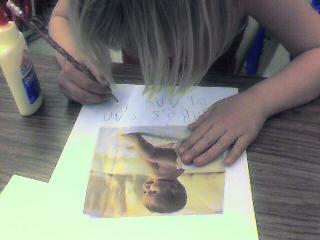
Katherine writes a story at her Parent-Teacher Conference. Faboo!

UPDATE: This was one of the four stations (reading, math, writing, conference) that Katherine rotated through at the PTC night. I wish you could have seen her intensity and earnestness in taking the picture, pasting it up on the page, and starting to write the story down. It was really neat.

They actually are teaching kids “Kindergarten Writing,” which is basically “write down for each word as many of the letters as you hear in the word” — which she’s gotten remarkably good at (such that it’s usually actually readable by an adult). The idea is not so much orthography in letter form or spelling, as to (a) get them used to writing, and (b) get them used to listening to the word sounds. So, for example, she started off the story with:

BABes cAn Du ANe Fng

which would be

Babies can do anything.

She’s actually ahead of the curve here — by the end of Kindergarten, they expect kids to be in “semi-phonetic” writing (“BBZ” or “BABZ”), while Katherine is into full-blown “phonetic.”

Keen

this post enabled by airblogging.com.

Curses!

So we’ve been chatting with Katherine about language. She’s let out a couple of mild expletives in recent weeks, most (though not all) of which she picked up around the…

So we’ve been chatting with Katherine about language. She’s let out a couple of mild expletives in recent weeks, most (though not all) of which she picked up around the house. “Darn it.” “God.” “Crap.”

Teaching about polite and civil language is tricky, the biggest trick being, of course, regulating my own. While I hardly cuss a blue streak, and, in fact, employ a number of euphemisms in my cussing, I do cuss. And, in fact, the problem is not so much the words used, per se, as the uncontrolled (and therefore dangerously thoughtless) anger that goes into uttering them, which leads inevitably to harsher language.

And there’s also, as a complication, the societal concept that some words are okay for grown-ups to use, but not okay for Kindergarteners. Which is just plain true, though it can be a difficult idea to work around. Katherine seemed to understand, though, using the model that there are some things that it’s okay for grown-ups to do (go into the street, drive a car) that it’s not okay for her to do.

As she’s learning these rules, she’s inevitably tossing them back at us. “Daddy, you said a bad word.” “I did?” “You said ‘dang it.'”

Hrm.

Okay. Dang is okay. I think darn is okay, though Margie seems more concerned by it. Both words are better alone than with an “it” after them. I suggested dagnabbit is also okay. As is heck.

The other words mentioned above are right out. She understands that, I think.

I also told her it was okay for her to correct my language, but not that of (grown-up) visitors to the house. While they might find it cute — once — it’s not her place to correct guests’ language. But by engaging with us as to what’s okay and what’s not (and when and from whom), hopefully we’ll be able to work out some understandable, instinct-level rules we can all abide with.

And, in the meantime, it will help me with my language.

I suspect this is not the last time we will have this particular conversation. It’s certainly not the first.

Context, context, context

Someone ran across this quote online and thought it would be a great idea to put it on their church website: “If you will but worship me, all will be…

Someone ran across this quote online and thought it would be a great idea to put it on their church website:

“If you will but worship me, all will be yours” (Luke 4:7)

At least until someone pointed out that it wasn’t actually Jesus saying that.

They did fess up to their mistake (once they’d removed the quote):

This lesson is a demonstration why when using tools online to identify quotes that you think deliver the honest and sincere message you intended you should always view the quotes in their whole context.

(via J-Walk)

The name’s the thing

Turin? Or Torino? The decision by NBC and USA Today (and the IOC) to use the Italian name for the city continues to ruffle some stylistic feathers. (Ironically, for those…

Turin? Or Torino? The decision by NBC and USA Today (and the IOC) to use the Italian name for the city continues to ruffle some stylistic feathers.

(Ironically, for those folks who tout the “Well, we should pronounce it the way the Italians do” meme, evidently the name as used in the local (if “fading”) Piedmont language is, in fact, “Turin,” though possibly with the emphasis on the second syllable.)

Potpourri for $600, Alex

This and that … Congresscritters vs. Wikipedia. Vogel said, “It makes sense to me the biography we submit would be the biography we write.” The change doubled the length of…

This and that …

  • Congresscritters vs. Wikipedia.

    Vogel said, “It makes sense to me the biography we submit would be the biography we write.” The change doubled the length of the entry on Meehan, corrected errors and replaced “sloppy” writing, Vogel said. “Let the outside world edit it. It seemed right to start with greater depth than a paragraph with incorrect data from the ’80s.”

  • AOL Acting Like God?

    America Online is now acting like God – using what some consider to be His very name in a marketing pitch for e-mail, voice chat, video chat, instant messaging, text messaging and other forms of communication. AIM’s new slogan is “I AM.” (via J-Walk)

  • “Cool” remains cool.

    “It just keeps swaggering along,” he said. “I think this has gone beyond slang and into a word that is so useful and versatile that it is just one of the words we use. There are no other words in the vocabulary that quite do the job. Cool is already firmly ensconced in several generations. It’s got street cred. And it had street cred before we even used the phrase street cred.” (via J-Walk)

To know recursion, you must know recursion

This Is the Title of This Story, Which Is Also Found Several Times in the Story Itself Nice. (via Doyce)…

This Is the Title of This Story, Which Is Also Found Several Times in the Story Itself

Nice.

(via Doyce)

I hear you want a Resolution …

First off, a review of last year’s New Year Resolutions: 1. Spend more time with Kitten. Hmmmm. Yes and no. Enjoyed my post-pre-school drives home with her, but those have…

First off, a review of last year’s New Year Resolutions:

1. Spend more time with Kitten.

Hmmmm. Yes and no. Enjoyed my post-pre-school drives home with her, but those have gotten much less frequent with her bus riding from Kindergarten. I’d say this remains a necessity. Knowing myself, I need to set up a standard time for this sort of thing — when she gets home, or when I got home, or at bed time (difficult), or “Katherine Thursdays” or something of that sort. I get too easily distracted (to/from everything).

2. Try to cut back on external commitments some. Family first. In particular, as rewarding as the various activities at church have been, I’ve overcommitted there on both the Search and the Vestry stuff. Nothing to do for that (and I’m not going to back out on them), but as those responsibilities begin to wind down, I don’t plan on going out of my way to backfill that time with more commitments there. Easier said, perhaps, than done.

Well, I’m not sure that I succeeded here, either, though I certainly tried. Coming off of Vestry will be a big help. Unfortunately, work commitments have ramped up even as other commitments have ramped down.

On the other hand, I have, as noted elsewhere, been spending more time with Margie (CoH-wise) than our parallel pasttimes in the past have allowed.

3. Write. Edit. Write. To wit, a minimum of 15 minutes per day on writing activities. Minimum. Whatever it takes.

I was really glad I did the pseudo-NaNoWriMo over November, and I’ve done a fair amount of light writing for the CoH boards. But, really, didn’t do much with this. Bleah.

4. Keep the weight off, and walk 1,000 miles to nowhere.

Aha! A pretty decent success. Actually dropped added weight and made it to 1,500 miles! Who’d have thought that the stereotypical physical health side of a Resolutions List would be what I ended up doing successfully?

So … what to take for next year?

Hrm.

Well, hell, I don’t see much reason to change the list:

  1. Spend more time with Kitten.
  2. Try to cut back on external commitments some. Family first.

  3. Write. Edit. Write.

  4. Keep the weight off, and walk 1,500 miles to nowhere.

How’s them apples?

Happy New Year!

More trouble than it’s worth

I believe most conventional studies of typing speed and keyboard use would confirm that “your” is actually faster to type than “u’r” — not to mention being grammatically correct and…

I believe most conventional studies of typing speed and keyboard use would confirm that “your” is actually faster to type than “u’r” — not to mention being grammatically correct and easier to read.

I’m just saying.

The Wrathful Dispersion Controversy

To me it seems grossly unfair that while schools busily teach concepts of modern archaeo-linguistics, talking about “Indo-European” languages and the “evolution” of French from Latin, the quite plausible concept…

To me it seems grossly unfair that while schools busily teach concepts of modern archaeo-linguistics, talking about “Indo-European” languages and the “evolution” of French from Latin, the quite plausible concept of Wrathful Dispersion is suppressed in our schools.

The opponents of Wrathful Dispersion maintain that it is really just Babelism, rechristened so that it might fly under the radar of those who insist that religion has no place in the state-funded classroom. Babelism was clearly rooted in the Judeo-Christian story of the Tower of Babel (Genesis 11: 1–9); it held that the whole array of modern languages was created by God at a single stroke, for the immediate purpose of disrupting humanity’s hubristic attempt to build a tower that would reach to heaven: “Let us go down,” God says to Himself, “and there confound their language, that they may not understand one another’s speech.” Wrathful Dispersion is couched in more cautiously neutral language; rather than tying linguistic diversity to a specific biblical event, it merely argues that the differences among modern languages are too perverse to have arisen spontaneously, and must therefore be the work of some wrathful (and powerful) disperser who deliberately set out to accomplish a confusion of tongues.

For the sake of equal time and “teaching the controversy,” shouldn’t we be making sure our children know all the different viewpoints out there?

Here’s hoping he’s proven wrong

C.S. Lewis was not at all sanguine about a live-action Narnia adaptation, according to this letter to a BBC producer — though, unlike the framing prose in the BoingBoing post…

C.S. Lewis was not at all sanguine about a live-action Narnia adaptation, according to this letter to a BBC producer — though, unlike the framing prose in the BoingBoing post this is quoted in, his 1959 objections seem a bit more technical than philosophical.

As things worked out, I wasn’t free to hear a single instalment of our serial [The Magician’s Nephew] except the first. What I did hear, I approved. I shd. be glad for the series to be given abroad. But I am absolutely opposed – adamant isn’t in it! – to a TV version. Anthropomorphic animals, when taken out of narrative into actual visibility, always turn into buffoonery or nightmare. At least, with photography. Cartoons (if only Disney did not combine so much vulgarity with his genius!) wld. be another matter. A human, pantomime, Aslan wld. be to me blasphemy.

To that end, actually, the new film ought to be less objectionable than, say, the previous BBC live action series, which featured much clumsier puppetry for Aslan, though it’s still charming in my opinion). But bear in mind that Lewis died in 1963 — the CG capabilities available today have the potential to render Aslan et al. as something that partakes neither of “buffoonery or nightmare,” and far removed from someone dressed in a lion’s suit (which would smack enough of pagan ritual to seem blasphemous to someone like Lewis).

Given what BBC TV productions looked like in 1959 (or even 1969), I can’t say as I blame him for his concerns.

That all said, the movie may very well suck. While Walt Disney is no longer present at the helm of his company (having died in 1966), and it’s not clear what “vulgarity” Lewis is objecting to, the present company may certainly make something that is not true to the spirit of the writer. Heck, Peter Jackson approached LotR with near-reverence, and there will still folks (including in the Tolkien estate) who frothed at the mouth over his changes. It’s easy to believe that a company that’s taken such liberties with properties such as The Little Mermaid or Pocahontas or The Hunchback of Notre Dame (not to mention Kimba the White Lion) might easily screw up Narnia.

But, by the same token, that’s a battle for the fans of the work, not something to rely overly much on the 50-year-old opinions of the original author. Even someone such as C.S. Lewis.