https://buy-zithromax.online buy kamagra usa https://antibiotics.top buy stromectol online https://deutschland-doxycycline.com https://ivermectin-apotheke.com kaufen cialis https://2-pharmaceuticals.com buy antibiotics online Online Pharmacy vermectin apotheke buy stromectol europe buy zithromax online https://kaufen-cialis.com levitra usa https://stromectol-apotheke.com buy doxycycline online https://buy-ivermectin.online https://stromectol-europe.com stromectol apotheke https://buyamoxil24x7.online deutschland doxycycline https://buy-stromectol.online https://doxycycline365.online https://levitra-usa.com buy ivermectin online buy amoxil online https://buykamagrausa.net

Sealed and delivered

LA County has caved on the ACLU complaint about their seal (as earlier reported here). Los Angeles County supervisors on Tuesday ended an emotional debate over the symbolism of the…

LA County has caved on the ACLU complaint about their seal (as earlier reported here).

Los Angeles County supervisors on Tuesday ended an emotional debate over the symbolism of the tiny gold cross on the county seal by deciding to remove it rather than defend it against a threatened ACLU lawsuit.
Advised by county attorneys that the cross might not withstand a court challenge, the Board of Supervisors voted to seek a compromise with the ACLU — perhaps by replacing the cross with images of a Spanish mission and Native Americans..

There was some indication that the cross had been intended as a religious, vs. historic, statement when originally included in the seal’s design in 1957:

But a review of the transcript from a 1956 Board of Supervisors meeting reveals that, at the time, the cross was intended as a religious symbol. After some speakers joked about what they considered an emaciated cow, Kenneth Hahn praised the seal for depicting “the cultural and educational and the religious life of this county.”

Is that impermissible? Would it be worse (or only a problem) if Hahn had specifically mentioned “the Christian life of this county”? Does what the seal mean to people now (in parts and as a whole) outweigh what it meant then?

I don’t know. I’m not sure that redesigning things to have a Mission and a Native American (shoehorned into a small space, unless we’re talking about a major redesign or dropping other elements) is going to work in the long run, either.

But Molina, who is Catholic, quietly pointed out that “there are many people who argue that the missions were not a great part of our history. The reality is that they were built by slaves.”

And, of course, there’s that cow that’s there to be butchered, those oil derricks destroying the environment, that huge pagan goddess, that Spanish conquistator ship, and all those other nasssssty symbols.

We’ll see.

(via Volokh)

Eggs in one basket

Some conservative Christians are touting the idea of taking over their own state. ChristianExodus.org has been established to coordinate the move of 50,000 or more Christians to a single conservative…

Some conservative Christians are touting the idea of taking over their own state.

ChristianExodus.org has been established to coordinate the move of 50,000 or more Christians to a single conservative state in the U.S. for the express purpose of reestablishing constitutional governance. It is evident that our Constitution has been abandoned under our current federal system. The efforts of Christian activism have proven futile over the past five decades and, whereas desperate times require desperate measures, we are now in the most desperate of times. The federal government is considering whether marriage, the foundation of civilization since Creation, should be reserved solely to a man and a woman. Christians must now draw a line in the sand and unite in a sovereign state to dissolve our bond with the current union comprised as the United States of America.
The success of ChristianExodus.org will lead to an independent Christian nation where people may once again worship God under the protection of a friendly government. In addition, such a nation will be free of burdensome taxation and federal meddling in local affairs. Matter of factly, the liberties we have lost to liberalism over the past century will be restored in one fell swoop.

I suspect there are quite a number of folks — Left and Right — who would be interested in seeing such a thing happen. It seems, though … well, kind of unlikely.

Hah! Silly me!

“Final” or “climactic” it appears not. At least one prominent diocesan conservative priest has (in an e-mail being CCed about) zinged Bishop O’Neill for deciding that no canons had been…

“Final” or “climactic” it appears not. At least one prominent diocesan conservative priest has (in an e-mail being CCed about) zinged Bishop O’Neill for deciding that no canons had been broken — since, after all, we’re talking about a same-sex committed relationship, clearly (according to the writer) at odds with Scripture, and thus at odds with all sorts of canonical stuff.

And, on top of that, obviously it was being done in mimicry of an actual marriage, and thus is even further beyond the pale.

Thus, the cleric concludes, the bishop is now on record in support of the anti-Scriptural concept of gay marriage.

It’s noteworthy that this is precisely the sort of reaction that Bp. O’Neill wanted to avoid, at least before he was ready for it — but it’s also indicative of the equally hard-line beliefs that he faces having to balance, and the possible futility in trying to do so.

A cross to bear

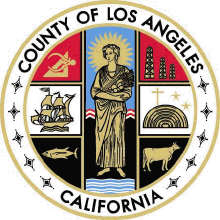
The county seal of Los Angeles County (my old stomping grounds) is shown to the right. It was designed in 1957 by then County Supervisor Kenneth Hahn. The ACLU is…

The county seal of Los Angeles County (my old stomping grounds) is shown to the right. It was designed in 1957 by then County Supervisor Kenneth Hahn.

The ACLU is now pushing to have the seal changed, giving the county two weeks or face a law suit. Why?

Well, if you look really carefully, off to the right, there’s a little cross …

Supporters of the current seal argue that the cross — like the other symbology on the seal — is representative of the history of the county. There are oil derricks, and the Spanish sailing ship ship that first arrived in the county.

The Goddess Pomona – the goddess of gardens and fruit trees – is holding in her arms a sheaf of grain, an orange, a lemon, an avocado and a few grapes to represent Los Angeles County’s agriculture.
She stands on the shore of the Pacific Ocean with the San Gabriel Mountains in the background.
The engineering instruments – the triangle and the caliper – relate to the industrial construction complex of the County and Los Angeles’ vital contribution to the conquest of space.
The Spanish galleon is the San Salvador, which Cabrillo sailed into San Pedro Harbor on October 8, 1542.
The tuna represents the fishing industry of Los Angeles County, and the championship cow, Pearlette, represents the dairy industry.
The Hollywood Bowl indicates the cultural activities, while the two stars represent the County’s motion picture and television industries.
The cross represents the influence of the church and the missions of California.
Oil derricks are symbolic of the oil fields that were discovered on Signal Hill.

The ACLU argues that, based on a letter from the county to the California Secretary of State in 1957, the cross represents religion, and thus is improper under the First Amendment.

Current Supervisor Mike Antonovich says that it’s an historic symbol:

“The cross on our county seal reflects these historical facts,” he said. “It does not mean that we are all Roman Catholic or that everyone who resides in our county is a Christian — it only reflects our historical roots.”

I certainly try to be sensitive to religious freedom issues, but I’m also an historian at heart. The (overwhelming) presence of a pagan goddess in the center of the county seal is not seen as an imposition on religious freedom. Nobody sees the oil derricks as a sign that the county is under the control of the petroleum industry. Nobody thinks Pearlette represents the Golden Calf.

Ah, but Christianity is a living religion, and so folks who feel themselves in explicit or implicity competition against it, or see Christianity (or contemporary religion) as an adversary might conceivably see this as …

… well, as what? I mean, how many people actually were aware of the cross on the seal before the ACLU saber-rattling? And, aware of it now, how many people really think it represents a Vast Christian Conspiracy?

Certainly, were the seal being created today, it would probably be different. Environmentalists would object to the glorification of oil, social conservatives would rail against the celebration of the movie industry, and PETA would plotz over the twin abattoirs of fishing and cattle. And, yes, the ACLU would actively object to inclusion of a cross (and, yes, the Religious Right would actively object to the inclusion of a pagan goddess).

So what? That everyone would find something to object to today is indicative to me that the seal is arguably an historic artifact. Christians lay no more claim to the county than the conquistadors do.

Unless we’re going to rewrite history to ignore the impact of the missions on the county (let alone Christianity on its name), I really can’t support the ACLU’s suit.

(via Volokh)

Save the Children! Huzzah!

What a marvelous idea! Why not let parents sue folks in federal court for disseminating material “harmful to minors”? Now, most people might think that’s something that the police would…

What a marvelous idea! Why not let parents sue folks in federal court for disseminating material “harmful to minors”?

Now, most people might think that’s something that the police would want to step into. I mean, harming minors, good heavens! But, see, that’s the brilliance of this idea! There’s only so many police, but there are zillions of parents! And police have all sorts of other distractions, like crime and criminals and stuff, but surely there are some busy-body parents who want to sue! And, of course, the police and the DA have to worry about tripe like “beyond a reasonable doubt,” whereas law suits only require a “preponderance of the evidence.”

Oh, yeah, there’s that whole state “censorship” worry and the Bill of Rights and the like. That tends to restrain the criminal courts, but, hey, private citizens filing suits? Piece o’ cake!

And — here’s the kicker — since it lets folks sue everyone along the publishing chain — from publishers to distributors to retailers to creators — it can have a massive chilling effect, as everyone along that chain will be extra-special cautious about churning out anything that anybody might possibly consider capable of causing “suffer personal or emotional injury or injury to mental or moral welfare.”

I mean, the “moral welfare” clause alone is priceless! Woo-hoo!

Never mind all those worry-warts at places like the Comic Book Legal Defense Fund:

“This bill is troubling on several levels,” explains CBLDF Director Charles Brownstein. “It appears to allow for civil actions against any, or every, member of the dissemination food chain, from the retailer to the distributor to the publisher, of work that an individual parent may object to. So any citizen, using their own sense of what is obscene or harmful to minors, can bring suit. Considering that comics still suffer the cultural and legal stigma of being perceived as a juvenile medium, this bill could become a dangerous weapon in the hands of an individual who walks into a comic book store and is shocked to find that comics offer much more than Archie and Superman.”

Well, if they do, they shouldn’t. And this law will see to that, you betcha. After all, if it’s a comic book, it’s clearly designed for little tykes to read — regardless of where it’s racked, or what it says on the cover. Why, the whole idea of a “mature adult” reading a comic book is absurd! It’s all obviously a plot to warp our children and pollute our precious bodily fluids. I think I saw something on the 700 Club about that the other night …

Anyway, huzzah for HB 4239! Huzzah for clogging our federal courts with more law suits! Huzzah for promoting a clean and wholesome society, even if we have to scare everyone into it! Huzzah!

(via BoingBoing)

The message

The ACLU often gets a (generally) bum rap for being “anti-religion,” when in reality it is anti-state-religion, fighting the state imposing official religious messages and stances on individuals. A good…

The ACLU often gets a (generally) bum rap for being “anti-religion,” when in reality it is anti-state-religion, fighting the state imposing official religious messages and stances on individuals. A good example of the difference can be seen in a recent case where the ACLU assisted a student with a religious message in a high school yearbook.

The American Civil Liberties Union of Michigan — often known for helping to keep religion out of schools — announced a settlement Tuesday with Utica Community Schools that reinstates Moler’s religious message in the yearbook.
Moler, who was a class of 2001 valedictorian at Stevenson High School in Sterling Heights, was among a group of high-achieving students school officials asked to submit a few words to pass on to their classmates for the yearbook. She used a biblical verse, Jeremiah 29:11: ” ‘For I know the plans I have for you,’ declares the Lord, ‘plans to prosper you and not to harm you, plans to give you hope and a future.’ ”
The entry was cut from the yearbook; school officials told her at the time that it was because it was religious. So Moler enlisted the ACLU’s aid.

You can’t solicit personal messages in a neutral forum and then exclude ones for specific religious content — any more than you can require folks to provide only religious messages, or only give an audience to religious messages.

Makes sense to me.

UPDATE: Les has more (so to speak).

Gender-fender-bender

Even though women can’t drive in Saudi Arabia, that doesn’t mean traffic problems there aren’t their fault. I wonder if those responsible for organizing traffic awareness campaigns and programs aimed…

Even though women can’t drive in Saudi Arabia, that doesn’t mean traffic problems there aren’t their fault.

I wonder if those responsible for organizing traffic awareness campaigns and programs aimed at educating motorists and pedestrians have realized the role of women in the chaos characteristic of our streets and the accidents which occur there all too often.
It is of course true that women do not drive in the Kingdom but the great majority of drivers here take their orders from women. And it is also true that once a woman is seated in her car, she begins issuing contradictory orders which she demands the driver carry out. Just think of the sheer number of foreign drivers in the streets of Riyadh — no exact numbers are available — from early morning until late at night and you can begin to see the magnitude of the problem.

By “foreign drivers” the writer means foreign workers who’ve taken on a chauffering job for women in the kingdom.

For those who think this is gratuitous Saudi-slamming, it’s not. Consider the not-too-antiquated American stereotypes of the “backseat driver” (usually the mother-in-law) or nagging-wife-in-the-passenger seat, and we don’t have that much room to boast.

Still, it’s sort of a fascinating glimpse into Saudi society (or at least one guy’s perspective on it).

(via Daimnation)

Some freedom is more free than others

Take a blow for freedom (providing proxy Internet access service through Anonymizer for folks in repressive countries like Iran and China), add in equal parts prudery and stupidity, shake well,…

Take a blow for freedom (providing proxy Internet access service through Anonymizer for folks in repressive countries like Iran and China), add in equal parts prudery and stupidity, shake well, and serve, and what do you have?

Something that looks a lot like this.

The U.S. government concocted a brilliant plan a few years ago: Why not give Internet surfers in China and Iran the ability to bypass their nations’ notoriously restrictive blocks on Web sites?
Soon afterward, the U.S. International Broadcasting Bureau (IBB) invented a way to let people in China and Iran easily route around censorship by using a U.S.-based service to view banned sites such as BBC News, MIT and Amnesty International.
But an independent report released Monday reveals that the U.S. government also censors what Chinese and Iranian citizens can see online. Technology used by the IBB, which puts out the Voice of America broadcasts, prevents them from visiting Web addresses that include a peculiar list of verboten keywords. The list includes “ass” (which inadvertently bans usembassy.state.gov), “breast” (breastcancer.com), “hot” (hotmail.com and hotels.com), “pic” (epic.noaa.gov) and “teen” (teens.drugabuse.gov).

I’m equal parts offended by the doltish by which this was done, and the sentiment behind it. I can appreciate the image trouble, at the very least, behind this decision (headline: “US Taxpayer Funds Chinese Net Porn Viewing!”), but when you’re talking about giving folks access to the free world, turning back around and saying, “Yeah, but not all of it,” seems a bit hypocritical.

And … yeesh, could they have figured out a worse way of doing things? I mean, come on, filter it through some commercial net blocker, if you feel compelled by Mrs. Grundy to do so, but at least be reasonably effective about it.

A look at the keyword list of what’s apparently blocked, I can see a few that arguably it would be difficult to say are not adult-related. On the other hand, in addition to the words above, any site using “dick” (cheney, anyone?), “jack,” “boy,” or “my” and “tv” (so much for access to Malaysian and Tuvalu-TLDed sites) may be in trouble. Not to mention …

The official naughty-keyword list displays a conservative bias that labels any Web address with “gay” in them as verboten–a decision that affects thousands of Web sites that deal with gay and lesbian issues, as well as DioceseOfGaylord.org, a Roman Catholic site.
More to the point, the U.S. government could have set a positive example to the world regarding acceptance of gays and lesbians–especially in Iran, which punishes homosexuality with death.

Perish the thought.

(via BoingBoing)

See?

This should have conservatives — or at least supporters of marriage — dancing in the streets, or so you’d think. Now that it is about to be legal for same-sex…

This should have conservatives — or at least supporters of marriage — dancing in the streets, or so you’d think.

Now that it is about to be legal for same-sex couples to marry, some Massachusetts employers are eliminating domestic-partner benefits for gay workers, requiring them to say “I do” if they want to keep their partners on their insurance.
Beth Israel Deaconess Medical Center, one of the state’s largest employers, will drop domestic-partner benefits for Massachusetts residents at the end of this year, as will Babson College.
“The original reason for domestic-partner benefits was to recognize that same-sex couples could not marry,” Beth Israel spokesman Jerry Berger said. “Now that they can, they are essentially on the same footing as heterosexual couples.”

There is a huge embedded legal and contractual infrastructure around marriage in this country — evolving (rightfully), but already functioning with the lessons of years. Trying to overcome artificial barriers to marriage by creating “civil unions” and “domestic partners” bypasses that, making for a crazy-quilt of rights and obligations.

Extending marriage to gays simplifies matters, and puts everyone on an even footing. That seems pretty efficient to me.

If the punishment fits …

Because Louisiana is such an idyllic state that they have plenty of time to worry about crap like this: With her hip-hugging jeans fastened low enough to show off the…

Because Louisiana is such an idyllic state that they have plenty of time to worry about crap like this:

With her hip-hugging jeans fastened low enough to show off the sparkly strings of her thong, Britney Spears could be a common criminal when she comes home to Louisiana to put on a show. And Nelly’s baggy jeans, if they happen to slip and show his drawers, could get him booted from the rap circuit to a New Orleans jail cell if state lawmakers approve a bill filed Tuesday in the House that would make it a crime to wear pants below the waist.
Even plumbers could get canned under the draft law that state Rep. Derrick Shepherd, D-Marrero, said he filed because he was tired of catching glimpses of boxer shorts and G-strings over the low-slung belt lines of young adults.
House Bill 1626 would punish anyone caught wearing low-riding pants with a fine of as much as $500 or as many as six months in jail, or both.

That’ll teach ’em! Those … those … rude people!

“I’m sick of seeing it,” said Shepherd, a first-term legislator, who added he’s gotten similar complaints from ministers in his district. “The community’s outraged. And if parents can’t do their job, if parents can’t regulate what their children wear, then there should be a law.”

This is why some folks vote Libertarian, people.

Shepherd said such technicalities generally would be overlooked by police, who would only cite violators who deliberately wear pants low on their hips. His bill does not define an unlawful outfit.
“It’s sort of like nudity,” he said. “You know it when you see it.”

Just the kind of rigorous and thoughtful law-making the good people of Louisiana deserve, say I.

No

While I recognize the environmental aspects of the debate over the best type of diapers for babies — disposable being landfill-clogging and cloth consuming valuable water — I’m pretty certain…

While I recognize the environmental aspects of the debate over the best type of diapers for babies — disposable being landfill-clogging and cloth consuming valuable water — I’m pretty certain that this particular out-of-the-box solution is not the answer — at least not for folks coming to visit my house.

As environmentalists celebrate the 34th annual Earth Day, some in the green movement are now advocating “diaper-free” babies to help save the planet.
[…] The green movement is now promoting diaperless babies as a “retro, cutting-edge, environmentally friendly scheme” to mothers throughout the industrialized world.
[…] “There is a way to have a baby and NOT use diapers,” says one website advocating diaperless babies. Parents are urged to get in tune with their infant’s body signals and hold babies over toilets, buckets and shrubbery or any other convenient receptacle when nature calls.
One advocate suggests bringing a “tight-lidded bucket” along to serve as a waste receptacle when mothers take their babies out in public.

Riiiiight. I’m sure that will impress the the proprietors of all the businesses you choose to visit.

Scott Noelle, editor of the Continuum Concept website and a father, explained why he eventually stopped using diapers on his infant daughter Olivia, in a web essay titled “Going Diaperless.”
“In my mind, diapers became the symbol of the Evil Empire of Western Parenting in which babies must suffer to accommodate the needs of their parents’ broken-continuum culture: a controlled, sterile, odorless, wall-to-wall carpeted fortress in which to live with the illusion of dominion over nature,” wrote Noelle, on the website livingharmony.com.
Despite his concerns, Noelle continued to use diapers on his daughter, despite the fact that he “felt like a monster and a fraud.”
Noelle finally chose to go diaperless and looked to traditional cultures for inspiration. “How I longed for a simple, dirt-floored, baby-friendly hut like that of a Yequana family,” he wrote.

No mention of the infant mortality rate due to dysentry amongst the “dirt-floored, baby-friendly” Yequana.

I tried reading Noelle’s essay but only got this far:

As Olivia grew, so did her objections to being diapered, as well as my feelings of guilt. I worried that diapering her could cause sexual hang-ups, impede her natural diaphragmatic breathing, and even interfere with the proper development of her bones as she walked in the bulky abominations. Maybe some of my worries were irrational, but certainly, I thought, the practice of diapering must be at odds with a human infant’s innate, continuum expectations.

I think you had it right with the “irrational” part, but … well, I’ll tell you what: you raise your child the way you want, and feel free to visit my house … after the kid is fully potty trained. Assuming potty training is not also “a symbol of the Evil Empire of Western Parenting.”

(via Ipse Dixit)

Morlocks ‘R’ Us

Yes, folks, I understand that sunlight can be dangerous. We’ve all had it drummed into our heads that UV radiation can cause melanoma and other skin cancers. But it’s also…

Yes, folks, I understand that sunlight can be dangerous. We’ve all had it drummed into our heads that UV radiation can cause melanoma and other skin cancers.

But it’s also a source of Vitamin D, and it’s a condition that humanity has lived with for — well, all of its existence. Does that make preaching minor exposure to sunlight a firing offense in the science community? Evidently so.

Michael Holick, a dermatologist at Boston University, was recently asked to resign from school’s department of dermatology because of a book in which he describes the importance of sunlight in boosting vitamin D levels and his ties to the indoor tanning industry.
Holick’s book “is an embarrassment for this institution and an embarrassment for him,” department chair Barbara Gilchrest told the Boston Globe. According to the Globe, which first reported the story, Holick was asked to resign from the department of dermatology in February. He has resigned, but continues to teach and to direct the medical center’s vitamin D lab, and has not received a pay cut.
Although the benefits of vitamin D in bone health have been long known, new research is emerging that suggests the fat-soluble vitamin may also help prevent different types of cancer. As a result, Holick argues that moderate amounts of sunlight—the main source of vitamin D—are more beneficial than dangerous, and he recommends that fair-skinned people who live in the Boston latitude spend a few sunblock-free minutes a couple of times per week outside, with their skin exposed. He summarizes his thoughts on the issue in The UV Advantage, scheduled to be released in May.

Or, described in more detail:

In the book, The UV Advantage, to be published next month in the US, Holick recommends people spend a few minutes two to three times a week, depending on skin type, exposed to the Sun or lying under a sun lamp (without sunscreen) to ensure they get enough vitamin D.
He says he does not advocate tanning or sun worship but “moderate” exposure to the Sun sufficient to gain its benefits. “I am advocating common sense, something often in short supply in America’s approach to health. Our society doesn’t seem to believe in a happy medium, only in extremes. The notion that we have to protect ourselves from the Sun all the time is misguided and unhealthy.”

And for his sins?

In a statement to The Scientist, Boni E. Elewski, president of the American Academy of Dermatology, argued that even a few minutes of sunlight exposure can be dangerous, and people can get what they need of the vitamin through supplements. “Any group, organization, or individual that disseminates information encouraging exposure to UV radiation, whether natural or artificial, is doing a disservice to the public,” Elewski said.

Even a few minutes? Whether or not Holick has ties to the Indoor Tanning Association, he’s not suggesting everyone sport a “healthy” tan, just that they get a few minutes in the sun a couple of times a week. That the ADA finds this to be dangerous to the point of unacceptability is, itself, illuminating.

[Dr Barbara Gilchrest, chairwoman of the department of dermatology at the university] added: “I would ask anyone to resign his appointment in the department if I felt that person was conducting himself in a way that was professionally irresponsible, potentially dangerous to the public and not conforming to what I think are very high standards for reporting scientific information.”
The AAD said Holick was irresponsible and compared his advice on the benefits of the Sun to suggesting that smoking might be used to combat anxiety.

Which might be true if he were discussing how space aliens and perpetual motion machines would keep sun burns from being dangerous. But Holick has plenty of non-lunatic support:

Some vitamin D experts said that Holick should not have to resign. “If he was fired for his opinion, which is based on science, then it would appear to be a violation of the principles of academic freedom,” James Fleet, who studies nutrition and vitamin D at Purdue University, told The Scientist. Whether small amounts of sunlight can boost vitamin D intake without raising the risk of cancer “is an issue worth debating,” Fleet said.
Reinhold Vieth of the University of Toronto, who has worked with vitamin D since 1974, said that shunning Holick from the department of dermatology represents a “narrow-minded” approach to health. “It’s like a horse with blinkers, and the only thing they see is melanoma,” he told The Scientist.

I’m not trying to downplay the dangers of skin cancer here, given my own family history, but it seems to me that if only a few minutes exposure to sunlight every couple of days is, in fact, of significant danger, we would be seeing skin cancer as the number one killer in America, and folks like Holick would be worthy of firing (not to mention laughingstocks), as opposed to the other way around.

Neil Walker, chairman of the UK Skin Cancer Prevention Working Party and a consultant dermatologist at Churchill Hospital, Oxford, said: “If dermatologists say ‘never go in the sun’ people are going to look at us as idiots.
“We have got to find a way of putting the message across about the most damaging behaviour which is why I tell my patients not to bake or burn. There are lot of people who have this almost religious conviction about the dangers of the sun.
“My view is that we have got to look at things practically.”

How … refreshing.

(via GeekPress)
Motes and Beams

Nicholas Kristof — no fan of Relgious Right politics — offers a worthwhile op-ed on the need for tolerance and respect to go both ways. I’ve argued often that gay…

Nicholas Kristof — no fan of Relgious Right politics — offers a worthwhile op-ed on the need for tolerance and respect to go both ways.

I’ve argued often that gay marriage should be legal and that conservative Christians should show a tad more divine love for homosexuals.
But there’s a corollary. If liberals demand that the Christian right show more tolerance for gays and lesbians, then liberals need to be more respectful of conservative Christians.
One of the most ferocious divides today is that between evangelical and secular America. Some conservative Christians are all too quick to sentence outsiders to hell. And liberals denounce stereotypes of Muslims but not of “Christian nuts.”

Worth reading, even if (or particularly if) you find the actions of some Christian right blowhards and hypocrites to be justifiable brushes with which to tar an entire, broad religious movement.

(via Blinne)

Bodies of evidence

I’ve had very mixed feelings over the whole regulating of showing soldiers’ coffins coming back to the US brouhaha. On the one hand, the Bush Administration cracking down on a…

I’ve had very mixed feelings over the whole regulating of showing soldiers’ coffins coming back to the US brouhaha. On the one hand, the Bush Administration cracking down on a Clinton-era policy sure smacks of “If we keep ’em in the dark and don’t give ’em photo ops, the hoi polloi won’t get peeved at us.” It’s not the only stunt of that sort the Bushies have pulled, which lends credence to the suspicion.

On the other hand, were I one of the families of the fallen, I might be a bit irked at pictures of my loved one being used for political purposes, regardless of how I felt about the war. There is that which stands in defense of the Bush Administration’s stance.

Last week, a whole slew of new photos of returning war dead popped up on the Internet at the Memory Hole.

>>>Since March 2003, a newly-enforced military regulation has forbidden taking or distributing images of caskets or body tubes containing the remains of soldiers who died overseas. [read more]
Immediately after hearing about this, I filed a Freedom of Information Act request for the following:
All photographs showing caskets (or other devices) containing the remains of US military personnel at Dover AFB. This would include, but not be limited to, caskets arriving, caskets departing, and any funerary rites/rituals being performed. The timeframe for these photos is from 01 February 2003 to the present.
I specified Dover because they process the remains of most, if not all, US military personnel killed overseas. Not surpisingly, my request was completely rejected. Not taking ‘no’ for an answer, I appealed on several grounds, and—to my amazement—the ruling was reversed. The Air Force then sent me a CD containing 361 photographs of flag-draped coffins and the services welcoming the deceased soldiers.
Score one for freedom of information and the public’s right to know.

Which was much the tune played on various sites pointing to the Memory Hole pictures. “See? The truth will out! People will realize the deep dark secret that soldiers are dying in Iraq, and will then rise up to throw the ShrubCo types out of office! Huzzah!”

Except … those may not be actual pictures of American war dead.

NASA sent out the following bulletin on Friday:

Columbia Crew Mistakenly Identified As Iraqi War Casualties
Many news organizations across the country are mistakenly identifying the flag-draped caskets of the Space Shuttle Columbia’s crew as those of war casualties from Iraq. Editors are being asked to confirm that the images used in news reports are in fact those of American casualties and not those of the NASA astronauts who were killed Feb.1, 2003, in the Columbia tragedy.
An initial review of the images featured on the Internet site www.thememoryhole.org shows that more than 18 rows of images from Dover Air Force Base in Delaware are actually photographs of honors rendered to Columbia’s seven astronauts.
News organizations across the world have been publishing and distributing images featured on the web site.

So — an error in the FOIA data returned to the Memory Hole poster? A devious anti-war plot? A devious government plot? A devious NASA plot?

At any rate, an odd twist in the tale.

UPDATE: As of this afternoon, the Memory Hole site has segregated out the photos it says are the astronaut ones. It notes also that, while there is no confirmation that the other military coffins are from Iraq, circumstantial evidence indicates they are.

What’s interesting is that the site seems defensive about whether these are war dead from Iraq vs from Afghanistan. There are no identifiers shown, but the circumstantial evidence (and the ratio of deaths) seem to make it likely that at least some are from Iraq. The site seems unclear whether the outrage is regarding all war dead coffin photos being suppressed (which would seem to need no further analysis), or just those from Iraq (which would seem an odd distinction). Which seems … odd.

Sauce for the goose

Speaking of PETA, they’ve had to pull recent ads they were running up in Canada which were exploiting a grisly set of murders. A fierce backlash sparked by ads that…

Speaking of PETA, they’ve had to pull recent ads they were running up in Canada which were exploiting a grisly set of murders.

A fierce backlash sparked by ads that exploit the grisly serial killings of women in British Columbia has prompted a militant animal-rights group to dump plans to expand its current anti-meat campaign to three Canadian cities. People for the Ethical Treatment of Animals said Thursday its intention was not to hurt the victims’ families. “The one unexpected aspect was hearing from the family members, who were and are not the target of the campaign,” Bruce Friedrich, PETA’s director of vegan campaigns, said from Washington, D.C. “Our intention was to provoke meat-eaters, not upset the families.”
The ad in question shows a young woman on one side, a “smiling” pig on the other, and a slogan: Neither of us is meat. It’s a reference to the case of Robert Pickton, who is to stand trial late this year or early in 2005 on charges he killed 15 women on his farm in Port Coquitlam, B.C. The province’s medical officer of health said recently meat products from Pickton’s farm may have contained human remains.
[…] Friedrich said he was surprised by the backlash. “I really don’t get what all the fuss is about,” he said.

And PETA accuses omnivores of being insensitive.

The ads will be pulled — in a couple of weeks — from Canadian markets. They will still be used in the US.

(via Daimnation)

Darling

If you work for the English Natoinal Opera, don’t call your fellow staff “darling.” It might be actionable as sexual harassment. An ENO spokesman said: “Some people may have used…

If you work for the English Natoinal Opera, don’t call your fellow staff “darling.” It might be actionable as sexual harassment.

An ENO spokesman said: “Some people may have used the term ‘darling’ to each other for years, but there are others who may consider it inappropriate.”
The policy, set out in a document called Dignity at Work, singles out the word “darling” as part of a code of conduct which addresses workplace protocol. It tells employees: “The use of affectionate names such as ‘darling’ may constitute sexual harassment.”
The spokeswoman added: “This isn’t about banning the word, it’s all about the context in which it is used. Whilst it may be acceptable between friends, it would be thought of very differently if the term is used by a senior colleague and accompanied by a wink. Our policy puts in place a mechanism which allows an employee who feels uncomfortable to enter into a grievance procedure.
“We realise that it would be almost impossible to ban the word ‘darling’ in theatreland, but this is about addressing some serious issues.”
The policy also warns about unwelcome sexual advances and “offensive” flirtation.

Granted that someone using the term could use it with an intent to harrass. Granted that it might be a part of “unwelcome sexual advances” and “offensive flirtation.” Nonetheless, you could say the same about how you look at people, too. Will we expect guidelines about not looking at other people, so as avoid causing “offense” of those who consider it “inappropriate”?

By singling out “the use of affectionate names such as ‘darling'” as perhaps being, in and of themselves, sexual harrassment, it is about trying to ban a word. Because ultimately it then comes down to a jury having to interpret the context and (if it even counts) intent, and it thus become simply easier to argue that using the word “darling” is harrassment in and of itself.

Feh.

(via Overlawyered)

Twixt and tween

Okay, try this … I am going to force you to do something — something you consider immoral, abetting behavior you consider immoral, something that violates your conscience, your religion,…

Okay, try this …

I am going to force you to do something — something you consider immoral, abetting behavior you consider immoral, something that violates your conscience, your religion, your holy vows. I am going to force you to do it. If you don’t, I’m going to ruin your livelihood, your business, and I’m going to sue you for every last penny you own. You have no choice. No choice at all.

And, on the other hand …

I don’t like you. I don’t approve of you, or of what you do, or why you do it. So you know what? To hell with you. I’m not going to help you. I don’t care if it makes you suffer. I don’t care if it hurts you. I don’t care if it’s my job to help you. I just don’t care for trash like you and your kind. Get out of here.

Michigan’s legislature is in the process of passing the “Conscientious Objector Policy Act” and related legislation. It shields health-care workers and insurance companies from firing or law suits if they refuse to perform a medical procedure, fill a prescription or cover treatment for something they object to for moral, ethical or religious reasons.

In most of the debate on the matter, the focus is on abortions and emergency (morning-after) contraceptive services. But as this article notes, it could also give someone an out to turn away someone from (non-emergency) medical care just because they’re, say, gay. While there is evidently a provision in the bill to prevent discrmination based on race, deciding that homosexuals are abominations before the Lord, and therefore can be refused treatment or insurance coverage would evidently be perfectly legal.

Yeesh.

And yet, by the same token, should a Catholic pharmacist who believes that abortion is a sin be compelled to sell someone morning-after contraception? I’m not sure I’m willing to say yes — but I’m also not sure I’m willing to have someone be unable to get such a (legal) prescription because of it.

(Oddly enough, ordinary contraception is excepted by the bill, which seems to fly in the face of its basic principles.)

In other words, the ostensible principles (never mind for a moment anything about ulterior motives) behind the bills seem sound, but their application is troubling.

Republican state Rep. Randy Richardville of Monroe, who introduced the main bill of the package, said the legislation is intended to protect religious, moral and ethical freedoms of health-care providers. “Nothing in this bill, not a thing, denies a patient from receiving medical care,” he said. “This simply means a medical professional cannot violate their religious obligations.”
Paul A. Long, vice president for public policy for the Michigan Catholic Conference, said the bills promoted the constitutional right to religious freedom.
“Individual and institutional health-care providers can and should maintain their mission and their services without compromising faith-based teaching,” he said in a written statement.

But the odd set of exceptions — the two noted above, race (can’t folks be bigotted for religious reasons?) and birth control (which, last I checked, was also against Catholic doctrine) — make this a bit less than a pure First Amendment defense. And the breadth of what discrimination could be allowed, and the pain and suffering that could stem from that (even if emergency services cannot be denied), seems a dangerous path to take.

And that doesn’t even get into what constitutes a “legitimate” religious objection, something I’m as loath to let the courts decide as I’m sure they are — but which I’ll be damned (so to speak) if I’m to let someone claim it as a rationale for whatever they do or don’t want to do.

If the specific, openly-debated matters of conscience were themselves the only target of the bill, I might see it as a reasonable compromise between religious convictions (even ones I don’t share) and the public good. I wouldn’t be happy about it, but unhappiness is usually part of compromise. But by turning it around and making it about everything except a few sacred cows, it seems to open the door far too wide to let individual — and institutional — discrimination prevail.

(via Scott)

UPDATE: Subject revisited.

When they came for …

Where’s Martin Niemoeller when you need him? That may be an exagerration, but — well, the good reverend’s famous quote is all about slippery slopes. I find hate speech ……

Where’s Martin Niemoeller when you need him? That may be an exagerration, but — well, the good reverend’s famous quote is all about slippery slopes.

I find hate speech … well, hateful.

Problem is, what I consider hate speech may simply be someone’s expression of opinion or moral conviction or political belief. And, frankly, I find suppression of opinons and beliefs even more abhorrent. Because it all becomes a matter of who’s doing the defining of what’s “hate” right now.

‘Canada is a pleasantly authoritarian country,” Alan Borovoy, general counsel of the Canadian Civil Liberties Association, said a few years ago. An example of what he means is Bill C-250, a repressive, anti-free-speech measure that is on the brink of becoming law in Canada. It would add “sexual orientation” to the Canadian hate propaganda law, thus making public criticism of homosexuality a crime. It is sometimes called the “Bible as Hate Literature” bill, or simply “the chill bill.” It could ban publicly expressed opposition to gay marriage or any other political goal of gay groups. The bill has a loophole for religious opposition to homosexuality, but few scholars think it will offer protection, given the strength of the gay lobby and the trend toward censorship in Canada. Law Prof. David Bernstein, in his new book You Can’t Say That! wrote that “it has apparently become illegal in Canada to advocate traditional Christian opposition to homosexual sex.” Or traditional Jewish or Muslim opposition, too.
Since Canada has no First Amendment, anti-bias laws generally trump free speech and freedom of religion. A recent flurry of cases has mostly gone against free expression. The Saskatchewan Human Rights Commission ruled that a newspaper ad listing biblical passages that oppose homosexuality was a human-rights offense. The commission ordered the paper and Hugh Owens, the man who placed the ad, to pay $1,500 each to three gay men who objected to it. In another case, a British Columbia court upheld the one-month suspension, without pay, of a high school teacher who wrote letters to a local paper arguing that homosexuality is not a fixed orientation but a condition that can and should be treated. The teacher, Chris Kempling, was not accused of discrimination, merely of expressing thoughts that the state defines as improper.

I think that Biblical teaching opposing homosexuality is wrong. I am not a believer in the inerrancy of Scripture, and even if the passages usually quoted mean exactly what they say, I don’t believe they’re applicable today (any more than any number of other Biblical injunctions). And even if they did, using the Bible as the basis per se for civil law seems unwise (if not unconstitutional).

But that doesn’t mean that I want folks who speak out Biblically against homosexuality — whether in quiet, studied tones or with the flipped-out fire and brimstone of the Phelps Gang — to be prosecuted for doing so.

When you allow the state to suppress opinions the ostensible majority find repugnant, it’s a recipe for (at the very least) a tyranny of that majority. Dressing it up as protection against “hate speech” is missing the point — a shift in the public wind, and you could as easily fine people and send them to jail for criticizing the church. It’s bad, bad, bad public policy.

The churches seem to be the key target of C-250. One of Canada’s gay senators denounced “ecclesiastical dictators” and wrote to a critic, “You people are sick. God should strike you dead.” In 1998, lesbian lawyer Barbara Finlay of British Columbia said “the legal struggle for queer rights will one day be a struggle between freedom of religion versus sexual orientation.”
It’s starting to be defined just that way in other countries. In Sweden, sermons are explicitly covered by an anti-hate-speech law passed to protect homosexuals. The Swedish chancellor of justice said any reference to the Bible’s stating that homosexuality is sinful might be a criminal offense, and a Pentecostal minister is already facing charges. In Britain, police investigated Anglican Bishop Peter Forster of Chester after he told a local paper: “Some people who are primarily homosexual can reorientate themselves. I would encourage them to consider that as an option.” Police sent a copy of his remarks to prosecutors, but the case was dropped. In Ireland last August, the Irish Council for Civil Liberties warned that clergy who circulated a Vatican statement opposing gay marriages could face prosecution under incitement-to-hatred legislation.

There’s a certain irony here, of course. Neither side of the political spectrum, Left or Right, has been immune to prosecution of unpopular speech. Certainly conservatives in the 20th Century scurrilously used “un-American” and “unpatriotic” and “anarchic” and “Communist” as labels under which to crack down on dissent — often abetted by Christian churches with their own social axe to grind. It’s ironic that the Left, which struggled mightily against those suppressions of opinion and belief, are so quick to institute their own now that they have the political power to do so.

The article is a bit breathless in its warnings about the situation, and there is certainly room for considered differing opinion on the wisdom of this legislation. But it’s worrisome. It echoes a trend of Goodthink that perennially infects this country, even with the First Amendment. And it makes me wonder — what sort of stuff have I written about here could be considered “incitement to hate” somewhere else?

If you liked the War on Drugs …

Volokh has a good thought exercise on what alternative outcomes the DoJ Smut Crackdown will lead to: The crackdown on porn is doomed to be utterly ineffective in its stated…

Volokh has a good thought exercise on what alternative outcomes the DoJ Smut Crackdown will lead to:

  1. The crackdown on porn is doomed to be utterly ineffective in its stated goals of preventing the supposedly harmful effects of porn on its viewers, and on the viewers’ neighbors.
  2. The crackdown on porn will be made effective — by implementing a comprehensive government-mandated filtering system run by some administrative agency that constantly monitors the Net and requires private service providers to block any sites that the agency says are obscene.
  3. The War on Smut will be made effective by prosecuting, imprisoning, and seizing the assets of porn buyers.

[…]So, supporters of the Justice Department’s plans, which do you prefer — #1, #2, or #3? Note that I’m not asking whether porn is bad, or whether porn should be constitutionally protected. I’m certainly not asking whether we’d be better off in some hypothetical porn-free world (just like no sensible debate about alcohol, drug, or gun policy should ask whether we’d be better off in some hypothetical alcohol-, drug-, or gun-free world). I’m asking: How can the government’s policy possibly achieve its stated goals, without creating an unprecedentedly intrusive censorship machinery, one that’s far, far beyond what the Justice Department is talking about right now.

Worth thinking about.

Don’t they know there’s a war on?

I mean, there’s the old War (on Drugs), and a current War (on Terror). With all of that going on, you mean to tell me that the DoJ really has…

I mean, there’s the old War (on Drugs), and a current War (on Terror). With all of that going on, you mean to tell me that the DoJ really has the resources for a new War on Porn?

I mean, regardless of your personal tastes in the matter, it sure seems like it should be waaaaaay down the priority list (particular in computer resources) compared to some other DoJ activities.

(via InstaPundit)