Arafat is dead. Commentary here.
It appears to be final, this time
Arafat is dead. Commentary here….
Arafat is dead. Commentary here.
Arafat is dead. Commentary here….
Arafat is dead. Commentary here.
(Like most such lists, about 80% accurate and about 70% funny, but …) You switch from “Heat” to “A/C” in one day. You know what the “Peoples Republic of Boulder”…
(Like most such lists, about 80% accurate and about 70% funny, but …)
And most important:
(via a co-worker)
Hypothetical: A new drug treatment is developed that suppresses homosexuality. It is made legal. Should a doctor be compelled to prescribe the treatment should someone ask for it, even if…
Hypothetical: A new drug treatment is developed that suppresses homosexuality. It is made legal. Should a doctor be compelled to prescribe the treatment should someone ask for it, even if he or she feels that it’s a terrible thing to do? Should a doctor be allowed to decline such treatment (with a reference, perhaps, to someone who is willing to do so)? And should a pharmacist, similarly horrified at the treatment, be allowed to decline to stock the medication or sell it?
Hypothetical: A new drug treatment is developed that will gradually make black people look white — reducing the melanin in the skin, unkinking the hair, altering certain facial features, etc. It has minimal ill side effects. Some black people choose to take this medication voluntarily, because they want to “pass” in a prejudiced world. Some white parents adopting black babies choose to use it on them, to make them “more like us.” Should a physician be compelled to write a prescription for this drug treatment? Should an insurance company be required to pay for it if a doctor okays it as essential to the emotional health of the recipient? Should a pharmacist have to dispense those pills, even if they think it is a sick, twisted, racist thing to do to a child?
A parallel story has come back to the headlines — parallel in terms of questioning what role the moral beliefs of a medical caregiver can or should play in the legal treatment that can be demanded of them.
For a year, Julee Lacey stopped in a CVS pharmacy near her home in a Fort Worth suburb to get refills of her birth-control pills. Then one day last March, the pharmacist refused to fill Lacey’s prescription because she did not believe in birth control.
“I was shocked,” says Lacey, 33, who was not able to get her prescription until the next day and missed taking one of her pills. “Their job is not to regulate what people take or do. It’s just to fill the prescription that was ordered by my physician.”
Several states have — and other are considering — laws to allow medical care providers, including pharmacists, to do just that. It’s not couched, of course, as “regulating what people take or do.” Just the opposite, in fact, as it’s ostensibly to prevent doctors and pharmacists from being “regulated to do” something that they morally object to.
The American Pharmacists Association, with 50,000 members, has a policy that says druggists can refuse to fill prescriptions if they object on moral grounds, but they must make arrangements so a patient can still get the pills. Yet some pharmacists have refused to hand the prescription to another druggist to fill.
In Madison, Wis., a pharmacist faces possible disciplinary action by the state pharmacy board for refusing to transfer a woman’s prescription for birth-control pills to another druggist or to give the slip back to her. He would not refill it because of his religious views.
And I can see the argument there, too. If I refuse to sell someone a gun because I think he’s going to shoot his wife with it, it would be irresponsible — immoral, in fact — for me to give him directions to another gun shop that might be more accomodating.
The situation hasn’t gotten any less thorny since I last tackled it in April. That hasn’t kept some from treating it all as a simplistic battle of Good vs Evil — with the role of Evil being played by … well …
US druggists refuse to give out birth control because of “moral values”
A number of states have enacted (or may soon pass) laws that allow pharmacists to refuse to dispense birth control if their beliefs (read: fundamentalist Christian dogma) dictate otherwise. […] Just in time for next season’s hotly anticipated coathanger abortion fad. Welcome to Jesusistan.
It’s easy to see this all as some horrific Right Wing Bushie Jerry Falwell Conservative Christian Plot — and I’d even be willing to suggest that that there are those in the Christian Right who see this as a way to backdoor their way into preventing certain things they dislike.
But it remains a more powerful and nuanced issue than that. If I object to providing you a service on moral grounds, under what circumstances can I be forced by the state to do so anyway? And a straightforward cuts both ways — whether it’s crazy fundie pharmacists refusing to dispense birth control pills, or wise and humanistic pharmacists refusing to dispense “straight” or “white” pills in my hypothetical.
The danger, of course, is that this may mean that folks are unable to get treatment that they want, and are legally allowed to receive, if all the pharmacies in an area (especially a smaller, rural area) choose to not provide such a service. We’ve seen something similar happen with the increasing difficulty of women being able to find abortion services (though nobody has, on the flip side, yet argued that doctors should be compelled to learn how to perform abortions and provide them to anyone who asks).
I still don’t know what the answer is. But I’m pretty certain that we’re not going to get to it by simply treating it all as some “Jesusistan” plot.
Note: In a world bound together by the Internet — indeed, when dealing specifically with Internet-related matters, and with someone who’s not afraid to use that forum herself — it…
Note: In a world bound together by the Internet — indeed, when dealing specifically with Internet-related matters, and with someone who’s not afraid to use that forum herself — it just doesn’t pay to screw someone over. Especially just to, evidently, be a cheapskate.
Yes, I mean, you, Bill.
“Either a good or a bad reputation outruns and gets before people wherever they go.”
   — Lord Chesterfield
UPDATE (22-Dec-04): Bill has contacted me and asked (nicely, explictly non-threateningly, but firmly) that, given the high pagerank this page has ended up having in Google associating his name with this matter, and given that he claims to have documentary proof that that he’s in the right of the dispute (which, at this late date, I declined to review), I either publish a retraction, or, preferably, delete this post.
Being an historian, and being an honest man, I’m always reluctant to delete something from the record. Even when in error (which is not a concession of same), that error is part of the historical record and should remain as such.
Still, not wishing to either prolong unpleasantness, nor paper it over, I’m taking the following steps:
Hopefully that will satisfy all quarters, including my idiosyncratic own.
Bottled Holy Water. You may not be religious, and you may not even believe in heaven or hell, but if you have the choice between two quality spring waters, one…
You may not be religious, and you may not even believe in heaven or hell, but if you have the choice between two quality spring waters, one that has been blessed, and one that has not been, then why in heaven’s name would you even take the chance? Our spring water tastes great, costs about the same price as other brands, and is blessed by religious leaders as it is being bottled.
For thousands of years, in virtually every religion, water has been used to wash away the sins of Jews, Christians, Muslims, Buddhists, and even members of the Occult. Now you can cleanse and protect yourself while extinguishing your thirst with with Holy Spring Water™.
Holy Spring Water™ is 100% pure natural Spring Water, that tastes great and has been blessed. By a Monk, a Catholic Priest, or a Holy Shaman, the blessing does not take away from the taste. Holy Spring Water™ washes away the sins of anyone feeling “less then saintly” while quenching your thirsts…like nothing else can. Try our Holy Spring Water™, Your immediate redemption and satisfaction is guaranteed.
(via J-Blog)
… Here, let me patch that up for you … The prospects of “cosmetic neurology” — chemical and other methods to tweak the brain and improve how it works. Like…
… Here, let me patch that up for you …
The prospects of “cosmetic neurology” — chemical and other methods to tweak the brain and improve how it works. Like “cosmetic surgery,” it has the both alarming and intriguing prospect of going beyond fixing injuries and crippling conditions to being something that folks choose electively.
As he envisions it, cosmetic neurology one day could mean not only sharpening intelligence, but also elevating other dictates of the brain ? reflexes, attention, mood and memory. Studying for the SAT? Take this drug to retain more of those pesky facts. About to report for duty at the fire station? These pills will improve your reflexes. Here’s the 800 number. Ask your doctor.
These are not only theoretical musings. Last month in the journal Neurology, Chatterjee noted that some current drugs already may have many of these effects. In one study, for example, emergency-room patients given a memory-altering drug appeared to be spared some symptoms of post-traumatic stress. Another small study of pilots in flight simulators suggested that those taking medications for Alzheimer’s disease performed better, particularly under emergency conditions.
Chatterjee reserves opinion but says the idea speaks to the basic purpose of medical practice.
“I’m not arguing that this is a bad thing, and I’m not arguing it’s a good thing.” Before doctors are caught by surprise, he said, they need to be prepared. “What I’m hoping to do with this is get people talking.”
(via GeekPress)
Okay, so we finally watched Veronica Mars last night. It was Tuesday, it was 8 p.m., the previous show was over, nothing else was on, Margie asked “Do we dare?”…
 Okay, so we finally watched Veronica Mars last night. It was Tuesday, it was 8 p.m., the previous show was over, nothing else was on, Margie asked “Do we dare?” and I said “Sure” …
And — yeah, well … those who like that sort of thing will maybe find it the sort of thing they like.
The main VM plotline (Veronica goes all Nancy Drew over the guy upstairs who she thinks has done in his gal) had some moderately witty dialog, leavened with clunky and difficult-to-suspend-disbelief plotting. Frankly, I found Buffy a lot more realistic. Heck, I found Nancy Drew more realistic (and Pamela Sue Martin was hot) …
The B-plot (the snarky white rich kid and the snarky Hispanic gangsta kid engage in a war of wills with a cranky teacher) just didn’t float my boat. Perhaps I am too much of an old codger (and former teacher) to get my kicks out of smart-ass kids triumphing over stodgy school disciplinarians (though I thought it was done quite nicely — and with real humor — in Ferris Bueller and any number of other movies and shows I’ve watched, all the way to Recess). It just fell flat for me, and made me want to give them detention scrubbing out the toilets or mucking the stables or something. Or, perhaps, a good box to the ears.
So … I’m glad for all you VMaddicts that the show has been renewed, and Whatever Gets You Through the Night. But I don’t see me going out of my way on future Tuesdays to watch it. If it happens to be on, and nothing else is … maybe. Or maybe not.
I’m sure it’s short-sighted of me, but I really don’t care who replaces him — I’m just glad to learn that, finally, at long last, Ashcroft’s outta there. UPDATED: I…
The NY Times weighs in editorially on election reform goals. And, by and large, they’re things I can support: It’s patently obvious that presidential elections, at least, should be conducted…
The NY Times weighs in editorially on election reform goals. And, by and large, they’re things I can support:
It’s patently obvious that presidential elections, at least, should be conducted under uniform rules. Voters in Alaska and Texas should not have different levels of protection when it comes to their right to cast a ballot and have it counted. It’s ridiculous that citizens who vote in one place have to show picture ID while others do not, that a person who accidentally walks into the wrong polling place can cast a provisional ballot that will be counted in one state but thrown out in another. States may have the right to set their own standards for local elections, but picking the president is a national enterprise.
True. Problem is, it’s difficult, confusing, and costly to maintain separate electoral standards between local and state elections. Which means that whatever is pushed out by Washington for federal standards will become the standards, either de facto, or de jure (when someone files a suit about it). That’s not a bad thing, perhaps, but it’s a cost to these suggestions that needs to be borne in mind.
And, of course, a lot of the below is going to cost money. And that will need to come from the federal level as well. And that means the feds will have an even bigger say in how elections are run.
I believe there’s a pesky Constitutional provision about how states get to run elections, though I suspect ways can be found around that.
1. A holiday for voting. It’s wrong for working people to be forced to choose between standing in a long line to vote and being on time for work. Election Day should be a holiday, to underscore the significance of the event, to give all voters time to cast ballots and to free up more qualified people to serve as poll workers.
2. Early voting. In states that permit it, early voting encourages people to turn out by letting them vote at times that are convenient for them. And it gives election officials and outside groups more time to react to voting problems ranging from faulty voting machines to voter intimidation.
If we do #1 we need to do #2, otherwise (as has been worried about) folks will treat #1 as a vacation day and voter turn-out will actually drop.
Now, what I’d like would be some sort of “I voted” receipt or token that folks would need to return to their employer to justify getting the day off …
3. Improved electronic voting. For voters to trust electronic voting, there must be a voter-verified paper record of every vote cast, and mandatory recounts of a reasonable percentage of the votes. The computer code should be provided to election officials, and made public so it can be widely reviewed. There should be spot-checks of the software being used on Election Day, as there are of slot machines in Nevada, to ensure that the software in use matches what is on file with election officials.
Agreed on all counts.
4. Shorter lines at the polls. Forcing voters to wait five hours, as some did this year, is unreasonable, and it disenfranchises those who cannot afford the wait. There should be standards for the number of voting machines and poll workers per 100 voters, to ensure that waiting times are reasonable and uniform from precinct to precinct.
Just send money.
5. Impartial election administrators. Partisan secretaries of state routinely issued rulings this year that favored their parties and themselves. Decisions about who can vote and how votes will be counted should be made by officials who are not running for higher office or supporting any candidates. Voting machine manufacturers and their employees, and companies that handle ballots, should not endorse or contribute to political candidates.
On the surface of it, all reasonable. In practice, a lot trickier. I suppose secretaries of state (or “secretaries of elections”) could be made, themselves, non-partisan elected positions — though in practice, elected non-partisan positions rarely are. And while I can see how you might legally forbid such folk from being active members of political campaign committees, you can’t (practically or constitutionally) forbid them from “supporting any candidates.” I think you would also run into problems, constitutionally, with forbidding voting machine manufacturers, et al., from protected political speech, i.e., “endorsing or contributing to political candidates.”
6. Uniform and inclusive voter registration standards. Registration forms should be simplified, so no one is again disenfranchised for failing to check a superfluous box, as occurred this year in Florida, or for not using heavy enough paper, as occurred in Ohio. The rules should be geared to getting as many qualified voters as possible on the rolls.
Agreed.
7. Accurate and transparent voting roll purges. This year, Florida once again conducted a flawed and apparently partisan purge of its rolls, and went to court to try to keep it secret. There should be clear standards for how purges are done that are made public in advance. Names that are due to be removed should be published, and posted online, well in advance of Election Day.
Agreed. Though expect privacy lawsuits regarding such names being published.
8. Uniform and voter-friendly standards for counting provisional ballots. A large number of provisional ballots cast by registered voters were thrown out this year because they were handed in at the wrong precinct. There should be a uniform national rule that such ballots count.
Certainly we need uniform standards. I find the whole provisional ballot thing a bit pernicious — I understand why it’s becoming more common, but I also think it’s going to lead to more problems in the future. Indeed, if these other suggestions are carried out, provisional ballots should be unnecessary.
That said — um, what’s with not going to the right precinct to vote?
9. Upgraded voting machines and improved ballot design. Incredibly, more than 70 percent of the Ohio vote was cast on the infamous punch card ballots, which produce chads and have a high error rate. States should shift to better machines, ideally optical scans, which combine the efficiency of computers and the reliability of a voter-verified paper record. Election officials should get professional help to design ballots that are intuitive and clear, and minimize voter error.
Optical scans aren’t fool-proof by any means. I agree, though, that we need better — and uniform — standards for voting devices and ballot layout.
10. Fair and uniform voter ID rules. No voter should lose his right to vote because he is required to produce identification he does not have. ID requirements should allow for an expansive array of acceptable identification. The rules should be posted at every polling place, and poll workers should be carefully trained so no one is turned away, as happened repeatedly this year, for not having ID that was not legally required.
Agreed, though the purpose of such voter ID rules — to prevent voter fraud (voting when ineligible, voting multiple times) — should also be encompassed by such processes.
11. An end to minority vote suppression. Protections need to be put in place to prevent Election Day challengers from turning away qualified minority voters or slowing down voting in minority precincts. More must be done to stop the sort of dirty tricks that are aimed at minority voters every year, like fliers distributed in poor neighborhoods warning that people with outstanding traffic tickets are ineligible to vote. Laws barring former felons from voting, which disproportionately disenfranchise minorities, should be rescinded.
If there are sufficiently strong voter ID rules, much of the legitimate justification for challengers will be removed. Dirty tricks should indeed be fought against (though I’m not sure that’s good fodder for federal intervention). Part of what I’d rather see in this context is more vigorous prosecution of electoral law violations that already take place.
As to the felony disenfranchisement — I’m of mixed minds on it (and the disproportionate minority impact is not part of the equation to me).
12. Improved absentee ballot procedures. Voters outside of their states, including military voters, have a right to receive absentee ballots in a timely fashion, which did not always happen this year. Absentee ballots should be widely available for downloading over the Internet. Voters should not be asked, as military voters were this year, to send their ballots by fax lines or e-mail, denying them a secret ballot.
Agreed. The problem becomes how to ensure secrecy of the vote while also ensuring security of the vote, particularly in an absentee process.
(via LawGeek)
A Coke is a Coke is a Coke … except when it isn’t. Deep in the heart of Coca-Cola country, there’s at least one place where the iconic caramel-colored fizz…
A Coke is a Coke is a Coke … except when it isn’t.
Deep in the heart of Coca-Cola country, there’s at least one place where the iconic caramel-colored fizz doesn’t reign supreme — at least not the version most Americans know.
At Las Tarascas Latino Supermarket, 30 miles from the soft drink giant’s world headquarters, store manager Eric Carvallo adjusts prized bottles of Mexican Coke displayed prominently at the front of the store.
Taste is the main reason why his discriminating shoppers buy Mexican Coke — they say the cane sugar sweetener used in Mexican Coke has a sweeter, cleaner flavor than the high-fructose corn syrup in the American version. Many are willing to pay $1.10 per 12-ounce bottle for the imports, even with cans of American Coke sitting nearby for 49 cents each.
“You drink it and taste it — it’s something you tasted all your life,” said Carvallo, referring to the many immigrants who prefer Mexican Coke over its American counterpart.
I’ve heard of this before, actually, usually more in context of when Coke changed in the US market from cane sugar to the less expensive “high-fructose corn syrup” in the 80s.
Alas, this is not producing a Coke and a smile in some quarters.
With a niche market for Mexican Coke taking root in the United States, The Coca-Cola Co. and its bottlers are quietly looking to block its passage across the border.
One reason the Atlanta-based company wants the drink to have a low profile in the United States is that bottlers here don’t profit from sales of the import, which are produced by independent Mexican bottlers. Mexican Coke, brought in by third-party distributors and retailers, infringes on franchise territory rights of the U.S. plants.
“We believe that those territory rights belong to the rightful bottlers,” said Coke spokesman Mart Martin.
I.e., “Never mind what the customer wants, we cut deals with distributors, and they’re the ones we’re interested in making happy.”
Coke may also be afraid that consumers will begin to prefer the alternate formulation and want Coke to provide it domestically — at the same cost, and, thus, at lower margins.
Fortunately, since it’s not a counterfeit product, there’s no basis for asking Customs to hold up shipments of Mexican Coke at the border. At least not the fizzy kind.
(via DBD)
Blacks die from heart failure at twice the rate of whites. So a medication that is tested and efficacious for blacks that cuts those deaths by over forty percent would…
Blacks die from heart failure at twice the rate of whites. So a medication that is tested and efficacious for blacks that cuts those deaths by over forty percent would seem to be a great thing, right?
Although many cardiologists Monday hailed the findings because blacks die from heart failure at twice the rate of whites, some geneticists were concerned, arguing that racial categories were an inappropriate way to guide medical treatment.
“It’s great that this is showing such promise to treat heart failure,” said ethicist Jonathan Kahn of Hamline University School of Law in Minnesota. “But it is extremely unfortunate that the packaging has been associated with race. All you can tell from the data is that [the drug] works against heart failure. The patients happened to be black, but you can’t make any claims based on the data.”
[…] Kahn, the ethicist, said the label sent the wrong message in a society where blacks often received inadequate medical treatment. “It lends credence to the idea that blacks and whites are genetically different,” he said. “And it’s a short step from saying blacks are genetically different to saying they are genetically inferior.”
Crikey.
Okay, race, as some sort of monolithic “You are X, You are Y,” is an arbitrary and goofy concept. That said, across the continua of bloodlines tangled through the human species, one can identify trends and predispositions and biochemical processes and reactions that associated, generally, with racial labels.
[P]hysicians are aware that many drugs have different effects in whites and blacks. The ACE inhibitors, for example, are generally agreed to be less effective in blacks. A recent report in the journal Nature Genetics listed 29 drugs that were known to have different efficacies in the two races.
Certain diseeases and conditions seem to be more prevalent among folks of certain ethnic and “racial” backgrounds than in others. To make that observation is not to be racist, it is to be realistic. Can you find a “white” person and a “black” person who react more similarly to certain meds than two “black” people do? Probably. But either you completely discard effective groupings, or you pay attention to them. As was the case in the development of this new drug therapy, a combination of two other meds. It was originally tested on a broad cross-section of individuals.
The combination of isosorbide dinitrate and hydralazine provided some benefit, but not enough to justify approval, according to the Food and Drug Administration.
When Cohn reanalyzed the data and stratified the results by race, however, it appeared that the drug provided greater benefits for blacks. That was an intriguing finding because, even though heart failure affects 5 million Americans, blacks are 2 1/2 times more likely to suffer from it. […]
Spurred by these findings, Cohn and his colleagues organized a new study of the two drugs in 1,050 patients self-identified as black. Half received the drugs in conjunction with normal therapy for heart failure, and half received only conventional therapy. In both cases, subjects were given an ACE inhibitor.
The results were so striking that the study was terminated prematurely in July. Over the two years of the study, 6.2% of the patients given BiDil died, compared with 10.2% of those given the standard treatment. First hospitalizations for heart failure were observed in 16.4% of those receiving BiDil, compared with 24.4% of those receiving conventional therapy.
The difference seems to be statistically very real. To object to recognizing it as such because some folks might say, “See, they really are different,” is horribly self-defeating — pro-active political correctness of a lethal sort.
Why is the drug company, NitroMed, not simply asking the FDA to approve the drug for all patients, with the footnote that it appears more effective for blacks? Two reasons. First off, the FDA the drug did not show as being sufficiently effective among the general population in the initial studies.
The second reason is a bit more sinister. The drug, BiDil, is, as indicated above, actually a combination of two medications. That combination, as a treatment for the general population, loses its patent protection (can be made generically) in 2007. But a new patent application, using the drug for just blacks, is good until 2020. Ch-ching. Physicians could prescribe the two meds for anyone, of course — and, at $0.44/dose (for the generic constituents), even if insurance companies don’t cover it, it’s not a deal breaker.
We are all different. We are all the same. If someone came out with a drug that corrected a condition more prevalent in whites, but only in whites, I wouldn’t feel like it was a tacit admission that whites were somehow inferior, or that I might be discriminated against in my next job interview. Of course, granted, I’m probably less likely to be discriminated against due to my race anyway, but the only folks who are going to think that a medication that specifically treats a condition only effectively in blacks — and, in fact, is a condition that affects blacks more commonly — is proof that blacks are therefore somehow “inferior” — almost certainly already beleves that without any additional evidence.
(via Kevin Drum)
A follow-up from Scott on a story I ran here back in April 2003 (also originally spotted by Scott). In it, a girl and her parents were suing a Tennessee…
A follow-up from Scott on a story I ran here back in April 2003 (also originally spotted by Scott). In it, a girl and her parents were suing a Tennessee school district over how she was being harassed as a pagan in her middle school, and how she suffered punishment for declining to participate in on- and off-campus Christian activities (a tent revival and a Christmas pageant).
The case has been settled for $50k, and the school district has agreed to new “guidelines” regarding outside religious events that they allow students to attend during school hours.
Specifically, the new requirements state that permission slips for the religious events can be handed out only in common areas at the school, not in classrooms. And when the event hires buses that are marked “Union County Schools” to transport students, a sign “that is visible to passers-by” must say who is providing the transportation services and that they are not costing the school system.
Also, school employees who chaperone students to the crusades or other religious events during school hours must wear a name tag saying they are on leave from their job.
That, at a minimum, seems proper to me. There are, after all, probably a minimal number of busses available in the area, and if the religious event organizers are hiring them (at a reasonable rate), I don’t see a problem so long as it’s clear it’s not the school sponsoring the transportation. Having the school actually organize the permission slip hand-out, even in a common area (as opposed to in the classroom, where everyone can see you taking or declining a permission slip) is still a tad dicey, IMO, but may be a reasonable accommodation should a large majority of the kids be attending such an event.
How the district and schools there deal with what sounds like some awful harassment remains to be seen.
Scott quotes, presumably from the Knoxville News Sentinel (which is both subscription-only and is currently not responding well) this reaction from the Baptist minister who organizes the tent revivals at the heart of the suit:
Beeler, who runs the nationwide crusades through Crusade Ministries, laughed at the new requirements. “I don’t know other than petty and childish what words to use on these rules. They’re completely worthless,” he said. “I’m glad I can chuckle at them and laugh at them because it’s a laughable situation really.”
Remember that sense of humor when the school, with your tax money, starts formally organizing and bussing kids to Evil Secular Humanists for Satan Day, Rev. Beeler, or to the Get Out the Vote for the the Next Democratic Presidential Candidate Rally. I’m sure you’ll see your own outrage as similarly “petty” and “childish.”
… don’t say anything at all. So I shan’t say anything at all about the death of Yassir Arafat. Nothing. At. All. Except, perhaps, to hope that his removal from…
… don’t say anything at all.
So I shan’t say anything at all about the death of Yassir Arafat. Nothing. At. All.
Except, perhaps, to hope that his removal from the scene will allow some other voices — perhaps more moderate and less self-aggrandizing ones — to flourish amongst the Palestinians.
(via Scott)
UPDATE: No, he’s alive again. Perhaps a cricket bat …
Not sure when I’m going to upgrade to the full-blown huzzah! v1.0 of Firefox, but I give it about 50% chance of happening before I head out on my trip….
Not sure when I’m going to upgrade to the full-blown huzzah! v1.0 of Firefox, but I give it about 50% chance of happening before I head out on my trip. (My 1.0 Preview Release version is stable enough at the moment, and I’ve got plenty to do before then.)
But for all the rest of you, g’head. The thing’s been beta-tested pretty brutally, and while any browser out there is going to have kinks, I’ve been pretty darned pleased with Firefox (vs IE).
Note to self: Also need to upgrade to Thunderbird 0.9.
Wow. That was my 7,000th entry here at Dave Does the Blog. I mean, I know I’m a verbose guy when I have an audience, but, sheesh, that verbose?…
Wow. That was my 7,000th entry here at Dave Does the Blog. I mean, I know I’m a verbose guy when I have an audience, but, sheesh, that verbose?
If a CD rip into Apple iTunes aborts for some reason, crashing iTunes (yes, it happens), the tracks already successfully copied over remain in the appropriate directory, but unused and…
If a CD rip into Apple iTunes aborts for some reason, crashing iTunes (yes, it happens), the tracks already successfully copied over remain in the appropriate directory, but unused and invisible to iTunes. This can, of course, add multi-megabytes of unwanted/unused duplicate files, only visible if you actually go into the My Music\iTunes\iTunes Music directory.
How to easily get rid of them? Well, there is no easy way, but the biggest trick is identifying which of the files sitting out there are orphans and which are actually in use with iTunes.
Three methods:
Pros: Minimal labor.
Cons: Huge amount of duplicate disk storage needed.
E.g., you might have “Music Track Name.mp3,” “Music Track Name 1.mp3,” and “Music Track Name 2.mp3.” You quickly discover that all the in-use song files for that album are the ones with the “2” suffix, so you delete the extras in that pattern.
Pros: Well, it works.
Cons: Labor-intensive; makes a few assumptions; easy to delete the wrong file(s).
Pros: Lets iTunes do the work of identifying the right files; gives you an excuse to clean up your album names
Cons: More labor-intensive than #1
Hope this saves you some time and effort.
I hope. (via J-Walk)…
In reading through various folks’ reviews of The Incredibles, it seems that pretty much everyone enjoyed it (with a few Scrooge-like exceptions), but that a number of people seemed sensitive…
In reading through various folks’ reviews of The Incredibles, it seems that pretty much everyone enjoyed it (with a few Scrooge-like exceptions), but that a number of people seemed sensitive to something I really hadn’t given a second thought: death.
People die in this film. Not gorily or grotesquely or bloodily or even on-screen. But people die. People are killed. Mr. I, in reviewing the Kronos Project, runs across lengthy references of dead individuals (and even encounters some skeletal remains). More directly, assorted and sundry henchmen of the villain are wiped out in the island battle, several of them at the hands of Dash and Violet, the two kids.
Is The Incredibles “SpatterGoreFest 2004”?
I guess it’s a matter of perspective. I didn’t think so. I didn’t see anything that isn’t implicitly or explicitly present in any number of other super-hero comics and movies. Indeed, the threat and impact of death was a lot more present, it felt, in the last Pixar outing, Finding Nemo, which starts out with Nemo’s mom and hundreds of egg-brethren getting killed and eaten — though, again, offscreen — and continues with predators, abusive pet owners, and fishing nets as things to worry about.
A mook in a flying saw-saucer disappears in a fiery explosion running into something while trying to kill our under-age hero? Really doesn’t strike me the same way. Indeed, I’d have probably been more upset if we’d seen them all descending in little parachutes …
Am I being insensitive? Have I permanently warped (okay, further warped) my daughter by taking her to this? Given that it was a PG film (I know a lot of folks probably thought, walking in, that it was a G — since, after all, we’re talking Disney/Pixar here), is all this a tempest in a bloody teapot?
Philosophical Break-up Lines. (via GeekPress)…
… and that trip to a couple of offices in the UK has gone from “Some weeks out” to “OMG, I leave in less than a week!” Okay, so it’s…
… and that trip to a couple of offices in the UK has gone from “Some weeks out” to “OMG, I leave in less than a week!”
Okay, so it’s a business trip. I’ve done a zillion of those before. Ah, but this is a business trip to two locations I’ve never been to before, and in a foreign country to boot. Now, I’ve travelled recreationally in the UK, but that’s a bit different. More city stuff this time, more using cabs and the train, and significantly less (gulp) Margie to keep me on an even keel.
That’s the unpleasant part. Not being 100% certain of where I’m going or what I’ll do while I’m there is one thing. Not having Margie around is a significantly less enjoyable aspect of the whole trip.
So, meantime, I’m busy gathering up stuff to take with me on the guest bed, worrying about voltage for my PC and cell phone and palm, and keen stuff like that. Actually, it’s the power thing that has me worried the most at the moment (with visions of Doyce’s burnt-out Palm dancing in my head).
Okay, so I come from an era when stuff was built for either NA 110 or European 220, and using one in the other was a guarantee for bursts of flame, loud popping noises, and lots of blog entries. It’s looking like, in reality, all these adapters are now designed to handle both voltage levels without blinking (or popping), and it’s so self-evident that they don’t even need to mention it anywhere. If so, keen. If not …
I’m sure it will be an interesting trip, and I will manage to eke out some fun, and there will be amusing anecdotes, and I will get a lot of productive work done. But it’s not going to be a holiday, by any means.
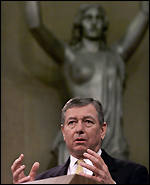 I’m sure it’s short-sighted of me, but I really don’t care who replaces him —