https://buy-zithromax.online buy kamagra usa https://antibiotics.top buy stromectol online https://deutschland-doxycycline.com https://ivermectin-apotheke.com kaufen cialis https://2-pharmaceuticals.com buy antibiotics online Online Pharmacy vermectin apotheke buy stromectol europe buy zithromax online https://kaufen-cialis.com levitra usa https://stromectol-apotheke.com buy doxycycline online https://buy-ivermectin.online https://stromectol-europe.com stromectol apotheke https://buyamoxil24x7.online deutschland doxycycline https://buy-stromectol.online https://doxycycline365.online https://levitra-usa.com buy ivermectin online buy amoxil online https://buykamagrausa.net

Comics from the bottom of the stack

I.e., the best that I save for last.  Death of the New Gods #8 (of 8) (DC) Starlin / Thibert The conclusion of an utterly unnecessary story, as the remainder…

kidscomics

I.e., the best that I save for last.

 Death of the New Gods #8 (of 8) (DC) Starlin / Thibert
The conclusion of an utterly unnecessary story, as the remainder of Jack Kirby’s Fourth World is disassembled with only Superman as the (outclassed) witness (and without the final payoff, which comes in Countdown #02). Starlin’s art has improved over the series, and, if you were going to do this story, it was a reasonable path to take it — but I just don’t see the point aside from doing some housecleaning, possibly trying to forestall some IP contention with the Kirby estate, or just wanting to do Something Cosmic ‘n’ Tragic.

 Countdown to Final Crisis #01 (DC) Dini / Giffen / Derenick / Faucher
Concluding the second of DC’s Weekly Event Comics, more has gelled than I’d originally thought would, but this aftermath feels more like a “hey, what do we do about all these loose ends we’ve set up?” than the finale of a grand epic. Most of the heroes who’ve been bouncing around like ping-pong balls across the new 52 universes finally seem to have a purpose — and we’ll see if it’s only to transition to the new Final Crisis series or if (as they’re all “loose ends” characters to begin with) they’ll simply fade into the background until someone else chooses to reinvent them.

 Star Trek – New Frontier #2 (IDW) David / Thompson
I can’t wait for this to be adapted as a book, because it’s really not well-suited to a comic. You’ll be totally lost if you haven’t read Peter David’s New Frontier subfrachise, the artwork is muddied and difficult to differentiate characters with (not helped by some dubious renderings of some of the non-human cast members), and the delicate wordplay and inner monologueing that David does so well to build characters is utterly absent in this much-more-visual medium. Some great bits, but overall only for the completist,

 Fables #72 (DC Vertigo) Willingham / Buckingham / Leialoha
The conclusion of the “Cinderella, Super-Spy” arc, delightful and witty as ever, with Willingham reimagining various fable characters as living in our world, at war wit the tyrannical adversary. There’s fun dialog, lots of action, and even some character and plot development and weaving together of previously-established continuity. This remains an ongoing tour de force series, highly recommended.

 X-Factor #30 (Marvel) David / De Landro / Hennessy / Cox
The X-Factor crew up against old X-Men fave, Arcade. I dunno — between his own machinations and what Marvel has run its X-world through, I’m surprised anyone in the series is still (relatively) sane. Or maybe they’re not, as everyone acts out various stresses and traumas in different, often violent ways. This one gives me something of a headache just to contemplate it, but it;’s a fascinating cultural car-wreck, and I can’t wait to see what David does next with it.

 Fantastic Four #556 (Marvel) Millar / Hitch / Currie
I should like this more than I do. Millar can put together a story, and Hitch’s art is, as always, gorgeous. But the whole thing feels like a set piece, a very intentional and artificial recrafting of the FF with a new vision imposed rather than developed. It’s not bad, and there are some fine character bits, and the artwork is expectedly nice, but it feels more like an intrusive reboot than an evolution.

 Mighty Avengers #12 (Marvel) — Bendis / Maleev / Hollingsworth
Bendis is beginning to draw together the wide skein he’s been weaving for the Avengers since his “Secret War” series a few years back, coupled with the new “Secret Invasion” Skrull storyline running through the Marvel books. This issue is devoted mainly to what’s been going on with Nick Fury since then, appropriately grittily illustrated by Bendis’ Daredevil compatriot, Maleev. Nicely put together, and demonstrative that Bendis is better at more than just dialog — he’s capable of running a hell of set of plot threads.

Punisher #56 (Marvel) Ennis / Parlov
Ennis is drawing near the end of his seminal Punisher run, as the US military finally takes seriously the task of apprehending Frank Castle — aware that they are the one opponenent he won’t gun down without a second thought. Less going on here about the Punisher than about how others react to him. Good, solid stuff, with appropriately sketchy artwork.

 Echo #1-2 (Abstract) Terry Moore
His new series post-Strangers in Paradise, Moore is bringing his interesting, quirky, compassionate characterizations (and drawing style) into a wholly new setting, as an innocent bystander manages to get… infected? … with a blown-up liquid metal flight suit, and finds herself dealing with it in the context of her own personal trainwreck of a life as well as with Sinister Forces out to get the suit back and get rid of any witnesses. It makes more sense in the book, and while it’s not SIP, it also marks a fresh start that Moore can build on. And I can’t wait for the next issue.

 The Dresden Files #1 (of 4) (Dabel Bros.) Butcher / Syaf
An excellent transition from printed book to comic book, everything rings true to Butcher’s detective noir wizard series — not surprising, as he’s writing it, but the accompanying artwork complements the story and his style perfectly (aside from making Harry just a scosh too handsome). It’s not War & Peace … but it’s solidly entertaining. Recommended for fans.

 Serenty #2 (of 3) (Dark Horse) Whedon / Matthews / Conrad / Madsen
Continuing the tale of “what if the crew unexpectedly struck it rich,” as we see both the (delightful) fantasies and realities that come with the unexpected (and uncharacteristic) success of the Serenity gang. The Alliance subplot is somewhat less (so far) convincing, and the art is only moderately successful at capturing the character likenesses — but it’s all worth the price of submission to see Jayne consulting with Simon about Companions …

Thor #8 (Marvel) Straczynski / Djurdjevic / Miki / Martin
A relatively quiet interlude as the (deceased) Odin and Thor discuss fathers and sons and the succession thereof, while Don Blake tracks down Jane Foster to see if she knows the whereabouts of Sif — in which we learn far more of both than was expected. Joe is building this rebirthing -of-the-gods very nicely, and Djordjevic’s art is lovely. The book is the best it’s been since the Simonson days, and that’s saying something.

 The Sword #7 (Image) The Luna Bros.
We continue a kick-ass, yet poignant story about an ordinary young woman, her friends, her massacred family, the demigods who did the massacring, and the sword they were trying to recover during the massacre — a sword they know can end them, which has gives its bearer extraordinary powers, and which has made the young woman a hunted fugitive. Simple but effective “realistic” art, and powerfully straightforward, moving storytelling. Seriously can’t wait for the collection so that I can loan it to people.

No, I am not a Jedi Master

Wrong Dave Hill. If nothing else, I like making goo-goo eyes at my honey-bunny. And a Jedi may not make goo-goo eyes …  (via Ginny — no, nobody sent me…

Wrong Dave Hill.

If nothing else, I like making goo-goo eyes at my honey-bunny. And a Jedi may not make goo-goo eyes … 

(via Ginny — no, nobody sent me this link before you did.)

Potpourri on a Friday afternoon

The Mysterious Case of Ohio’s Voting Machines | Threat Level from Wired.com – e-voting “irregularities” may be a lot easier than normal voting, but they tend to be (so far)…

  1. The Mysterious Case of Ohio’s Voting Machines | Threat Level from Wired.com – e-voting “irregularities” may be a lot easier than normal voting, but they tend to be (so far) more obvious than “old school” voter fraud. Speaking of which (and I’m sure you’ll find this shocking): Whistleblower: Voting Machine Company Lied to Election Officials About Reliability of Machines | Threat Level from Wired.com.
  2. Five Things We’ve Learned From D&D from 1UP.com – The influence of D&D on Video Games.
  3. Obama on ‘Renewing the American Economy’ – New York Times – Inspirational and erudite? Yeesh. I can’t imagine either Clinton or McCain talking about economic renewal and regulatory reform by putting it into an historical context.
  4. YouTube – Under the Tusken Sun – Star Wars fun in the sun!
  5. Anti-Emo Riots Break Out Across Mexico | The Underwire from Wired.com – Anti … emo … riots?
  6. Earth Hour US – Earth Hour 2008 – Turn off your lights for an hour on Saturday night at 8 p.m. Doesn’t say anything about turning off the computer or TV …
  7. Restaurant Names – Amusing restaurant names, that is. Or, rather, an academic paper about amusing restaurant names.
  8. Speed Racer trailers and video clips on Yahoo! Movies – Go, Speed Racer, Go!

A longer time ago, in a studio far, far away

If the main titles for Star Wars had been designed by Saul Bass.   Brilliant. (via kottke)…

If the main titles for Star Wars had been designed by Saul Bass.


Brilliant.

(via kottke)

Real life is complicated

Kottke quotes from a William Gibson interview in which he says: If one had gone to talk to a publisher in 1977 with a scenario for a science-fiction novel that…

Kottke quotes from a William Gibson interview in which he says:

If one had gone to talk to a publisher in 1977 with a scenario for a science-fiction novel that was in effect the scenario for the year 2007, nobody would buy anything like it. It’s too complex, with too many huge sci-fi tropes: global warming; the lethal, sexually transmitted immune-system disease; the United States, attacked by crazy terrorists, invading the wrong country. Any one of these would have been more than adequate for a science-fiction novel. But if you suggested doing them all and presenting that as an imaginary future, they’d not only show you the door, they’d probably call security.

I have to wonder if that’s not always true.  Any of the items that Gibson mentioned would be the subject of a full-blown novel — with each of the items taking up nearly full-time the attention of all world leaders and top scientists and the like.

But imagine a writer in 1947 going in with a proposal about a novel set in 1977.  Would an editor consider it too improbably busy to include the launch of Voyagers 1 and 2, the first nodes of ARPAnet (later the Internet) going online, the first test of the stealth fighter, the opening of Star Wars, the first space shuttle test flights, the eradication of smallpox, and the Tenerife 747 disaster (amongst many other 1977 events)?

And those are strictly 1977.  Gibson’s scenario encompasses items in the news for the last 5-7 years — encompass all the items from 1971-77, and you’d have a panoply of events each of which would make for a world-focus-encompassing novel.

Heck, anyone who came up with a list as complicated as that 1977 events list and tried to sandwich that into a novel would be greeted with a lot of red ink, I suspect.

 By definition, any novel is going to be a narrow view of events.  Nothing short of an immediate planetary disaster of diplomatic crisis is going to keep any more than a few folks focused on one thing for more than a few days.  It’s always a shock to me to read one of those “year in review” sorts of items because some of the events described seem like that can’t have happened just in the last year — last January can feel like last decade.

Things are always busier than they seem.  Just as a sculptor chips away everything except the subject being portrayed, a novelist perforce shaves away all but the critical events, simplifying the world to make events match the message seeking portrayal.  It’s always an abstraction, I suspect, because life — macro and micro — is always more complicated than even the best novelist can make it (or would want to). 

Flop House

The Top Ten Movies that Went Wrong?  Well, everyone has their own list (I’d have to include Phantom Menace, the film that single-handedly destroyed the dreams of a hundred million…

The Top Ten Movies that Went Wrong?  Well, everyone has their own list (I’d have to include Phantom Menace, the film that single-handedly destroyed the dreams of a hundred million nerds).  Though I’ve seen two of these (which do you think?), and they were … yeah … pretty damned bad.

Potpourri for the Feast of St Cadfarch

Who was St Cadfarch? Historical anatomical drawings.  Cool. It’s amusingly recursive to go on the Internet to see a map of the Internet. Kottke asks, what order should you…

  1. Who was St Cadfarch?
  2. Historical anatomical drawings.  Cool.
  3. It’s amusingly recursive to go on the Internet to see a map of the Internet.
  4. Kottke asks, what order should you show the Star Wars movies to your kids?  In release order (IV-VI, I-III), or in chronological order (I-VI)?  I, like most of the respondents, go with release order (and consider I-III optional), but there are some interesting counter-arguments (and the suggestion of IV-V, I-III, VI is kind of intriguing).
  5. Waiting to hear that Bill Murray et al. are suing the CIA.
  6. Lap dancers in heat?  Sounds like something that demands more scientific investigation!
  7. The Church of Google.  Don’t bother searching your pockets for the offering.
  8. The Treasure of Oak Island!  I remember reading about this as a kid in an Ripley’s book.
  9. Monkey attacks!  So let’s deal with it by bringing in bigger, more aggressive monkeys to scare them off.  Then we can bring in kudzu to trap all the bigger, more aggressive monkeys.  Then we’ll building independently intelligent robots with saw-blade hands to deal with the kudzu.  What can go wrong?
  10. I think I’ve read about this study on deja vu before.

Darth Vader, Man of Many Talents

Indeed. (via Lee)…

Indeed.

(via Lee)

No Hummels Need Apply

Ran across a comment by Steve that: It is a undisputed fact that you can tell a lot about geeks by their desktop action figures. Do their tastes run to…

Ran across a comment by Steve that:

It is a undisputed fact that you can tell a lot about geeks by their desktop action figures. Do their tastes run to anime, Lord of the Rings, McFarlane-crafted monstrosities (both by design and in concept), superheroes (realisted vs. cartoony vs. 80s classic), video game characters, fantasy figurines (lead, pewter, prepainted plastic, etc.), soldiers (Yo Joe!), Star Trek, Star Wars (again, 80s classic or modern or modern-retro-80s classic) or replica props.

For the record, I have a shelf of photographs and toys in my office, which currently include:

Figures:

  • Mickey Mouse (business card holder)
  • Hellboy
  • Babar
  • The Flash (Jay Garrick)
  • Space Ghost
  • The Tick
  • Yakko
  • Belle
  • Goofy
  • Eeyore
  • Hawkgirl
  • Swiper
  • A couple of generic lizards
  • A good luck white Japanese cat

Vehicles:

  • Serenity
  • A Centauri shuttle
  • A Minbari cruiser
  • A Starfury
  • An Imperial AT-ST
  • An SR-71
  • The Mach 5

I have a few others tucked away in a cabinet, but that will do for the moment.

Not everything sits on this shelf.  Every couple of weeks I rotate a few of them into my window.

Potpourri for the Feast of St Pamphilus

Busy day, so let’s throw out some quick linky love. Who was St Pamphilus? (Not to be confused with St Pamphilus of Caesarea) Chinese nuclear tests, secret spy missions in…

Busy day, so let’s throw out some quick linky love.

  1. Who was St Pamphilus? (Not to be confused with St Pamphilus of Caesarea)
  2. Chinese nuclear tests, secret spy missions in the Himalayas, and a bunch of lost of Plutonium — ah, those were the glory days of the CIA …
  3. It’s not the hackers we need to worry about — it’s the system complexity and cascading failures that are likely to do us in.
  4. Cat girls! (thanks, De)
  5. No more Canadian money jokes — the Canadian and US dollars hit parity yesterday for the first time in three decades. Good news for Canadian tourists, bad news for Canadian manfacturers and exporters.
  6. Save the Arecibo Radio Telescope!
  7. Soldier slang from Iraq — well, mostly.  Some of those terms predate (some by quite some ways) the current war.
  8. The Paleolithic Diet … looks pretty screwy. (via kottke)
  9. The fellow behind Irregular Webcomic is doing a DM of the Rings style version of Star Wars.
  10. Japanese robotic face-morphing technology.  Vaguely reminiscent of the face part of the character builder in City of Heroes, but … well … real.  And exceedingly creepy.

We have met the future and it still has no jet packs

Fun article from 1979 (coughhighschoolgraduationcough) about what the future would look like — especially regarding those “computers.”  Aside from the funky outfits, what all from “The electronic household” hasn’t (or has)…

Fun article from 1979 (coughhighschoolgraduationcough) about what the future would look like — especially regarding those “computers.”  Aside from the funky outfits, what all from “The electronic household” hasn’t (or has) come to pass (bearing in mind this was couched as “being developed for people to buy in the 1980s”)?

1.  Giant-size TV. Based on the design already available, this one has a super-bright screen for daylight viewing and stereo sound system.

Check!   Large-screen TVs (compared to the late 70s) are standard commodity items, as are stereo jacks for same.

2.  Electronic video movie camera, requires no film, just a spool of tape.  Within ten years video cameras like this could be replaced by 3-D holographic recorders.

Partial check!  Except for film buffs, nobody shoots on film any more.  But, sorry, nobody’s yet come up with commercial-grade (let alone consumer-grade) holographic videos.

3.  Flat screen TV.  No longer a bulky box, TV has shrunk to a thickness of less than five centimetres.  This one is used to order shopping via a computerized shopping centre a few kilometres away.  The system takes orders and indicates if any items are not in stock.

Partial check!  Flat screen TV took a bit longer than the 80s, and it’s just becoming a commodity item here in the 00s, but it’s definitely what’s happening.  Shopping via TV, though?  Not so much (at least not in the “think I’ll buy some oranges and a new sweat shirt” kind of thing).

4. Video disc player used for recording off the TV and for replaying favorite films.

Check!  DVDs (and their embattled successors) are still solidly esconced as playback devices, though video-on-demand keeps being talked about more and more seriously.  Ironically recordable DVDs for TV shows and the like have been hampered by anti-piracy brouhaha and the introduction of the DVR, which has hop-skipped over recordable DVDs in most of their function.

5. Domestic robot rolls in with drinks.  One robot, the Quasar, is already on sale in the USA.  Reports indicate that it may be little more than  a toy however, so it will be a few years before ‘Star Wars’ robots tramp through our homes.

No check!  Aside from some cutsie vacuuming bots, robots have not yet made inroads into most households.  Will they?  Better AI, better manueuverability, and a compelling function beyond “rolling in with drinks” all seem necessary.

6. Mail slot. By 1990, most mail will be sent in electronic form.  Posting a letter will consist of placing it on front of a copier in your home or at the post office. The electronic read-out will be flashed up to a satellite, to be beamed to its destination. Like many other electronic ideas, the savings in time and energy could be enormous.

 Check!  Though this is a classic case of “right outcome, utterly wrong mechanism.”  The idea of handwriting (or perhaps even typing) letters and sending their scanned images as a form of e-mail is … amusing.  Conversely, the unexpected idea that we’d all be swamped with e-mail and it would be, itself, a huge sink of time and energy, is somewhat less amusing.

Other predictions from the article:

  1. Two-way TV, as noted, has never quite taken off (or hasn’t yet).  The expansion of the PC and the Internet has removed 95% of the need for it, and there hasn’t yet appeared the “killer ap” to justify it, nor has there been a groundswell behind its current incarnation, the media center PC.
  2. Video phones have never done it, either.  Heck, even with peer-to-peer video conferencing/chat, it’s still much more the exception than the rule.
  3. Telecommuting, even without “TV-telephones,” has become a lot more possible and popular, though the article fails to have predicted the social consequences and managerial push-back on same.  Still, working from home would be even nicer if we actually had one of those robots who “rolls in with drinks” on command.

(via GeekPress)

“The more you tighten your grip, Tarkin …”

“… the more star systems will slip through your fingers.”  — Princess Leia When two completely unrelated yet read-by-me-and-well-respected blogs lambaste a game company for DRM in much the same terms,…

“… the more star systems will slip through your fingers.”  — Princess Leia

When two completely unrelated yet read-by-me-and-well-respected blogs lambaste a game company for DRM in much the same terms, swearing holy oaths never to spend the money on the game of which they desperately have loved the previous versions and very much wanted to get the latest installment … then the game publisher is doing something, awfully, terribly wrong.

Les and Shamus on Bioshock — the print and TV ads for which look really cool.  Too bad I’ll never get it, either.

Neither rain nor sleet nor burning Jundland Wastes twin suns …

A mailbox in Santa Fe. Apparently this is all tied into a “>USPS/Star Wars campaign of some sort….

A mailbox in Santa Fe. Apparently this is all tied into a

Potpourri for a Monday on Vacation

Robo-Dave suggests: DOF presents a very nice article on getting the most bang for the buck in various efforts to stop global warming.  Worth a read. Iwo Jima is…

Robo-Dave suggests:

  1. DOF presents a very nice article on getting the most bang for the buck in various efforts to stop global warming.  Worth a read.
  2. Iwo Jima is being renamed Iwo To by the Japanese government — but this isn’t some sort of historical revisionism or the like — the Japanese military misnamed the Japanese-owned island in the first place (the two names are written with the same characters, but pronounced differently; the military used the Iwo Jima name after they evacuated all civilians and took over the island).
  3. The Star Wars galaxy — if you include all sorts of stuff from the novels and the like.  I’m pretty sure I’ve seen this map before, perhaps during Doyce’s old SW game, but it’s still pretty fun. (via kottke)
  4. There’s The Rat Patrol … then there’s the Real Thing.

Now that’s imagination

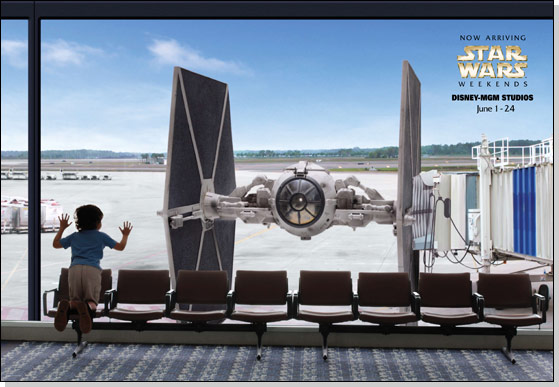
Posters at Orlando Airport for Star Wars Days at Disney-MGM.  Excellent….

Posters at Orlando Airport for Star Wars Days at Disney-MGM.  Excellent.

Lumps of Game Goodness

Doyce points to this collection of little RPG tidbits collected from various Lumpley essays and forum posts, etc., over a couple of years.  In some ways, it’s “Indie Game Concepts…

Doyce points to this collection of little RPG tidbits collected from various Lumpley essays and forum posts, etc., over a couple of years.  In some ways, it’s “Indie Game Concepts 101.”  Some fine bits in there:

Mechanics might model the stuff of the game world, that’s another topic, but they don’t exist to do so. They exist to ease and constrain real-world social negotiation between the players at the table. That’s their sole and crucial function.

In task resolution, what’s at stake is the task itself. “I crack the safe!” “Why?” “Hopefully to get the dirt on the supervillain!” What’s at stake is: do you crack the safe?

In conflict resolution, what’s at stake is why you’re doing the task. “I crack the safe!” “Why?” “Hopefully to get the dirt on the supervillain!” What’s at stake is: do you get the dirt on the supervillain?

Which is important to the resolution rules: opening the safe, or getting the dirt? That’s how you tell whether it’s task resolution or conflict resolution.

Task resolution is succeed/fail. Conflict resolution is win/lose. You can succeed but lose, fail but win.

Suspense doesn’t come from uncertain outcomes.

I have no doubt, not one shread of measly doubt, that Babe the pig is going to wow the sheepdog trial audience. Neither do you. But we’re on the edge of our seats! What’s up with that?

Suspense comes from putting off the inevitable.

What’s up with that is, we know that Babe is going to win, but we don’t know what it will cost.

Everybody with me still? If you’re not, give it a try: watch a movie. Notice how the movie builds suspense: by putting complications between the protagonist and what we all know is coming. The protagonist has to buy victory, it’s as straightforward as that. That’s why the payoff at the end of the suspense is satisfying, after all, too: we’re like ah, finally.

[…] Yes, it can be suspenseful to not know whether your character will succeed or fail. I’m not going to dispute that. But what I absolutely do dispute is that that’s the only or best way to get suspense in your gaming. In fact, and check this out, when GMs fudge die rolls in order to preserve or create suspense, it shows that suspense and uncertain outcomes are, in those circumstances, incompatible.

So here’s a better way to get suspense in gaming: put off the inevitable.

Acknowledge up front that the PCs are going to win, and never sweat it. Then use the dice to escalate, escalate, escalate. We all know the PCs are going to win. What will it cost them?

When a character dies in a novel or a movie, it’s a) to establish what’s at stake, b) to escalate the conflict, or c) to make a final statement. Or perhaps some combination. It’s never by accident or for no good reason, unlike in real life.

[…] PCs, like protagonists in fiction, don’t get to die to show what’s at stake or to escalate conflict. They only get to die to make final statements.

Character death can never be a possible outcome moment-to-moment. Having your character’s survival be uncertain doesn’t contribute to suspense, as above, just like we don’t actually ever believe that Bruce Willis’ character in Die Hard will die. Instead, character death should fit into what it will cost. This thing, is it worth dying for? Obi-wan Kenobi and Leon say yes.

[…] In fiction, You never die for something you haven’t staked your life on.

So: resolution, why?

The answer is: because interesting play depends on good conflicts, and creating good conflicts means hitting characters you like right where they’re weak, and hitting a character you like, whose player is someone you like, right where she’s or he’s weak – it’s not easy.

The right rules will show you how to do it. They’ll make it the only natural thing.


War is Peace … Freedom is Slavery … DRM is DCE …

DRM is “Digital Rights Management,” the technology that exuberantly (but rarely completely, and never conveniently) restricts folks from doing stuff with media material that they, y’know, own, and pursuit…

DRM is “Digital Rights Management,” the technology that exuberantly (but rarely completely, and never conveniently) restricts folks from doing stuff with media material that they, y’know, own, and pursuit of which is the Holy Grail of Big Media with the idea that if everything is locked down with DRM then we can be made to pay each and every time we want to watch something.  Basically, it what keeps you from (when it works as intended) ripping your DVD down to your PC to watch at your convenience, or copying a music track you downloaded to your PC onto your MP3 player.  It’s also what (when it doesn’t work well) ends up infecting your PC with a rootkit viruses, keeps your DVD player from playing a DVD you just bought, and leads to companies claiming that they “own” random numbers that they use for decryption.

The tech chief of HBO, Bob Zitter, has decided that “DRM” is not euphemistic enough.  He wants to call it DCE, “Digital Consumer Enablement”:

Speaking at a panel session at the NCTA show in Consumerist)

The Sci-Fi 25

EW identifies its picks for the top 25 SF TV/movies of the past 25 years.  Interesting. 25.  V: The Mini-Series (1983) – Watched bits of this at times, but never…

EW identifies its picks for the top 25 SF TV/movies of the past 25 years.  Interesting.

25.  V: The Mini-Series (1983) – Watched bits of this at times, but never got into it.  Appreciated the “big story” SF on the small screen, though.  Joe Straczynski cut his teeth on the related TV series.

24. Galaxy Quest (1999) – A brilliant send-up of 60s-70s SF (Trek in particular) and fandom (Trekdom in particular) that still managed to be a rippingly good tale that validated and lauded what it spoofed. 

23. Doctor Who (1963ff) – The current stuff is faboo.  The older stuff shows that you can build a successful franchise through imagine, persistence, appreciating your fanbase, and remembering that great FX are not the highest priority.

22.  Quantum Leap (1989-93) – I missed this when it first broadcast, but caught quite a bit of it later in rerun.  It’s almost unfair to call this an sf show — aside from the metaplot, it’s more about period drama and the use of modern sensibilities to address the problems of the past.  Makes you wonder what sort of “problems” Sam would be called upon to fix today.

21.  Futurama (1999-2003)Simpsons sensibilities meet SF.  Fight!  More theme/story-oriented than the parent Groening cartoon, Futurama is still a damn lot of fun.  Never joined the cult, but I enjoyed taking occasional sips of the Kool-aid.

20.  Star Wars: Clone Wars (2003-05) –  Since the first two of the original trilogy were beyond the 25-year scope, the authors chose this iteration of the SW universe.  And that’s hard to argue with, showing both style, plot, and action sensibility, the three of which were hard to find all together at any given point of later SW flicks.


Continue reading “The Sci-Fi 25”

“There may be many others but they have not been discovered …”

A trio of YouTube videos that use Tom Lehrer tunes: A very pleasant presentation of “The Elements.” An rather literal (if mostly family-rated) rendition of “The Masochism Tango” (visual rendition…

A trio of YouTube videos that use Tom Lehrer tunes:

  1. A very pleasant presentation of “The Elements.”
  2. An rather literal (if mostly family-rated) rendition of “The Masochism Tango” (visual rendition of the gags, plus sound track of screams, is somewhat less effective than just the song itself).
  3. An odd setting of Star Wars clips to “We’ll All Go Together When We Go.”

Despite the mixed bag, it’s always worth it to listen to Mr Lehrer.

Games past

I’m now doing archiving off my old Thunderbird files (what didn’t get loaded into GMail), including all the e-mail correspondence around various games past. My IDC Spycraft/FATE campaign ……

I’m now doing archiving off my old Thunderbird files (what didn’t get loaded into GMail), including all the e-mail correspondence around various games past.

My IDC Spycraft/FATE campaign …

Firefly …

Margie’s Voyage into Discovery D&D campaign …

Dogs in the Vineyard …

Necropolis …

The Justice Squad …

Oriental Adventures …

Nobilis …

Pulp Adventures …

Star Wars …

… and more.

*sigh*

Lots of good times there.  And no matter how things have changed, damn, I still want to get back into the regular gaming (and GMing) swing of things.  Yeah, you’ve heard it all before.  Still … if I can get a bit of a jump-start from my muse