https://buy-zithromax.online buy kamagra usa https://antibiotics.top buy stromectol online https://deutschland-doxycycline.com https://ivermectin-apotheke.com kaufen cialis https://2-pharmaceuticals.com buy antibiotics online Online Pharmacy vermectin apotheke buy stromectol europe buy zithromax online https://kaufen-cialis.com levitra usa https://stromectol-apotheke.com buy doxycycline online https://buy-ivermectin.online https://stromectol-europe.com stromectol apotheke https://buyamoxil24x7.online deutschland doxycycline https://buy-stromectol.online https://doxycycline365.online https://levitra-usa.com buy ivermectin online buy amoxil online https://buykamagrausa.net

Dogs foam at the mouth for this tasty treat!

Um … like Les, I’m more than a bit dubious about the Kroger/Disney test marketing of (wait for it) “Old Yeller” dog food. I mean, sure, it has name recognition….

Um … like Les, I’m more than a bit dubious about the Kroger/Disney test marketing of (wait for it) “Old Yeller” dog food.

I mean, sure, it has name recognition. But … um … isn’t that sort of like selling “Brian’s Song” footballs or “Love Story” maternity-wear? Yikes.

End of a Typographic Era

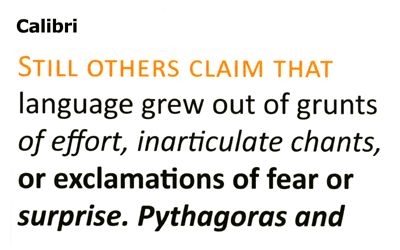
Times New Roman has been the default font of a generation of computer users. But … in Office 2007, the default font is … Calibri? It’s a major change –…

Times New Roman has been the default font of a generation of computer users. But … in Office 2007, the default font is … Calibri?

It’s a major change — Calibri is a san serif font, easier to read onscreen (though perhaps not when printed). But it raises some interesting questions.

But what will happen to Times New Roman? In ten years, will it be just another term-paper alternative? Will instructors’ syllabi accept Calibri, or will they stand firm with Times because so many Word documents are still printed out to be read? Would you ever write a paper in Calibri because it’s easier to read on a screen, and then change it to Times at the last moment for your print reader? What about Phil’s theory about The Secret Lives of Fonts—is Calibri so pretty that universities will experience a round of aesthetics-inspired grade-inflation? And wtf is up with the new fonts’ not being available on Macs without a separate license? In general, what are we in for if the font-king is dead?

Actually, it’s that latter question about Mac availability that I find the most irksome. Micro$oft has been steadily reining in all the “standard” (read “free”) fonts it once distributed about through the aether, no doubt because somebody there figures they can make money off of font sales. Unlikely, but highly irritating.

Much more info on the fonts in question can be found here, including examples.

Of course, how likely the corporate (let alone private) world is to adopting Office 2007 (quickly, or at all) is anyone’s guess. Times New Roman may be safe for a looooong time.

The networks offer a carrot, not a stick.

So more and more people are getting DVRs like TiVo, and commercial TV networks have been getting more and more up in arms over the “theft” involved in people watching…

So more and more people are getting DVRs like TiVo, and commercial TV networks have been getting more and more up in arms over the “theft” involved in people watching their shows without watching commercials as well. To date, their efforts have been to try and cripple DVRs from being able to skip through commercials (which makes one wonder whether, if they had they power, they’d develop a way to shackle viewers to their chairs).

But, miracle of miracles, a few enlightened souls have figured out it’s probably more effective, and less alienating, to try to encourage people to watch commercials, rather than try and prevent them from not doing so.

This September, AOL and Mark Burnett Productions will launch “Gold Rush,” an interactive game that asks players to monitor CBS television programs and commercials for clues to find $2 million in gold.

The game will last for approximately the first two months of the fall television schedule, according to a CBS representative. Clues will be scattered throughout CBS television programs, commercials, the AOL Web site and other media properties, AOL said.

The game could be a sign of a new tactic in the television advertising battle. As TV show downloads and ad-skipping DVRs pull viewers away from live advertising, the networks must find new ways to draw them in. The solution may be low-tech creativity: constructing new blends of advertising with content viewers are compelled to watch.

CBS isn’t alone. Since May 3, ABC has featured fictitious ads for the mysterious “Hanso Foundation” during commercial breaks of “Lost.” Viewers who stayed tuned during commercial breaks were rewarded with “ads” featuring phone numbers and Web sites leading to clues about the show.

Amazing — TV networks trying to make themselves more entertaining and desirable to watch. What will they think of next?

Posted by CyberDave

(via BoingBoing)

All your recordings are belong to us!

XM radio announced it would create a version of its players that would let people record up to 50 hours of music that plays on their XM radios. Sounds great,…

XM radio announced it would create a version of its players that would let people record up to 50 hours of music that plays on their XM radios. Sounds great, right? Fun way to build a library of music you enjoy for long trips or commutes, and, after all, you’re already paying a subscription fee for the music — just as XM is paying a broadcast fee to the recording industry — so everyone’s happy, right?

Until the RIAA sues the snot of out XM for copyright infringement. Never mind that the technology falls well within fair use law, or even the 1992 AHRA law, which specifically legalized digital audio recording at home. And never mind that there’s essentially nothing different between what XM is going to allow and what you can do with TV shows and a VCR.

Which tells you where Big Media wants to go with laws regarding VCRs.

Inducement isn’t just for pirates anymore: In the wake of the Supreme Court’s ruling in MGM v. Grokster, EFF warned that the newly minted “inducement” weapon would not be reserved for “bad actors,” but would also be leveled against legitimate innovators building the next generation of fair use technologies.

Sure enough, the complaint accuses XM of inducement based on the following statements in promotional materials: “Hear It, Click It, Save It!,” “[XM] delivers new music to you everyday and lets you choose tracks to create your own custom playlists,” “record with the touch of a button,” and “store up to 50 hours of XM.” Not exactly a pirates “ahoy,” is it?

The bottom line is that Big Media feel that any time you play someting that “belongs to them,” they should get money for it. Any use of it that they don’t get money for is theft. A personal recording, a time-shifting, something with a VCR or your TiVo, something you keep to share with family and friends or to enjoy in the future? That’s piracy. And anyone who creates technology to do it will get sued for, literally, billions of dollars.

O, brave new world …

Australia as the stalking horse for American DRM

In Australia, it’s been techncally illegal to record a program for later viewing, or do other sorts of activities we Americans take for granted under the Sony ruling and with…

In Australia, it’s been techncally illegal to record a program for later viewing, or do other sorts of activities we Americans take for granted under the Sony ruling and with fair use. The Australian government is proposing legislation, written by a major Digital Rights Management (DRM) consortium, that would remove that illegality (which nobody paid attention to), but replace it with … well, just what Big Media wants to see implemented globally.

Per the FAQ on the Australian Attorney General’s site:

Does this mean I can record my favourite television or radio program to enjoy later?
Yes. For the first time you will be able to record most television or radio program at home to enjoy at a later time. This will allow you to watch or listen to a program as it was made available to the public at the time of the original broadcast.

How long can I keep the recording?
The recording must be deleted after one use. It will not be possible to use the recording over and over again.

Can I make a collection of copied television and radio programs?
No. You will not be able to burn a collection (or library) of your favourite programs on DVD or CD to keep. (It will be permitted to record a program on DVD or CD but only temporarily until you watch or listen to it for the first time.)

What can I do with recorded program?
You can watch or listen to the recording with your family or friends. It will not be permitted to sell or hire a recording or to play it at school or work or in any kind of public audience.

Can I give a recording I have made to a friend?
No. A recording is for the personal use of the person who made it. You can invite a friend over to watch or listen to your recording but you can’t lend or give it to a friend to take home with them.

This is the sort of thing Big Media would love to see in the US, and has been pushing in a dozen different legislative and technical directions to do: limit recording and replay of media, first by law, then by technology to enforce the law.

So, consider — I record an episode of, say, Doctor Who onto tape (or DVD). Under the proposed Australian law, I could watch it — once. After that, I’d be obliged by law (or my DVR would be pre-programmed) to delete the recording. And loaning the tape to a friend would be absolutely out of the question.

Further, similar restrictions apply, in the FAQ to CDs.

Doubtless if they could figure out a way to do this with books, they’d impose the same restrictions. Which sounds like a fabulous argument against e-books.

Hopefully the Australian people, if not the Australian government, will be smarter than this.

(via BoingBoing)

The fine print on Windows licenses

The (admittedly biased) folks at LinuxAdvocate.org give a summary of what the End User License Agreement (EULA) on Windows XP Home says. That’s all the tiny fine print in a…

The (admittedly biased) folks at LinuxAdvocate.org give a summary of what the End User License Agreement (EULA) on Windows XP Home says. That’s all the tiny fine print in a scrollable window that you click “I Accept” to during installation.

Bottom line: “You have to do what we say. We aren’t responsible for anything that happens. We may change our mind about anything or everythign at any time, and the most you can ever possibly demand under the most outragious and egregious actions on our part is, maybe, if we’re feeling generous, your money back.”

(via Les)

It’s a sale! No, it’s a license! No, it’s …

Sony, like any other media giant, seems to want to have it both ways, as long is it adds to the bottom line. To artists, Sony claims that music it…

Sony, like any other media giant, seems to want to have it both ways, as long is it adds to the bottom line.

To artists, Sony claims that music it puts up into the iTunes store is, in fact, a sale, not a license. After all, on sales, Sony only pays artists 4.5 cents per song, whereas on licenses it would be paying them substantially more.

To consumers, though, Sony claims that iTunes purchases are licenses, not sales, which is why, it claims, you can’t be allowed to sell it to someone else, give it to someone else, etc., th way you could if it were a sale, like a CD.

Doubtless this dichotomy will all go away once Sony fixes its contract language and gets a few new laws passed. In the meantime, though, I’m delighted that they’re getting the snot sued out of them by artists like Cheap Trick and the Allman Brothers.

(via BoingBoing)

All your media are belong to us

If I weren’t already overworked and undergruntled today, I’d be waxing long and apoplectic over the latest volley in the copyright wars. Congresscritters at the behest of Big Media are…

If I weren’t already overworked and undergruntled today, I’d be waxing long and apoplectic over the latest volley in the copyright wars. Congresscritters at the behest of Big Media are cutting the Gordian Knot of how to balance Fair Usage and First Purchase rights vs. We Paid Money To See This Made So It’s Ours Forever by simply making copyright uber alles. Given that copyright now extends and indefinitely length into the future, the direction our Representatives are taking us is to say that if Company X has the intellectual property ownership of Medium Y, you will never own more than the narrowly defined stake they decide you can own. Buy a CD? Cool, but don’t expect to be able to rip it to your iPod, or (in the future) listen to it more than the defined times/inside the defined period the media makers (and media player makers) decide you are allowed to.

In the latest effort, we not only don’t get a rationalization of the DMCA, but the DMCA gets expanded and all sorts of cool criminal penalties latched onto it. Woo-hoo!

For the last few years, a coalition of technology companies, academics and computer programmers has been trying to persuade Congress to scale back the Digital Millennium Copyright Act. Now Congress is preparing to do precisely the opposite. A proposed copyright law seen by CNET News.com would expand the DMCA’s restrictions on software that can bypass copy protections and grant federal police more wiretapping and enforcement powers.

The draft legislation, created by the Bush administration and backed by Rep. Lamar Smith, already enjoys the support of large copyright holders such as the Recording Industry Association of America. Smith, a Texas Republican, is the chairman of the U.S. House of Representatives subcommittee that oversees intellectual-property law. A spokesman for the House Judiciary Committee said Friday that the Intellectual Property Protection Act of 2006 is expected to “be introduced in the near future.” Beth Frigola, Smith’s press secretary, added Monday that Wisconsin Republican F. James Sensenbrenner, chairman of the full House Judiciary Committee, will be leading the effort.

This is all necessary because, of couse, people burning copies of their favorite music track as an MP3 file and passing on to their friends for a listen to are, naturally, in cahoots with Osama bin Ladin.

During a speech in November, Attorney General Alberto Gonzales endorsed the idea and said at the time that he would send Congress draft legislation. Such changes are necessary because new technology is “encouraging large-scale criminal enterprises to get involved in intellectual-property theft,” Gonzales said, adding that proceeds from the illicit businesses are used, “quite frankly, to fund terrorism activities.”

Of course, the DoJ and the RIAA haven’t been getting much press for putting the screws to Big Copyright Violating Criminal Enterprises. But what we have heard a lot of is the RIAA suing the snot out of individual citizens — who will now find, under the suggested law, that they can be wiretapped by the Feds, server logs concerning anywhere they’ve been can be examined, and the PC they used to make a copy of some music can be confiscated.

The proposed law scheduled to be introduced by Rep. Smith also does the following: […] Creates civil asset forfeiture penalties for anything used in copyright piracy. Computers or other equipment seized must be “destroyed” or otherwise disposed of, for instance at a government auction. Criminal asset forfeiture will be done following the rules established by federal drug laws.

Because we all know how well that’s worked out.

As it’s put in the Ars Technica article:

Piracy isn’t the issue here. With the federal government’s help, the labels and studios are aiming at is complete content lockdown. It’s worth quoting Ken’s article on the analog hole from last fall:

These laws aren’t about piracy, and anyone who thinks they are needs to stop, look, and listen. Once the MPAA and pals have their way, you’re going to pay through the nose for even the most basic of Fair Use rights. You’re going to pay for the right to rewind and “re-experience” content. The Copy Prohibited Content class, complete with its asinine insta-delete feature is nothing but a back door into attacking what the content industry hates most: your ability to timeshift content. Yes, Jack Valenti said the VCR would destroy Hollywood, and while these moonbats no longer believe that, they do know that the rhetoric works.

To put it bluntly, the claims of the content creation industry do not add up. Here’s what the equation really looks like: Intellectual Property Protection Act of 2006 + analog hole legislation + the broadcast flag = zero Fair Use rights + pay multiple times for the same content. If you don’t like that math, it’s time to get in touch with your congressperson and senators.

Feh.

(via Les)
Muzak is no longer Muzak

At least in terms of being the stereotyped “Muzak.” The syrupy orchestral “elevator music” that most people associate with the company scarcely exists anymore. Muzak sells about a hundred prepackaged…

At least in terms of being the stereotyped “Muzak.”

The syrupy orchestral “elevator music” that most people associate with the company scarcely exists anymore. Muzak sells about a hundred prepackaged programs and several hundred customized ones, and only one—“Environmental”—truly fits the stereotype. It consists of “contemporary instrumental versions of popular songs,” and it is no longer terribly popular anywhere, except in Japan. (“The Japanese think they love it, but they actually don’t,” a former Muzak executive told me. “They’ll get over it soon.”)

All of Muzak’s other programs are drawn from the company’s huge digital inventory, called the Well, which contains more than 1.5 million commercially recorded songs, representing dozens of genres and subgenres—acid jazz, heavy metal, shag, neo-soul, contemporary Italian—and is growing at the rate of twenty thousand songs a month. (Some record labels now upload new releases directly to the company, which, like a radio station, pays licensing fees for the songs it uses.)

The Well includes seven hundred and seventy-five tracks recorded by the Beatles, a hundred and thirty by Kanye West, three hundred and twenty-four by Led Zeppelin, eighty-four by Gwen Stefani, a hundred and ninety-one by 50 Cent, and nine hundred and eighty-three by Miles Davis. It also includes many covers—among them, versions of the Rolling Stones’ song “Paint It Black” by U2, Ottmar Liebert, and a late-sixties French rock band with a female vocalist (who sang it in French) and approximately five hundred versions of the Beatles’ song “Yesterday,” which, according to Guinness World Records, is the most frequently covered song in the world.

Fun article, going into the company’s history, their original pseudo-science behind play lists (and their new pseudo-science), and all sorts of stuff you probably never thought about regarding piped music.

Masters of their domains

Looking for a cool new domain for your business, and want something short and pithy? You’re probably SOL because … … every one of the 676 two-byte .COM domains is…

Looking for a cool new domain for your business, and want something short and pithy? You’re probably SOL because …

… every one of the 676 two-byte .COM domains is registered (and registrars now require domains to be at least three characters long).

… every one of the 17,576 three-letter .COM domains is registered. If you throw in numbers, of the 46,656 possibilities there are only 228 open, but not available for another month (and speculators are circling like vultures).

Of the 456,976 four-letter domains, a whopping 97,786 are free, a bit over 20% of the possible combinations — if QFEV.COM is what you’re looking for. Add in numbers, and there are 1.16 million available. You, too, can make ML7G.COM a household name!

And of the five-letter domains, only about 8% are taken. Huzzah!

The average .COM domain is eleven letters long. The maximum is 63 letters — and, yes, DIDYOUKNOWTHATYOUCANONLYHAVESIXTY-THREECHARACTERSINADOMAIN-NAME.com is already taken (but for sale).

The article has many more fun stats, including how many of the most common male and female and family names are already taken (don’t hold your breath). Fun stuff.

Super!

The LA Times is (rightly) annoyed by continuing efforts by Marvel and DC to lock down the term “super hero” with a trademark. Tickets to the California Science Center’s latest…

The LA Times is (rightly) annoyed by continuing efforts by Marvel and DC to lock down the term “super hero” with a trademark.

Tickets to the California Science Center’s latest exhibit, “Marvel Super Heroes Science Exhibition,” sell for $6.75 and up. But there’s one lesson the exhibition offers free of charge to anyone who wanders by the museum, and it’s not about science.

The lesson is in the giant sign looming over the center’s entrance archway: “Marvel ® Super Heroes(TM) Science Exhibition.” The “TM” stands for trademark, signifying that Marvel is claiming exclusive rights to use the term “super hero” as a marketing term for, well, superheroes. The company and its largest competitor, DC Comics, jointly obtained the trademark from the federal Patent and Trademark Office in 1981.

The government’s action means that any company wishing to market a comic book, graphic novel or related item with any variation of “super hero” in the name or title must get permission from Marvel and DC. Dan Taylor, the Costa Mesa-based creator of the “Super Hero Happy Hour” comic, learned about this absurdity two years ago when he was contacted by lawyers for Marvel and DC, prompting him to rename his series to the more pedestrian “Hero Happy Hour.”

The notion of superheroes goes back at least to 1938, when Superman made his debut in Action Comics. The term’s first commercial use, the trademark holders say, was in 1966. Still, it’s hard to think of “super hero” as anything more than a description of the entire category of characters, not a particular brand. As a familiar DC series so aptly puts it, there is an entire legion of superheroes, and their ranks extend far beyond the rosters created by those two companies.

It’s a really stupid trademark claim, and I seriously doubt it would hold up to a serious (deep pockets) legal challenge (which may come about via Sega). But what makes it particularly idiotic is that it’s so unnecessary. People who think of Marvel and DC as the only purveyor of “super heroes” only think that because those are the leading publishers of same. Anyone who sees the term doesn’t think of Marvel and DC per se, but of the metahuman characters they know — for most of the public, that means Spider-Man and Captain America and Superman and Batman and maybe Wonder Woman. They de facto own the reference due to the success of their franchises, which is how it ought to be. But to de jure demand such kow-towing is not only unnecessary, but unseemly. Folks who are familiar with the super heroes from other publishers are going to continue to lump them into the same category, and Marvel and DC just making a legal stink about it will make them seem increasingly petty.

Which won’t make them (or their characters) appear all that heroic at all.

(via BoingBoing)

Sold in the USA!

Why would you set up an Internet advertising network, then require it to be somehow limited to just one country? Especially if you’re a large Internet firm that supposedly understands…

Why would you set up an Internet advertising network, then require it to be somehow limited to just one country? Especially if you’re a large Internet firm that supposedly understands how all this “Net” thing works?

I joined the Yahoo Publisher Network, a beta program through which Yahoo provides text ads in much the same way that Google does. I started running the Yahoo text ads on many of my web sites.

A couple of days ago Yahoo sent me a notice stating they’d revised their Publisher Policy. Item ’11.l’ stated that I will not “display all or part of the Ad Unit to any user located outside the US”. In other words, I can’t allow users outside of the United States to view my pages if there is a Yahoo ad on the page!

This seemed insanely limiting, to say the least, and I wrote Yahoo to clarify this. Here is their reply: […] “In regards to your inquiry, as per section 11.l of the Terms and Conditions, you are in violation if your ads receive traffic from sources outside the United States.”

Um … why? And why would anyone join an ad network of that sort?

Bizarre.

When Geeks Collide

Joss Whedon and Warren Ellis … chat … on Ellis’s web page. Or, as Ellis puts it: Look, everybody. Joss and Warren are avoiding writing. Fun stuff. And, yes, I’d…

Joss Whedon and Warren Ellis … chat … on Ellis’s web page. Or, as Ellis puts it:

Look, everybody. Joss and Warren are avoiding writing.

Fun stuff. And, yes, I’d pay good money (and a fair amount of bad money, too) to see them collaborate on something.

(via Doyce)

Dirty Harry need not apply

Yahoo — in a fit of politically correct pique, one assumes — is banning the name “Allah” from its Yahoo IDs. That includes those letters inside of another name, as…

Yahoo — in a fit of politically correct pique, one assumes — is banning the name “Allah” from its Yahoo IDs.

That includes those letters inside of another name, as someone named Callahan discovered.

Nor will Yahoo! accept yahoo, osama or binladen. But it will accept god, messiah, jesus, jehova, buddah, satan and both priest and pedophile.

Spiffy.

Someone has prevoiusly examined this in more detail. Ah, the joys of trying to come up with a banned words list that doesn’t have silly exceptions (and silly inclusions).

Tune deaf

Do these people ever actually listen to themselves, to hear what they sound like? The RIAA has declared that copying music from a CD you own to an MP3 player…

Do these people ever actually listen to themselves, to hear what they sound like? The RIAA has declared that copying music from a CD you own to an MP3 player you own is not necessarily covered by “fair use,” previous statements by media industry lawyers notwithstanding.

Nor does the fact that permission to make a copy in particular circumstances is often or even routinely granted, necessarily establish that the copying is a fair use when the copyright owner withholds that authorization. In this regard, the statement attributed to counsel for copyright owners in the MGM v. Grokster case is simply a statement about authorization, not about fair use.

The referenced statement, by an industry lawyer before the Supreme Court, intended to show how the music industry was kind and gentle and loved bunnies and consumers, said:

The record companies, my clients, have said, for some time now, and it’s been on their website for some time now, that it’s perfectly lawful to take a CD that you’ve purchased, upload it onto your computer, put it onto your iPod.

Except, of course, what he really meant to say (according to the RIAA’s current stance) that they are simply, out of the goodness of their hearts, authorizing you, permitting you, allowing you, to do this. If they decide not to, if they “withhold that authorization,” then, well, damn, you’re stuck with being an illegal schmuck pirate if you decide to copy your their music onto your iPod, and ought to be subject to the full force of the DMCA and the courts.

Idiots. I don’t see any “licensing agreement” or “conditions of use” or similar lawyerly claptrap on any of the CDs in my collection (not that I don’t doubt someone’s considering slipping them in). As far as I’m concerned, it’s mine, baby, and the only thing I have to do to respect your copyright is not give away or sell copies of it. Which is quite reasonable.

But if I make copies for myself, that is my business, not yours.

(via BoingBoing)

Toiling in obscurity

And proud of it! By all appearances, the blog boom is the most democratized revolution in media ever. Starting a blog is ridiculously cheap; indeed, blogging software and hosting can…

And proud of it!

By all appearances, the blog boom is the most democratized revolution in media ever. Starting a blog is ridiculously cheap; indeed, blogging software and hosting can be had for free online. There are also easy-to-use ad services that, for a small fee, will place advertisements from major corporations on blogs, then mail the blogger his profits. Blogging, therefore, should be the purest meritocracy there is. It doesn’t matter if you’re a nobody from the sticks or a well-connected Harvard grad. If you launch a witty blog in a sexy niche, if you’re good at scrounging for news nuggets, and if you’re dedicated enough to post around the clock—well, there’s nothing separating you from the big successful bloggers, right? I can do that.

In theory, sure. But if you talk to many of today’s bloggers, they’ll complain that the game seems fixed. They’ve targeted one of the more lucrative niches—gossip or politics or gadgets (or sex, of course)—yet they cannot reach anywhere close to the size of the existing big blogs. It’s as if there were an A-list of a few extremely lucky, well-trafficked blogs—then hordes of people stuck on the B-list or C-list, also-rans who can’t figure out why their audiences stay so comparatively puny no matter how hard they work. “It just seems like it’s a big in-party,” one blogger complained to me.

Boo, and, also, hoo. The right to own a soapbox doesn’t entail the right to be heard. And once you get of a size, it’s like any other creative product — a mixture of creativity, sweat, and connections. The idea that it’s somehow not “fair” that other folks are far more successful, hit-count or money-earned, than me has never seriously entered my mind. It’s not a matter of some great conspiracy, it’s a matter of that’s how successes are made in the real world as well as the virtual.

And, frankly, my own sense of “success” isn’t bound up on how many people read me. I get a thrill when folks come here, but I’m not doing it just for that. If I were, I’d make it my profession/vocation, not my hobby.

What’s missing from this picture?

An image search on “Tiananmen” on … Google.cn (the China-based Google site) Google.com (the US-based Google site) Google’s explanation, which boils down to, “Better a censored search engine than one…

An image search on “Tiananmen” on …

Google’s explanation, which boils down to, “Better a censored search engine than one that gets periodically blocked altogether by the Chinese authorities.” Which I find less than comforting.

(via GeekPress)

Potpourri

A melange of articles I don’t have quite the get-up-and-go to get-up-and-blog in detail: Kids are blogging! By themselves! Unsupervised! Gads! Okay, granted, kids do dumb things. Fine. Educate them….

A melange of articles I don’t have quite the get-up-and-go to get-up-and-blog in detail:

  1. Kids are blogging! By themselves! Unsupervised! Gads! Okay, granted, kids do dumb things. Fine. Educate them. Educate their parents. Making personal blogs or certain blog spaces verboten only makes them forbidden fruit. Hasn’t the education system learned anything?
  2. How the President learns of a nuclear attack.

  3. Seeing the shockwaves of guns. Very cool.

  4. This looks very cool — especially for people who walk around and read a lot. :cough:

  5. Google Cache of copyrighted material is fair use.

  6. This “Hey, D&D geeks are funny” movie that Kate forwarded is funny — or would have been, about ten years ago. Or maybe fifteen. And at about half the length.

At the root(kit) of the problem

A nice (and biting) summary article on the shenanigans by Sony in sneaking rootkit code onto consumers’ PCs on a number of CDs they shipped. Money quote: The only thing…

A nice (and biting) summary article on the shenanigans by Sony in sneaking rootkit code onto consumers’ PCs on a number of CDs they shipped. Money quote:

The only thing that makes this rootkit legitimate is that a multinational corporation put it on your computer, not a criminal organization.

That ties into the real point of the article — not that Sony was scummy for putting this rootkit code onto PCs in the first place (we sort of expect Big Media to do that sort of thing), but that the OS (Micro$oft) and anti-virus vendors have been so quiet in detecting this, cleaning this, or even complaining about it.

What happens when the creators of malware collude with the very companies we hire to protect us from that malware? We users lose, that’s what happens. A dangerous and damaging rootkit gets introduced into the wild, and half a million computers get infected before anyone does anything.

Who are the security companies really working for? It’s unlikely that this Sony rootkit is the only example of a media company using this technology. Which security company has engineers looking for the others who might be doing it? And what will they do if they find one? What will they do the next time some multinational company decides that owning your computers is a good idea?

These questions are the real story, and we all deserve answers.

(BoingBoing has its latest roundup of news items on this matter, too.)

DVDs for the rest of us

Wandering through Target the other day, trying to find my wife and child, I passed by the dollar bins at the front by the checkstand. Dollar DVDs? Yup. Little one-off…

Wandering through Target the other day, trying to find my wife and child, I passed by the dollar bins at the front by the checkstand.

Dollar DVDs?

Yup. Little one-off $1 DVDs with 3-5 TV episodes from old shows (Dragnet, The Rifleman, One Step Beyond), movie serials (Flash Gordon), or even a couple of old movies. For $1.

Frankly, for $1, even if it’s crap and disposable, it’s still hard to go wrong. I picked up five of them that looked moderately interesting, and if they give me an hour or two of background entertainment, it’s a fabulous deal.

This sort of thing is where TV show DVDs can and should be going. Any number of old series out there that would lend themselves to this treatment. No need for commentary tracks and other fanciness (for most shows, anyway) — a buck for a couple of hours of eps is a great price point, and if there’s a lot of interest you can look at the bonuses on a re-release.

On a related note, Margie forwards me an article from the NYT about cheap video downloads of classic TV series.

Looking for “The Fugitive?” Didn’t get enough “Eight Is Enough?” Would you like to “Welcome Back, Kotter” one more time? Warner Brothers is preparing a major new Internet service that will let fans watch full episodes from more than 100 old television series. The service, called In2TV, will be free, supported by advertising, and will start early next year. More than 4,800 episodes will be made available online in the first year.

WB plans on having some commercials (1-2 min. per half-hour episode), which would be annoying. More annoying is watching TV on my PC. I like having my PC and my TV active at the same time (as homework aficionados will appreciate), and keeping a little window up on my screen is not very convenient (one reason I don’t watch many movies while on the road).

I also think the price point for this is a bit high. $2 for a downloaded half-hour episode? Even for an hour-long one? That I can only watch once (or as long as I can store it)? That gets up into DVD-class prices, and I can watch those a lot more conveniently.

The fact is, a lot of these series costs are already recovered (Hollywood accounting practices notwithstanding). The actual costs for these services are therefore mostly “what the market can bear” — and I suspect that not only will this price point turn out to be too high, but I expect these services will also push down DVD prices as well.

As demonstrated at Target this weekend …