
 Part of an ongoing series of 5e (2014) Rules notes. See the end of the post for notes on 5.5e (2024) rules.
5e has very much simplified (perhaps oversimplified, some argue) the issue of dealing with water as an obstacle, a location for fighting, and a danger. Always remember, D&D is not a physics simulator (or, as some have countered, it is a horrendously and hilariously bad physics simulator).
Note that there are a lot of exceptions below for creatures that have a Swimming speed in their stat block.
Movement in the Water
Water is basically considered Difficult terrain if you don’t have a native Swimming speed. That is, each foot moved costs two feet of movement. If the terrain within the swim is itself Difficult (e.g., a strong current, a kelp bed, etc.), this might increase to each foot moved costs three feet of movement.
You can, however, use any other movement speed (e.g., walking, flying) to swim with.
If the water is “rough,” making any progress swimming might require a Strength (Athletics) check.
There is (remarkably) no distinction in speed between swimming underwater or swimming on the surface.
Don’t forget the Dash action, if you are doing nothing but movement.
Long-Distance Movement in the Water

If you have a Swimming speed, you can swim all day without penalty; use Forced March rules from the PHB.
Otherwise (per DMG 116), you need to roll a CON Save vs DC 10 for each hour swimming. Failure means +1 level of Exhaustion. Beyond that, there is a cap on 8 hours of swimming per day.
Deep Water
The pressures and temperatures of deep water take their toll. Per DMG 116, for creatures lacking a Swimming speed:
- if swimming over 100 feet deep, makes every hour count as two for Exhaustion checks and limits.
- if swimming over 200 feet deep, makes every hour count as four for Exhaustion checks and limits.
Vision in the Water
- Clear water, bright light — 60 foot visibility to notice an encounter
- Clear water, dim light — 30 foot visibility to notice an encounter (Disadvantage to Perception).
- Murky water / no light — 10 foot visibility to notice an encounter (Disadvantage to Perception).
The above presume light sources or Darkvision.
Doing Stuff in the Water
By which we mean, of course, combat and magic.
Combat in the Water

When fighting underwater, again unless you have a native Swimming speed:
- Melee weapon attacks are at a Disadvantage (as you and/or your weapons are slowed by the drag of the water) …
- … except for a thrusting/piercing weapon like a dagger, javelin, shortsword, spear, or trident.
This melee weapon restriction Rule-As-Written would seem to apply to fighting while on the surface (swimming), or even while partially immersed (imagine fighting in waist-deep water); I’m not sure that last makes sense, and an appeal to the DM might be possible. (I can see any sort of melee weapon attack being at Disadvantage when standing in, but not under, water, as you are partially Restrained.)
- Ranged weapon attacks are possible underwater, but they are at a Disadvantage …
- … except when using a crossbow, net, or a weapon thrown like a javelin, spear, trident, or dart.
- They are an automatic miss if beyond normal range.
Magic in the Water

You can cast spells underwater.
- But if they have a Verbal component, you have stopped holding your breath and have gone into step 2 of Drowning (below).
- Material components may be difficult to manipulate while swimming or immersed in water. Arcane/Spiritual Foci are your friends!
- Somatic components aren’t a problem, as only a single hand is needed for them.
Spells that require a to-hit roll do so at a Disadvantage (if above water, because of aiming while trying to stay afloat; if underwater, because of the murk and visual distortion underwater, and drag on your body).

When you are fully immersed in water, you have Resistance to Fire damage.
But aside from that, spells don’t do anything tricky. For example, lightning does not electrify the whole area. (Remember (a) Bad Physics Simulator, and (b) it’s not actual lightning, it’s magic acting like lightning (handwaves)).
Going “Prone” underwater
If something should knock you Prone while in the water, you are instead tumbling/floundering … but suffering the same status effects as being Prone condition (including slowed movement, Disadvantage to attack, Advantage to adjacent attackers) until you “stand up” / regain control with half your movement. (References 1, 2, 3).
Drowning
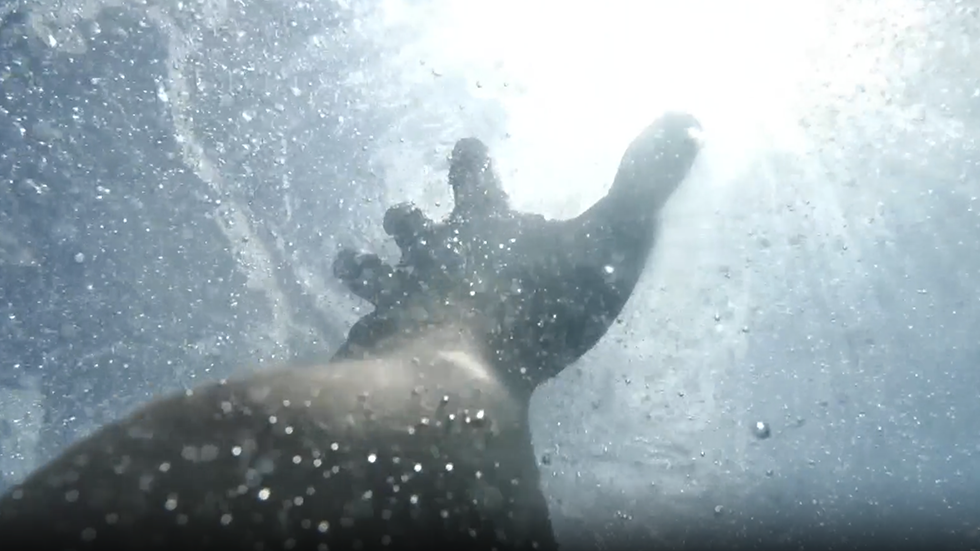 The rules here are essentially the same as suffocation rules:
- You can hold your breath for (CON mod + 1) minutes (with a minimum of 30 seconds or five rounds).
- After that you survive (CON mod) rounds (minimum of 1) without needing more air.
- After that, you are at 0 hp and are unconscious and dying. You can’t stabilize or heal until you can breathe — even if you make your three successful Death Saves, you only erase any unsuccessful ones and start the process over. You can be magically healed, but that can only get you back up to Step 2 unless you are out of the water by then.
Example: A creature with CON = 14 (CON mod = 2) can hold their breath for 3 minutes (30 rounds). After that, they start drowning/suffocating, and have 2 rounds (12 seconds) to reach air before dropping to 0 hp.
Note that 3 minutes (or even 1 minute) is a ridiculous amount of time in the game. People tend to be terrified of their character running out of air … the first time they get into underwater combat. (It’s still a real danger, but not a present one.)
Workarounds
- Various races can either breathe underwater, or (such as Lizardfolk and Tortles) can hold their breath for longer, as defined in their stat blocks.
- Wild Shape and Polymorph can change folk into creatures that can swim or breathe in water.
- Anything that magically gives you a Swimming speed will be useful in the above.
- Water Breathing is a spell that literally lets you breathe underwater for 8 hours. It’s a 3rd level for Druids, Rangers, Sorcerers, and Wizards, can affect up to ten people, doesn’t require concentration, and can be done as a ritual. Alternately, Water Walk (same parameters) lets you walk on water and not worry about having to breathe it.
Wait, that’s it?
But aren’t there some classic tropes that these rule ignore?
Yes.

- There’s no provision for heavy armor or a full backpack dragging you to the bottom, etc.; if you are strong enough to wear it, you are strong enough to swim in it (handwaves) … which is good, because it takes 5 minutes to remove heavy armor.
- There are no provisions for using up breath faster if you are (slowly) flailing about with your greatsword instead sitting still and preserving oxygen.
Again, largely this is because D&D is a crappy physics (and biology) simulator, and intentionally so. The game design thought seems to be “Does this complication take away from the fun? Does it mean extra calculations, rolls, and otherwise bogging-down of the game? Then simplify or eliminate it.”
(Note to self: if I ever decide this is too simplified, this site has some interesting homebrewed additions.)
Any changes here with 5.5e?
 The rules in 5.5e (2024) for swimming (and drowning) aren’t changed too much from 5e (2014).
One place there is more clarification seems to be with when these swimming rules come into play for movement and combat. The Difficult Terrain definition notes it applies in water between shin-deep and waist-deep. Water any deeper than that you are arguably either swimming (feet off the bottom) or most of your body is underwater and your movement (for moves and combat) are hampered enough that the swimming rules start to apply.
Swimming is defined in 5.5e:
While you’re swimming, each foot of movement costs 1 extra foot (2 extra feet in Difficult Terrain). You ignore this extra cost if you have a Swim Speed and use it to swim. At the DM’s option, moving any distance in rough water might require a successful DC 15 STRength (Athletics) check.
That’s pretty close to 5e, if a bit more simplified.
The drowning rules are a little different (though, as before, they come up under Suffocation as a Hazard):
A creature can hold its breath for a number of minutes equal to 1 plus its CONstitution modifier (minimum of 30 seconds) before suffocation begins.
So far, so same.
When a creature runs out of breath or is choking, it gains 1 Exhaustion level at the end of each of its turns. When a creature can breathe again, it removes all levels of Exhaustion it gained from suffocating.
Here’s where things get interesting (and simpler in a useful way) in 5.5e. Rather than have a final CON-based seconds to get to air and then dropping to 0 hp, you “simply” start accruing Exhaustion each round, i.e.,
- Your D20 Test rolls are reduced by (2 x Exhaustion level)
- Your Speed is reduced by (5′ x Exhaustion level)
This is fully reversable, instantly, upon being able to breathe again.
But, if it goes on 6 rounds (6 levels of Exhaustion), you are dead. Not dying. Dead. No Death Saves or Stabilizing.
Simpler. Not necessarily more or less dangerous.
The rules on combat underwater remain the same as far as disadvantages and weapon / range limitations if you don’t have a Swim Speed. I could not find any commentary on spellcasting underwater, but presumably it is much the same.
There is still no distinction made for hauling around massive weight or armor and how well you can swim (or sink). There is also still no modification in the drowning rules for minimizing activity.
Deep Water swimming has been modified (DMG 68). Only a 100 foot level is specified; after swimming an hour at that depth or below, creatures without a Swim speed need to succeed on a DC 10 CONstitution Save or take a level of Exhaustion.
If water is particularly “frigid” (DMG 68), then creatures can be immersed in it up to CON minutes; after that, each minute requires a DC 10 CONstitution Save or take a level of Exhaustion.