This one is mostly written from a 5.5e (2024) perspective, as I needed to clarify all of this for a 5.5e game I was running. Plus, it seems like 5.5e does a bit better job of defining all this stuff, vs. an array of official and unofficial rules around how these things all work. If you’re not sure how it all works in 5e, you could do worse than adopting some of the (backwards-compatible!) 5.5e approaches.
What if I want to break a door?
If a door is barred or locked (always check first!), here’s how you can get through it by brute force. There are two options, one using magic, one using your bodily strength in some fashion.
Use the AC / HP for an Attack or (damaging) Magic action against a Medium door. (In theory, you could also use a physical attack against it, though as a DM I’d probably prefer you try with an axe, rather than with arrows.) And, no, the damage type is not spelled out — you can use Psychic as easily as Bludgeoning damages.
Use the DC for a Utilize action against a Medium door with a STR (Athletics) check.
Door Type
AC to attack
HP if attacked*
DC to Break Open with an Athletics check*
Glass
13
4
10
Wood
15
18
15
Stone
17
40
20
Metal
19
72
25
* for larger doors of this type, HP x2 or x3, DC + 5.
What if the door is locked?
Time to try and Pick That Lock!
Simple locks take 1 Action to try to pick
Complex locks take 1 Minute to try to pick
The DC against picking is based on the quality of the lock:
Inferior lock is DC 10
Good lock is DC 15
Superior lock is 20.
Locks can only be picked by someone using Thieves Tools. The basic roll is a DEX (Sleight of Hand) check against the quality DC.
Thieves Tools
DEX (Sleight of Hand)
Roll
Not Proficient
Not Proficient
Sleight of Hand
Proficient
Not Proficient
Sleight of Hand + Proficiency Bonus
Not Proficient
Proficient
Sleight of Hand (PB is baked in)
Proficient
Proficient
Sleight of Hand at ADVANTAGE
Note that this follows the 5.5e general rule pattern about tools and the skills using them. Note also that under those rules that it is possible to get Expertise (double Proficiency) in a skill, but not on a tool set.
What about a portcullis?
Portcullis Size
DC if Iron
DC if Wood
Medium (8′ tall x 5′ wide)
20
15
Large (10′ tall x 10′ wide)
25
20
Huge (20′ tall x 15′ wide)
30
25
If you can’t get to the winch, then the DC is what you need with a Utilize action for a STR (Athletics) check.
If you want to destroy the portcullis, use the AC and HP of a large Metal or Wooden door (above).
Note that targets within 5 feet of a portcullis have 3/4 cover (+5 AC) from attacks from the other side; if further away, they have Total Cover.
Secret Doors!
Difficulty to find:
Barely hidden secret doors are DC 10
Standard secret doors are DC 15
Well-hidden secret doors are DC 20.
A Search action will let you search a 10-foot square section of wall with a WIS (Perception) check against the door’s DC; success means you spotted the door and know the means to open it.
You can also use an INT (Investigation) check if the clues are visible (scrapes on the floor where the door has rubbed it, for example) but need to deduced from or understood.
Something I often joke about here is how D&D is not a physics simulator, and, in fact, is a very mediocre tactical combat simulator. All games, more or less, are, both because drama is more exciting than reality, and because reality is really hard to simulate
One of the things that D&D 5e (2014) brought to the mix was the KISS principle. Gone was to be the crunchity-crunch-crunch of multiple bonuses and penalties on rolls from the 3.5e period. Gone was the slick but somewhat joyless tactical detail of 4e. Instead, 5e tried to keep it simple while at the same time making it fun.
By and large, not a bad job. Lots of abstractions, lots of handwaving about Advantage and Disadvantage, pretty good show.
5.5e (2024) for all its plusses and minuses, added a new element to combats by somewhat-popular demand — and which has turned out to be a lot more controversial than I would have expected.
Weapon Mastery!
A Longsword does 1d8 slashing damage.
A Flail does 1d8 bludgeoning damage.
A Morning Star does 1d8 piercing damage.
Are these the same?
Damage is damage, amirite?
Well, obviously not. A flail slams weights against its target. A longsword slices and dices (and pierces, but we’ll ignore that for D&D). A morning star pokes little pokey bits backed by weight into its victim. The damage type is different — bludgeoning vs slashing vs piercing — but there is very, very little in the rules were that actually means anything (skeletons being vulnerable to bludgeoning weapons is the only thing that comes to mind).
Abstraction is useful, even necessary, to deal with real-world details that could easily overwhelm. But too much abstraction is equally problematic. I once abandoned a super-heroes gaming system because there was no mechanical, in-game difference between someone attacking with a telekinetic blast, jet of flame, or lightning bolt. The same, to an extent, is true for weapons and their use. If a flail = a longsword = a morning star in every way that counts except for your character picture — is that too much abstraction?
5.5e says, “Yeah, let’s see what we can do about that.”
Weapon Mastery?
The Weapon Mastery rules consist of two parts: What It Is and How To Get It
What Is Weapon Mastery?
Weapon Mastery is an additional aspect to weapons that certain characters can get by becoming “masters” of that particular weapon and learning to use its more interesting features.
If you look at the Weapons table, you can see the Mastery column that indicates how a trained user of the weapon can do something extra. That something extra, as spelled out by the rules, includes (with some weapon examples):
Cleave: Once a turn, on a hit, the attacker does a follow-on attack on another target within 5 feet of the first and within reach. Damage on that second attack does not include the Ability modifier (unless negative). [Greataxe, Halberd]
Graze: If the attack misses, it still does damage equal to the attacker’s Ability modifier. [Glaive, Greatsword]
Nick: When the attacker make an extra attack because the weapon is Light, they can do it as part of your Attack action, not using up their Bonus Action. [Scimitar, Dagger]
Push: On a hit, the attacker can push the target 10 feet away if size Large or smaller. [War Hammer, Heavy Crossbow]
Sap: On a hit, the target has Disadvantage on its next attack roll. [Longsword, Morning Star]
Slow: On a hit with damage, the target’s Speed is reduced by 10 feet until your next turn (no stacking). [Club, Light Crossbow, Longbow]
Topple: On a hit, the target makes a CON Save vs DC (8 + attacker’s Ability Modifier + attacker’s Proficiency Bonus) or go Prone. [Maul, Quarterstaff]
Vex: On a hit with damage, the attacker has Advantage on the next roll against that creature before the end of their next turn. [Short Bow, Rapier]
How Do I Get Weapon Mastery?
Various martial classes (Barbarian, Fighter, Paladin, Ranger, Rogue) automatically get at a Level 1 the Weapon Mastery class feature. This lets you use the Mastery feature of some (the number varies by class) simple or martial weapons of your choice. You can swap out for another one of these each Long Rest. For some classes, the number of Weapon Masteries increases as levels go up.
The Weapon Master feat gives you an ASI and (to the point) lets you use the Mastery of one simple or martial weapon of your choice (which can be swapped around after any Long Rest) if you have Proficiency for it. This basically opens up the ability to non-martials.
Pros and Cons
The plus and minus of Weapon Mastery as a game rule is the same: It’s one more thing to do stuff with.
As a plus? It sets apart martials a bit more; it allows additional tactical elements in combat; it improves flavor by keeping flails and longswords and morning stars from all being the same.
As a minus? It slows down combat while tactical decisions are made (do I want to use the push-back? what path? does that mean it would be better to attack this other opponent? etc.); the mapping between the Masteries and the actual weapon is a bit sketchy, so the verisimilitude is strained.
I don’t have a net-net here, until I see how it works in actual gameplay. To the extent that it adds some additional flavor to folks like Fighters (beyond “I hit him with my sword. And again. And again.”) it seems like it would be a good thing, but it’s easy to understand why some folk think it represents a creeping re-complexity for D&D combat.
That’s a generalization, so suspect, but in my multiple decades of playing and DMing D&D and other FRPG / TTRPGs, I have yet to find anyone who wants to keep track of all the things they are carrying and their weight and have that impact how their character performs. Conan and Legolas and [insert fantasy hero here] never worries about Encumbrance — why should I?
The only people who have any use for Encumbrance are GMs, as a check against player characters carrying around golf bags full of specialized magic swords (“Hmmm, a Flametongue for this encounter, I think”) and, more importantly, on player characters stripping the Temple of the Really Rich Lich of its 500,000 gold pieces and its diamond altar and the three giant jade statues with gems the size of toaster ovens for eyes.
In other words, Encumbrance is a tool for managing edge cases and, in some cases, exploits, and, frankly, can be skipped unless those come to pass.
Indeed, the D&D Rules themselves actually make that case. For 5.5e (2024), the PHB says on p. 20:
Carrying Objects: You can usually carry your gear and treasure without worrying about the weight of those objects. If you try to haul an unusually heavy object or a massive number of lighter objects, the DM might require you to abide by the rules for carrying capacity in the rules glossary.
The game should be fun. If a mechanic stops it from being fun, ignore the mechanic. But if lack of a mechanic stops it from being fun, be ready to use it when you need to.
So how about the rules?
The basic rules for Encumbrance are the same between 5e (2014) and 5.5e. The only difference in significance is that 5e calls it Encumbrance and 5.5e calls it Carrying Capacity.
The underlying numbers, though, are the same, just differing i how they are presented. 5e gives some formulae and then a series of exceptions and extrapolations. 5.5e presents a table, which is a much clearer way of doing it, so that’s what I’ll use here.
Creature Size
Carry
Drag / Lift / Push *
Tiny
STR x 7.5 lbs.
STR x 15 lbs.
Small/Medium
STR x 15 lbs.
STR x 30 lbs.
Large
STR x 30 lbs.
STR x 60 lbs.
Huge
STR x 60 lbs.
STR x 120 lbs.
Gargantuan
STR x 120 lbs.
STR x 240 lbs.
*If you are dragging / lifting / pushing a weight greater than you can carry, your Speed drops down to 5 feet. If the weight is beyond the D/L/P level, you cannot move it.
That’s pretty much it: Size (basically your ability to balance a heavy load) and STRength (your ability to overcome inertia and gravity).
The numbers calculate the same between both 5e and 5.5e, so easy peasey.
(The variant rule in 5e, PHB 176, abut encumbering and heavy encumbering and their effects on your die rolls and speed, are not carried over in 5.5e, which is probably a good thing.)
The rules don’t explicitly state it, but presumably burdens can be shared. The math probably gets a bit dodgy, but I would let STRength be additive here, with some sort of proportion around the creature sizes of the folk sharing in the carrying.
Don’t ask me to factor in how having a wheeled setup (e.g., a cart, rollers, etc.) affects all of this if it’s the players pushing/pulling it.
Exhaustion is a special set of escalating conditions that occur when rest or nutritional intake are inadequate, or when environmental conditions (heat, cold) are life-threatening.
Exhaustion consists of 6 levels:
Level
Effect (Cumulative)
1
DISADvantage on Ability Checks
2
Speed halved
3
DISADvantage on attack rolls and Saves
4
Hit point maximum halved (HP reduced, if necessary, to the new max)
5
Speed reduced to 0
6
Death
Yeah, not fun. The term “death spiral” literally fits here, since each level of Exhaustion can make it more difficult to remove oneself from the causes of the Exhaustion.
These effects are cumulative, e.g., a creature at Exhaustion level 2 has its Speed halved and a DISADvantage on Ability Checks.
If a creature that already has a level of Exhaustion suffers another effect that causes Exhaustion, its current level goes up by the number described.
A creature suffers the effect of its current level of exhaustion as well as all lower levels. For example, a creature suffering level 2 exhaustion has its speed halved and has disadvantage on ability checks.
Effects that remove Exhaustion reduce the level as they describe. When Exhaustion drops below 1, the creature is no longer exhausted.
A Long Rest will reduce Exhaustion by 1 level, as long as the resting creature has been able to eat and drink. Being raised from the dead also reduces Exhaustion by 1, though that’s kind of the hard way to do it.
Okay, how does this change in 5.5e?
Though the 5e (2014) rules are pretty simple, 5.5e (2024) makes them even simpler.
Exhaustion is cumulative / stackable. You still die if your Exhaustion level is 6. When you have any level of Exhaustion:
Your D20 Test rolls are reduced by (2 x elevel).
Your Speed is reduced by (5′ x elevel).
So, if you are at Exhaustion Level 3, your D20 rolls (attacks, saves, ability checks) are all reduced by 6, and your Speed is reduced by 15 feet per turn.
Exhaustion can be alleviated by finishing a Long Rest, which removes 1 level. When you reach level 0, you are no longer Exhausted.
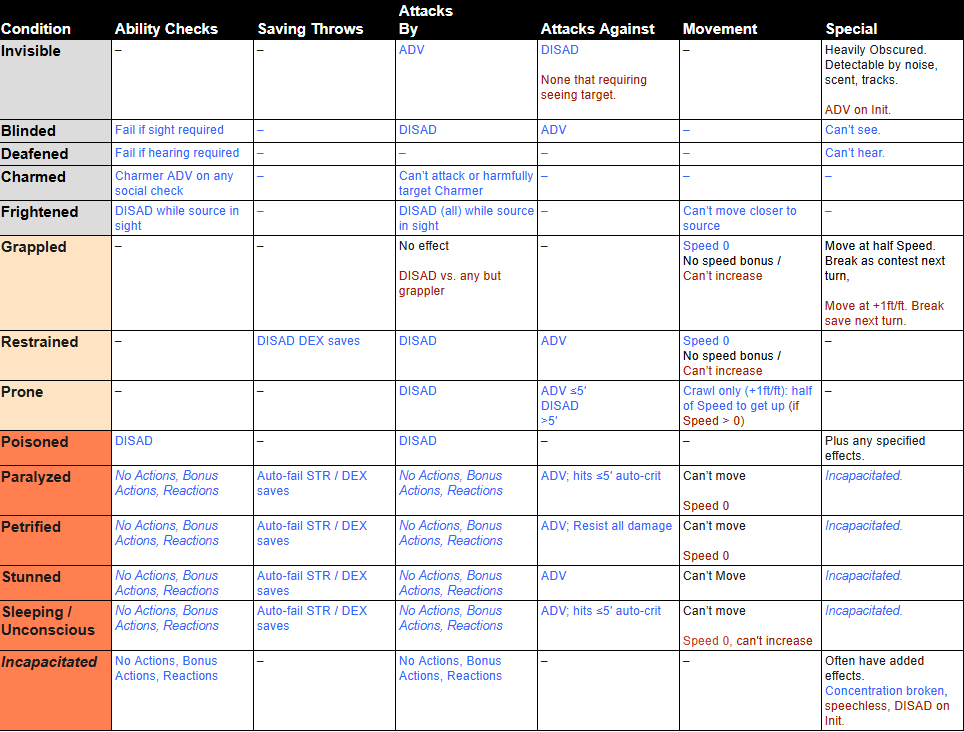
D&D 5e uses common Conditions as a modular way of showing the results of various attacks, spells, environmental issues, etc. By defining what it means to be “Blinded,” the rules can say that Condition is applied to someone without explaining what it means.
5.5e (2024) continues this, but modifies some of the Condition meanings, as well as adding a few new ones. See here and here.
In the table below, 5e (only) notes are in black, 5.5e (only) notes are in red, and notes common in both editions are in blue.
Click to embiggen
Note that for the Incapacitated-related action restrictions, while 5e did not specify “no Bonus Actions” in the Condition descriptions, elsewhere in the rules it did note that if Actions were not allowed, it was the same for Bonus Actions. The notes of this sort in italics are inheriting it from the Incapacitated Condition.
Note also that Exhausted is another type of Condition, and is the only one with effect that can stack.
This is one that the tables of our gaming group generally do wrong — or, at least, not Rules as Written (PHB 190) for quite some time: what it takes, action-wise, to change from one weapon to another.
When describing what you can do on your turn, the rules say:
You can also interact with one object or feature of the environment for free, during either your move or your action. For example […] you could draw your weapon as part of the same action you use to attack. If you want to interact with a second object, you need to use your action.
And, under the rule on interacting with objects around you, it says:
draw or sheathe a sword
In other words, you can on any given turn, for free, (a) draw a weapon, or (b) sheathe/put away a weapon … but not both. This means the (very common) “Hmmm, with which of my array of weapons am I attacking with on this turn?” maneuver doesn’t work (RAW).
Round 1 – I plonk the bad guys with my bow.
Round 2 – Ooh, a bad guy is in my face, I stab him with my sword.
Round 3 – I shoot the guy across the room with my bow.
Round 4 – I charge in and stab that guy with my sword.
Nope. Essentially, switching weapons takes a full Action (putting away one weapon for free, Use an Object for your Action to draw the other one), meaning no attack that round.
This also complicates life for thrown weapon players. If drawing one of your throwing daggers takes up your free object interaction, then even if you have multiple attacks for your Attack action, you won’t have a way to draw additional daggers / shuriken / etc.
A couple of ways around this if you want a quick weapon change (one-way):
Don’t put your weapon away. Just drop it (as you would a torch), which takes no time, and then lets you use your free interaction to draw your new weapon. Except in exceptional circumstances, there’s no call to worry about damage to the weapon. Dropping something takes no no time, and then you can draw your other weapon.
Getting that weapon back to use again in the battle seems like it would be dodgy, but the rules do let you pick something up just as easily as drawing from a sheathe, for that free object interaction. Of course, if you have to flee the battle, the weapon might be left behind. Or, more seriously, the bad guys could grab the weapon you dropped, too.
You can also, if you really don’t want to lose your weapon and maintain maximum flexibility, do something along the lines of (Turn 1) Attack-Sheathe then (Turn 2) Draw-Attack as a way of switching weapons, but it’s not something you can do every turn, and it does leave you empty-handed (for Opportunity Attacks) elsewhere in that turn.
Rogues (Thieves) can use Fast Hands on their Bonus Action to Use An Object. That totally works for this (free action to put away a weapon, FH>UAO to draw a new one, then Attack). That’s doubtless why Legolas took a couple of levels of Rogue at one point.
Frankly, all of this strikes me as Not Fun. Which is why we’ve tended to drop this from our games, as DMs are allowed to do. But that has some consequences. The design idea behind this restriction, among other factors, seems to be
Drawing that distinction between archery fighters and melee fighters, and balancing between them (archery fighting is generally considered a bit OP in 5e; this means archery fighters dealing with guys getting in their faces have to decide between retaining their bow and being at a Disadvantage for shooting at folk at 5 feet, or switching weapons and being slowed down after their attackers are gone before resuming plonking at range). It reduces the homogeneity of folk swapping instantly between being ranged fighters and melee fighters.
It also breaks the “video game weapon-swap” meme a bit.
And it addresses the RL aspect that sheathing a sword and unlimbering a bow and drawing and shooting really does take more than six seconds (though, of course, RL considerations only go so far).
Lastly, of course, there are Feats and Sub-Class Features that explicitly allow faster drawing / sheathing of weapons; playing without that restriction renders them less useful. (I.e., the game is already built around the restriction, so removing the restriction theoretically unbalances things.)
5.5e (2024) shakes things up a bit here, by explicitly (PHB Appendix C, p. 361, and the Free Rules) allowing a draw or sheathe/stowing of a weapon as part of an attack within the Attack action, either before or after an attack, and not necessarily with the same weapon.
Equipping and Unequipping Weapons. You can either equip or unequip one weapon when you make an attack as part of this action. You do so either before or after the attack. If you equip a weapon before an attack, you don’t need to use it for that attack. Equipping a weapon includes drawing it from a sheath or picking it up. Unequipping a weapon includes sheathing, stowing, or dropping it.
This lets you juggle weapons much more easily, especially as you get, e.g., Extra Attack, coming along.
It also appears that this Equipping / Unequipping rule is distinct from the Thrown property on weapons in 5.5e, which separately notes you can draw-and-throw as part of the attack. That means you could (if you can attack twice during your Attack action:
Attack 1:
Attack with my sword.
Sheathe my sword (Unequipping) for free after that first attack.
Attack 2:
Draw-and-throw a dagger
Draw my sword again.
Note that the previous free “interaction” from 5e has been, if not dropped, then scattered a bit. There is now an explicit Utilize Action for when an object requires an action to use it. If you are doing something with an object as part of a different Action, that interaction should be free, as with the Equipping / Unequpping text above.
You can interact with one object or feature of the environment for free, during either your move or action. For example, you could open a door during your move as you stride toward a foe. If you want to interact with a second object, you need to take the Utilize action. Some magic items and other special objects always require an action to use, as stated in their descriptions. The DM might require you to use an action for any of these activities when it needs special care or when it presents an unusual obstacle. For instance, the DM might require you to take the Utilize action to open a stuck door or turn a crank to lower a drawbridge.
It’s unclear to me if you can do that free Interaction for an initial draw/sheathe of a weapon, which would make things even more flexible.
Use of a wand in combat is not an Attack, or a Weapon Attack, or anything you could put into the chain of attack actions that a higher level martial character (like a Fighter) can use.
The Magic Missile wand, for example (and other wands use similar language), says:
While holding it, you can use an action to expend 1 or more of its charges to cast the magic missile spell from it.
Using a wand is an Action (more specifically, a Use an Item Action). You get one Action per turn (and one Bonus Action and one Reaction), with very few exceptions.
This doesn’t come into play with the Fighter’s Extra Attack feature at higher levels. While the nomenclature is confusing, that lets a fighter do multiple attacks within a single Attack Action (it isn’t adding to the number of Actions, it’s adding to the, if I can coin the phrase, sub-actions under the Attack sort of Action).
I.e., a higher level Fighter may be able to swing a sword at an opponent three times in a round, but they can still only fire off a wand a single time.
Using a wand also not casting a spell. That is a particular type of action (quite literally, the Casting a Spell Action). If it were, then it would affect the limitations of only one leveled spell cast per turn. If a magic user uses a wand, they can still cast any level spell is cast as a Bonus Action.
The edge case exception here is that Action Surge gives a Fighter an extra Action — which Action could, in fact, be used for Using a [Magic] Item. I.e., getting two shots off the Magic Missile wand.
Wands and 5.5e
Things are mostly the same under the 5.5e (2024) rules, though with slightly different nomenclature.
Using a wand (or any magic item) is done as the newly named Magic Action, as is spellcasting and the like. Unfortunately, the new rules also are quite clear that you cannot use Action Surge to take an extra Magic Action, so we’re back down to a single use of the wand per turn.
On the other hand, allowing use of a wand as a Magic Action still doesn’t forestall using a leveled spell via a Bonus Action or Reaction (5.5e calls them “slotted spells”).
Since it comes up periodically and I Here are my notes on how Surprise works in D&D 5e — at our table, at least, given the complexities of Active vs. Passive skills and variations under different DMs.
When Does Surprise Happen?
Surprise occurs when two parties (1+) meet and one of them is unaware of the other until action has begun.
Two thoughts on this:
A situation where there is obvious risk can’t engender surprise unless an attack comes from a completely unexpected direction. If are aware of danger, and are taking normal precautions for it, you cannot easily be surprised (you can be ambushed, but you won’t suffer the consequences of surprise).
Trying to be and stay aware has limitations. Even if you know you are in a combat zone, you can only spend so much time and energy watching for bad guys above, below, and in all directions.
Note that “action” usually means “combat,” given D&D’s proclivities, but it doesn’t have to.
The basics are encapsulated thus (broken into points for clarity):
So what happens when the parties meet?
The PHB says (broken into points):
The DM determines who might be surprised.
(Though he’ll try to be fair about it and as impartial as possible.)
If neither side is trying to be stealthy, they automatically notice each other.
E.g., “You round the corner and there is a party of dwarves walking toward you. Both sides stare at each other for a moment … but after that joint moment of, yes, startlement, each party remains on an even footing with each other.”
Or it’s even, both sides are approaching the corner, chatting with each other, hobnailed boots clattering, and they become aware of something around the corner at about the same time. In either case, surprise is moot.
Otherwise, the DM compares the Dexterity (Stealth) checks of anyone hiding [or otherwise trying to be stealthy] with the Passive Wisdom (Perception) score of each creature on the opposing side.
The caveat I added is important; the rules (and a lot of discussion) has to do with one party laying in wait for the other, but it could as easily be trying to creep up on another group. There’s also sort of an arbitrariness here — it’s easy to think of a situation where both sides are trying to be stealthy while listening for trouble … the thief sneaking up on a corner while a guard is waiting for someone to step around the corner, but is unaware of when it will happen. Who gets to make the Stealth check vs the Perception check? Hmmmmm …
Also, note that comment on Passive Perception. We’ll get back to that.
Any character or monster that doesn’t notice a threat is surprised at the start of the encounter. […] A member of a group can be surprised even if the other members aren’t.
There’s a bit of artifice here. While there is a remarkable amount of argument about “a threat,” essentially it means that if you hear any of the orcs who are laying in wait ahead, sufficient to put you on your guard, you will not be surprised by any of them — even, arguably, by the orcish assassin coming up from behind (because there’s no facing, so your presumed awareness is 360° once you’re on the alert).
You can be surprised even if your companions aren’t, and you aren’t surprised if even one of your foes fails to catch you unawares.
Surprise, then, is an individual thing for characters (and, to a more limited degree, for opponents): I, as a character, have to detect any of the other side to not be surprised (if I hear one person’s chain mail jingling, I become alert and won’t be surprised). But my not being surprised doesn’t affect my fellow players.
That can seem kind of weird, depending on the timing. But if we’re walking into a trap, my detecting someone is deemed a last-second thing; I can’t shout out, “Hey, it’s goblins! Don’t be surprised!” (Though circumstances can allow that — I’m trying to spot something on the trail ahead, and there’s a glint of metal three switchbacks up the hill … I am allowed to warn my friends in that case.
How Does Surprise Get Determined?
This starts getting into that whole Active and Passive Skill thing.
Active Skills are when you roll 1d20 and add your Ability and Skill Proficiency scores. They represent an active effort on your part (“I’m trying to do X”).
Passive Skills are just “what you do most of the time,” and they are served by basically replacing that d20 roll with a 10 (i.e., making it a perpetual average role).
Some DMs out there argue that it also represents the minimum you can get on an Active Skill roll, but I disagree; actively looking for things can allow someone to get distracted (while I’m focusing on telling whether that glint ahead on the trail is steel or a shiny rock, I miss the tripwire across the path I might otherwise have seen).
The problem with Passive Skills is that they are meant to represent two things: (1) the “average” background ability and (2) a way for the DM to save time. Rather than have everyone roll Perception (or the roll it themself behind the screen), it’s far easier (and less alerting to the players) for the DM to know that Bob’s Passive Perception is 12, so they will always see a hidden thing with DC10, and always miss one with DC15, unless they are actively searching.
Easier, but kind of dull. “Oh, this floor of the dungeon appears to be populated by DC10 traps. Bob strolls through it with no chance of being caught by any of them.”
And the “easy” aspect is dubious in Roll20 (or any VTT): I can click on a pre-set macro and roll everyone’s Active Perception any time I want. Not only is it hidden from the players, but it allows for variation — someone other than the highly perceptive Rogue can spot the trap once in a while (though, on average, it’ll still be the highly perceptive Rogue), and it means that if the highest Passive Perception is 15, DC20 traps aren’t automatic hits.
As a general rule, and for DM convenience, the “who rolls this, the Players or the Monsters” is usually focused on the Players (which is more fun for them, but also a lot easier for the DM). So a way to do this is that the Orcs, as they lay in wait, all use their Passive Stealth (effectively the DC number), while the Players all roll their Active Perception (or the DM rolls it for them) — or, if the ambush is on the other foot, the Orcs all use their Passive Perception and the Players all roll their Active Stealth. While the bad guys relying on Passives is kind if dull, it’s much simpler.
Two examples:
Characters Surprising Monsters
E.g., “Hey, here come some monsters, lets ambush them!” (Or perhaps, “There’s a monster camp up ahead, let’s creep up on them.”)
In its most basic form, the players prepare their ambush, and each rolls a Stealth check. It gets compared to the Passive Perception of the target monsters. The problem here is that the big fighter wearing plate mail is always going to have a crap Stealth roll, meaning the monsters (who all have the same Passive Perception) will always hear them.
An alternative, especially if the party has a chance to collaborate and plan and are aware of what the bad guys are doing, is to roll a Group Check (PHB 175, and more written here):
When a number of individuals are trying to accomplish something as a group, the DM might ask for a group ability check. In such a situation, the characters who are skilled at a particular task help cover those who aren’t.
To make a Group Ability Check, everyone in the group makes an Active Ability Check. If at least half the group succeeds, the whole group succeeds. Otherwise, the group fails. That lets the stealthy Rogue counter the noisy Fighter (“Pssst — watch out for that twig you’re about to step on!”). The success usually has to be against a unitary number/difficulty, though, e.g., the Passive Perception of the opposition.
Group Checks can be used for anything, but they’re really designed for when a single individual failure would mean the whole group fails.
Monsters Surprising Characters
This sounds like it should be the same thing, and, ideally, it is, but pragmatically, it’s usually handled a little differently.
So, for example, rather than the DM rolling (Active) Stealth for each of the monsters (fine for one or two, a real problem with twenty), the suggestion is to use the Passive Stealth (10 + DEX bonus + Stealth bonus).
The only problem with using the Passive Stealth there is that a Player who misses (either Passive Perception or an Active Perception roll) misses against all of them, and someone who makes the needed number succeeds against all of them. Unfortunately, that’s the kind of abstraction that is inevitable in this kind of simulation.
Using Active Perception rolls for the Players is probably better (and, if the DM has a macro set up for it, easy).
What Happens When Someone Is Surprised?
Pre-5e there was the concept of a “surprise round” — a round in which the surprisers get to act, and the surprised don’t.
5e changed this a bit. When the first action of an encounter takes place, Initiative gets rolled by everyone (even folk who are surprised). If you are deemed surprised, it means you:
cannot Move or take an Action (including a Bonus Action) on your first turn
cannot React until after your first turn
So the band of goblins gets the drop on all your party. Everyone’s initiative rolled and likely intertwined, but as each party member’s turn comes up in the first round, they cannot do anything during during that turn. But once each their turns has come up (and been squandered as they recover from surprise) they can React (e.g., take an Opportunity Attack, cast Shield, etc.).
E.g. Susan and Bob surprise Goblins 1 and 2. They all roll Initiative, and it goes in the order Susan, Goblin 1, Bob, Goblin 2.
Susan runs past Goblin 1 (who cannot React with an Opportunity Attack because they are surprised) and stabs Goblin 2.
Goblin 1’s turn comes up; they cannot take any Move or Action and just stand there, agog with surprise.
Bob decides to finish off Goblin 2. He runs past Goblin 1 … but since Goblin 1’s turn this first round has passed, Goblin 1 Reacts, taking an Opportunity Attack to stab Bob.
Goblin 2’s first turn comes up; they, too, cannot take any Move or Action … but once their turn is over, if Susan tries to run back to help Bob, Goblin 2 can try an Opportunity Attack, too. And when Goblins 1 and 2 come up in the next round, they will be Moving and Acting as normal.
We’ll evaluate at a later time all of the Active/Passive stuff above (the stuff that determines if there is surprise). The meat here is how the effects of surprise
Surprise in 5.5e has been significantly simplified — maybe a bit too much.
Surprised creatures roll Initiative at Disadvantage.
That’s it. No special Surprise Round. No differentiating between types of actions. Roll Init at Disadvantage. Quick characters will (likely) still be pretty high in the Initiative order (but maybe not).
Though it’s worth noting that if the attackers in ambush are successfully (through Hide (with Stealth) or Invisibility) hidden, they get Advantage on the Init roll. Which widens the gap in Init still more.
The upshot of this, though, is that Surprise matters a bit less. Everyone will get to do something Round 1; you won’t have surprisers who effectively get two attacks in, which, in an Action Economy, can be deadly. This is a Good Thing if it’s your party being surprised; it’s a Bad Thing if you’re doing the surprising.
Arguably, this almost takes too much of the sting out of Surprise. The surprisers will still get the first blows in, but the surprised will spring back quickly.
It will be interesting to see how folk end up in their evaluation of it.
So I’ve been neglecting my work on this website for a while, and want to play a little catch-up, especially as our gaming group starts encountering the new semi-edition of D&D.
Branding Past
First, some nomenclature. The new semi-edition was originally called “One D&D,” so as to imply that it’s the system we would have forever. For some reason, that was then changed to calling it “D&D 5th edition (2024),” with the previous version now being referred to as “D&D 5th edition (2014)” (the parentheses indicating the year it first came out).
This is cumbersome, so most references are to just “2024” vs “2014.”
Personally, I think this is still kind of confusing, for two reasons:
“2014” and “2024” look very similar. They are the same length, 75% the same characters, and the only difference is in the same place. Easy for the eye to mistake them, and I find myself doing that almost every time.
These are not the same game.
Not that they aren’t very similar, mind you. And there is a very rough comparability between them. And you can do some mixing and matching — with work — between the systems. But the implication that these are both “5th edition” is a pleasant fiction design to deflect accusations that WotC just wants to sell more books.
So I’ll be generally using the alternate terminology that a number of sites have adopted of referring to the older semi-version as 5e and the new semi-version as 5.5e (see keen little icon I drew up to the right).
So from what I have read (and which we are now encountering in the Real World), here are the answers to some basic comparability questions.
Some questions
Can I use 5e characters in a 5.5e campaign?
In theory, yes, though there is a sense that 5e characters are a bit less powerful and usable than 5.5e, so doing a character built in 5e as a 5.5e character, without making any other changes, it’s suggested to just give them an extra feat.
But … it’s also clearly stated that if you run a 5e character in a 5.5e campaign, you really need to use as many of the 5.5e rules as possible; a 5e character in a 5.5e campaign must use the 5.5e rules on Surprise and Inspiration, etc. Just like a running an old 1950s Ford operating on a 2025 freeway, you can do it, but finding leaded fuel and a mechanic that can service it, etc., might be difficult, plus you run risks with not having a third brake light or daytime headlamps, let alone full-blown seat belts front and back (which you might be required to install after the fact). It’s a bit hazy what to do as your 5e character levels up — should they use 5e leveling rules for their class, or 5.5e?
An alternate option is to rebuild your 5e character in 5.5e. This is probably the cleanest solution, especially if you try to be diligent about keeping a similar growth path and set of options (which hopefully haven’t been annoyingly nerfed in 5.5e). It’s biggest advantage is that there is no question but that it is a 5.5e character when you are done, and you can easily move on from there.
UPDATE: In revising all of my 5e rules posts to also reflect 5.5e rules, my overall analysis is that while most of the major game subsystems are the same (sometimes a bit simplified), the biggest changes are in the details: Spells, Feats, etc. Any conversion from a 5e character to 5.5e is supposed to use the latter’s rules, which means reviewing all those spells very carefully and seeing what you maybe need to tweak.
Some sites that go into changes between the semi-editions:
What if I am bringing over from 5e, or using from 5e, a class or subclass that 5.5e doesn’t support yet?
One of our players wants to run an Artificer in a new campaign. Artificers haven’t been formally added to the 5.5e rules yet (a play test draft has been released, but with unpleasant, I am told, differences from 5e, and further changes are expected until the new class is published). The same can be true for certain subclasses.
The guidance is if you are building fresh, you take the manual process of building the character as 5.5e one, with timing of class features as in 5.5e (subclasses always come in at 3rd level), but adding the spells and (sub)class features that 5.5e uses.
If converting over from 5e character, and you don’t want to rebuild the character … the rough guidance is to just give them an extra Feat. Talk with your DM.
What if I have a 5e character of a race (species) that hasn’t been written up for 5.5e yet?
The guidance here parallels that of class/subclasses that haven’t been converted over yet. Go ahead and use the 5e race with its features, but build it under 5.5e rules (regarding stat bumps, backgrounds, when species features come in, etc.). Talk with your DM first, of course. When WotC sells you a new book down the line with the revised version of the species, decide whether to backfill the new changes, or just stick with “classic.” It’s not going to break the game.
The exception here is for races that will not be converted, in particular, hybrids or “half-” creatures like half-elves and half-orcs, which WotC has decided are too problematic (not without some justification). The recommendation is to choose one thing or the other (make your half-elf either an elf or a human; make your half-orc either an orc or a human, etc.). If you need backstory around it, have them be adopted.
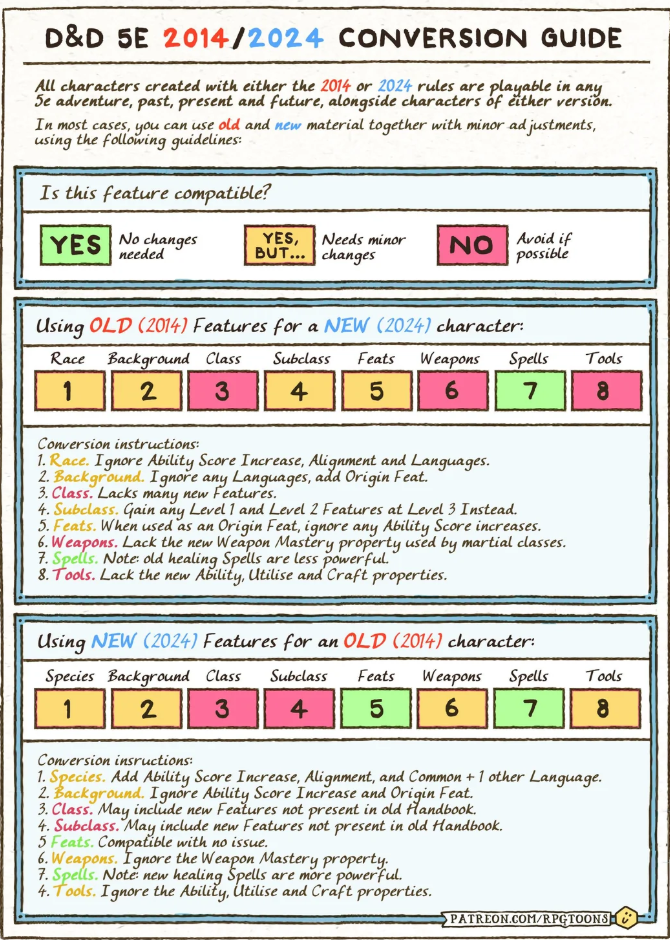
Here’s a nicely done guidelines of the “minor” things that have to be done differently to use 5.5e to build 5e characters, or 5e rules to build 5.5e characters. The author has a different threshold of what’s a significant compatibility problem (and glosses over some major spell changes), but it’s another way of looking at this information.
A lot of red and orange there
Can I use a 5e scenario / module in 5.5e?
Yes, but …
The module materials will all be written up with 5e rules and versions of monsters and NPCs and 5e spell lists and 5e mechanics. You can Just Do It as written, or you might want to take the time and effort to update some or all of the material to take advantage of the new way 5.5e handles things like monsters that cast spells, monster races with multiple “classes”/roles, etc.
What about VTT issues?
This is where we get an added layer of complexity. I can’t speak to VTTs other than Roll20, but here’s what I’ve learned so far about 5.5e and that VTT. This centers on the character sheet system, as that is the only place where the system rules are embedded.
Implementation of 5.5e into Roll20 is still dodgy. Or so I’ve been told by at least one player. Not all species / classes / feats that have been brought into 5.5e have made it into the character sheet and advancement features in Roll20.
Working in a mixed campaign — one supporting 5e and 5.5e characters and/or NPCs — causes problems. This is because Roll20 implemented its 5.5e character sheets with a new tech stack, different from what was used with 5e. The new tech stack removes a ton of cruft from the old one, and is much more easily modifiable as 5.5e progresses, but it doesn’t have the same hooks and API variable names or exposure that the old 5e character sheet had. Thus, macros you have written for 5e may not work with 5.5e characters or NPCs (and vice-versa)
This last is particularly a problem when you want to run with 5.5e rules and characters, but are using a 5e module, as all of its NPCs will be using the 5e character sheet (for NPCs), which Roll20 will get indigestion over (and, again, some macro issues will crop up). Converting all the monsters to 5.5e would be a huge lift.
I spent about a week trying to overcome those issues. I didn’t come up with a great answer, most of the macro stuff can be worked around (esp. if the only 5e characters are NPCs, meaning the NPCs run with their own set of macros, which often happens). The best answer may be to hold off running a 5.5e set of characters until (a) more 5.5e material is published and brought into Roll20, and (b) Roll20 makes their 5.5e implementation more robust.
Net-net
All of the above issues are, fundamentally, compatibility issues. They are very similar to what came up when D&D went from 3.0 to 3.5, which is why it’s frustrating for WotC to pretend that there are no significant compatibility issues.
Mixing and matching 5e/5.5e stuff is going to be something of a pain for the next few years. Ultimately, the 5e stuff will die out or be successfully converted (for VTT purposes, if nothing else). For our table, at least, we’re just going to stick with 5e for the moment, and see where things are in a few years when the next campaign kicks off.
Due to folk creating thousands of fake subscribers here on this blog, and various password reset shenanigans (if it came from “wordpress@hill-kleerup.org,” it’s not legit), and similar suspicious stuff, I have …
Deleted all but admin-level users. Sorry if you were a legit user and I deleted you and you want to subscribe here, please contact me at dave and then at hill-kleerup.org, and I can manually add you in.
Blocked automatic enrollment at the site.
The fact is, there are plenty of ways to follow or subscribe to this site without registering with it, so I am not too worried. But if they don’t work for you, please use the process noted above.
There will be SPOILERS. If you are playing in a PotA game, please don’t read this. But if you are DMing a PotA game, or are a DM who wants to see what the ride was like … read on!
GM Recap
The Eternal Flame
Session 54 (Day 41)
In … The Temple of Eternal Flame
Moony led a very cautious exploration of the hallway of dwarvish statues. Behind one he found the Crypt of Findon and Gitte, apparently never found by any cultists and undisturbed since the fall of Tyar-Besil. They left the sarcophagi undisturbed at Aldrik‘s insistence, though they did hide briefly in the crypt when a loud axe trap was poorly disarmed.
Razerblast token (official)
An octagonal chamber beyond with lightly glowing obsidian pillars turned out to be a guardpost for three Razerblast fire cultists, as well as a flash-frying magma oven. The party prevailed, but not without Nala and William nearly perishing from vicious attacks and explosive deaths.
The party hid back in the crypt and took and enforced long rest. DING! Level 9!
Player Recap
Sleeping with the Dead and Liking it!
After finishing off the ogres and finding their stash of coins, Moony sets off towards the hall leading out of the room. William and the others continue to look around the room or watch Moony explore the hall. Moony discovers a secret door behind the first statue. He enters the room with Aldrik close behind. It looks like a shrine with a couple of sarcophaguses’. Dust is thick on the ground. It doesn’t look like the cultists have found this room. There are Darvish rune on the sarcophagus “Rest well, Findon Stonemender. Dream of hammer and chisel echoing in your halls.” The second says “Beloved Gitte. Heavy are the hearts of all who knew ye.” Moony looks for traps on the first sarcophagus and asks if anyone would mind if he opens it. Aldrik eventually says that he would rather not have them disturbed.
Farther down the hall, Moony spots a trip wire between the last two statues. Unfortunately, he sets off the trap as he is disarming it. An axe drops across the hall. The group retreats to the crypts. They listen at the door and hear two people coming to the hallway. “I’m not surprised that one of them set off the trap.” “Surprised they aren’t here with an axe in their head.” Take more than that to damage them” “Should we check on them” “Nah” Then the voices retreat. Waiting a few minutes after the sounds stops, Moony creeps back out and explores further.
In a large octagonal room with molten red pillars. Three razerblast fighters, with flaming spears and heavy armor. It is a tough fight, especially when the razerblasts explode upon death.
Game Notes
Check and double-check
The party has gotten high enough in level that the stock DCs on secret doors and traps are kind of getting laughable. I need to either up them, or just assume they will not be triggered.
That said, I watched to see if the party was actually checking out the statues in detail. In anticipation of which, I came up with a description for each of the 8 statues in the “Hall of Remembrance,” because of course I did:
Male, war pick, shield, ringlet beard
Male, axe and shield, long beard with glimpses of chain.
Male, one-headed axe, chain, braided beard
Female, plate armor, two-headed axe
Male, great hammer, stylized beard.
Female, shield and warhammer, hair in braids
Male, great-hammer, ringlet beard
Male, apron, hammer & chisel, plumb line from belt
Again, nothing I couldn’t have improvised … but why burn brain cycles mid-game when you can burn them during prep and not sound like you’re improvising? (“Hey, those descriptions are written down … they must mean something!”)
So the Rogue was able to see the hidden Secret Door to the crypt. Which, inadvertently, became their go-to hide-out for much of this part of the adventure.
Kudos to the players (and a would’ve-been-Inspiration to the barbarian dwarf) that they asked before simply yoinking off the sarcophagus lids inside. And the Dwarf decided, y’know, these two deserve their rest. And the others (banter aside) went along with him. Good on them for not being mindless murder hoboes. This time, at least.
Giving the Players a break
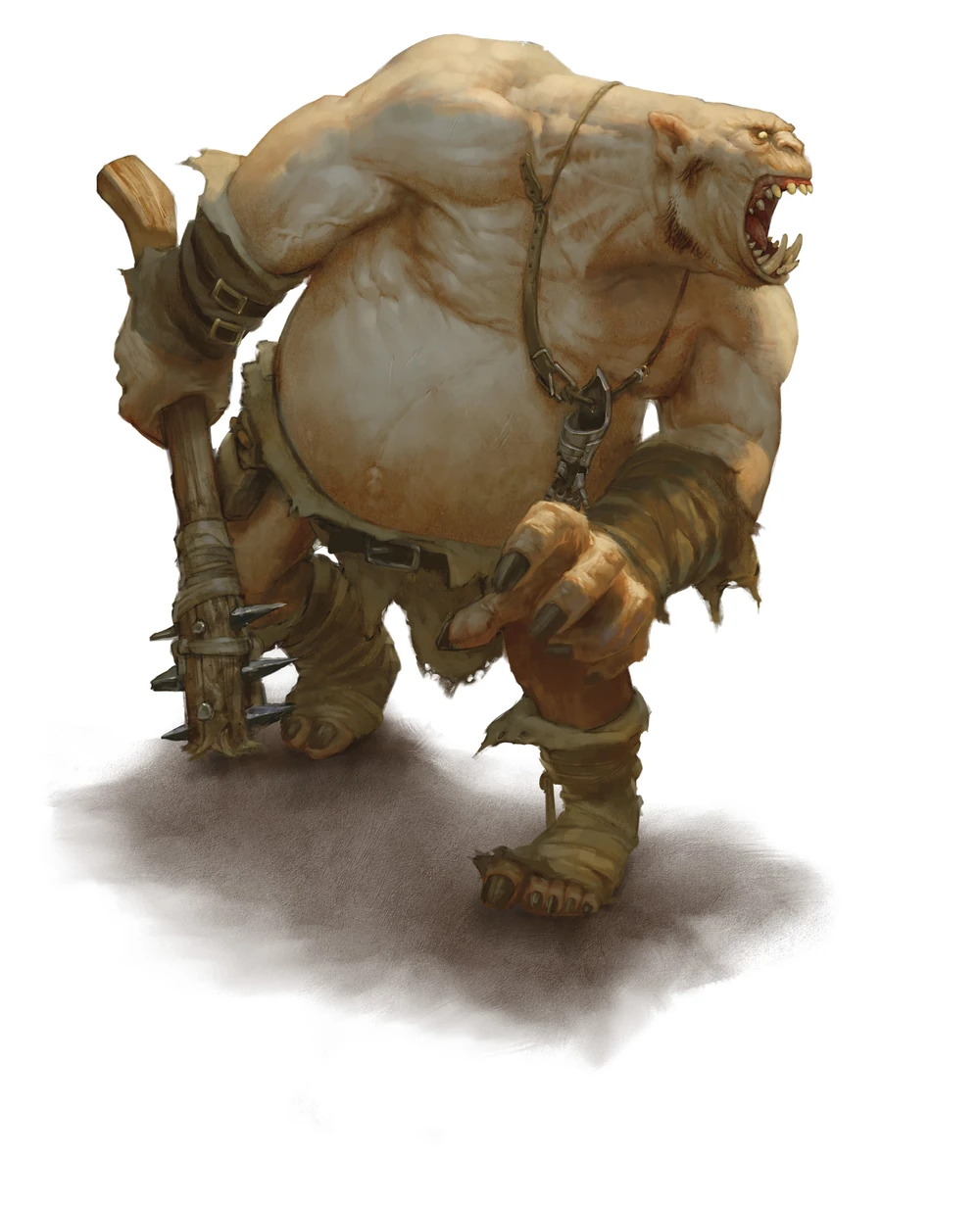
Ogre (from the 5e Monster Manual)
So when the Rogue did poorly with the axe trap, the sound it made attracted guards from further in.
I could have had the guards (who assumed the trap was tripped by the ogre contingent up in the NE corner of the map) go and check things out there (“What are you dolts doing? We’ve shown you how to turn off the trap when you go off-shift!”).
Except (a) the guards probably wouldn’t have wanted to rile up the ogres. And (b) I didn’t want to suddenly turn this into another messy melee, with the guards discovering the massacred ogres and to start running and screaming for help. I mean, it could have happened, but I chose not to.
Beating up the Players
It is always important to remember that the DM and the Players are not competitors. The DM should not get into beating up the Players, or try to kill them. We are all here to create an intriguing and involved fantasy tale that will be satisfying for all.
Of course, part of that fantasy tale should involve beating up the Players.
Last game, after Aldrik rejoined into the party, I went around to the various encounters in the Temple of Eternal Flame and bumped them up a bit. An extra Hobgoblin here, a Guardian not asleep there. That sort of thing. No checking on CRs — I’m a professional! — just a slight bump.
This was not done as wisely as I intended.
First, the Party was a level below the recommendations for this dungeon (they had not Long Rested and dinged up yet). I was so used to them being a leg up on things that I simply forgot to check.
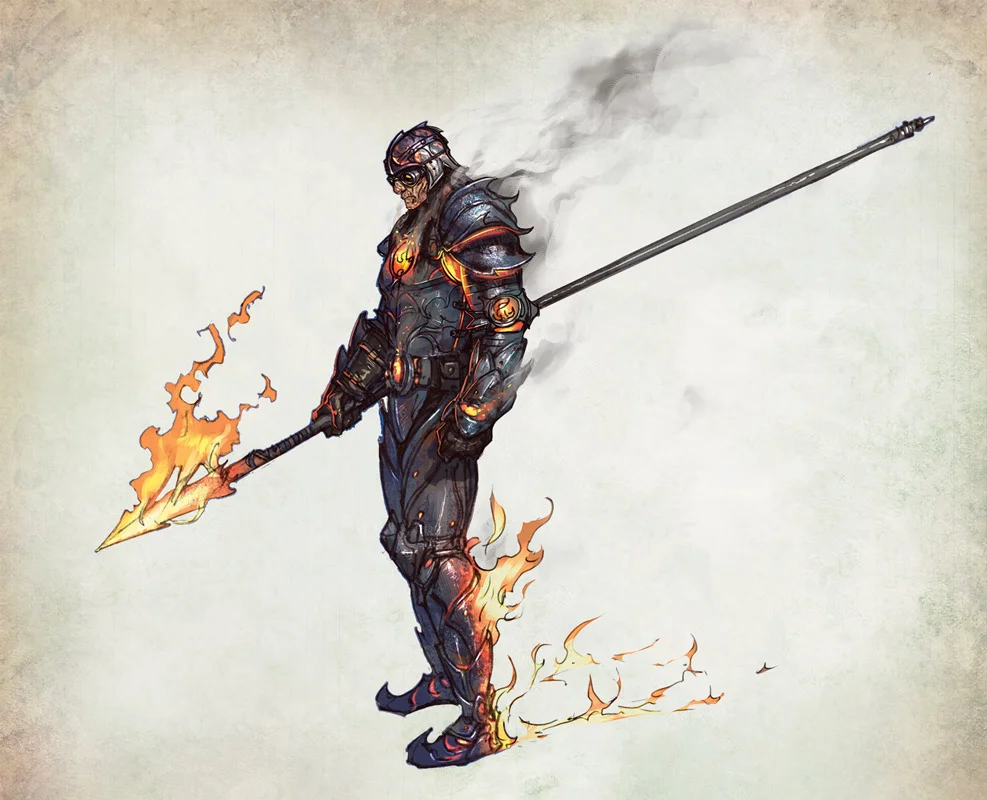
Second, the Razerblasts they were about to bump into are powerful foes, and adding an extra one didn’t help the Party’s calm. They lack effective ranged tactics (unless they want to throw away their weapons), but up close they combine high AC, very high (for this level) HP, and three attacks / turn. Plus I had them hold back a bit so that the party would come after them and they could trigger the heat trap. Once that was done and they closed to melee range, they were murder and, in fact, their saves and HP meant that the Party began to think the Razerblasts had resistance to Radiant as well as Fire damage.
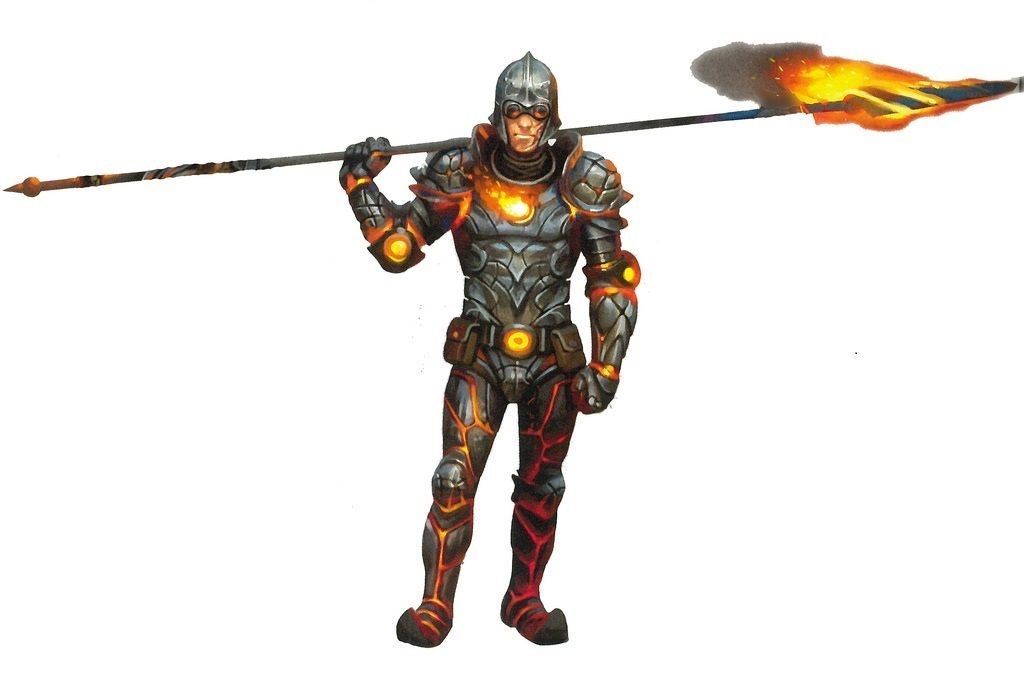
Razerblast – these guys are pretty cool … er, hot.
And then there was the way they exploded when they died, which became very problematic for our heroes. Both the Fighter who charged in and the Druid who was at the edge of the trap (and, when a Razerblast engaged, he scored a hit and two crits) nearly died, and others in the party were bloodied — except the Barbarian, who, damn, is a killing and damage resistance machine.
(Indeed, I concluded I needed to look at the balance between the Fighter and the Barbarian. The former was having problems keeping up, melee-wise.)
It was, even if an ultimate Party success, a pretty wild melee, lots of maneuvering (and hiding), but also a huge bloody nose and reminder that not every opponent could be walked over. Which was not my intent, but … y’know, that’s not necessarily a bad reminder now and again.
Level up!
Especially since the session then ended with the party taking their Long Rest (in the crypt), and getting their ding up to 9, to then sleep with dreams of vengeance.
And, well, other dreams I had in mind …
As well as restocking the two rooms they just cleared …
Amusing moment of the evening
Hey, look at that cool Razerblast spear! Wish I had one!
After the battle, the party spent a chunk of time trying to figure out how the heck to magically ignite the Razerblast spears for their own use, as the added damage was quite nice. Alas, as with the rods of Stonemelders, their extra elemental damage is just an intrinsic part of Razerblasts being highly ranked / initiated fighters in the Fire cult. And none of the players, when they finally reached that conclusion, were that interested in it.
What the party had found so far, and what was on their map.
There will be SPOILERS. If you are playing in a PotA game, please don’t read this. But if you are DMing a PotA game, or are a DM who wants to see what the ride was like … read on!
GM Recap
Session 53 (Day 41)
In … the Temple of the Black Earth (one more time!)
The Black Earth
Xharva Deem insisted she did not want a fight, nor Nala‘s soul, but just what Nala was carrying on her. Which turned out to be the Sands of Broken Bonds, a trinket Nala was carrying as a good luck charm. They negotiated an exchange, the can containing the Sands for Xharva reanimating the petrified form of Aldrik.
Aldrik didn’t speak much of his experience, except that he’d seen some sort of conflict between the Crushing Wave cult and the Black Earth cult, and had been petrified by the medusa, Marlos Urnrayle.
Nala recalled that she had been given a letter for Aldrik in Red Larch, but didn’t give it to him.
The Eternal Flame
After a short rest, and Aldrik nicking a crystal glaive from the dead Black Earth Priest in the room, the party headed for the Tyar-Besil – Manufactory Quarter, which they had every expectation would be the Temple of Eternal Flame. On their way, they had a sudden feeling like they were Being Observed from everywhere, the sensation passing after a few, brief moments.
The first room in the new zone they found a guard set against intruders from the Temple of Black Earth consisting of several half-ogres and ogres — who were little match for the party, bolstered by Aldrik.
Player Recap
We traded a can of sand for Aldrik
Xharva Dreem requests that Moony let her negotiate with Nala. Eventually, Nala decides to bargain. After much back and forth it turns out that Xharva wants Nala’s trinket, the can with what sounds like sands in it.
They go back to Marlos’ room where the Aldrik statue stands. Xharva encircles the stone with her sandy form. When she withdraws, an unhappy Aldrik is standing in his loincloth. His manacles are strange stony substance, maybe coral. Once freed the group decides to quickly move out of Marlos’ room.
While taking a short rest, they get a very brief story from the Aldrik. Mostly that the water and earth temples aren’t working together and that he needed more beer before getting anything else out of him. They find some clothes and a glaive from a earth priests.
When the group decides to head towards the northwest door leading to the fire temple. Moony explores ahead down the hall and hears a group speaking in low guttural voices. The group decides to charge in. After a few tense moment against the large opponents, the group of 2 ogres and 4 half-ogres fall.
Game Notes
A very fun pay-off session, with all sorts of things wrapping up neatly.
Unlike Anakin, Xharva loves sand
We finally got the Xharva Deem story resolved, with the mysterious Sands of Broken Bonds earning the party a Wish spell from the Dao to de-petrify Aldrik.
Yeah, with enough time I had neatly expanded the whole sands thing from a rando trinket (#47 “A metal can that has no opening but sounds as if it is filled with liquid, sand, spiders, or broken glass (your choice)”) to an artifact with its own journal write-up:
Sands of Broken Bonds
In the words of Xharva Deem:
The stuff that dreams are made of. In fleshling cultures, they speak of it as though alive, carrying them into the dream world, where all things are possible, all pleasures fulfilled. That is but a crude, meaty misinterpretation of the Dust, the Grit, the Sands of Broken Bonds, of which all creatures long for, even if they cannot use them, and even if their vision is blurred by the sands within their eyes.
As Xharva described it, any creature of the Plane of Elemental Earth would find the sands a combination of a mind-expanding hallucinogenic, an aphrodisiac, a reward pathway stimulant, a Nepenthe of forgetting sorrows, and a rich, powerful, mind-blowing experience. She did not mention any limitations of time or dosage, or any down side or harmful effects of using the substance.
It turned out that one of the party’s Trinkets, a can apparently filled with sand that Nala‘s old guard captain, Brex Gelvain had given her as a good luck charm, actually contained some of these Sands. Xharva, detecting that, sought to buy them from Nala when they met in the Temple of Black Earth, and could not believe that the Dragonborn warrior didn’t realize what she had, leading to multiple antagonistic encounters.
Xharva considered the sands beyond price, however, and, in a final, peaceful engagement, even deigned to cast a Wish spell to reanimate the petrified Aldrik in exchange for the can.
Happy Xharva!
Xharva, at least, had a “happy Gollum clutching the Ring as he falls into lava” look as she vanished from the campaign indefinitely. Normally Dao will only grant Wishes in exchange for personal service (slavery) of some value; in this case, a brief case full of uncut heroin did the trick.
Will she use the Sands herself? Or sell them to someone else for even more treasure? Let’s leave that as a mystery for another day, perhaps another campaign.
Freeing Aldrik
Besides the Dao Wish, I had figured three other ways to free Aldrik by the time the episode came around —
Wait for Faith to level and get Greater Restoration (imminent), or
Play around with the Basilisk Fountain I’d introduced, or
Everything’s better when Windvane is involved!
(A new one) have Windvane pitch a fit about them abandoning a comrade in the Earth Temple (she has abandonment issues, not surprisingly, and is, from the Air perspective, utterly opposed to Earth) and wielding some sort of Wish-like magic from inside the Bag of Holding, which would burn her out for several episodes (and make her all the more fun when she came back).
Aldrik
But my wife figured out the “Oh, she offers to buy the can at any price? Can she do something for Aldrik?” move, as I was hoping, and some nifty negotiating later, everyone walked away from the deal happy.
Except Aldrik, who was near-naked (again) and unarmed (again) and without any ale.
Fortunately as a barbarian, Aldrik didn’t need armor (there was some Duergar scale mail elsewhere in the area, but the only thing worse than Duergar to the Dwarves are Duergar who have been a few days dead.
Crystal glaive
Instead, he armed himself with one of the crystal glaives of the Black Earth Priest in the barracks room where they Short Rested. It’s a fun-looking weapon, it will provoke reactions from anyone in the cults they meet, it counts as a magic weapon for attack purposes (even though it has no particular bonus), and it gave me a chance to learn more about how Reach Weapons work in 5e.
So what was going on with Aldrik?
Aldrik, before he got snatched.
I had already decided that the dwarf was somehow linked by blood and spirit with the old king of Tyar-Besil, such that he had some control over aspects of the city (or could be used for such control). This tied in some strange way to his first appearance as an apparent escapee from the Stone Circle Monastery.
Aerisi had detected it back at Feathergale Spire, and kidnapped him via Air Elemental to serve her (and, when he refused, stuck him into amnesiac slavery).
And then Gar Shatterkeel got wind of it and used a Water Elemental to nab him — and take him with him when he went to the ziggurat Temple of Elemental Evil in the Fane … convinced to either get him cooperating over control of the city, or using him as a sacrifice to the Elder Eye.
Marlos, also getting info about this, led his forces into the Fane, and managed to capture Aldrik for himself, then put him on ice (er, rock) while he figured out his next move.
Gar Shatterkeel and the Ziggurat
It’s 2-3 that Aldrik remembers, with a fair amount of trauma (threats from Gar being less awful than witnessing the horrors of the rituals seen, not to mention being literally petrified). Or so I guess: Aldrik’s player had been very intentional to be gruff and laconic, so a lot of the background I wrote up (or that he wrote up, for that matter) never got brought out at the table.
Which is fine.
None of this is in the campaign, of course. But working character stories into campaign is one of a DM’s main jobs. Plus, as structured, it helped him disappear as a player at various times (as Real Life interfered), which was also helpful.
The Purloined Letter
Bruldenthar letter to Aldrik
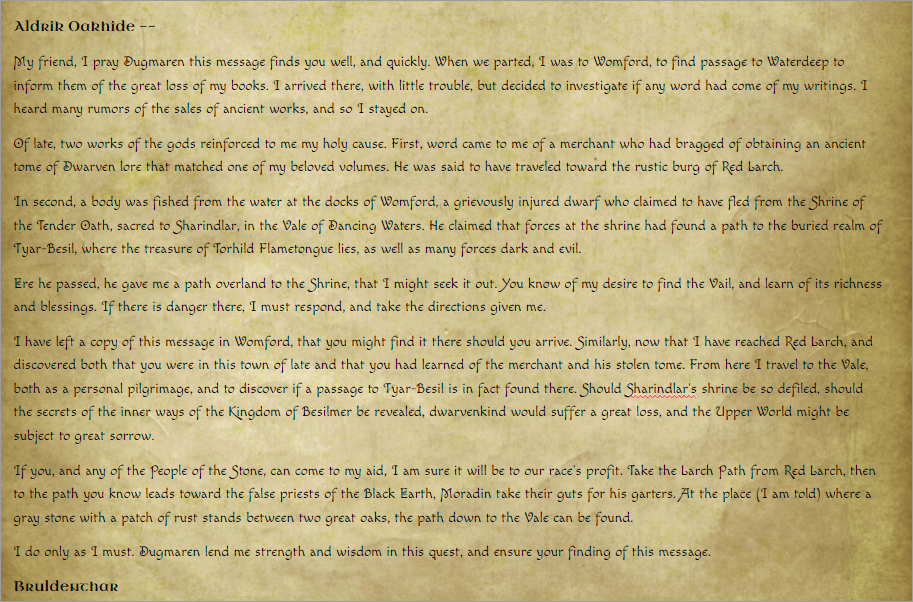
Way back on the last visit to Red Larch, I think it was, they were given a letter that Bruldenthar, the dwarvish librarian from Mirabar, had left for Aldrik. Nala had been holding onto it, but for whatever reason, didn’t see fit to share it with him (yet).
Which is … maybe okay (though intriguing), as it was a letter intended to drag him/them over to the Vale of Dancing Waters sidequest, which I think they had outleveled by this point, and didn’t actually need to do.
Now Leaving the Temple of the Black Earth
And praise Ogremoch for that!
Speaking of Whom, I finally gave the party that “Oh, Ogremoch is paying a fraction of their attention to me and what I’ve done and bring me my brown pants!” feeling of wiggins — late, but the party didn’t necessarily know that.
Ogre (from the 5e Monster Manua)l
The rest of the evening was taken up heading into the Fire Temple (the Manufactory Quarter, better known as the Forge) and fighting several ogres/half-ogres. The bad guys never really had a chance, but, then, the guard posts aren’t supposed to be impenetrable, just wearing down and interesting. And if they back out of the Fire Temple, there are rules for how the room gets re-populated shortly.
And back out they might, because that’s the third Temple down, and the Cult Retaliation rules say they will get “Race to Destruction,” a warning that the someone (Fire Temple, most likely) is going to send more mad bombers against … their dear friends in Red Larch. (They will find out they already missed out on the devastation of Westbridge, a town they’ve never been in.)
Presumably this will get them out of the dungeons for a bit. And, sometime shortly, they’ll Long Rest and ding up to Level 9 …
There will be SPOILERS. If you are playing in a PotA game, please don’t read this. But if you are DMing a PotA game, or are a DM who wants to see what the ride was like … read on!
GM Recap
Session 52 (Day 41)
In … the Temple of the Black Earth
Black Earth
The party continued their exploration of the Temple of Black Earth. The crevice led to a hidden trail midwall in a great cavern, ending up at an arrow slit in the rocky wall. Moony‘s use of the Claws of the Umber Hulk let the pass from there into Marlos Urnrayle‘s chambers. There they found luxurious treasure and two very realistic statues — one of whom they concluded was the petrified form of their old friend, Aldrik. Which was odd, because Aldrik had been taken at the Air Temple by a Water Elemental ….
Carefully searching the chamber beyond as a giant crab (as they had decided there was a petrifying creature nearby, and giant crabs can use Blindsight), William was attacked by a shadow demon, who viciously struck at him, only to discover that a restored William, with lighting, and a Moonbeam, could do a hella radiant damage.
Spells up and clock ticking, the party left Aldrik behind and rushed down the hall to the shrine that Moony had previously scouted out. Kicking in the door, they interrupted the Black Earth Priestess Erione doing something creepy and mystic that seemed to involve a lot of very fragile cultists and sacrificing a deep gnome named Rukh to a black pudding. A shortlived melee ensued, though Nala‘s armor was damaged by the black pudding’s acid.
Rukh gave Nala some information about he’d come there and what lay below, including about the Fane of the Eye.
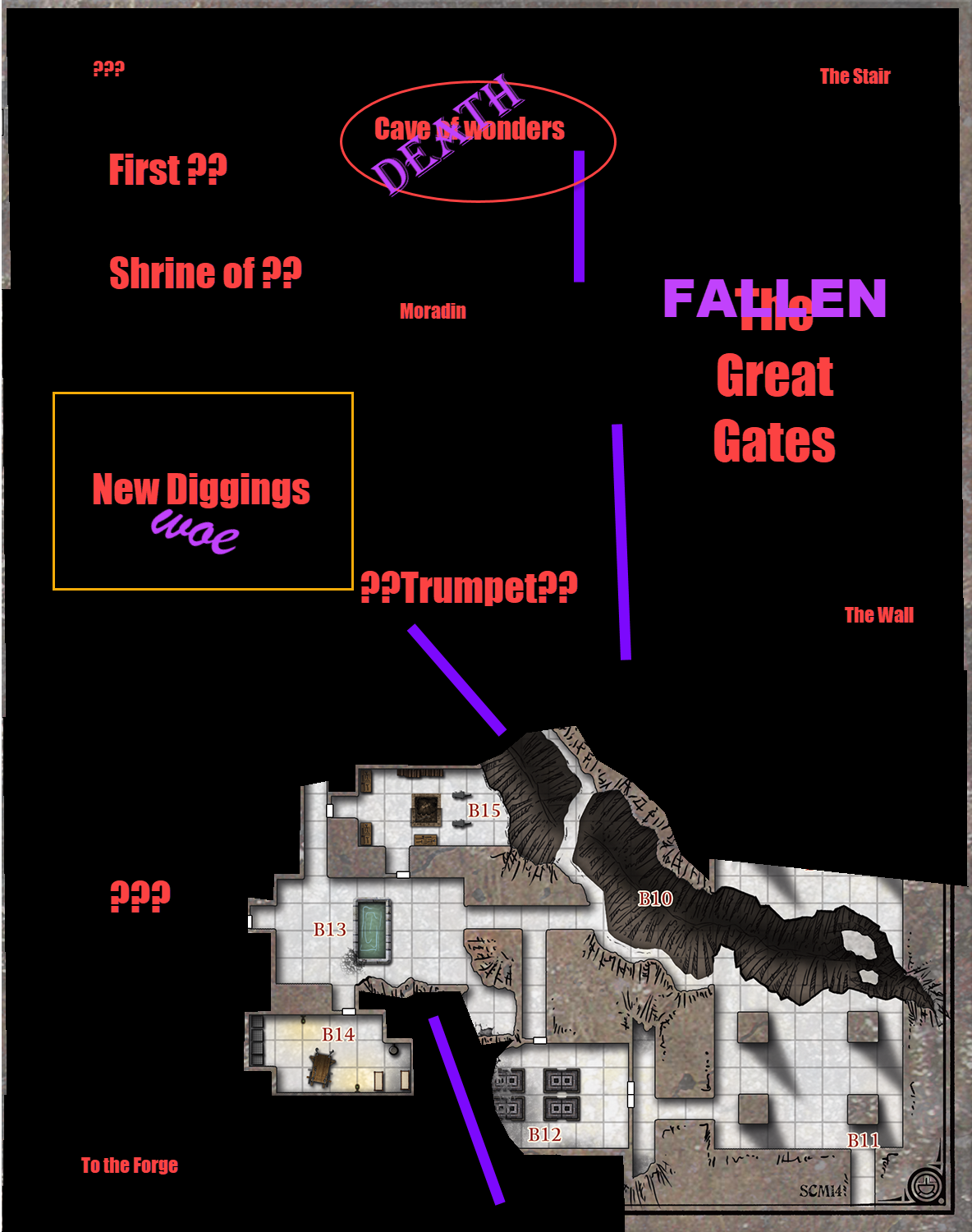
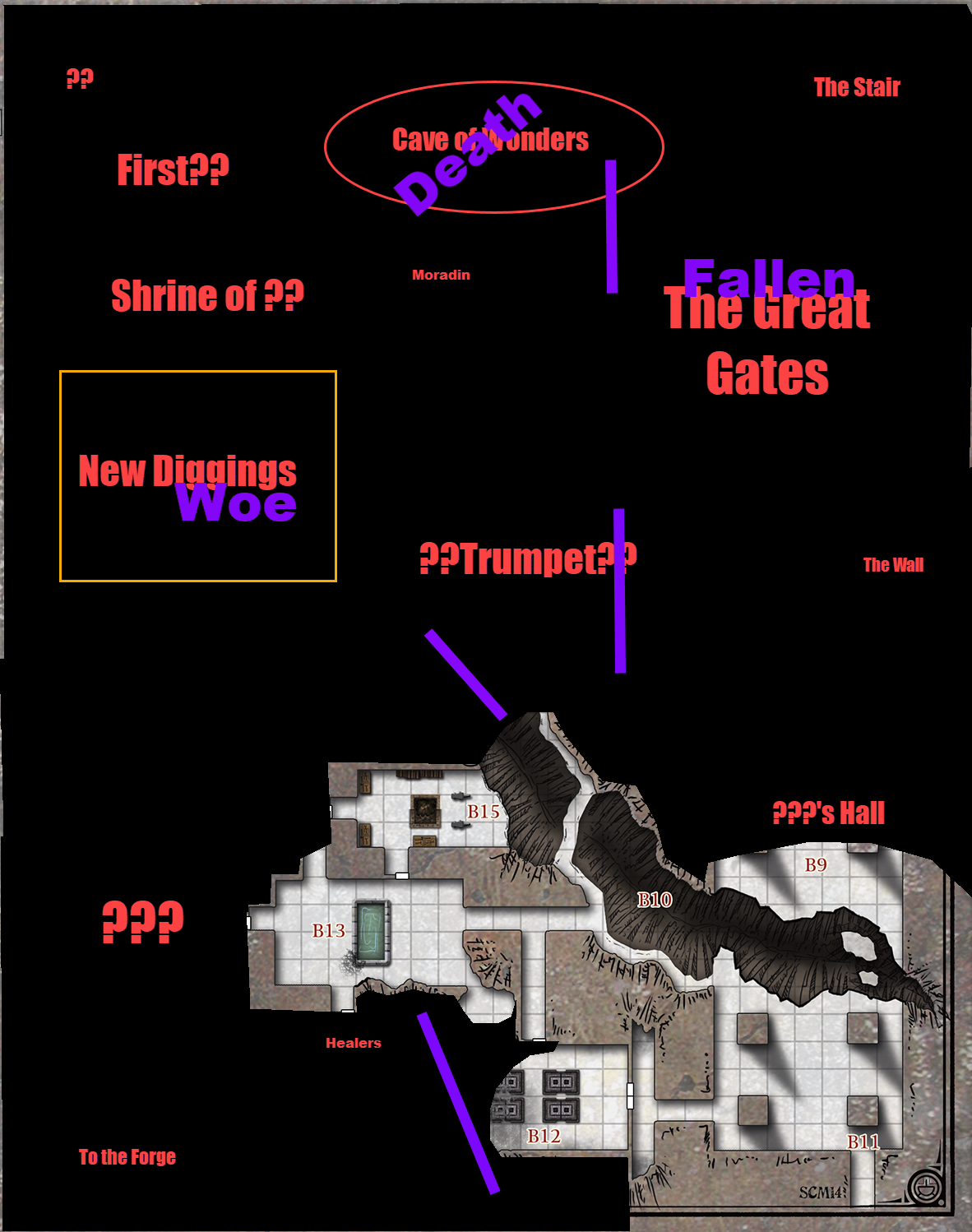
The party ran to the “First ???” location on the map, a chamber of great square pillars. Another of the great stone warriors was there, watching to the northwest, but they attacked and quickly dispatched it.
It was time for a short rest, so they decided to take a quick peek at the area that might be the staircase that Rukh had spoken of leading to the Fane of the Eye. Moony found it a great cavern with a pillar and spiralling staircase leading downwards into the dark. Which is the point when Xharva Deem came up around the final turn of the stairs. “YOU!”
Player Recap
Where we once again find Aldrik in a loin cloth!
They leave the room and travel down the rough hall to the North. It ends in a blank wall that with some chicken bones and other human trash. Moony locates a hidden door and concealed latch. Looks like it hasn’t been used frequently. Traversing along a path around a large crevasse leads Moony to an arrow slot. When the group joins him […]
A beautiful appointed room. Lushes tapestry … There is a status of a dismayed elf (holding a cloak) and an angry dwarf in a loin cloth. It’s Aldrick. Don’t […]
William turns into a giant crab and scuttles into the room to the south of the bedroom. In the dark he can sense large immovable object and then senses a presence coming from above. William tries to find. The creature says in Williams head “You don’t belong here” and slashes him. William quickly changes to human form and drops a moonbeam on to the creature. It screams loudly and flees East as the others enter the room.
Pressing on rapidly while Faith’s fairies are active. The cavern was once beautiful, but the natural stalactite’s, stalagmites, and flows have been destroyed. There is a small cleared path through the cave. Around the room are more petrified statues
Trying to maximize the fairy time, the group quickly goes to the door to the South. Next is a large room with a tall domed ceiling. The tiles have been pulled up in the center of the room and a pit is being dug. There is a large dark obelisk in the pit with bones littered around it. There are several earth cultists, Erione – female earth priestess in stone armor and Rukh – Gnome shackled to a smaller stone obelisk. The cultists and Erione go down quickly, but not before Erione hits Faith and Moony with a shatter spell. Nala approaches Rukh asking him in Gnomish, “Friend or Foe?” Rukh is too terrified of black ooze coming up around large obelisk. Nala swings at the chains with her sword and shatters them. She then tries to shove him out of the way of the black pudding. The Black Pudding gets an attack on Nala just before she takes it out.
The Gnome tells us that he was captured below. His people use to have a colony there and he was an explorer looking for them when he got caught and brought up to serve as bait for the black pudding. He lets Nala know that Marlos is a Gorgon.
Continue North and enter room devoid of carvings with a large stone statue in the middle. It is another of the Giant Dwarf animated statues. Faith’s fairies damage and slow the status. Other move into attack range.
Party decides to check out one other hallway before taking a short rest. The corridor leads to a large cavern area with a grand staircase down. A voice in Moony’s head says “YOU” A figure that looks amazingly like Xharva Deem comes charging up the stairs.
Game Notes
Sneak, sneak, sneak
The big crevasse around the northeast of this map means there are a lot of ways to get into Marlos’ hide-out other than the main doors. Given the map marking of “Death,” it made sense to figure those ways out.
The party’s use of the hidden path was great out-of-the-box thinking, especially as they sussed out what its use was (a back door for a guy who can walk through walls).
It also gave me a great opportunity to use Roll20’s new one-way vision dynamic lighting barriers, perfect for multiple layers of “this is above and you can’t see it, but it can see you.” I retrofitted that tech onto the map, rather than have a lot of removable light barriers.
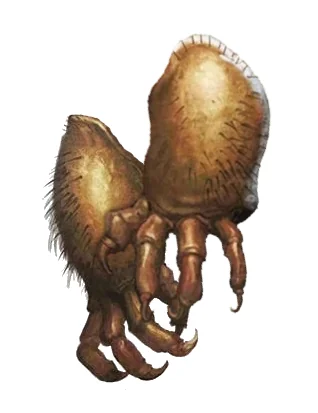
Claws of the Umber Hulk (though I pictured them more metallic and forged)
It was also a completely unanticipated use of the Claws of the Umber Hulk. I wish Moony hadn’t already had Inspiration, because I would have given him one for it.
That said, little did I know how tired I would get of that particular magic item.
Marlos’ hang-out
Marlos has a sumptuous private chamber, which bolstered their treasure supply. It also had (I decided) two statues — one the petrified Aldrik (see below), the other a petrified elvish warrior. On the assumption that he wouldn’t end up revivified, I didn’t bother to work up a backstory on him — at a guess, an adventurer whose near success led Marlos to giving him a place of honor (or to contemptuously use him as a coat rack).
Some (poor) AI renditions of terrified statues
The main chamber outside of it was a bit different. There are a dozen statues placed around the map — very cool, but not a word of description about them, other than that they all look terrified (having been petrified by Marlos). I numbered them all and crafted up some brief descriptions across races, genders, and classes (e.g., “Male human, a bit fat, holding a hammer, squinting as if to see something”) — it’s the sort of thing a DM should be able to improv, but why improv it when you have prep time for it?
Also, the way the place is described, the floor is covered with rock, stalagmites, flowstone, etc. So … there should be paths to allow the statues to be enjoyed (or just to get between the doors). I had to add those on the map.
The main doors into the this area from the south I covered with stone masks — actually, stone faces of still more of his victims. I thought it was a nicely gruesome touch.
Aldrik!
Aldrik
They found Aldrik! Huzzah! And he’s back to being in a loin cloth. And, of course, made of stone.
Now they need to figure out what to do with him. For the record, there are now three relatively clear options (since I put a kibosh on their putting a 1400-pound Aldrik statue into the Bag of Holding):
Cut a deal with Xharva Deem, who has also shown up. She can do a Wish, if persuaded (and bribed with the Can of Sand, which I have finally given a name).
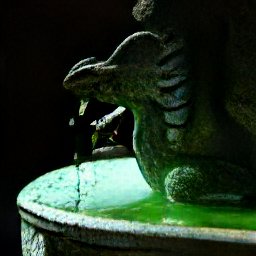
Oh, I made an AI image of the basilisk fountain I made up.
Purify (with the Ewer they picked up earlier) the water of the Basilisk Fountain I had placed at the Duergars’ hidey-hole. Ironically, the party thought that the Basilisk Fountain is evil, and the Gargoyle Fountain might be able to do the job.
Wait until next level-up for Faith to get Greater Restoration, and use that.
My son, who runs Aldrik, sat silently through the game that night, since that aspect didn’t get resolved. Which I felt kind of bad about, but I still thought it was a great re-entrance.
Speaking of which, I (minorly) blew it. I’ve been establishing that each time they fulfill the level-up requirements for the zone they are in, they get a brief sense of Being Observed (as they attract the momentary attention of the Prince/Godling involved). That should have happened when they took down Erione and the Black Pudding, but I completely spaced on it (not helped by the party wanting to rush off to the next encounter) …
What’s the rush?
Rush, rush, rush …
Yes, my current pet peeve is that Faith’s Spirit Guardians (which Moony noticed look a lot more like Aerisi than they used to) lasts for 10 minutes (with Concentration), which has suddenly created a huge motivation for the whole party to run from one encounter to the next to get maximum utility out of them. Which, as in this case, kind of ruins the moment. Rukh had a lot of info to dump (and was an interesting character in and of himself), and I ended up skipping some and rushing through other bits, just because Faith was dragging everyone onward to the next battle.
I decided I was going to have to something about that. I understood the incentive, but it felt artificial and encouraged bad metagaming behavior (i.e., game mechanics were driving behavior that was not good for the game). Maybe being under that kind of pressure should have an impact on the rogue’s scouting — disadvantage on Perception, trap clearing, disadvantage on the party’s Stealth, etc. …
Xharva Deem
Xharva Deem
Anyway, Xharva Deem is back! One of the players said it was the surprise of the evening, which I felt somewhat gratified about.
Running into her again was, by DM fiat, inevitable — they would have encountered her trudging her way back to them whatever exit they went to first. It’s hard to permanently Banish someone who can Planar Travel, even if it’s not that accurate (“Take me back to my Forge” ended up with her being somewhere in the Black Geode and having to make her way through the Fane back to here).
An AI-generated Stone Warrior. I eventually decided I liked the one I had come up with last episode.
Let’s see if she can convince the party to not immediately attack her. At least I was able to reasonably suggest that the party’s internal debate after killing the Stone Warrior (which, honestly, wouldn’t have attacked them if they hadn’t attacked it first) about where to Short Rest was long enough for the Spirit Guardians to have faded.
Hmm. For some reason, I didn’t do (or save) an exploration map for this session. Ah, well.
There will be SPOILERS. If you are playing in a PotA game, please don’t read this. But if you are DMing a PotA game, or are a DM who wants to see what the ride was like … read on!
GM Recap
Session 51 (Day 41)
In … the Temple of the Black Earth
Dreams and Visitations occurred for all the characters. Upon waking there was much discussion about how real dreams were, or, in Nala‘s case, could they be an actual communication? The final answer was indeterminate.
Black Earth
The party went south to the laboratory of Miraj Vizann, which was filled with giant stone statues of dwarvish warriors and lab workbenches. Moony pretended to be delivering a message via Yarsha for Marlos Urnrayle, but Miraj was taken in only briefly. After some inconclusive dialog, the party eventually attacked Miraj, who activated one of the Stone Warrior statues to “protect.” It actually didn’t last long under the onslaught of the party’s spells and weapons, but Miraj, escaping, swore vengeance for the destruction of her plans and lab.
The party explored to the north, finding a dining hall full of Black Earth guards, who were quickly dispatched. In exploring further, the party found another partially-collapsed barracks — and the dead body of Yarsha, apparently killed by one of her Black Earth Guards. They took a Short Rest there, with an apparent inclination to follow a crevasse to the north.
Player Recap
Why we don’t like sleeping!
Dreams Dreams Dreams
William
Deeper, darker, every step more terrible.
Once there was sunlight, bright, cleansing. But now, for far too long, it’s been gone, leaving just the chill and shadow.
Once there was air, fresh, brisk, invigorating. But all the wind and breezes have been stilled, the air sterile in your nose..
Once the air carried a dampness, allowed for growth, the sound of creeks tinkling in the air, the drip of moisture sustaining the green around you. But that, too has been cut off …
Now there is only stone, still and dry, sand and earth and the cool of the tomb …
… except ahead is heat, heat to melt stone, heat to dry any moisture, heat to whip up winds.
And after that? Only darkness …
Faith
You are in a great stone palace, the place where you dwell. It’s a grand palace … no, not a palace, the Great Cathedral in Waterdeep, the high church of all gods, the temple complex of all the traditional gods of the great city, a pile of cold stone, distant, hostile to mortals save the wealthiest … the finest … powerful bishops and bombastic prophets and bejeweled hierophants, who sit at long tables, laden with food, gorging themselves, arguing amongst each other as to who is of the highest rank, who is of the greatest power, then purging themselves in gemmed buckets to start the cycle over. Gold and diamonds vie with filth and corruption for what catches most your eye, what turns most your stomach.
You realize you are merely a servant, a drab, bedraggled girl, mopping and sanding the floors, keeping the candles lit, and, most importantly, airing the room out by opening the great windows to let something fresh inside, even as the men and women at the table shout and yell against it, preferring their own reek to an invigorating breeze.
The servant girl next to you, her gray-blue hair barely tucked into the scarf across her hair. “Wouldn’t it be funny if we left all the windows open and wind just swept them out of the room?”
She pulls out an ornate spear from behind her back. “Wouldn’t it be funny if we just killed all of them?”
And … it would be kind of funny.
Moony
The ancient Tabaxi elder with the odd, triangular pupils puffs on his pipe.
“Dimensions. Dimensions and angles and the ways one leaps from branch to branch, or ground, or into the air. The Tabaxi understand dimensions, do we not?”
“Consider one dimension. The layers of an onion, growing in strength, growing in pungency, growing in sweetness as one bites inward.” [illustrated]
Or … The shell of a shellfish — the rough surface, ground down, to a pearlescent layer, and delve further to find the sweet and salty meat [taste!], and, in some cases, a pearl, itself a world of many layers.
“To find what is valuable, drill down, seek what lies within. Beware the sharpness of flavor, the hardness of the hidden gem, but know that what is of value, what must be found, lies deep inside.”
“Those of the Tabaxi know to clean their food well. Wash well. Be thorough. But … as all is cleaned, bite deeply.”
Nala
You are in the Port Market of Waterdeep, a place you patrolled regularly against petty thieves, pickpockets, drunks, disturbances of the peace …
But today it’s nothing but peace. Utterly deserted. Every shop, every wagon, every booth … everything is stocked — fruits, vegetables, fish, meat, spices, and other things — ironmongery, scrolls, toys, anything anyone would want to buy …
… but nobody is there to buy.
And nobody is there to sell.
You hear a small bell, ringing, in the distance.
The breeze blows a hundred scents to your nose, whistles in the buildings about you. But, aside from the bell, you hear nothing. You make your way down Fishmonger Way, into another courtyard. Vegetables mostly here, as you recall, and as you see now.
In a small, not terribly clean booth in the back of the courtyard, its display tabletop covered in crates of multi-colored carrots, you can see, on the table at the back, a small brass bell, sitting atop a folded piece of cloth.
A throat clears behind you after you’ve gone around the table.
Xharva Deem is there on the other side of the table. The customer side.
“Now. I will buy. You will sell. I have traveled many, many leagues to be here. And now, what you have, I will buy... YOUR SOUL.”
Theren
The walls press around you. Stone, some dressed, some rough and jagged, forces you to crouch down, scrape against the walls, scramble down and up and down the floor, as the air gets more and more warm, more stuffy, sweat across your body, salt in your eyes, taste of salt on your lips …
And ahead of you, a crackling sound, a roar of something consumed in flame, generating a hot wind.
“Theren …” you hear within that crackling, that roaring. “You have called to me. Now I call to you ….” as the air blasts into your face, hotter than a furnace, singing to the flames within your mind, the wild magic that burns so brightly, without control, unstoppable, and …
Back in the real world
Nala shares her dream and asks the magic users if Xharva could actually be in her dream. Faith, Theren and William offer suggestions for how it might be done. After the long rest the group heads back to the large hall and explore South towards the assumed location of the mud sorcerer. Half way down the hall their is a T intersection. About 20 feet down the West hall the walls and ceiling have collapsed and block the passage. To the East is a door with a scowling dwarf with maces for hands.
Moony cracks open the door and sees a humanoid, her skin and hair seemingly earthen, though in places slick with moisture, dressed in earth-brown robes. There are statues around the walls all of dwarves’ with maces or clubs for hands. Some have been deformed.
Miraj Vizann token
“Yes, what do you want?” “Yarsha sent me to tell you Marlo wants you right now.” She sighs and then looks more closely at Moony. “Marlos has other means of contacting me. What does Yarsha really want?” “She is not happy with your lack of progress on furthering Marlos’s vision” “I am not surprised, she wants to replace me. But you interest me, your accent is interesting, it might be something with your throat, step closer.” The conversation continues. Eventually, she invites Moony and the party to discourse. Moony asks what she will offer us to switch to her side. She only offers not to kill the group.
Stone Warrior token
About then, Faith gets bored and starts preparing a spell. Moony take a sneak attack against Miraj, who doubles over and calls to the statues to protect her. William casts Spike Growth inside the room and steps back around the corner. Faith casts Bless on the group. One Stone Warrior moves into action. Nala shoots magic missiles at it and Theren tosses off a fireball into the room. The warrior is quickly taking damage. Miraj gets off a shatter spell and then flees into the back wall.
In exploring the room, they find golds, gems and a potion of water breathing. There is also the dwarvish runes for protect carved into the the tables. They appear in various location around the room. William uses his wood working tools to remove the runes while they take a short rest.
After the rest they head back North towards Marlos. At the T intersection North of the Ogremoch statue they turn East. Four Black Earth Guards go down quickly. A cultist comes out from the back room to join the fray. When the room is clear and move on to the room beyond. The body of Yarsha is in the middle of the room. A guard who fled first room tries to ambush Moony and while he scores a hit, it’s not enough to take Moony out. The guard is severally out-classed. It looks like the guard killed Yarsha when she came back to the barracks to get her stuff. Maybe he overheard her selling them out. Either way, one less stone witch to worry about. A Short Rest and the party will be back on the hunt.
Game Notes
More churn and grind, to a certain degree.
Dreams
Since there was a long rest, I did another set of dreams for everyone (recorded by my wife in the player log above). William had basic druidic depression about being underground so long. Moony was told by his Tabaxan god that he should head downwards (while still cleaning the areas above). Theren was given a hint that his invoking the name of Imix (the Fire Elemental Prince) in vain was maybe not a good idea. [I don’t recall when he did it, but it had been recently.]
Nala, the fighter holding the thing that Xharva Deen wanted, was visited by her in a dream and, after appropriate prompting, when she asked what Xharva wanted, was responded with, Your soul!
This led to much discussion over breakfast as to the reliability of dreams — or, rather, the question of how much messages could be sent from another plane via dreams. The idea that this was a combination of maybe a bit of message and a bit of unreliable internal fear never occurred (which is fine). It shook folk up, and it laid the groundwork for some interesting discussion when Xharva reappears, so it’s all good.
Faith, meanwhile, had a dream that meant to suggest that all worship of the mainstream gods was futile and corrupt, and only a brisk wind (and maybe some stabbing with a spear) would clear things up. She was not happy about this.
The Mud Sorcerer
I’d added some lab tables to the map of Miraj Vizann because the color text mentions all the tables and the map itself had zilch. I mean, they had the statues set up in the room, but no tables. I had some Roll20 materials for tables and lab gear and tomes, so that made for a nice, complex room.
Miraj Vizann lab … with furniture!Miraj Vizann
Miraj Vizann herself was an interesting bird. A magical researcher whose allegiance was to the Black Earth (kinda-mostly), but didn’t feel like she needed to restrict herself to just those magics. Call her Crushing Wave-Curious. Thus her disdainful moniker as the “Mud Sorcerer.”
(Yes, “her.” The character struck me that way, and I had this very nice image I found of a stone genasi that looked to be a great fit.)
Marlos still relied on her for her knowledge and power and, being Marlos, her lack of ambition. This didn’t sit well with the other important folk in the temple, thus Yarsha’s betrayal.
I saw her as smart, somewhat distracted into her research on the old magicks of Tyar-Besil (its stone warrior defenders, as an example), and happy to give orders efficiently so as to keep people out of her damp.
Stone Warrior
She was smart enough, I thought, to figure out the party’s bullshitting her, even if distracted, so I thought it would be an engaging, dialog-heavy encounter, at least to start. But the encounter and discussion I anticipated never happened. Moony said many taunting things from the door, Miraj tried to engage in discussion (but not until everyone was willing to come into the room), the Stone Warrior was unleashed, the party quickly whittled it to size (action economy!), and Miraj swore vengeance for the disruption of her experiments before blending into the wall (something she had the spells to do, and which tied into her showing up later in the Black Geode — kinda-sorta).
I always like it when old threats get teed up as future threats. It feels … efficient, and narrative. Miraj Vizann has a lot going for her as an intelligent foe.
Windvane
Some good experience, then, all-around, but the most notable event was Windvane trying to influence Faith to attack with her, and Faith easily resisting, and then shoving the spear into the party’s Bag of Holding.
So, Inspiration for Faith, certainly. But that’s really not fun for me, so Windvane will still talk with her from behind the Bag (because it’s already in her head. And I need to come up with a situation where Windvane will be essential (or maybe have it be repentant and thus turn into a useful tool again).
(We are at session 51. I’ve been treating Windvane resistance as a Wisdom Save of 10+(episode-50), so it should be getting a bit rougher as we continue.)
Further clean-up
Yarsha, Yarsha, Yarsha
Cleaning out the refectory took a short bit of time (I handwaved the cooks down in the kitchen). The party was … surprised to find Yarsha dead in the back room.
Yarsha certainly had the possibility of causing trouble. But her forces were limited (if I wanted to make the level what it was), and I need to get moving onward.
So the idea is that Yarsha, taking advantage of the ridiculously loose oath she was sworn to (that Faith would not see her for the next week) snuck back into the temple while the party was taking a Long Rest, and went for the barracks where her goods were. Maybe she was going to rally the troops, or maybe she was going to bug out with her treasure.
But the crossbow mook who was left in that room was able to hear through the arrow slit the things she said when she was surrendering to the party last session. So at some point in time, while gathering her goods, he whopped her in the back of the head with his morningstar, game over.
(All her treasure was found on a mook that had been sitting in the refectory alone, saw the party, and ran off to the back room, only to be quickly taken down by the party. Fun.)
Not a lot of map left … but a lot of stuff in those unexplored areas.
Temple of the Black Earth (as the party had explored it by this point)
There will be SPOILERS. If you are playing in a PotA game, please don’t read this. But if you are DMing a PotA game, or are a DM who wants to see what the ride was like … read on!
GM Recap
Session 50 (Day 40)
In … the Temple of the Black Earth!
Black Earth
The party charged into the hall of the Great Gates to Tyar-Besil, dealing with a small guard party led by Yarsha, a Stonemender lieutenant. Yarsha surrendered, providing the party information on Miraj Vizann, the Mud Sorcerer, and the real leader of the Black Earth cult, as their next target. Faith made Yarsha swear that she wouldn’t catch sight of her again for a week and she agreed, heading out of the Temple of Black Earth.
After a Short Rest, the party went to check out the passages to the north, only to have Ko ambushed by archers. The party attacked the chamber to the east–stuffy, hot, filled with Duergar. After shifting the bodies aside, peering through arrow slits, and playing with a brackish basilisk fountain, they dossed down for the night.
Player Recap
Why we don’t like hostages!
This was once an impressive hall. Now the ceiling and walls are cracked and patched. There are exits north, south, east and west. The group attacks and defeats all of the minions. Yarsha calls a truce and wants to destroy the mud sorcerer. She is a bit snarky but gives significant information. She is willing to leave the temple of Earth and leave the party alone to deal with Miraj Vizann, the mud sorcerer. After additional negotiation she agrees to to leave and stay way for one week.
The group takes a short rest back in the room where they fought the Bulette rider. They explore the rooms and look at the weapons and trophies on the walls. After the rest they return to the great hall. Ko explores to the antechamber to the north. The room is heavily carved with scenes of dwarven battle. No matter where you are you have a sense of menace. Ko gets shot at from the arrow slits on either side of the room. They quickly return to the group and describe the attack.
William recommend that they go through the door in the East wall of the hall. Unfortunately, there are several Duergar hiding in the room. The party is bottlenecked in the entrance and the guards unleash their javelins at Moony. After the initial constraint, the party moves into the room. Even after the Duergar magically enlarge, the party quickly defeats all nine guards. The room is crumbling with age. To the North is a hall to the arrow slit and to the South is a rubble strewn alcove with a chamber pot and a fountain with a basilisk carving and stagnant water pooling in a cracked basin. William takes some water from the fountain and drips it over one of the dead Duergar. It doesn’t appear to have an impact.
The party moves the bodies to one end and begins a Long Rest.
Game Notes
More grinding. The party in the Great Gates hall was easier than in the book, largely because that’s where the ambush down at the bulette chamber was staffed from. Which is fine — I kinda want to get the players moving forward, as we headed into our 6th session in this zone.
Yarsha, Yarsha, Yarsha
Yarsha token, via Hero Forge
Had fun playing Yarsha, being mean and sarcastic. She didn’t get a chance to gack one of her own guys (they all went down too quickly), but she did successfully surrender, aim the party at Miraj Vizann next time, and get out of Dodge. Faith extract an oath on Ogremoch’s name that I listened to very carefully:
I never want to see you here.
Yarsha anticipates won’t be a problem because Faith will never see her coming ….
I think. I was not sure what to do with her. She wasn’t someone I necessarily want to make a recurring baddy. The choices seemed to be (a) yes, she backs off for a week (hobnobbing with the Lich up at the Monastery), (b) she sneaks back down for some reason. She might have already done that, or might do it tonight while the party snoozes.
But what reason? Go warn Marlos? Wait to see if the party takes down Miraj? Recover some treasure of hers? Did I really want the party to encounter her again and take up that time?
(I could imagine their breaking into her chambers and finding her there, dead, throat cut. Didn’t explode like she’s supposed to, but the party really didn’t know that piece of lore yet.)
The Duergar
The Duergar were a bit of a disappointment. They did an initial ambush of the party breaking into their room, being Invisible and in hiding. I didn’t really run that properly, juggling the hiding and invis and ambushing and surprise and perception and initiative order, but it worked out fairly satisfactory. They got in some good licks, but the party really did take them apart pretty fast. The ones who took an extra turn to embiggen to Large Duergar never got a chance to attack.
I did go ahead and put in the brackish basilisk fountain as an optional means to un-petrify Aldrik when they get around to finding him in Marlos’ quarters (while prepping some nice write-ups for all the statuary there). The son confirmed he was ready to get back into things. I just needed the party to get to where they need to go.
But now they were aimed the opposite direction, at Miraj Vizann, the Mud Sorcerer …
Temple of the Black Earth (as the party had explored it by this point)
There will be SPOILERS. If you are playing in a PotA game, please don’t read this. But if you are DMing a PotA game, or are a DM who wants to see what the ride was like … read on!
GM Recap
Session 49 (Day 40)
In … the Temple of the Black Earth!
Black Earth token
The party made short work of the Black Earth Guards and Priest in the guard room (aided greatly by a well-placed fireball from Theren). One guard grudgingly surrendered and was fed to Ko.
Moony scouted north, finding a large double-doorway with defaced figures on it. The party realized (some sooner than others) that religious (in particular) artwork, sculptures, reliefs, mosaics from the dwarvish days of Tyar-Besil had been systematically defaced.
This seemed true with a sculpture they found that Theren identified as possibly being of Ogremoch –seemingly carved from an older statue at that location.
Choosing to head east, rather than confront Marlos Urnrayle before a long rest, the party found and cleared a trophy-festooned barracks, including defeating a burrowshark named Dynath.
At the far end of the barracks was an additional door. The party (wanting to still be able to make use of Faith‘s demonic faeries) barged in, finding a large, pillared hall — and several hostile figures staring back at them.
Player Recap
Roll Initiative – The Arrow Slots Open
Mooney starts things off and tries to attack through the arrow slit. William steps up to the other side of the arrow slit and cast Entangle into the dark. The guards continue to try and attack. Faith casts Sacred Flame and Nala uses her new magic missile wand through the southern slit. Theren moves to the door and tosses off a fire ball into the room. A fighter emerges from the room wielding a morning star but wearing no armor. Nala makes short work of them. The rest of the battle is mostly clean-up. When the battle ends the group takes stock of the room. It is a neat barrack room with an exit to the West and North-East. There is not much in the room of value. After healing Nala, the group continues North.
Mooney finds the double doors with the faces and returns to the group. They decide to head East to look at the lieutenants. There is a room off of the East-West hallway. When they enter, they find two fighters. The first cultist goes down with a magic missile from Nala. Ko moves up to menace the second cultist. The cultists jumps up and yells “Intruders!” and lunges at Ko. Moony steps up to intimidate the cultist. He falls back over the bad and Moony takes him out. The room has beds and bunks. There are weapons on the walls, both ancient and new. An unknown creature is mounted on the wall.
I gave Dynath his own token, because the default Burrowshark token is dorky.
There are steps coming from the halls beyond both the curtains to the East and South. Dynath comes from the South and an earth guard comes in from the East. Faith casts spirit guardians and engages Dynath. The room to the South is a room with a single bed. The walls are in disrepair with spears and a pair of boots nailed to the wall. There is a large stack of leather tack that appears to be Buelette size. Another curtain leads out of Dynath’s room. Dynath’s spear is nothing special, but he does have a heavy pouch of gold and some gems.
The room to the East contains a couple of beds, a body, and a table with stone dice on it. A door to the East leads into another sleeping room that wraps around to a doorway into Dynath’s room. There is another door to the East of this room. A women’s voice can be hear complaining and a murmur of voice responding.
Game Notes
I was feeling disappointed in this session, until my wife emphatically and unsolicited told me, afterwards, “That was fun!” So it goes to show you that, as a DM, getting feedback is important.
My concern had been that it was, mostly, two grindy (if successful) melees against fairly mookish types, a little scouting, and … that was it. No real advancement of higher plots, no schemes being penetrated, etc. But sometimes players seem to want that. Or, as G’kar once put it:
By G’Quon I can’t recall the last time I was in a fight like that! No moral ambiguity, no hopeless battle against ancient and overwhelming forces. They were the bad guys, as you say, and we were the good guys! And they made a very satisfying thump when they hit the floor!
There were some color notes I enjoyed. For example, finding the (map-labeled) statue of Moradin that Marlos had recarved (poorly) into a statue of Ogremoch was nicely creepifying.
The party’s decision to put off running into Marlos until they’d had another Long Rest was understandable (and wise), but did send them off in a somewhat different direction than expected. That still left things free for Aldrik’s petrified form to be discovered, if my son decided to rejoin the game shortly.
Some of the stuff in the upper right quadrant of the map had been weakened by the reinforcement down in the bullette room, the ambush that had whomped them seriously a few sessions ago. The campaign book provides for shifting around reinforcements like that, which I think is the right thing to do. It does mean making weaker challenges later on, and part of me wanted to restock the next encounter, but I also didn’t want to unbalance what folk were facing overall.
A lot of new territory explored on the map, though nothing too extraordinary uncovered …
Temple of the Black Earth (as the party had explored it by this point)
There will be SPOILERS. If you are playing in a PotA game, please don’t read this. But if you are DMing a PotA game, or are a DM who wants to see what the ride was like … read on!
GM Recap
Session 48 (Day 40)
In … The Temple of the Black Earth!
Black Earth token
The party interrogated the four freed prisoners: Orna, Droth, Wulgreda, Gervor. In the end, they escorted them to the far side of the Water Temple and gave instructions on how to get out of the Air Temple and up to the surface, thence to Red Larch. In return, Orna gave them information about the leadership structure in the Temple of Black Earth, and a few of the locations they would pass on their way to finding Marlos Urnrayle.
The party stopped for a short rest in the Gargoyle Fountain Chamber, and discovered that its waters actually provided a Short Rest.
The party, wanting to use her forge to destroy the Orb of Red Larch, decided to tackle Xharva Deem. A brief but bloody battle ensued, cut off when Faith used a Banish spell to send Xharva back to the Elemental Plane of Earth, her home.
After another short rest, the party continued up the corridor in the direction where Orna had said Marlos Urnrayle was. At an intersection with two arrow slits, an inopportune clatter from Theren looked to be drawing an attack from those at the guard post.
Player Recap
Where the weal takes us, part 2
After they release the prisoners, they each have a different idea of what should happen.
Orna (Angry Human – Former Earth Cultist): One of the fancy ass priests wanted a grope. I broke his hand and ended up here. She offers to tell the group where Marlos Urnrayle is in exchange for her armor and a sword.
Wulgreda (Quiet Dwarf): Quietly she states that she is from XX and was captured and forced to work below.
Droth (Blind Human Air Cultist): I won’t do nothing. I’ve been here for a while and I think (his voice trails off). He turns and stumbles towards Faith and professes his undying devotion and willingness to kill anything she requires.
Gervor (Snobbish Elf): Came with a band of adventurers to loot the temples. He was the last of the band when he got caught.
William casts Augury and the raven shakes his head and claims Weal. However, he knows that the spell becomes less reliable if used frequently. After further discussion they escort the former prisoners to the entrance to the Air Temple. Faith has included a note for the priest serving at the All Faiths shrine in Red Larch. It requests that they give some gold to the group if they arrive together. It also lays out a penance for Droth.
When they return to the Gargoyle room for a rest. Moony notices that the gargoyle fountain looks like the gargoyle on the defaced mural in the healing area. (The religious motif is in the alcove along the southern wall by the door to B14). It is of a Dwarvish woman (her face has been obliterated), towering over smaller creatures — dwarves, apparently injured, being blessed. On the left are priests tending to the injured. On the right, magical creatures — an elemental, a dragon made from gems, a gargoyle — from whose mouths water flows. The words “LADY OF MERCY AND” in Dwarvish script can be made out by her head.) William decides to take a drink from the gargoyle fountain. It is cool and slightly minerally. He feels well rested. The others also partake and gain the benefit of a Short Rest.
The party decides to return to the forge to destroy the orb in the forge. Xharva Deem is there and senses Nala near. Xharva says in her head “I smell it; you have no reason not to negotiate with me. You dishonor me””
Faith enters first casting silence over much of the room. William comes next and transform into the starry form of the archer. He sends a radiant bolt at her. Xharva attacks Faith with her maul and knocks her to the ground. Moony and Theren attack from their respective doorways. Nala joins the battle and gets a great hit on Xharva. Xharva returns the damage with interest. After William heals Nala, he asks What do you want. “This one knows! But now I will tear the sand from her dead body!” As the battle continues Faith tries to banish the earth elemental but Xharva makes her save. But on the next round Faith succeeds and Xharva disappears with a pop.
After much discussion, they decide to destroy the orb in the forge. The group exits the room and Ko pushes the orb into the forge. There is no boom. After a while they return to the room to find the broken orb sizzling in the fire. They then take a Short Rest in the forge room and attune to the wand and the rod from Heldorm and his treasure chest. The wand is a wand of magic missiles. Nala can not discern the purpose of the rod. William decides that the spiked club that Xharva was forging is very nasty but not magic.
To the West where the guttural sounds are contains ogres guarding the gate to the fire temple. They they head up the north passage.
Directions to Marlos: North up the hall past the forge. Continue past a place on the left where you can go down to the Fane of the Eye, brr, further north, then to the right, and the door with stone faces on it.
Game Notes
Various family, personal, medical, and other events led to a six week gap between session, so it took a bit for folk to settle down from chit-chat, recall what was going on, and get back into the swing.
The Prisoners
We chewed up easily 90 minutes dealing with the prisoners — more, arguably, than it was worth. I’m not sure sending them back on their own was the wisest of moves, but there weren’t any very good answers.
(The party was getting a bit tired of freeing prisoners — and, to be fair, I was, too, but it’s not only a good trope to convey information and remind about stakes, but the whole “but what do we do with them now?” thing can be an interesting challenge, not just a grind.)
Orna token
Orna gave them some info about the Temple, including how to get to Marlos, but didn’t have an opening to mention what his nature is. She did get to mention the stairs down to the Fane of the Eye, hopefully with sufficient apprehension to give them pause. Her info will be added to their working map of the level.
Droth token I picked out
I had a lot of fun with Droth, the thug/cut-throat Howling Hatred prisoner, feeling tremendous gratitude toward Faith and perceiving the power of Windvane on her. He did the whole fawning, “I’ve killed whomever you wanted killed, milady! I can kill more for you, as you want!” This came complete with supportive whispers from Windvane in Faith’s head. I need to start leaning on her a bit more.
That damned fountain
Gargoyle Fountain
I finally — through some Passive Investigation — got the party to realize the Short Rest healing power of the Gargoyle Fountain. I thought it should be of some minor help, though they hadn’t yet learned that it only helped them once a day.
That said, this marked one of the last times they marched past it. Ah, well.
That damned Dao
Xharva Deem
The Xharva Deem stuff had taken on somewhat farcical qualities. She was hot after Nala at this point for the trinket “A metal can that has no opening but sounds as if it is filled with … sand” that Nala took on character generation, just a something she picked up in her career — that turns out to be the equivalent of cocaine/love potions for the Dao. Xharva hadn’t actually named it (because she assumed everyone knew that was the most valuable thing the party had), so Nala was originally thinking it was her enchanted greatsword, and then “figured out” that it must be the Devastation Orb from Red Larch that she has in her Bag of Holding.
The Mystery of the Metal Can!
William’s player had a clue, though, and tried to get Xharva to explain it. I talked around it a bit, but actually did end up saying it out as part of a threat against Nala — “I will tear the sand from her dead body!” … and everyone just read it as a Dao metaphor.
Sigh.
This was all something I added into the campaign, because I thought it would be fun, and in fact it was, but it also ended up slowing things down. Still, finding things to do with some of trinkets the characters have is a nice way to add flavor to a campaign. And, honestly, it made Xharva a much more interesting character than Just Another Monster to Slay.
It was very, very cool that Faith, the cleric, finally managed to Banish her. It put an abrupt end to the battle. Banish is a high-level spell for her, so burning it is costly, and hadn’t always worked in the past. This time it did exactly what they wanted.
Of course, Xharva had Plane Shift, so she’d be back. Nobody had really voiced that concern as of yet.
Destroying the Devastation Orb in the forge was probably a terrible idea, but since I allowed Dispel Magic to break its charge, I let the party do it without setting off Earthquake in the Earth Temple and do more map-distorting damage. Yay.
Planning ahead
Aldrik, before he got snatched.
So at this point my son was just settling down in his out-of-state apartment with a new job. It occurred to me that if I wanted to reintroduce Aldrik to the campaign, I had an upcoming hook: Marlos’ cavern. I’d been envisioning Aldrik as captive of Gar Shatterkeel at the altar/temple down in the Fane, but that was too far way. Marlos had to have him.
Why all the interest in this dwarf from the north? Maybe, I’d been increasingly thinking, because Aldrik (in my head) has some nascent power over the Tyar-Besil complex (being either descendent or reincarnation of Torhild Flametongue), which is why everyone has been wanting to get hold of him — maybe Marlos decided to steal him for himself. And, until he could figure out how make use of him, he petrified him. As one does as a medusa.
But how, you might ask, would they un-petrify him (without going back to Waterdeep)? Two ideas popped to mind:
Maybe there was a Basilisk Fountain somewhere that corresponded with the Gargoyle Fountain, and has similar recuperative policies re Petrification (Basilisk, got it?)
Xharva Deem the Dao could, if pressed, do Wishes. Of course, that depended on they not attacking her as soon as she appeared …
Exploration Progress
Temple of the Black Earth (as the party had explored it by this point)
So a bit more information on here — the stuff in green that was intel passed on by Orna. Just a bit of movement up the map to the intersection, though.
So much fun here (from my fevered imagination), including that some dwarf had inscribed “WOE” over the stairs to the New Diggings … as the Fane is where the invasion that threw down the city started from, after the dwarves delved too greedily and too deep and broke into the ancient Underdark there …
It’s not clear why the Cave of Wonders (Marlos’ hang-out) would be marked “DEATH” since these markings far pre-date the Prophets moving in. Perhaps something else sinister moved in there for a time, which would explain why Marlos has a demonic majordomo …
And then there’s the marred set of runes that look like they say “Trumpet” (but most certainly don’t).
There will be SPOILERS. If you are playing in a PotA game, please don’t read this. But if you are DMing a PotA game, or are a DM who wants to see what the ride was like … read on!
GM Recap
Session 47 (Day 40)
In … The Temple of the Black Earth! (Mostly)
In the Gargoyle Fountain chamber, the party attuned to various magical items, then took a Long Rest. Dreams were had by Nala, Moony, and Faith. William just enjoyed the tinkling fountain.
Black Earth symbol
In the morning, an Augury bade good fortune to destroying the Orb of Red Larch in the forge of Xharva Deem. The party traipsed back into the Temple of Black Earth, only to be ambushed by a bulette and rider, along with a trio of hobgoblins, who apparently had found the previously slain bulettes. The party triumphed, but William nearly died, and Moony and Nala both took major hits (while Theren got Large)..
The party headed for the forge, only to hear that someone was back at work inside, presumably Xharva Deem. Moony checked out the doors from the pool room; to the south, it sounded like a barracks (someone talking about rotating beds); to the east, something deep-throated and gutteral.
They chose the south, in an area on the map marked for “Healers,” to find the stonemelder Heldorm, who presided over the prisoners and torture chamber there. Moony kept him calm long enough to tee up the team attacking. The cultists went down quickly; Heldorm took longer (and did some damage along the way, not to mention exploding after he died and turned to stone), but was eventually vanquished.
The party freed the four prisoners:
Orna, angry human prisoner in rags, who laid claim to the Black Earth guard armor in Heldorm’s treasure chest.
Droth, tattooed human who was suffering from major head trauma; Faith fixed his dementia, but not his vision.
Gervor, elvish noble, grateful to the little people for freeing and healing him, now, can he have his nice armor and sword back?
Player Recap
Where the weal takes us
The group has retreated to the gargoyle fountain room. After they have dinner and some time attuning to the new magic. When sleep comes it is filled with ominous dreams for all but William. He enjoys the soothing sound of the tinkling fountain.
In the morning William case augury and asks “Should we destroy the orb in the forges of Xharva Deem.” The onyx raven hops out of the gargoyle fountain, shakes it’s wings off and says “Weal! Weal!”
When they reach the hall where the bulette were, the group is surprised by the last bulette with Burrowshark, a human fighter, riding it. The bulette lands on Moony. A hobgoblin also joins the battle wielding a long bow and then two more hobgoblins. The group suffers from the attacks. William is gravely wounded, but the group fights on and finally takes down the bulette, hobgoblins, and fighter.
They move onto the room outside of the forge. There is hammering within the forge. Stepping away Moony checks the East and South doors. At the Eastern door he hears guttural sounds and the other sounds like a guard’s quarters. The group decides not to leave potential enemies at their back and choose to start with the barracks.
Through the Southwest door there is a villain and several prison cells. Holderm: “I’ve told Mallow more than once that they, Yarsha, are not to be trusted.” Opening the door they shout “Drown yourselves water scum.” Mooney calmly explains that he is not a water cultist. They pause long enough for the group flows into the room and attack. They quickly take down the jailer. There are cages in the room occupied by gaunt humanoids. The prisoners include several humans and an elf. Faith and William race forward to heal the wounded while the other check out the rest of the room. The jailer has some gold and is holding a rod. While Moony is searching the body it begins to shake violently. Nala reaches for the rod and removes it from the corpse. Shortly after that the body turns to stone and explodes. Moony and Theren open a treasure chest in the corner. The prisoners claims several of the items in the chest.
Game Notes
Not as much happened here as I expected, though some of that was because of my own actions.
All I have to do is (give) dreams
I had dreams set up for the players, which, of course, took some time. I continued my motif of Faith’s dreamscape with Windvane as a sulky chargirl. Nala had a dream where she was being pursued (Jesus in the “Lepers” scene in Superstar) by people who wanted various things from her (including Xharva Deem). Moony had a weird dream of being in a museum, being lectured by the grizzled Tabaxi (the Library God, Denier) about the history of Tyar-Besil, hinting about the Dwarvish love/healing goddess, Sharindlar.
William the Druid just had pleasant dreams of the babbling Gargoyle Fountain he was sleeping beside.
The Gargoyle Fountain
AI-generated Gargoyle Fountain
I was playing here (and elsewhere) with trying to noodge the players into learning that the Gargoyle Fountain is actually a Short-Rest generator, something that there’s no non-trivial way for the players to figure out without, y’know, taking random drinks, which my naturally cautious group of adventurers was reluctant to do.
One kinda-cool thing I did was play around with the nascent AI image generating tools out there to craft an image for the Gargoyle Fountain. It wasn’t great, but it still felt more interesting than just a verbal description.
The Orb
The party has not forgotten they are still carrying a deactivated Orb of Devastation. They took an Augury to determine that, yeah, melting it down in Xharva’s forge would probably work.
I don’t recall precisely what my thinking was here — the Orb had been disabled by Faith’s Dispel Magic back in Red Larch (and, no, that shouldn’t have worked, but I’d ruled at the moment it did). On the other hand, it’s not necessary that I now, or then, had a coherent story — as far as the party was concerned, they were holding a nuke with the pin put back in the trigger, and making sure that the bad guys didn’t get it back was a fine idea.
And then they did something reckless
Bulette
Wandering back into Earth Temple, I was surprised the party wasn’t more on-guard, having left a room-full of dead bulettes (that had clearly been under some sort of care) for the previous 8+ hours.
But, even with a couple of Passive Perception checks, they just sort of marched in to continue their explorations — and promptly got ambushed. Bingo!
The bad guys were taken down, eventually, but the party knew it had been hit.
(Most amusing moment of the night — the Sorcerer’s Wild Magic finally caught up with him, and he got basically stuck in the corridor coming in by growing too large.)
Exploration
Healing up, they returned to their course, and were disturbed to hear the sounds of Xharva Deem back in her forge. Rather than immediately attacking (the DM quietly applauds), they scoped out the rest of the room with the pool. I had added some decor, or expanded on what was suggested.
As the former dining hall, the walls were full of brag scenes of the bucolic wealth of King Torhild’s domain — echoing what Deneir had been lecturing Moony about that night in his dreams.
By one door were marred images of Sharindlar, the dwarvish goddess of mercy, healing, and love. That door led to what had been the infirmary (and was now the prison/torture chamber). I added in some symbology that tried to hint back to the gargoyle figure at the Gargoyle Fountain (healing!).
Kudos to the party for approaching the next encounter with something other than “We kick in the door and start fighting.” Being able to get everyone into the room before the balloon went up made for a much easier encounter.
That said, I wasn’t thrilled by how the encounter went with Heldorm and the prisoners. I felt like I rushed things, or had too many balls in the air, or something. As a result, I failed to have Heldorm explode when killed (it happened later). I hate it when that happens.
Also, throwing in four NPCs cause my brain to seize up a bit, and some of the reveals with them didn’t quite work right. I knew I’d need to practice a bit before the next game to make them come a bit more smoothly.
Orna token
The NPC prisoners actually get reasonable write-ups in the book, enough to RP them. Of course, they also get generic tokens in the Roll20 instance, so I had to find/craft some for them. I additionally gave them their own journal entries — because, again, if someone doesn’t have a journal entry, the players know they aren’t important and can ignore them.
Heldorm token
I also crafted custom tokens for each of the Stonemelders in the dungeon here, because they are high enough level to deserve them. Not finding anything through a simple search, I used Hero Forge to pull something together quickly, then with variations.
What will the party do with a mixed set of prisoners that wants help out — and likely won’t take “there’s the door, we don’t think there are any monsters over there” as an answer? We’ll see!
Temple of the Black Earth (as the party had explored it by this point)
Not much added to the map this time around, but I was still enjoying how the marred and added inscriptions on the map they’d copied from Aerisi’s pyramid throne room were both informative and obscure.
The 2024e edition is a new set of rules. WotC doesn’t want you to believe that.
Or whatever it’s being called this week
WotC has been insistent, insistent I say, that the new edition of D&D is not, in fact, a new edition. This is not D&D 6e! This is not even D&D 5.5e! This is …
Well, they call it 2024e, because that is not at all confusing with what 5e is being called now (2014e).
But, of course if it were not a new edition, why would we need to refer to it differently?
Or, to look at it another way, why not just call it D&D with new optional rules like have shown up in things like Tasha’s, etc.?
Because then they wouldn’t sell new books, amirite?
But we’re not to call it a new edition. It is simply rule changes that are completely compatible with the older, um, previous, er, differently-numbered-year edition not-an-edition set of numbers.
A Caveat
Note: the changes in rules from 2014e / 5e to 2024e are not necessarily bad. In fact, a lot of them sound kind of interesting. But are they backwards-compatible? Do they not imbalance encounters and conflicts in earlier modules? Will players in a given campaign be able to change to 2024e without making any difference? Will 5e characters be as good against new 2024e campaigns? If some players want to switch but others do not, will that work well? Will various Virtual Tabletops handle mixed parties and/or modules?
Two examples that got a fair amount of play in my reading today:
Surprise in 2024e
In 5e / 2014e, when a group or individuals are Surprised, they roll Initiative as normal, but are unable to take any Actions or Reactions or movement through their first turn, after which they can only React until their next turn.
So that’s pretty harsh. Surprised foes (or friends) are at a serious deficit here. In an Action Economy,
That’s a much simpler mechanic, but it’s also a lot easier mechanic. Rather than missing out on an entire turn, you just tend to come late in a turn.
Either alternative is arguable. But are they the same? Can you have a mix of players choosing a different version, for themselves or their opponents? Can you seamlessly change the rule to match previous challenges? Does it just become another option? Is it a significant enough change to actually alter how an encounter ends?
Inspiration in 2024e
Inspiration is an optional rule in 5e / 2014e. The DM (with input from the players) can give someone up to 1 point of Inspiration. That Inspiration can be turned in (in advance) for Advantage on an attack roll, saving throw, or ability check.
Okay, pretty straightforward. A D20 roll can be rolled with Advantage.
A key here, from the designers, was the sense that too much adds Advantage. That’s kind of ironic, as Advantage was intended as a way of simplifying the endless plusses/minuses of 3e, 3.5e, and 4e. But there was here a sense that too much was being simplified and rolled into a trinary Advantage/Disadvantage mechanic.
In addition to that rather significant change, there are now a variety of mechanical ways to gain “Heroic Inspiration,” including a Fighter subclass that just basically gets their point refreshed every turn.
It’s an interesting design choice, and I can see a lot behind it. It can make for more ways to leverage Inspiration (through broader dice rolls, and also by taking out of the unstackable Advantage bucket). It also makes, through its expanded Inspiration, a more reliable way of getting it.
On the other hand, it introduces Yet Another Mechanic. And it weakens that RP focus of the current Inspiration mechanic.
Good? Bad? I can see arguments either way. But it’s a very distinct choice, and something a table will need to decide One Way or The Other. Unlike the Surprise mechanic, I don’t think it changes balance — but does that make it Backwards Compatible?
Just call it a new edition, fergoshsakes
People who have bought 5e, will have three choices.
Change to 2024e, either mid-campaign, or next time there’s a module change (and upgrade any 5e-era modules to use the new rules).
Stick with 5e, and hope they can “backwards compatible” the mechanics of 2024e-era modules into those rules.
Mix and match — in existing campaigns or in new ones, evaluate the 2024e rules that have changed and depending which ones to pull in and which to continue using (and where players can select different conclusions).
Option 1 is pretty standard for a new actual edition. Option 2 might be possible with an actual edition change, but it would be a bit of work. Option 3 only is possible if that “backwards compatible” notion is real.
These sneak peaks (the first 2024e volume only comes out in September) make me think that WotC has tried to come up with something better enough and different enough to justify getting a new set of books (or virtual add-ins to the VTT … or both!) while pretending that it’s just a set of optional improvements.
I resent that.
I will almost certainly get the new edition of books and rules and use them in the future. I will remain resentful that WotC has been playing games with the whole thing to make money and pretend like they aren’t.
There will be SPOILERS. If you are playing in a PotA game, please don’t read this. But if you are DMing a PotA game, or are a DM who wants to see what the ride was like … read on!
GM Recap
Session 46 (Day 39)
Black Earth token
In … The Temple of the Black Earth!
The party fought two more previously chained bulettes, without further damage. The massive chamber they were in was split in half by a huge crevasse, which post-dated its construction.
To the west, the party found a large chamber apparently owned by an ettin named Broog-Norb. Moony, in Black Earth cult garb, avoided combat with him, er, them.
Going along a ledge on the crevasse, they found a hallway leading to a highly decorated chamber and a pool of water. To the north, they found a smithy. Theren fireballed a couple of duergar through the door, and then was confronted by the imposing figure of Xharva Deem, who said that she was forging weapons “under contract” for Marlos Urnrayle. The party moved in for the attack, and a lengthy melee ensued, with Xharva casting a number of spells (including summoning an Earth Elemental) as well as smiting mightily with her hammer. She was particularly interested in something Nala was carrying — “Lizard Fleshling! You dare possess such a thing? What is your price? I will meet it, to half of my fortune!” In the end, before the party could vanquish her, she walked through the stone wall and was gone.
The party retreated to the Water Cult room of the Gargoyle Fountain and spiked themselves in for a good Long Rest (and investigating some Magic Items they had picked up).
Player Recap
Two Fireballs No Waiting
A second Bulette races toward Moony and comes up short as its chain stretches tight. As the group attacks they hear a sounds of screeching metal. A third Bulette charges from the right. Faith notices that this one has some leather tack on it. Bulette Two breaks its chain. Nala steps up to attack it. The group is able to take down the Bulettes without getting bitten.
They explore the large room that the Bulette were chained. There is a corridor to the west and a large chasm to the North. It looks like the earth split open a long time ago they can see neither the ceiling or floor of the crevasse. There is a ledge along the west side of the crevasse. Some natural pillars form stepping stones across the chasm
Moony goes ahead and encounters an Ettin arguing with itself. He talks his way out of it and returns to the group. They decide to take the ledge path. There is a hallway going west from the ledge. It leads to a beautiful courtyard. There are frescos along all of the walls and fountain in the middle. The sound of hammering comes through a door. Moony takes a peek and tells the group that they are in fireball formation. Theren lights them up and takes out the duergar guards.
Unfortunately the smith Xharva Deem is not amused. She is a great stone-skinned figure in rich clothing and decorated with rings and gold. From the waist down, she is a swirl of sand. Her great hammer is massive, but strikes with incredible precision. After the initial flurry of attacks she calls forth an earth elemental. As she does, she stares at Nala. Speaking Auran in a very heavy elemental accent: “Lizard Fleshling! You dare possess such a thing? What is your price? I will meet it, to half of my fortune!”
When the battle turns against her, she steps back says “Our bargaining has not ended” then walks through the wall.
Game Notes
So this was another of those schizophrenic episodes where the players acted unpredictably and inconsistently. Which makes me think I need to plan things more than I do.
Bulette Time
Bulette
First off, yes, the party dealt with the two bulettes quite successfully. Part of that was due to some random factors in when they broken free from their chains, and Nala unexpected charging one of them (which meant it couldn’t do its leap attack). But a bigger part was that they were rolling like demons — great hits, amazing damage.
The encounter with Broog-Norb was not handled my best. Part of it was a deadly DM sin: falling in love with my own cleverness. I had written some additional dialog for the two of them, and really, really wanted to deliver it. So I did, beyond the extent that die rolls should have allowed, at which point the party kind of decided, y’know, we don’t really need to check this out, so we’ll back away. Which they did.
As self-punishment, I will leave my dialog in the bowels of my campaign notes, never to see the light again.
I did appreciate the rogue actually using a costume and pretending to be a cultist. Even if only an Ettin wouldn’t question a Tabaxi cultist.
I was curious to see if the party would ever circle back. In point of fact, they never did. Broog-Norb may be there still …
There are encounters, and there are encounters
Xharva Deem, the Dao
The encounter with Xharva Deem was … again, not what I expected.
As written (and this is true for way too much of the campaign), the party politely knocks on the door, opens it, and engages the folk within in conversation.
What this party tended to do was either (a) sneak a peek and then back off, daunted by what they saw, or (b) charge in, spells blazing, and kill everything in their path. What decided (a) vs (b) surpasseth all understanding (at least mine).
So the party peeked in, and sees Duergar. Duergar are, they remember (from the Sacred Stone Monastery) Bad Guys. So, hey, perfect opportunity for a fireball!
Which killed the duergar assistants, but fortunately didn’t impact Xharva.
She, in turn, moved over to see the sorcerer, declared she works under contract for Marlos Unrrayle, decried his action in costing her assistants, and cast Phantasmal Killer on him as a punishment, then slammed the door.
Now, given that, the party might have given it up as a bad idea, or at least approached matters more carefully.
Nah. They kicked open the door and charged in.
Xharva, as a Dao, could probably kill multiple of them. But she’s a mercenary, and not interested in dying herself, so she retreated when her HP are getting down in the “I might die soon” range, even after she’d unleashed an Earth Elemental on them (which levelled out the Action Economy wonderfully).
Three things of note:
The Powerful Weapon That Wasn’t
Windvane
First, the cleric wielding Windvane — which was begging to be used against a foul Earth creature — ended up rolling for crap during the melee, which did not do her relationship with the weapon any good.
(I mean, sure, it’s not fair to criticize the weapon when the player is doing the dice-rolling, but the player character was understandably put off by her failure to score a hit, which frustrated the scheming DM to no end.)
The One-Off Bad Guy That Wasn’t
Second, I decided that, in addition to the other canned motivation for Xharva, to give her one more bit of schtick to play with. And it would be, ahem, canned, too:
The Mystery of the Metal Can!
The players had rolled up trinkets at the beginning of the game. I’d found some fun stuff to do with the little silver raven the druid carried, making it the inspiration for some of the spells he’d used, or the preternational things that happened around him. This time, I played with the “metal can that sounds like it’s filled with sand” that the Dragonborn fighter had, which I decided was (for whatever happenstance reason) a incredibly valuable (and addictive) drug for those from the Elemental Plane of Earth.
Xharva, engaged in combat with the cleric and the fighter, basically turned to the fighter and said, “You have what on you? I will pay you up to half my fortune for it!” The fighter didn’t speak Auran (which the Dao used of surprise), but the cleric did — and promptly interpreted it aloud as the Dao wanting the fighter’s weapon: a magic sword taken from Thurl Merosska (the Feathergale Knight leader), renamed after his tragic assistant Savra, that (I decreed, to give the fighter a magical weapon) was a +1 Greatsword (+2 vs Earth Element creatures, +0 vs Air Element Creatures).
Thurl Merosska’s greatsword
The fighter was very confused about this, since while it’s a good weapon, it’s not spectacular. It was only later that she considered that, relistening to the quote, it might not be the weapon she wanted …
Xharva Deem turned out to be a fun recurring character, motivated by that bit of improvisation to not be as nasty as Dao are, personality-wise. Not that she wouldn’t be interested in enslaving all of them and carrying them off as gifts or trade, but she’s also both bound by her contract here with Marlos and kind of bored with it. Recurring characters — especially dangerous and mysterious frenemies — are a Good Thing.
The Grab Bag Marginally Useful Magic Item That Wasn’t
One of the objects in the Dao’s workshop is a set of Claws of the Umber Hulk.
I would come to regret that.
Dossing Down
Temple of the Black Earth (as the party had explored it by this point)
That the party retreated for their Long Rest was no surprise.
There weren’t really any good places they’d found to camp, and, frankly, the map notes they had from the Pyramid Map were a bit scary, with added lines and text that had been etched in by others as Tyar-Besil began to fall.
That they decided to camp out in the Gargoyle Fountain room is a bit more surprising. And would lead to a couple of interesting results, in terms of what they would find there, and what they would find when they returned ….
 Part of an ongoing series of 5.5e (2024) Rules notes.