We finally finished (a couple of months after the fact) AMC’s TV adaptation of Garth Ennis’ comic book series, Preacher.
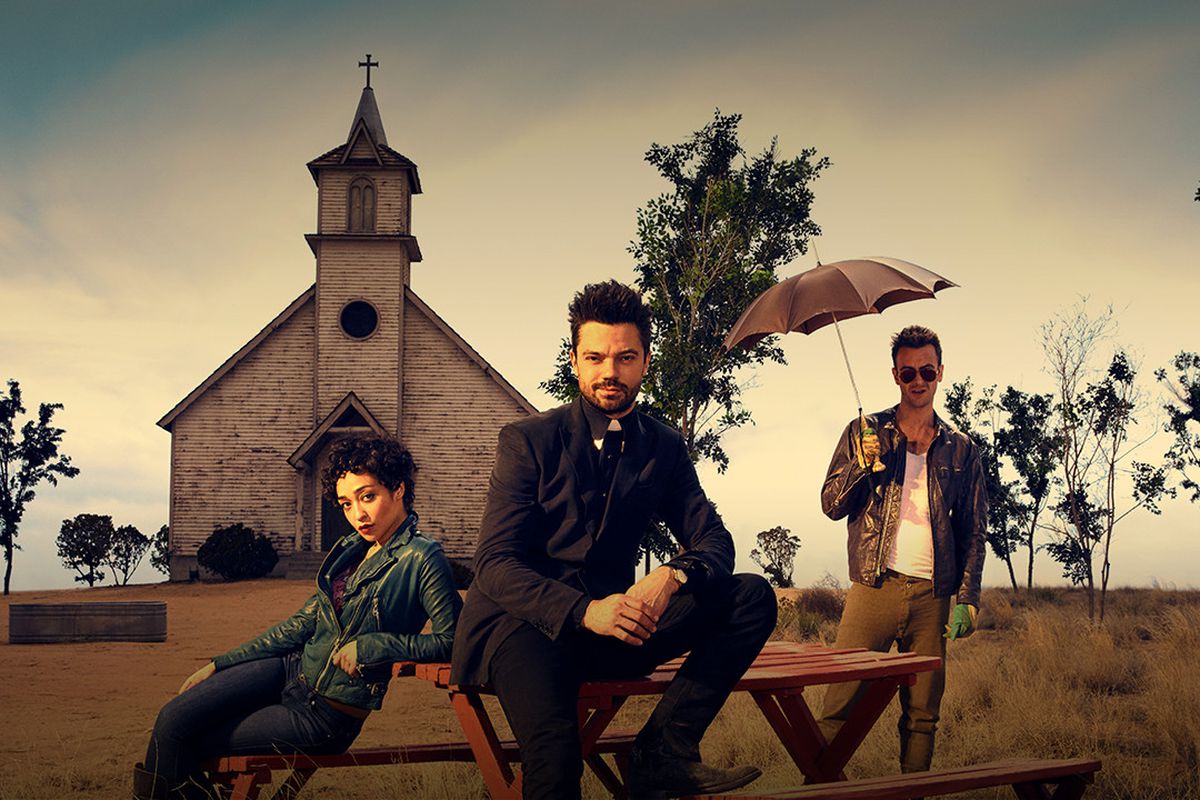
Long story short, the 4-season adaptation is a bit of a hot mess, full of many great moments (quite a few of them, but by no means all, lifted or adapted from the original), but as a coherent story it suffers even more than the original.
Ennis wrote an odd but moving (and arguably insightful) paean to America, using hyperbolic sex and violence and iconoclastic religion to provide a old-style Western romance in modern clothing. Written in 3-6 issue arcs (to allow for trade paperback collection), the tale sometimes felt fragmented, but still progressed along narrative about Jesse Custer, his lethal girlfriend Tulip, and their vampiric and right bastard friend Cassidy.
Seth Rogan (Executive Producer) and company faced an insane challenge to mirror the scope and over-the-topness of the original, coupled with, well, the need to maintain a budget (which, for example, dictated keeping kinda-sorta to a single setting per season).

The result a show that felt like a lot of great parts, cut-and-pasted together — plotlines that meandered, events and narratives that seemed locked into a given season without following through (or following through only weakly) in subsequent seasons, characters that came and went or faded in and out, just …

Well, it didn’t keep me from enjoying what I was watching. The music/sound, the cinematography, and, in particular, the actors were all great. Dominic Cooper, Ruth Negga, and Joe Gilgun owned the roles of Jesse, Tulip, and Cassidy (and kudos to Negga who genuinely made me forget the comic book Tulip was a blond white woman). Graham McTavish as the Saint of Killers, Pip Torrens as Starr, and (massive makeup-sympathy shout-out to) Ian Colletti as Eugene … the casting was all just excellent.
The parts were solid, but the whole … well, in the end, it was never quite clear what the TV series Preacher was about. The perils of absolute power, the dangers of hubris, the negligence (if not malignity) of God, the perversity of the universe, the power of friendship … there’s a palpable effort to make it all seem coherent and meaningful in the last episode, drawing in bits from the original (and some great scenes), but by then it’s too late.
Which is a reason why, though I’ve read the graphic novel series a half-dozen times, I won’t be re-watching the TV series any time soon. It was a fine experience while it lasted, and on an episode-by-episode basis, full of talent and imagination, but it never quite made it as a coherent story.
A tip of the hat, though. I’d have considered the series unmakeable. That we got something as good as this should be considered a triumph for the company. I wish it had been better, but I can imagine so many ways it could have been worse.